

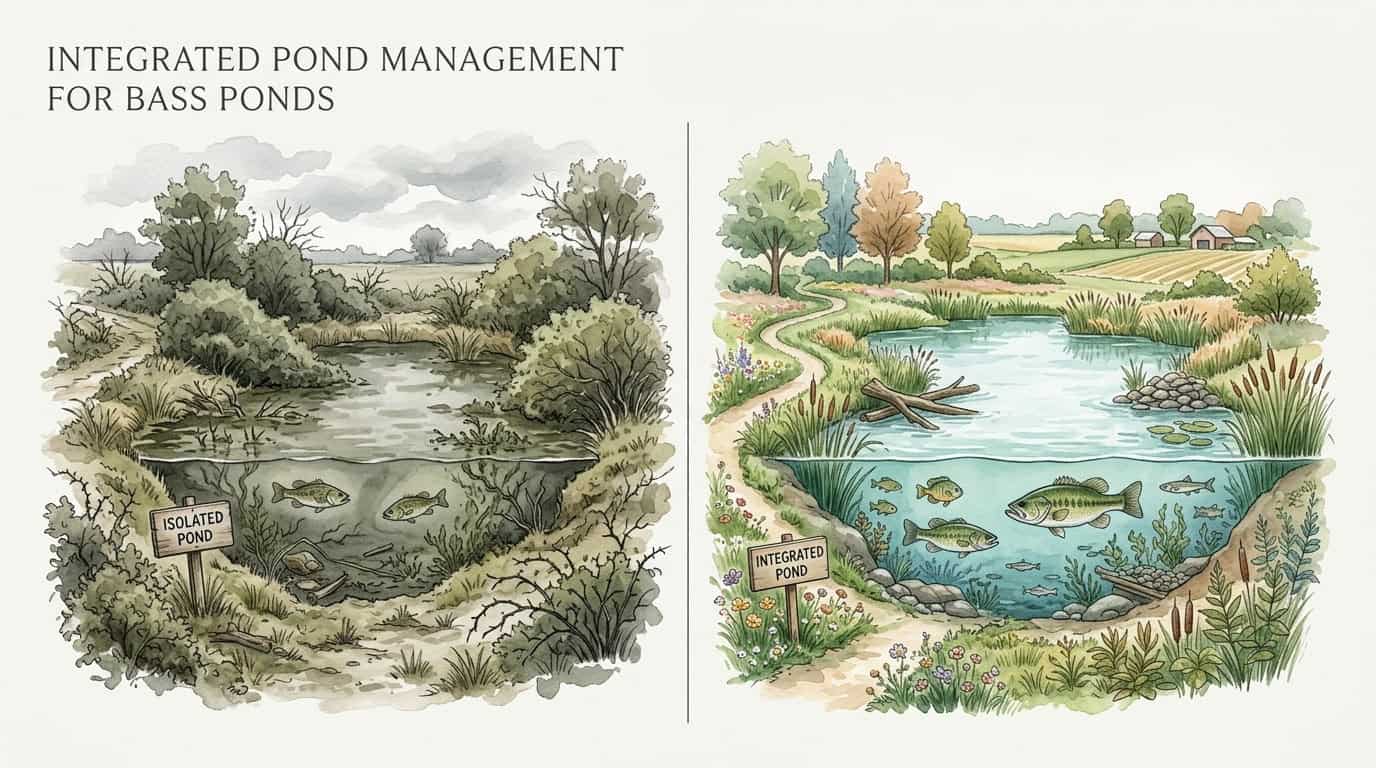
Is your pond an island, or is it the heart of your property’s food web? An isolated pond relies solely on its own water for nutrients. An integrated pond ‘harvests’ the land. Allowing overhanging vegetation to return enables you to tap into a massive, free stream of high-protein terrestrial insects for your fish.
Integrated pond management for bass ponds is a comprehensive ecological strategy that treats the pond as an extension of the surrounding landscape rather than an isolated container. It focuses on maximizing energy transfer through the food web by utilizing terrestrial insect biomass, shoreline vegetation, and optimized nutrient cycling to support a high-density, high-growth largemouth bass population. This method reduces reliance on expensive supplemental feeding by increasing the natural carrying capacity of the ecosystem.
Integrated Pond Management For Bass Ponds
Integrated pond management is the practice of aligning the physical, chemical, and biological components of a pond with its surrounding terrestrial environment. Traditional management often views the shoreline as a barrier that must be kept clear of “weeds” and brush. In contrast, an integrated approach views the riparian zone as a primary nutrient harvester. It leverages the “edge effect,” where two ecosystems meet, to create a more resilient and productive environment for apex predators like largemouth bass.
This management style exists to solve the problem of nutrient stagnation. In many isolated ponds, energy moves in a closed loop, eventually leading to stunted fish populations if external inputs are removed. Integrated systems use native grasses, overhanging trees, and diverse shoreline structures to capture terrestrial energy. This energy enters the water in the form of falling insects, organic matter, and filtered runoff, which fuels the lower trophic levels and ultimately leads to heavier bass.

Think of an isolated pond as a warehouse where you must pay for every calorie delivered. An integrated pond is more like a farm that utilizes the sun, rain, and local insect populations to generate its own “free” feed. This is used in real-world situations ranging from trophy bass production facilities to private recreational lakes where owners seek a more self-sustaining and biologically diverse ecosystem.
How Integrated Management Optimizes Bass Production
The mechanics of integrated management revolve around the trophic pyramid. Every pound of bass requires roughly ten pounds of forage fish, and every pound of forage fish requires ten pounds of insects or plankton. By increasing the baseline energy input from the land, you increase the total biomass at the top of the pyramid. The process begins with the establishment of a “soft” shoreline. This involves allowing specific native plants to grow along the water’s edge to provide habitat for dragonflies, grasshoppers, and beetles.
Managing the nutrient load is the second critical step. Traditional ponds often suffer from excessive phosphorus and nitrogen runoff, leading to toxic algae blooms. Integrated systems use buffer strips of tall grasses and sedges to filter these nutrients before they reach the water. These plants convert raw nutrients into terrestrial biomass, which then falls into the pond as high-protein forage or decomposes into beneficial organic matter that supports a healthy zooplankton population.
Another key mechanism is the optimization of thermal and physical refuge. Overhanging trees do more than just drop insects; they provide shade that reduces water temperature during peak summer months. This thermal regulation keeps dissolved oxygen levels stable and allows bass to remain active in shallow water longer. Submerged timber and root systems also provide a structural substrate for periphyton—the “slime” that forms the foundation of the aquatic food web.
Implementation requires a shift in maintenance routines. Instead of mowing to the water’s edge, managers create a 10-to-20-foot “no-mow” zone. This zone acts as the primary production engine. Selecting the right species is vital; for instance, planting willow or buttonbush can provide excellent overhanging cover without compromising the integrity of a dam or levee. Regular monitoring of water chemistry ensures that these increased inputs do not lead to oxygen depletion.
Benefits of Integrated Pond Systems
The most measurable benefit of an integrated approach is a reduction in the Food Conversion Ratio (FCR) required from artificial sources. When terrestrial insects account for a significant portion of the bluegill and sunfish diet, the cost of supplemental pellet feeding decreases. Studies show that terrestrial insects can provide up to 50% of the summer diet for certain forage species in healthy riparian environments. This translates directly to larger, healthier bass without increased overhead costs.

Biological resilience is another major advantage. Isolated ponds are prone to rapid “crashes” if a single variable, like water quality or a specific forage species, fails. Integrated ponds possess a higher degree of biodiversity, which provides a buffer against environmental stressors. If one forage source declines, the diverse habitat supports alternatives like crawfish, frogs, and multiple species of minnows that can fill the gap.
Long-term maintenance becomes simpler and more cost-effective. While traditional ponds require frequent chemical treatments to kill algae or unwanted weeds, integrated systems use natural competition and filtration to maintain balance. The physical structure provided by overhanging vegetation also reduces shoreline erosion, protecting the pond’s depth and preventing sedimentation issues that can ruin spawning beds over time.
Challenges and Common Pitfalls
One frequent error in integrated management is failing to differentiate between beneficial “overhanging vegetation” and invasive species. Uncontrolled growth of plants like common reed (Phragmites) or certain types of willow can quickly choke a pond, limiting access for anglers and reducing the open water necessary for bass hunting. It is essential to maintain a balance where vegetation is present but does not exceed 20-30% of the pond’s surface area or perimeter.
Another challenge is the potential for oxygen depletion in late summer. Increased organic matter from falling leaves and terrestrial debris increases the Biological Oxygen Demand (BOD). If a pond is too shallow or lacks adequate wind mixing, the decomposition of this material can strip the water of oxygen, leading to fish kills. This mistake often happens when managers introduce too much terrestrial biomass into a small, stagnant body of water without considering aeration needs.
Misunderstanding the predator-prey balance is a common technical pitfall. While terrestrial insects boost the forage base, they do not replace the need for high-calorie forage fish like Bluegill or Gizzard Shad in trophy bass ponds. Some managers assume that an integrated “natural” pond doesn’t need traditional stocking or harvest strategies. This leads to “bass crowding,” where too many small predators compete for the increased insect-driven forage, resulting in a stunted population despite the healthy ecosystem.
Limitations and Environmental Constraints
Integrated pond management is not a universal solution for every geographic location. In arid climates, the water required to maintain a lush riparian buffer may exceed the pond’s recharge rate, leading to excessive evaporation and water loss. In these areas, the “integrated” approach must be adapted to use drought-tolerant native species that provide cover without transpiring large volumes of water.
Site-specific topography also plays a role. Ponds with very steep banks or those located in deep ravines may have limited sunlight penetration, which restricts the growth of the very vegetation needed for an integrated system. Furthermore, ponds used primarily for livestock watering or heavy human recreation (swimming) may find the increased vegetation and insect activity undesirable or difficult to manage alongside those primary uses.
Small ponds—those under half an acre—are particularly sensitive to the increased organic load of an integrated system. The ratio of “edge” to “volume” in a small pond is much higher, meaning a small amount of leaf litter or terrestrial input has a disproportionately large impact on water chemistry. In these cases, managers must be much more conservative with the amount of overhanging cover they allow to develop.
Comparing Isolated vs. Integrated Management
| Feature | Isolated Management | Integrated Management |
|---|---|---|
| Primary Nutrient Source | Commercial Pellets / Fertilizer | Terrestrial Insects / Organic Runoff |
| Shoreline Appearance | Manicured / Grass to edge | Diverse / Riparian Buffer Zones |
| Maintenance Cost | High (Chemicals & Feed) | Moderate (Targeted Pruning) |
| Ecosystem Stability | Lower (Requires constant input) | Higher (Self-regulating) |
| Typical Bass Growth | Fast (if fed) / Slow (if not) | Consistent / Sustained Natural Growth |
Practical Tips for Implementation
- Establish a 15-foot “buffer strip” around at least 50% of the pond’s perimeter where native grasses are allowed to reach full height.
- Plant native shrubs like Buttonbush (Cephalanthus occidentalis) which tolerate wet roots and attract a high volume of pollinators.
- Install terrestrial insect light traps over the water if natural vegetation is still maturing; this provides an immediate boost to the forage base.
- Monitor the “Secci disk” visibility weekly. An integrated system should aim for a visibility of 18 to 24 inches, indicating a healthy plankton bloom fueled by organic inputs.
- Avoid using broad-spectrum insecticides anywhere near the pond or its drainage basin, as this destroys the primary energy source of the integrated model.
- Selectively prune overhanging trees to ensure they do not block more than 25% of the daily sunlight reaching the pond surface.
Advanced Considerations for Trophy Bass
For those targeting trophy-class bass, the integration must extend to “micro-habitats” within the riparian zone. Creating specific zones for different life stages of forage is critical. For example, maintaining a section of shallow, flooded grasses provides a nursery for Bluegill fry where they can consume small terrestrial invertebrates while being protected from adult bass. This ensures a constant “conveyor belt” of forage moving from the protected shallows into the open water as they grow.
Technically proficient managers also look at the Carbon-to-Nitrogen (C:N) ratio of the terrestrial inputs. Woody debris and dry leaves have high carbon content and decompose slowly, whereas green grass clippings or succulent plants decompose quickly and can cause rapid spikes in nutrient levels. Balancing these inputs is necessary to maintain long-term soil and water health. In some cases, adding a “pre-pond” or a small wetland cell to the primary inflow can help process these organic materials before they enter the main bass pond.
The use of “soft” mechanical aeration—such as bottom-diffuser systems—becomes even more important in high-biomass integrated ponds. These systems ensure that the increased organic load on the pond floor is decomposed aerobically. This prevents the buildup of toxic gases like hydrogen sulfide and keeps the entire water column habitable for both bass and their prey, even during the hottest periods of the year.
Scenario: Rehabilitating a Stunted Pond
A three-acre pond in the Midwest was characterized by clear water, mowed lawns to the edge, and a population of “paper-thin” 12-inch bass. The owner initially tried increasing commercial feeding, but costs were prohibitive. Under an integrated management plan, the following steps were taken. First, mowing was halted on the windward side of the pond to allow a 20-foot buffer of Big Bluestem and Switchgrass to establish. This immediately increased the “drop-in” rate of grasshoppers and beetles.
Next, six Buttonbush clusters were planted in the shallowest corners. Within two seasons, these shrubs provided significant shade and habitat for aquatic and terrestrial life. The owner also introduced several large, fallen oak trees into the shallows to act as “nutrient anchors.” These logs collected organic debris and provided a substrate for periphyton. Within three years, the average relative weight of the bass increased by 15%, and the need for supplemental feeding was reduced by 40%, demonstrating the efficiency of harvesting energy from the land.
Final Thoughts
Integrated pond management represents a transition from viewing a bass pond as a static asset to seeing it as a dynamic, living system. By leveraging the natural interactions between land and water, you create an environment where the “harvesting” of terrestrial energy becomes a constant, passive driver of fish growth. This approach prioritizes biological efficiency over expensive, high-maintenance interventions.
Successful implementation requires patience and a keen eye for ecological balance. The goal is not to let the pond “go wild,” but to direct its natural processes toward your specific management objectives. Whether you are aiming for trophy bass or a balanced recreational fishery, tapping into the surrounding food web is the most sustainable way to achieve long-term success. Expanding your knowledge of native riparian plants and local entomology will further enhance your ability to fine-tune these systems.
Frequently Asked Questions About Integrated Pond Management For Bass Ponds
How does overhanging vegetation actually increase bass size?
Overhanging vegetation acts as a biological bridge between the terrestrial and aquatic food webs. It provides a direct pathway for high-protein insects like caterpillars, beetles, and grasshoppers to fall into the water. These insects are consumed by forage fish such as bluegill, which in turn are the primary food source for bass. By increasing the calorie intake of the forage fish “for free,” the entire food chain becomes more efficient. Furthermore, the shade provided by these plants allows bass to stay active and feed in the shallows during the heat of the day, extending their prime hunting hours and increasing their overall metabolic efficiency.
Can integrated management cause my pond to become overgrown with weeds?
There is a distinct difference between managed riparian buffers and an overgrown pond. Integrated management uses specific, often native, plants to occupy ecological niches that might otherwise be taken over by invasive species. By strategically planting “beneficial” vegetation like sedges, rushes, or buttonbush, you can actually outcompete unwanted weeds. The key is to maintain a balance where roughly 20-30% of the shoreline is “integrated.” Regular maintenance, such as selective pruning or thinning of these zones, is still required to ensure the vegetation remains an asset rather than an obstruction to angling or water flow.
Does this approach replace the need for fish feeders?
Integrated management significantly reduces the reliance on commercial fish feeders but does not necessarily eliminate them if your goal is maximum trophy bass production. Think of the integrated system as providing a high-quality “base” diet for the ecosystem, while feeders provide concentrated “supplements.” In many recreational ponds, an integrated approach can provide enough natural forage to sustain a healthy bass population without any pellets at all. However, for those pushing the limits of carrying capacity, the two methods can work in tandem, with the natural system providing the micronutrients and diversity that pellets often lack.
What are the best plants to use for an integrated bass pond?
The best plants are those that are native to your specific region and provide both structural habitat and insect attraction. For the immediate water’s edge, plants like Pickerelweed and Arrowhead offer excellent cover for small fish. For the riparian buffer, native bunchgrasses like Little Bluestem or Switchgrass create a dense habitat for terrestrial insects. For woody cover, Buttonbush is often considered the “gold standard” for bass ponds because it thrives in wet soil, attracts a massive amount of pollinators, and has a root structure that provides excellent cover for crawfish and minnows without damaging pond dams.
How do I monitor if my integrated management is working?
Success can be monitored through three primary metrics: relative weight of the bass, forage fish diversity, and water clarity. Use a “Relative Weight” (Wr) chart to track if your bass are becoming thicker for their length. An upward trend indicates the increased forage is reaching the predators. Secondly, observe the shoreline at dusk; a healthy integrated pond will have high visible insect activity and small fish “popping” at the surface to catch them. Finally, use a Secci disk to ensure your water has a healthy greenish tint (18-24 inches of visibility), which indicates that the organic inputs are successfully fueling the phytoplankton bloom at the base of the food web.
