

Insurance and licenses aren’t optional in aquatic care. A single mistake with aquatic chemicals can lead to massive fines and environmental damage. Make sure your provider has these 5 essential credentials before they touch your water.
Reliable pond and lake management requires more than a passing familiarity with water chemistry. It involves the integration of biological science, mechanical engineering, and rigorous regulatory compliance. Property owners and facility managers often underestimate the legal and environmental risks associated with aquatic maintenance. These risks range from catastrophic fish kills due to improper dissolved oxygen management to federal lawsuits stemming from unauthorized pesticide discharges into navigable waters.
Hiring a professional with the correct credentials ensures that the technician understands the technical parameters of limnology and the legal constraints of the Clean Water Act. Without these safeguards, a property owner assumes full liability for any environmental degradation or physical injury occurring on the site. Technical proficiency in this field is measured by specific, verifiable certifications and specialized insurance policies that address the unique hazards of the aquatic environment.
What Credentials And Certifications Should A Pond Management Company Have?
Credentials in the aquatic industry are divided into two primary categories: regulatory mandates and professional certifications. Regulatory mandates, such as state-issued pesticide licenses, are legal requirements for any entity applying chemical treatments to water. Professional certifications, like those from the North American Lake Management Society (NALMS), indicate a voluntary commitment to higher standards of scientific expertise and ethical conduct.

A professional pond management company must hold a Category 5 Aquatic Pesticide Applicator License. This specific designation ensures the technician has passed examinations covering the behavior of herbicides in water, the protection of non-target species, and the calculation of dosing based on acre-feet rather than surface area. Beyond the legal minimum, top-tier firms often employ a Certified Lake Manager (CLM) or a Certified Lake Professional (CLP). These individuals have demonstrated mastery over watershed management, nutrient loading models, and invasive species mitigation.
Environmental insurance is equally critical. Most standard general liability policies contain a “Pollution Exclusion” clause, meaning they will not cover damages caused by a chemical spill, overspray, or water contamination. A qualified provider must carry a standalone Contractors Pollution Liability (CPL) policy or a specific endorsement that restores coverage for aquatic applications. These credentials collectively form a framework of risk management that protects both the ecosystem and the client’s financial interests.
1. State Commercial Pesticide Applicator License (Category 5)
The primary regulatory credential is the Category 5 license. Federal law, under the Federal Insecticide, Fungicide, and Rodenticide Act (FIFRA), requires that anyone applying restricted-use pesticides be certified. Most states extend this requirement to any commercial application of pesticides to water, regardless of the chemical’s toxicity level. Category 5 specifically focuses on aquatic pest control, covering the unique ways chemicals move through water columns and impact downstream users.
2. Certified Lake Manager (CLM) Accreditation
Issued by the North American Lake Management Society, the CLM is the highest level of professional certification in the industry. It requires a combination of a relevant scientific degree, years of field experience, and a rigorous evaluation process. A CLM is trained to look beyond the surface of the water, analyzing the entire watershed to identify the root causes of water quality issues rather than just treating the symptoms.
3. National Pollutant Discharge Elimination System (NPDES) Compliance
Under Section 402 of the Clean Water Act, discharges of biological or chemical pesticides into waters of the United States require an NPDES permit. While most small-scale pond managers operate under a statewide General Permit, they must still maintain detailed records of every application. A professional provider will have a robust system for tracking application rates, target sites, and environmental conditions to ensure compliance with federal reporting standards.
How To Verify Provider Credentials
Verification is a technical process that involves more than just asking for a copy of a certificate. Documents can be outdated or lack the necessary endorsements for specific types of work. A structured verification protocol ensures that the provider’s legal and financial protections are active and relevant to the scope of the project.

Start by requesting a Certificate of Insurance (COI) directly from the provider’s insurance agent. This prevents the risk of receiving an altered or expired document. When reviewing the COI, look specifically at the “General Liability” and “Pollution Liability” sections. Check for “Contractors Pollution Liability” or “Professional Liability” (Errors and Omissions) if the company is providing design or consulting services. Ensure the policy limits meet the requirements of the property, with a $1 million per occurrence and $2 million aggregate limit being the standard baseline for commercial aquatic work.
Verify pesticide licenses through the state’s Department of Agriculture or Environmental Protection database. Most states provide an online portal where you can search for an individual or company name to confirm their license status and expiration date. Ensure the technician assigned to the property is the one holding the license, as some states do not allow unlicensed employees to apply chemicals even under the “direct supervision” of a licensed manager.
The Verification Checklist
- Request the COI directly from the insurance broker.
- Confirm the presence of a Pollution Liability policy or endorsement.
- Cross-reference pesticide license numbers with the state’s regulatory database.
- Verify that the company is registered as a “Commercial Pesticide Business” in addition to individual applicator licenses.
- Ask for a list of professional affiliations, such as NALMS or the Society of Lake Management Professionals (SLMP).
Benefits Of Hiring Certified Professionals
The primary benefit of hiring a certified professional is the mitigation of operational risk. Aquatic systems are biologically sensitive; a minor miscalculation in dosing or an application during the wrong weather conditions can lead to total ecosystem collapse. Certified professionals utilize Integrated Pest Management (IPM) strategies, which prioritize mechanical and biological controls over chemical interventions whenever possible.
Operational efficiency is another significant advantage. A technician with a CLM or Master Pond Manager designation understands the relationship between nutrient loading and algal blooms. Instead of repeatedly applying algaecides, they may recommend a combination of sub-surface aeration, beneficial bacteria inoculation, and riparian buffer management. This holistic approach often results in lower long-term maintenance costs and a more stable, self-sustaining water body.
Legal protection is perhaps the most measurable benefit. If a chemical application leads to a fish kill or the contamination of a neighbor’s irrigation source, the liability falls on the applicator. If that applicator is unlicensed and under-insured, the property owner becomes the primary target for legal action and regulatory fines. A certified firm with Pollution Liability insurance provides a “Duty to Defend” clause, ensuring that the insurance carrier handles the legal complexities and financial settlements.
Challenges And Common Mistakes In Credentials
The most frequent mistake property owners make is assuming that a standard landscaping or lawn care license is sufficient for aquatic work. Turf management licenses (often Category 3) focus on terrestrial applications. Applying chemicals to water using a turf license is a violation of state law and often voids the company’s insurance coverage. Water reacts differently to chemicals than soil; the lack of a Category 5 license indicates a dangerous gap in technical knowledge regarding drift, solubility, and aquatic toxicology.
Another common pitfall is the “Ghost Insurance” policy. Some companies carry General Liability but have a total exclusion for “Pollution” and “Bacteria.” Since pond management often involves applying “pollutants” (herbicides) to control “bacteria” (blue-green algae), a policy with these exclusions offers zero protection for the core activities of the business. Managers must specifically ask for the “Pollution Liability” and “Fungi/Bacteria” endorsements to be listed on the COI.
Failure to verify the “Additional Insured” status is a third major error. A property owner or HOA should be listed as an “Additional Insured” on the provider’s policy. This ensures that the provider’s insurance is primary and non-contributory, meaning the provider’s insurance pays first in the event of a claim, protecting the property owner’s own insurance from being impacted.
Common Pitfalls to Avoid
- Accepting a lawn care or landscaping license for aquatic chemical applications.
- Ignoring the “Pollution Exclusion” in a standard General Liability policy.
- Failing to confirm that the assigned technician is the license holder.
- Neglecting to check the expiration dates on professional certifications.
- Assuming that “Direct Supervision” allows unlicensed workers to handle restricted chemicals.
Limitations Of Certifications
While certifications indicate a level of competence, they do not guarantee a specific biological outcome. Aquatic management is an “open system” science. Environmental variables such as unexpected rainfall, extreme heat waves, or heavy nutrient runoff from neighboring properties can override even the most technically sound management plan. A certification confirms that the manager has the tools to respond to these changes, but it does not make them immune to the laws of nature.
Furthermore, a license is a measure of minimum competency, not maximum expertise. A technician might pass a state exam but have limited experience with specific local issues like cyanobacteria (HABs) or complex dredging operations. This is why looking for a combination of state licenses and high-level professional accreditations like the CLM is essential. The license satisfies the law, while the certification demonstrates an advanced understanding of limnology.
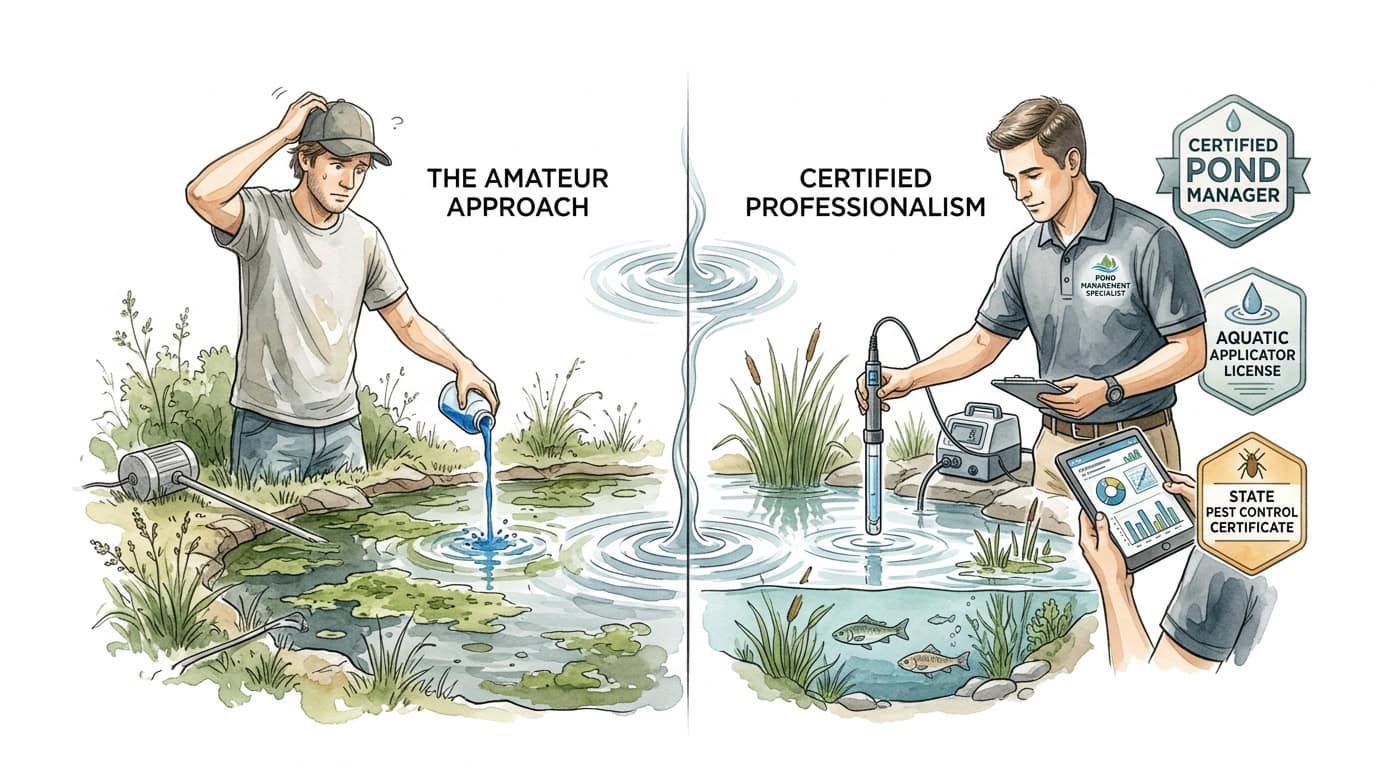
The Amateur Approach vs. Certified Professionalism
The differences between an amateur “truck and jug” operation and a certified professional firm are measurable in terms of risk and results. Amateurs often rely on aggressive, high-dose chemical treatments because they lack the technical equipment and knowledge for precision application. This leads to “rebound blooms” where the sudden death of algae releases a massive pulse of nutrients back into the water, fueling an even larger bloom weeks later.
| Feature | The Amateur Approach | Certified Professionalism |
|---|---|---|
| Licensing | General or Turf License (Invalid for water) | State Category 5 Aquatic License |
| Insurance | Standard GL (Pollution excluded) | CPL (Contractors Pollution Liability) |
| Methodology | Reactive / Chemical-Heavy | Proactive / Integrated Pest Management |
| Compliance | No NPDES reporting | Rigorous EPA/NPDES tracking |
| Risk Level | High (Total client liability) | Low (Contractual risk transfer) |
Practical Tips For Managing Your Provider
Once a qualified provider is hired, the management of those credentials must be ongoing. Licenses and insurance policies expire annually. Create a digital folder for each contractor and set calendar reminders to request updated COIs and license renewals. This proactive approach ensures that there is never a gap in coverage or compliance.
Require your provider to submit a “Post-Application Report” after every visit. This report should include the specific chemicals used, the EPA registration numbers, the exact amount applied, the targeted area, and the weather conditions during application. Not only is this a best practice for water quality monitoring, but it is also a critical component of NPDES compliance. If an environmental audit occurs, these logs serve as the primary evidence of professional due diligence.
Request an annual “State of the Lake” report from your lead technician. This report should move beyond basic maintenance and provide data on water clarity (Secchi disk readings), dissolved oxygen profiles, and nutrient levels (Nitrogen and Phosphorus). A certified professional will be able to explain these metrics and adjust the management plan based on the data, rather than simply continuing a fixed schedule of treatments.
Advanced Considerations: Professional Liability And E&O
For large-scale projects involving dam inspections, dredging specifications, or complex aeration system design, “General Liability” is insufficient. These activities fall under professional services and require Professional Liability insurance, also known as Errors and Omissions (E&O). If a manager incorrectly calculates the required horsepower for an aeration system, leading to a massive fish kill in a multi-million dollar fishery, standard GL will likely deny the claim as it was a “professional error” rather than a “physical accident.”
E&O insurance covers the financial loss resulting from inadequate advice or design. When interviewing companies for structural or engineering-heavy pond work, ask specifically about their Professional Liability limits. This is particularly important for firms providing consulting on National Environmental Policy Act (NEPA) requirements or those performing bathymetric mapping to calculate sediment removal volumes. The complexity of these tasks carries a high “error cost” that only specialized insurance can absorb.
Furthermore, check for a “Fungi and Bacteria” endorsement if the firm is managing swimming ponds or recreational lakes. Standard policies often exclude claims related to E. coli or Legionella. If a management company is responsible for testing and maintaining safe bacteria levels in a public swimming area, they must have the specific insurance language to back up that responsibility.
Example Scenario: The Cost Of A Credential Failure
Consider a mid-sized Homeowners Association (HOA) that hires a local landscaping company to treat a recurring algae problem in their central 2-acre pond. The landscaper holds a valid Category 3 Turf license but no Category 5 Aquatic license. They apply a high concentration of copper sulfate on a day with 95-degree temperatures and low wind.
Because the landscaper lacks Category 5 training, they fail to account for the “oxygen sag” caused by the rapid decomposition of the dying algae. Within 48 hours, the pond’s dissolved oxygen levels drop to near zero, resulting in a total fish kill. The decaying fish create a public health hazard and a severe odor, leading to complaints from residents and an investigation by the state’s Department of Natural Resources (DNR).
The DNR fines the HOA $15,000 for the illegal application and the resulting environmental damage. The HOA attempts to file a claim against the landscaper’s insurance. The insurance carrier denies the claim, citing the “Pollution Exclusion” and the fact that the landscaper was operating outside the scope of their Category 3 license. The HOA is left to cover the $15,000 fine plus an additional $8,000 for professional fish removal and restocking. Had the HOA verified the Category 5 license and Pollution Liability insurance, the risk and costs would have been entirely absorbed by the contractor’s carrier.

Final Thoughts
Professional aquatic management is an exercise in technical risk control. The credentials discussed here—state licensing, pollution insurance, and professional certifications—are not mere bureaucratic hurdles. They represent the difference between a healthy, sustainable water body and a significant legal liability. A provider who cannot produce a COI with a pollution endorsement or a valid Category 5 license is a liability, not an asset.
When selecting a firm, prioritize those that demonstrate a deep understanding of limnological data and regulatory frameworks. The inclusion of a Certified Lake Manager on the team and a commitment to Integrated Pest Management are clear indicators of a firm that values long-term ecosystem health over short-term chemical fixes. By enforcing these standards, property owners protect their investments, their communities, and the vital natural resources under their care.
The verification process may seem labor-intensive, but it is a one-time setup that pays dividends in safety and compliance. As environmental regulations become increasingly stringent, the gap between the amateur and the professional will continue to widen. Investing in certified expertise is the most efficient way to ensure your water remains a functional and aesthetic asset for years to come.