

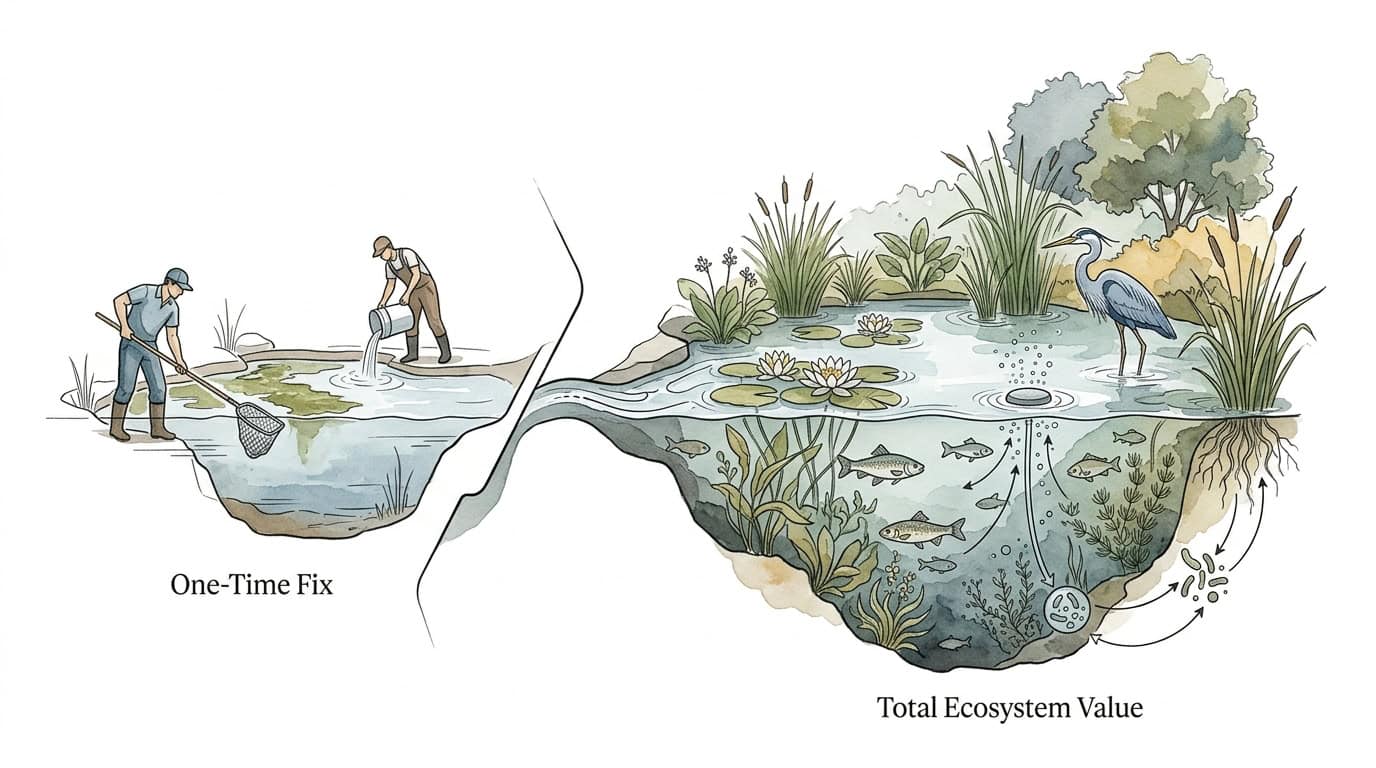
Is your pond professional treating a symptom or managing an asset? Don’t hire a guy with a sprayer. Hire a partner for your ecosystem. Use this checklist to separate the chemical jockeys from the true pond masters.
Effective pond management requires a shift from reactive chemical application to proactive ecological optimization. Many service providers operate on a “spray and walk” model, focusing exclusively on visual clarity through the application of copper-based algaecides. While this provides immediate aesthetic results, it frequently ignores the underlying nutrient imbalances that drive nuisance growth.
A true ecosystem partner focuses on the Total Ecosystem Value (TEV). This approach treats the water body as a biological machine with inputs, outputs, and internal metabolic processes. By optimizing these processes, you transition the pond from a high-maintenance liability into a self-sustaining asset.
The Ultimate Pond Owner’s Checklist Before Hiring A Management Company
Selecting a management firm requires evaluating their technical proficiency and their understanding of limnology—the study of inland waters. Use the following criteria to assess whether a provider is equipped to manage an ecosystem rather than just applying chemicals.

1. Do they conduct baseline water quality testing?
A professional must establish a baseline for Dissolved Oxygen (DO), pH, Alkalinity, and nutrient levels (Nitrogen and Phosphorus). Managing a pond without these metrics is equivalent to a mechanic attempting to fix an engine without a diagnostic scan.
2. Are they certified by recognized industry bodies?
Look for credentials such as the North American Lake Management Society (NALMS) Certified Lake Manager (CLM) or similar designations from the Association of Aquatic Professionals (AoAP). These certifications ensure the practitioner understands the complex interactions between chemical, physical, and biological variables.
3. Do they offer integrated pest management (IPM)?
Ask if they use a combination of biological augmentation, mechanical harvesting, and aeration alongside chemical treatments. A reliance solely on herbicides indicates a lack of long-term strategy.
4. Can they explain the “Nitrogen-to-Phosphorus Ratio”?
The balance between these two nutrients determines the type of algae or weeds that dominate the system. A professional should be able to discuss how they intend to manipulate these ratios to favor beneficial growth over nuisance species.
5. Do they provide bathymetric mapping?
Understanding the contours and volume of the pond is essential for accurate dosing and for planning future dredging operations. If they cannot tell you the exact volume of your “asset,” they cannot manage it efficiently.
How Aquatic Ecosystem Management Works
Pond management is the application of engineering and biological principles to maintain a desired trophic state. Most managed ponds suffer from cultural eutrophication—the acceleration of aging caused by human-induced nutrient loading.

The process begins with a Nutrient Budget Analysis. This involves identifying all sources of nutrient influx, such as fertilizer runoff, leaf litter, and waterfowl waste. Once the inputs are quantified, the manager applies various “sinks” to remove or sequester these nutrients.
Mechanical systems, specifically Subsurface Aeration, are the backbone of this process. By introducing compressed air at the pond’s deepest point, the system breaks the thermal stratification. This ensures that oxygen reaches the sediment-water interface, where aerobic bacteria can metabolize organic muck. Without oxygen, the pond becomes anaerobic, releasing trapped phosphorus back into the water column and fueling more algae growth.
Biological augmentation involves the introduction of specific strains of Heterotrophic Bacteria. These microorganisms are selected for their ability to digest organic matter and compete with algae for available nutrients. When paired with high DO levels, these bacteria can reduce the “muck” layer at the bottom of the pond by several inches per year, effectively reversing the aging process of the water body.
Technical Benefits of Ecosystem-Based Management
Adopting an ecosystem-focused approach provides measurable improvements in system stability and efficiency.
Reduced Chemical Dependency: By addressing the root cause—excess nutrients—the frequency of algaecide applications decreases. This prevents the “rebound effect” where dying algae release nutrients that immediately trigger a secondary bloom.
Extended Asset Life: Organic sedimentation (muck) eventually fills a pond, necessitating expensive dredging. Biological management slows this accumulation, deferring capital expenditures for years or even decades.
Improved Dissolved Oxygen Stability: Chemical-heavy management often causes “oxygen crashes” as large volumes of dead plant matter decompose simultaneously. Ecosystem management maintains a stable DO profile, protecting fish populations and maintaining aerobic conditions.
Optimized Biodiversity: A balanced system supports a diverse range of zooplankton and macroinvertebrates. These organisms serve as natural controls for algae and form the base of a healthy fishery.
Challenges and Common Pitfalls in Pond Maintenance
The most frequent error in pond management is the Copper-Cycle Trap. Copper sulfate is a common, inexpensive algaecide that kills algae cells on contact. However, it does not remove the nutrients. The dead algae sink to the bottom, adding to the muck layer and releasing phosphorus. This ensures a larger bloom will return, requiring more copper, which eventually leads to copper toxicity in the sediment.
Another challenge is Improper Aeration Sizing. Many owners install “fountains” thinking they are aerating the water. In reality, fountains are primarily aesthetic; they only move the surface layer. Effective aeration requires a diffusal system that moves water from the bottom to the top to ensure total volume turnover at least once every 24 hours.
Failure to manage Riparian Buffers is a common external pitfall. If the grass is mowed directly to the water’s edge, there is no filter for nutrient-heavy runoff. Maintaining a buffer of native vegetation can reduce nutrient influx by up to 90%, significantly lowering management costs.
Limitations and Environmental Constraints
Not every pond can be “fixed” with biology alone. Certain environmental factors impose hard limits on what management can achieve.
Hydraulic Residence Time: If a pond has a very high flow-through rate (it flushes out every few days), biological augmentation and chemical treatments are less effective because the products are washed away before they can work.
Extreme Eutrophication: In cases where the muck layer is several feet deep and the pond is nearly filled in, no amount of bacteria will “eat” it fast enough. At this stage, mechanical dredging is the only viable technical solution.
External Loading: If a pond receives runoff from a large, heavily fertilized golf course or agricultural field, the internal management systems will be overwhelmed. Management in these scenarios must focus on “sequestration” agents like lanthanum-modified clay, which binds phosphorus permanently.
Symptom Treatment vs. Asset Management
The choice between a “chemical jockey” and an ecosystem manager is often a choice between low upfront costs and long-term value.
| Feature | Symptom Treatment (Chemical) | Asset Management (Ecosystem) |
|---|---|---|
| Primary Goal | Temporary visual clarity | Nutrient balance and stability |
| Method | Reactive spraying of algaecides | Proactive aeration and bio-augmentation |
| Long-term Cost | Increasing (as muck builds up) | Decreasing (as system stabilizes) |
| Sediment Impact | Accelerates muck accumulation | Reduces organic sediment (digestion) |
| Risk | Oxygen crashes and fish kills | Predictable, stable performance |
Practical Tips for Immediate Optimization
If you are currently managing a pond, these technical adjustments can improve efficiency immediately:
- Check Your Secchi Depth: Use a Secchi disk twice a month to monitor water transparency. A sudden drop in transparency is a leading indicator of a coming algae bloom.
- Optimize Aeration Timing: In summer, run subsurface aeration 24/7. In winter, if fish health is the priority, ensure at least 10% of the surface remains ice-free for gas exchange.
- Monitor pH Fluctuations: Large swings in pH between morning and evening indicate excessive respiration/photosynthesis, suggesting the system is over-productive and nearing a crash.
- Identify Your Limiting Nutrient: Test for both Nitrogen and Phosphorus. Usually, phosphorus is the limiting nutrient in freshwater; focus your management on sequestering it.
Advanced Considerations: Phosphorus Sequestration
For serious practitioners, managing the Internal Phosphorus Load is the ultimate challenge. Phosphorus does not “leave” the pond; it cycles between the water and the sediment. Even if you stop all external runoff, the pond can remain eutrophic due to internal recycling.
Advanced techniques involve the application of Lanthanum-modified Bentonite. This material binds to phosphate molecules in the water and the top layer of sediment, forming an insoluble mineral (Rhabdophane) that cannot be used by algae. This “locks” the phosphorus away, effectively starving the algae without the use of toxic chemicals.
Understanding Redox Potential is also critical. When the bottom of the pond has a high oxidation-reduction potential (ORP), phosphorus remains bound to iron in the soil. If the ORP drops (becomes anaerobic), the iron releases the phosphorus. Maintaining high ORP through aeration is the most cost-effective way to keep your “nutrient bank” closed.

Scenario: The “Sick” Retention Pond
Consider a typical 2-acre retention pond in a residential development. For five years, it was treated with copper sulfate every three weeks. By year six, the treatments stopped working, the water turned pea-soup green, and a foul odor emerged.
A technical audit revealed 18 inches of anaerobic muck at the bottom and a phosphorus level of 250 µg/L (extremely eutrophic). The “chemical jockey” recommended more frequent spraying. Instead, an ecosystem partner installed a 1/2-HP subsurface aeration system and began a weekly regimen of high-concentration bacillus spores.
After 12 months, the results were:
- Muck Reduction: 4 inches of organic sediment digested.
- Water Clarity: Secchi depth increased from 12 inches to 48 inches.
- Nutrient Levels: Available phosphorus dropped to 40 µg/L as it was sequestered in bacterial biomass and sediment.
- Operational Cost: Total spend in year two was 30% lower than the previous year’s chemical-only budget.
Final Thoughts
Pond management is a technical discipline that requires a balance of biology, chemistry, and mechanical engineering. Treating your pond as an asset means looking beyond the surface and managing the underlying metabolic processes that dictate water quality. When you move away from the “guy with a sprayer” and toward a partnership based on data and ecological principles, you ensure the longevity and value of your water body.
The goal is not just to have “clear water” for a weekend, but to build a resilient system that can handle nutrient shocks and environmental stressors with minimal intervention. Start by demanding data from your provider. If they can’t provide a water quality report, they aren’t managing your asset—they’re just selling you chemicals. Experiment with biological augmentation and prioritize aeration; your ecosystem will respond with the stability and efficiency that only a balanced system can provide.