How To Grow Trophy Bass Without Pellet Feeding

Photo of author
By Mark Washburn

Mark is a pond management specialist with over 20 years in the field. His wealth of experience will help you with your pond!
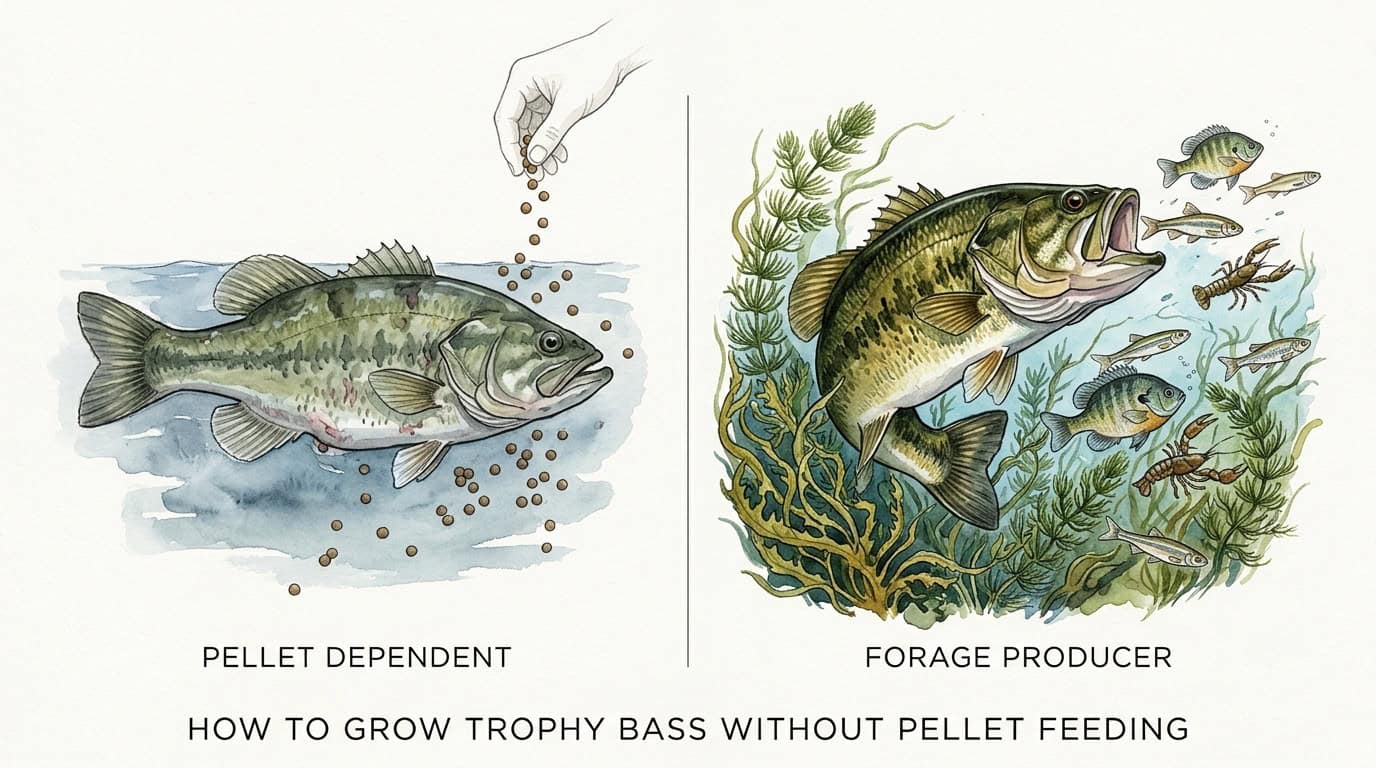

To grow trophy bass without pellet feeding, managers must establish a robust natural food chain where forage biomass outpaces predator consumption by a 10:1 ratio. This involves optimizing water chemistry to support plankton blooms, stocking diverse forage species like bluegill and threadfin shad, and installing extensive habitat sanctuaries. Aggressive culling of smaller bass is required to ensure available energy is concentrated into a few high-potential individuals, achieving trophy growth through natural biological efficiency.

Are you buying your bass’s weight by the bag, or is your pond producing it for free? Stop being a customer for the feed mill and start being a producer of a natural food chain. Installing ‘crawfish chimneys’ and ‘forage sanctuaries’ creates a 24/7 self-replenishing buffet that grows bigger bass than any pellet ever could.

How To Grow Trophy Bass Without Pellet Feeding

Natural trophy bass management is the practice of producing high-weight Micropterus salmoides using only the inherent biological productivity of a water body. This approach focuses on maximizing the conversion of solar energy and nutrients into forage biomass, which then transfers to the apex predator. In a typical unmanaged pond, bass often become stunted because they deplete their food source faster than it can reproduce. A forage-first system reverses this trend by creating an environment where prey species such as Lepomis macrochirus (bluegill) have the habitat and resources to spawn continuously.

Real-world applications of this method are found in high-end private fisheries where long-term sustainability and fish health are prioritized over immediate gratification. This system functions like a pyramid. The base consists of phytoplankton and zooplankton, the middle contains multiple layers of forage fish and invertebrates, and the narrow peak represents the trophy bass. Success in this model is measured by the Relative Weight (Wr) of the bass, which indicates if a fish is hitting its maximum growth potential for its length.

The Mechanics of Forage-Based Growth

The fundamental principle of growing trophy bass without supplemental pellets is the 10:1 conversion ratio. Data indicates that a largemouth bass must consume approximately 10 pounds of forage to gain a single pound of body weight [1.1.3, 1.1.6]. In a pellet-free system, the manager must ensure the pond produces several hundred pounds of forage per acre annually to support even a modest population of 10-pound bass.

Establishing this biomass requires a multi-species forage approach. Bluegill serve as the primary “backbone” because they are prolific spawners, capable of producing multiple generations per season in warm climates [1.4.3]. Threadfin shad (Dorosoma petenense) provide a high-lipid, open-water food source that bass can capture with minimal caloric expenditure [1.6.7]. Crawfish (Procambarus clarkii) offer a high-protein supplement that is particularly effective for boosting bass weight during the spring molting season [1.3.1].

Designing Habitat for Maximum Production

Habitat is the mechanical foundation of a pellet-free trophy pond. Effective management requires that 10% to 15% of the pond’s surface area be covered in complex structure [1.1.6, 1.2.8]. This structure must be divided into “forage sanctuaries” and “ambush points.”

Forage Sanctuaries

Sanctuaries are areas of extremely dense cover where small forage fish can escape predation long enough to reach sexual maturity. Using “crawfish chimneys” or artificial rock piles along the shoreline provides the necessary interstitial spaces for invertebrates and juvenile fish to thrive. Large expanses of shallow-water brush piles or dense aquatic vegetation serve as the “nursery” of the pond.

Ambush Points

Trophy bass are energy-efficient predators. They require transition zones where deep water meets shallow cover. Placing large hardwood logs or rock ledges near the edges of forage sanctuaries allows bass to wait for prey to venture out, minimizing the energy spent on the chase. This spatial arrangement ensures that the calories consumed by the bass are used for growth rather than movement.

Water Chemistry and Primary Productivity

The entire natural food chain depends on the “bloom”—a dense population of microscopic algae known as phytoplankton. Phytoplankton is the fuel for zooplankton, which in turn feeds the juvenile forage fish. Without a healthy bloom, the food chain collapses at the bottom.

Fertilization Ratios

Managers often apply phosphorus-heavy fertilizers to stimulate these blooms. A visibility of 18 to 24 inches on a Secchi disk is the technical target for a productive pond [1.5.2]. Excessive fertilization can lead to filamentous algae or toxic blue-green algae blooms, so water testing is a prerequisite for any nutrient addition.

Liming for Bioavailability

Nutrients like phosphorus are only bioavailable if the water’s alkalinity is sufficient. In many regions, adding agricultural lime is necessary to neutralize acidic soils and “unlock” the fertilizer. High alkalinity buffers pH swings and ensures the pond’s biological machinery operates at peak efficiency.

Population Dynamics and Culling Ratios

Removing fish is just as important as growing them in a natural trophy system. Overpopulation is the most common cause of management failure [1.3.4]. If too many intermediate-sized bass are present, they will consume the forage base before the trophy-potential individuals can eat.

Aggressive Bass Harvesting

A trophy-managed pond often requires the removal of 20 to 30 pounds of smaller bass per acre every year [1.5.4]. These “underperformers” are typically 10 to 14 inches long. Culling these fish reduces competition for the limited 10:1 forage resource, leaving more food for the top-tier predators.

Bluegill Protection

While bass are harvested aggressively, bluegill should be protected. Maintaining a population of “broodstock” bluegill—individuals too large for the bass to eat—ensures a constant supply of new offspring [1.1.6]. These large sunfish act as the “interest” on the pond’s biological capital.

Benefits of the Natural Approach

Choosing a natural forage system over pellet feeding offers several measurable advantages in terms of cost and ecological stability. Relying on the pond’s inherent productivity reduces the recurring expense of high-protein fish feed, which can be significant for larger water bodies.

Natural diets also result in healthier organosomatic indices. Bass fed exclusively on natural forage often show less liver vacuolization (fatty liver) compared to those on high-fat commercial pellets [1.1.5]. This often translates to increased longevity and more successful natural spawning cycles. Furthermore, a pond built on a natural food chain is less susceptible to sudden water quality crashes caused by decomposing uneaten pellets and excessive fish waste.

Challenges and Common Mistakes

The most frequent error in pellet-free management is underestimating the volume of forage required. Many pond owners stock a few hundred minnows and expect trophy results, but the 10:1 ratio dictates that thousands of pounds are needed over the lifespan of a single trophy fish.

Another pitfall is “stocking and forgetting.” A pond is a dynamic system. A single successful bass spawn can result in thousands of new predators that will decimate the forage base in months. Continuous monitoring through electrofishing surveys or meticulous catch-and-release records is necessary to maintain the balance [1.1.4]. Failure to cull smaller bass leads to a “bass-crowded” state where no fish can ever break the 5-pound barrier.

Limitations of Pellet-Free Systems

Natural management is not universally applicable. Small ponds, typically those under one acre, often lack the space to support a diverse forage hierarchy [1.2.1]. In these environments, the bass will inevitably over-consume the prey, leading to stunted growth unless supplemental feed is introduced.

Environmental factors like climate also set a ceiling on natural growth. Bass are cold-blooded; their metabolism and growth rate are tied to water temperature. In northern latitudes with short growing seasons, achieving trophy weights without the caloric density of pellets is significantly more difficult than in the Southeast or Southern California [1.1.2]. Owners in these regions must accept slower growth rates or lower total carrying capacities.

Practical Tips for Immediate Implementation

To begin transitioning a pond to a natural trophy producer, start by auditing the existing habitat. Adding 50 to 100 pounds of crawfish per acre in the spring provides an immediate caloric boost to the bass population [1.3.1]. Ensure these crawfish have shoreline “chimneys” or rock piles to burrow into, which protects the breeding population.

Next, establish a “no-kill” policy for bluegill over 8 inches while implementing a strict harvest of every bass caught under 14 inches. If the water appears crystal clear, consult a biologist about a fertilization program to jumpstart the plankton bloom. These three steps—habitat addition, selective culling, and nutrient management—form the core of the transition.

Advanced Biomass Optimization

Serious practitioners often use “buffer species” to protect their primary forage. Stocking golden shiners (Notemigonus crysoleucas) alongside bluegill provides an alternative target for bass, allowing the bluegill more time to reach spawning age [1.3.3]. Shiners are highly mobile and occupy different niches than sunfish, increasing the overall “forage density” of the water column.

Another advanced technique is the use of all-female bass populations. Since female largemouth bass grow significantly larger than males, stocking only females eliminates natural recruitment [1.5.3]. This prevents the pond from becoming overpopulated with “trash” bass, ensuring that every ounce of produced forage goes into a fish with trophy potential.

Scenario: The Self-Sustaining Trophy Pond

Imagine a 5-acre lake designed with a limestone base for high alkalinity. The shoreline is armored with 4-inch to 8-inch rip-rap, creating thousands of “crawfish chimneys” and nurseries for juvenile sunfish. Deep-water humps are topped with cedar trees, providing ambush points for the apex predators.

In this scenario, the manager harvests 100 pounds of small bass annually. The result is a population of Florida-strain bass that consistently gain 1.5 to 2 pounds per year. By the sixth year, the lake holds multiple double-digit fish, all grown on a diet of local shad, sunfish, and crustaceans. No feeders are present, and the water quality remains pristine because the biological load is perfectly balanced with the ecosystem’s processing capacity.

Final Thoughts

Growing trophy bass without pellet feeding is a masterclass in ecological engineering. It requires a shift in mindset from a “consumer” to a “producer,” focusing on the intricate needs of the smallest organisms to satisfy the largest. Success is not found in a bag of feed, but in the ratio of forage to predator and the complexity of the underwater terrain.

By prioritizing the 10:1 conversion rule and maintaining a relentless culling schedule, any suitable water body can become a trophy factory. The natural path may require more patience and observation, but the result is a robust, healthy, and sustainable fishery that reflects the true potential of the environment.

Frequently Asked Questions About How To Grow Trophy Bass Without Pellet Feeding

Can you really grow a 10-pound bass without using any fish food?

Yes, it is entirely possible to grow 10-pound bass using only natural forage, provided the pond ecosystem is managed with high precision. In the wild, almost all trophy bass reach their size without human intervention by inhabiting areas with massive forage bases, such as river systems or large reservoirs. In a private pond setting, you must replicate this by ensuring a continuous supply of high-protein prey like bluegill, shad, and crawfish. The key is maintaining a 10:1 ratio where the bass have a surplus of food, allowing them to expend minimal energy while consuming maximum calories. Without pellets, your primary job becomes managing the habitat and water quality to support that massive amount of natural bait.

Which forage fish is the most important for a pellet-free bass pond?

The bluegill (Lepomis macrochirus) is considered the backbone of any successful trophy bass pond. Bluegill are unique because they spawn multiple times throughout the spring and summer, whereas most other fish only spawn once. This creates a “conveyor belt” of different-sized prey for the bass to eat all year long. While other species like threadfin shad or golden shiners are excellent supplements, they cannot replace the consistent recruitment provided by a healthy bluegill population. To maximize their effectiveness, you must provide dense shallow-water habitat where juvenile bluegill can hide until they are the perfect size for your trophy bass to consume.

How many crawfish should I stock to help my bass grow?

For a noticeable impact on bass growth and condition, stocking rates between 50 and 100 pounds of crawfish per acre are generally recommended. Crawfish are an exceptional forage source because they are high in protein and relatively easy for bass to catch, especially during their molting phases. Unlike fish species where you stock a few and wait for them to spawn, crawfish stocking is often treated as a direct “caloric injection.” While some will survive to establish a colony, the primary goal is to provide an immediate high-energy meal for the bass. To help them persist, ensure your pond has rocky shorelines or “crawfish chimneys” that allow them to burrow and escape total predation.

Does culling smaller bass really make the remaining fish grow larger?

Culling is arguably the most critical step in growing trophy bass without pellets. Every pond has a limited “carrying capacity,” which is the total weight of fish the water can support. If a pond can support 50 pounds of bass per acre, you can either have fifty 1-pound bass or five 10-pound bass. By removing the 1-pound fish, you eliminate the competition for the 10:1 forage resource. This allows the remaining high-potential bass to eat as much as they want without having to compete with hundreds of smaller, faster siblings. Without aggressive harvesting of small bass, the pond will inevitably become “bass-crowded,” and growth will stop regardless of how much forage you stock.

How do I know if my pond has enough natural forage?

The best way to assess your forage base is by looking at the “Relative Weight” (Wr) of the bass you catch. A bass in perfect condition should be thick across the back and have a bulging belly; this is often called a “football” shape. If your bass have large heads but skinny bodies, it is a definitive sign that they have exhausted their natural food supply. You can also perform a visual audit of the shoreline during the spring spawning season. You should see thousands of small bluegill and minnows in the shallows. If the shallows look empty and you only catch skinny bass, your predator-to-prey ratio is out of balance, and you need to either add more habitat or increase your bass culling efforts immediately.

We're Not All Talk

Sign up for the best pond tips you'll find anywhere online.  We'll send them out during the summer months and you won't want to miss a single one!

Invalid email address
We promise - no spam. You can unsubscribe at any time.