

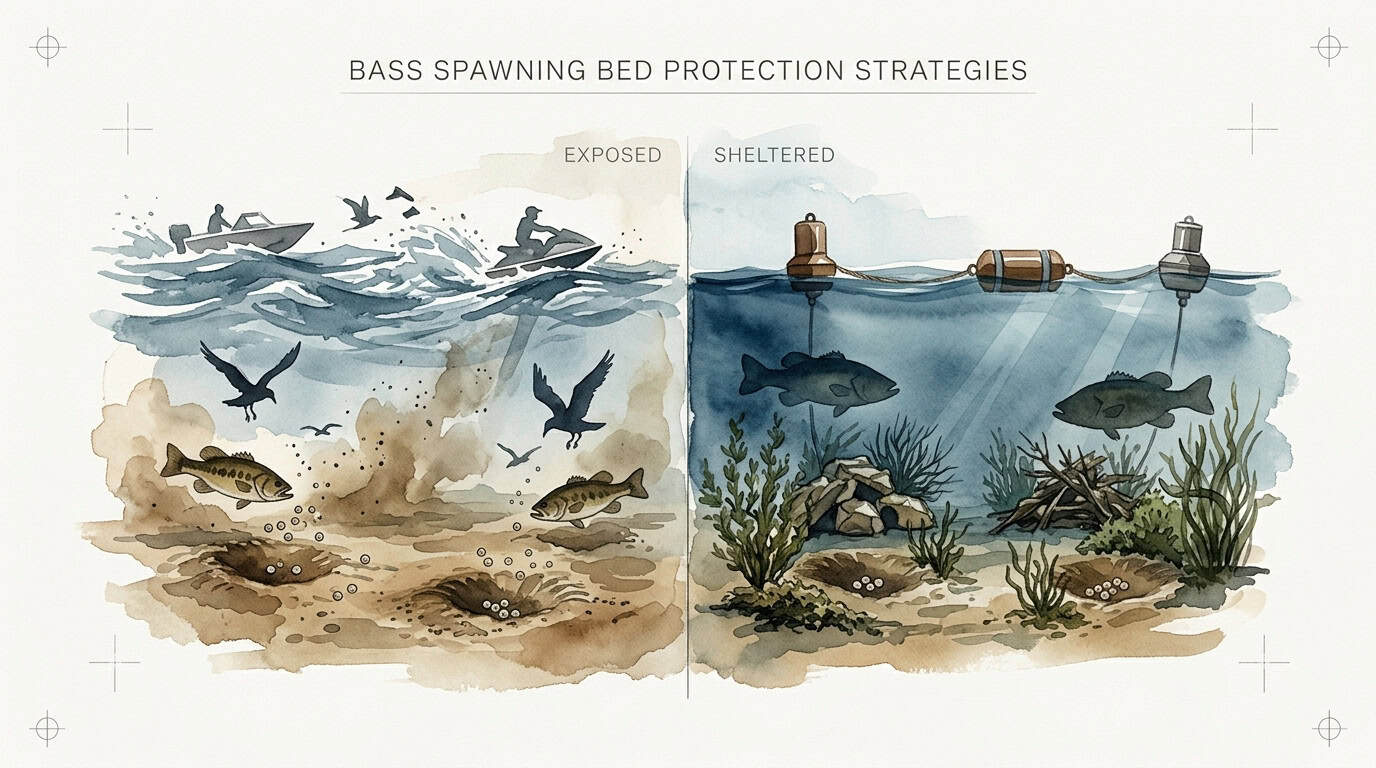
Bass spawning bed protection strategies are engineered interventions designed to mitigate the mechanical and environmental stressors that cause high egg mortality, specifically wind-driven wave action and sedimentation. By implementing structural barriers such as log booms, stone jetties, or breakwaters, pond managers can reduce wave energy by up to 80%, preventing the siltation of nests and the physical displacement of eggs. These strategies ensure the survival of the nest-guarding male and the successful development of embryos in high-fetch or exposed shoreline environments.
Why do 90% of bass eggs fail to hatch on ‘clean’ pond shorelines? Wind is the silent thief of your pond’s future. Without physical ‘shelters’ like log booms or stone jetties, your bass are working overtime to guard nests that will eventually be washed away by the first spring storm. Many pond owners mistake a manicured shoreline for a productive one, but for a spawning largemouth or smallmouth bass, a lack of structural complexity is a death sentence for their offspring.
In a natural or unmanaged environment, bass recruitment relies on a razor-thin margin of success. Biological data suggests that egg-to-fry mortality often exceeds 99.98% in unprotected environments. This technical guide outlines how to reverse these metrics through mechanical optimization and structural engineering. We will examine the fluid dynamics of wave attenuation and the geotechnical requirements of optimal nesting substrates.
Bass Spawning Bed Protection Strategies
Bass spawning bed protection refers to the application of hydraulic engineering and habitat management to stabilize the littoral zone during the spring reproductive cycle. The primary objective is to create “dead zones” of low-energy water where sediment transport is minimized and thermal stability is maximized. These protected areas allow male bass to maintain nests without the constant threat of egg-suffocating silt or mechanical displacement caused by orbital wave motion.

In technical terms, these strategies address the “fetch”—the distance wind travels over open water. As fetch increases, so does wave height and energy. On an exposed shoreline with a high fetch, even a moderate 15-mph wind can generate enough turbulence to lift eggs out of a nest or deposit a layer of fine silt that prevents oxygen exchange across the egg membrane. Protection strategies interrupt this energy transfer, creating a micro-environment suitable for the 7–10 day incubation period required for bass embryos.
Mechanical Implementation: How to Protect Spawning Beds
The implementation of protection strategies requires a two-pronged approach: wave attenuation and substrate stabilization. The goal is to reduce the shear stress acting upon the pond bottom at depths of 2 to 6 feet, where the majority of spawning activity occurs.
Wave Attenuation Structures
Floating log booms are one of the most efficient methods for reducing surface energy. Modern engineered booms utilize high-density polyethylene (HDPE) piping, often filled with closed-cell polystyrene foam for permanent buoyancy. When anchored strategically across the mouth of a cove, these booms can reduce wave run-up by approximately 58% to 80% depending on the diameter of the boom and the wavelength of the incoming energy.
Stone jetties or “groynes” offer a more permanent, albeit more expensive, solution. These are typically constructed from Class R-4 or larger rip-rap. By extending a jetty perpendicular to the prevailing spring winds, a “lee side” is created. This area experiences significantly lower current velocities and minimal wave action, making it a primary target for the first wave of spawning fish.
Substrate Specification and Geotechnical Preparation
A protected area is useless if the bottom composition is comprised of deep muck or anaerobic silt. Technical standards for bass nesting require a D50 (median particle size) of 0.5 to 2.5 inches. This typically consists of a mix of coarse sand, gravel, and small cobble. If the existing bottom does not meet these criteria, “nesting pads” should be installed.
To install a nesting pad, a base layer of non-woven geotextile fabric is laid over the existing silt to prevent the new substrate from sinking. A 4-to-6-inch layer of clean, washed gravel is then deposited on top. This provides the mechanical stability necessary for the male bass to sweep a clean depression and ensures that eggs remain oxygenated throughout the incubation phase.

Benefits of Engineered Protection
The primary benefit of spawning bed protection is a measurable increase in recruitment—the number of fish that survive to reach their first year of life. When wave action and siltation are mitigated, the biological efficiency of the spawning cycle increases significantly.
- Reduced Paternal Stress: Male bass expend significant energy fanning the nest to remove sediment. Protection structures reduce the sediment load, allowing the male to focus on predator defense, which directly correlates to higher fry survival.
- Thermal Stability: Sheltered coves often warm up faster than the main body of water. A 2–3 degree Celsius increase in temperature can accelerate embryo development, reducing the window of time that eggs are vulnerable to predation.
- Enhanced Larval Habitat: Structures like log booms and jetties often accumulate periphyton and micro-invertebrates, providing an immediate food source for “swim-up” fry once they leave the nest.
Common Mistakes in Spawning Bed Management
Failure in spawning bed protection often stems from a misunderstanding of hydraulic forces or improper material selection. One frequent error is the installation of barriers that are too small for the calculated wave energy. If a log boom has an insufficient diameter relative to the wave height, the energy will simply pass under or over the structure, rendering it ineffective.
Another common mistake is neglecting the “sink” factor of new substrate. Dumping gravel directly onto soft pond muck without a geotextile liner usually results in the gravel disappearing into the silt within one or two seasons. This not only wastes material but can also release trapped nutrients into the water column, potentially triggering filamentous algae blooms that can smother the very nests you are trying to protect.
Limitations and Environmental Constraints
While highly effective, protection strategies are not a universal fix. Regulatory constraints are a primary limitation; in many jurisdictions, placing structures like stone jetties or even log booms requires permits from environmental agencies or the Army Corps of Engineers. These regulations are designed to prevent the disruption of natural water flow and the displacement of existing wetlands.
Scale and cost also play a role. For very large reservoirs with fetch lengths exceeding several miles, the cost of effective wave attenuation can be prohibitive. In these cases, managers must focus on “micro-sheltering”—using smaller, localized structures like submerged root-wads or small rock piles that provide protection for a single nest rather than an entire shoreline.
Comparison: EXPOSED vs SHELTERED Spawning Environments
The following table illustrates the technical differences between unprotected (EXPOSED) shorelines and those utilizing protection strategies (SHELTERED).
| Metric | EXPOSED Sites | SHELTERED Sites |
|---|---|---|
| Wave Energy Attenuation | 0% (Full Impact) | 60% – 80% Reduction |
| Sedimentation Rate | High (>2cm per season) | Low (<0.5cm per season) |
| Egg Survival Rate | <5% in high wind years | 25% – 40% (Estimated) |
| Peak Water Temp (Early Spring) | Unstable / Slower warming | Stable / Rapid warming |
| Maintenance Requirement | None | Annual structure inspection |
Practical Tips for Pond Managers
Effective management begins with observation. During the late winter, identify the shorelines that receive the most direct sunlight (typically southerly facing) and map the prevailing wind direction. Protection structures should be positioned to intercept these winds before they hit the south-facing banks.
- Use Double-Anchor Systems: For floating booms, use a dual-point anchoring system with heavy-duty galvanized chain to allow for water level fluctuations while keeping the boom in the correct orientation.
- Integrate Vertical Cover: Place a single large boulder or a submerged log on the “windward” side of each nesting pad. This provides a physical backstop that the male bass can use to defend the nest more efficiently.
- Monitor Dissolved Oxygen: In highly sheltered areas, water exchange may be reduced. Ensure there is enough “sweeping flow” to maintain dissolved oxygen levels above 5 mg/liter near the substrate.
Advanced Considerations: Hydrodynamics and Thermal Mass
For high-level practitioners, the interaction between protection structures and thermal mass is a critical variable. Large stone jetties act as thermal sinks, absorbing solar radiation during the day and releasing it slowly at night. This can create a “thermal buffer” in the surrounding water, preventing the sharp temperature drops that often kill bass embryos during late-spring cold fronts.
Furthermore, the use of Floating Treatment Wetlands (FTWs) as wave attenuators is an emerging strategy. FTWs consist of buoyant mats planted with native emergent vegetation. These structures not only dissipate wave energy through the “drag coefficient” of their root systems but also actively remove excess nitrogen and phosphorus from the water, improving overall water clarity—a key factor in successful bass spawning.
Scenario: Engineering a 1-Acre Spawning Cove
Consider a 1-acre cove with a 500-foot fetch. Under a 20-mph wind, the calculated wave height may reach 8–10 inches. Without protection, this energy would erode the shoreline and deposit fine particles over the gravel beds.
By installing a 60-foot HDPE log boom across the cove entrance and three 10-foot stone jetties along the windward shore, the wave energy inside the cove is reduced to a negligible 2 inches. This transformation allows for the installation of ten 4×4-foot gravel nesting pads. At an average of 10,000 eggs per nest and a 30% survival rate (due to protection), the cove’s potential output increases from nearly zero to 30,000 viable fry per season.
Final Thoughts
Protecting bass spawning beds is an exercise in mechanical and biological optimization. By understanding the physics of wave action and the geotechnical needs of the fish, pond managers can move beyond the “luck of the draw” and begin to actively engineer the recruitment success of their fishery. The transition from an exposed, high-energy shoreline to a sheltered, stable environment is the single most effective way to ensure long-term population stability.
Implementing these strategies requires an initial investment in materials and engineering, but the return—measured in year-class strength and trophy potential—is substantial. As you assess your pond this season, look at your shorelines through the lens of fluid dynamics and sediment transport. The “silent thief” of wind energy can be stopped, but only if you provide the physical barriers necessary to protect the next generation of bass.
Frequently Asked Questions About Bass Spawning Bed Protection Strategies
What is the best depth to install protected spawning beds for largemouth bass?
The optimal depth for protected spawning beds is generally between 2 and 6 feet. This range provides the necessary balance of sunlight penetration for egg incubation and sufficient water volume to buffer against rapid temperature fluctuations. In exceptionally clear water, bass may spawn as deep as 10 to 15 feet to find security, but in most pond environments, the 3-to-4-foot mark is the high-productivity zone. Protection structures should be designed to shelter these specific depth contours from wind-driven wave action.
How does siltation actually kill bass eggs?
Siltation kills bass eggs primarily through suffocation. Bass eggs are adhesive and remain on the substrate; they require a constant flow of oxygenated water across their surface for the embryo to develop. When wind-driven waves deposit fine sediment or “silt” over the nest, it creates a physical barrier that prevents oxygen exchange and traps metabolic waste. Additionally, silt can promote the growth of fungus and bacteria on the eggs. Even a thin layer (less than 1mm) of fine sediment can be enough to cause 100% mortality in a nesting site.
Can I use recycled materials like tires or plastic crates for bed protection?
While recycled materials are often used in DIY habitat projects, they are generally less effective and potentially hazardous compared to engineered solutions. Tires, for example, can trap air and become buoyant or leach chemicals over long periods. Plastic crates lack the mass to attenuate wave energy effectively. For genuine spawning bed protection, it is better to use natural stone (rip-rap), clean washed gravel, and UV-stabilized HDPE for floating barriers. These materials provide the mechanical stability and longevity required to withstand the hydraulic forces of a pond environment without degrading the water quality.
When is the best time of year to install these protection structures?
The ideal time to install spawning bed protection is during the winter or very early spring, well before water temperatures reach the 55°F (13°C) mark. Bass begin moving into the shallows and scouting nesting sites as temperatures climb toward 60°F. Installing structures in January or February allows the environment to “settle” and ensures that the protection is in place before the first wave of spawners arrives. It also avoids the risk of disturbing existing nests or stressing fish that are already in the pre-spawn phase.
Do smallmouth bass require different protection strategies than largemouth bass?
The fundamental principles of wave attenuation and siltation prevention apply to both species, but their substrate preferences differ slightly. Smallmouth bass show a stronger preference for larger aggregate, such as 1-to-3-inch cobble and chunky gravel, often near deeper water or on more current-swept points. Their protection strategies should focus on creating “breakwaters” that allow for some water movement (to keep the substrate exceptionally clean) while breaking the heavy force of waves. Largemouth bass prefer the more stagnant, highly sheltered coves with finer gravel and sand, making total wave exclusion a higher priority for them.