

Are you hiring a chemical applicator or an ecosystem guardian? Many companies promise clear water but deliver a dead zone. True pond management is about life, not just lack of algae. Here is how to find a partner who understands biology over chemistry.
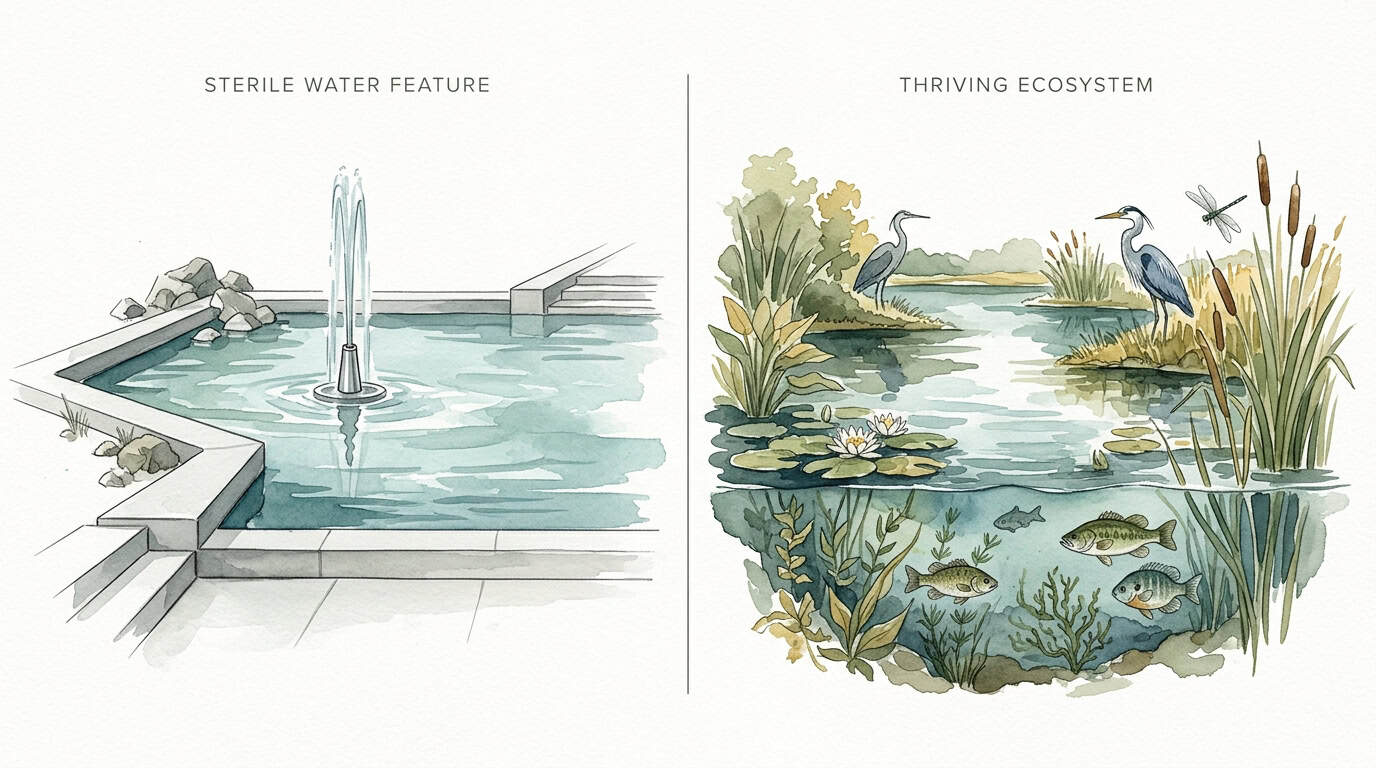
Managing a large-scale aquatic environment requires a shift from aesthetic preference toward rigorous mechanical and biological optimization. When a manager focuses solely on visual clarity through chemical suppression, they often ignore the underlying nutrient cycles that drive system instability. A professional partner should prioritize the restoration of a Thriving Ecosystem over the temporary maintenance of a Sterile Water Feature.
How To Choose The Right Pond Management Company For Your Lake Or Pond
Selecting a lake management partner is a technical decision that impacts the long-term asset value of a property. A qualified company does not simply react to algae blooms; it manages the nitrogen and phosphorus cycles to prevent them. In the field of limnology, this is the difference between symptom suppression and systemic restoration.
A professional firm functions as an engineering and biological consultant. They use data—such as dissolved oxygen profiles and sediment analysis—to determine why a system is failing. This approach is necessary because every water body has a unique Trophic State Index (TSI) score, which measures its biological productivity based on phosphorus, chlorophyll-a, and Secchi disk transparency.

Real-world pond management involves coordinating mechanical aeration, biological augmentation, and nutrient remediation. A company that lacks the equipment for bathymetric mapping or the technical knowledge to calculate oxygen transfer rates is likely just a chemical applicator. Property managers must evaluate candidates based on their ability to perform quantitative assessments rather than their inventory of algaecides.
How Aquatic Ecosystem Restoration Works
Sustainable management relies on three primary pillars: aeration, nutrient binding, and biological augmentation. Each pillar must be optimized using specific mechanical and chemical metrics to ensure system stability.
Mechanical Aeration and Gas Transfer
Effective aeration is not about creating surface bubbles; it is about achieving a full water turnover cycle. Sub-surface diffused aeration systems use shore-mounted compressors to deliver air through weighted tubing to membrane diffusers at the pond floor. These systems are sized based on a target turnover rate, typically displacing one acre-foot of water every 24 to 48 hours.
The efficiency of these systems is measured by Standard Aeration Efficiency (SAE), which quantifies the pounds of oxygen transferred per horsepower-hour (lb O2/hp-hr). Fine-bubble diffusers are the industry standard for high-volume applications because they maximize the surface-area-to-volume ratio of the air bubbles, increasing Oxygen Transfer Efficiency (OTE).
Nutrient Binding and Sequestration
Internal nutrient loading occurs when phosphorus is released from bottom sediments under anoxic (low oxygen) conditions. To counter this, managers use binding agents like Aluminum Sulfate (Alum) or Lanthanum-Modified Bentonite (LMB). These compounds undergo a chemical reaction with reactive phosphorus to form an insoluble mineral precipitate, such as Rhabdophane in the case of LMB.
Stoichiometry plays a critical role here. For example, Alum requires specific pH levels (typically between 6.0 and 8.0) to form a stable floc. If the pH is too high or too low, the aluminum can become toxic or fail to bind the phosphorus. A technical partner will conduct jar tests and water chemistry analysis before any application to ensure the dose rate is calculated accurately.

Biological Augmentation
Biological augmentation involves the introduction of specific microbial strains—probiotics and biocatalysts—to outcompete algae for available nutrients. These microbes metabolize organic matter in the water column and the sediment layer, a process often called “bio-dredging.” Research indicates that consistent application of engineered tablets, such as MuckBiotics, at a rate of approximately 33 lbs per acre per month can significantly reduce organic sludge depth over a 5 to 7-month period.
Benefits of Data-Driven Management
A data-driven approach provides measurable improvements in water quality and long-term cost efficiency. By focusing on mechanical optimization, property owners avoid the “rebound effect” where killed algae decay and release even more nutrients back into the water.
- System Stability: Maintaining dissolved oxygen levels above 2.0 mg/L at the sediment-water interface prevents the chemical release of phosphorus, stabilizing the entire ecosystem.
- Reduced Chemical Dependency: Biological augmentation reduces the need for frequent algaecide applications, which preserves the beneficial microbial communities necessary for natural filtration.
- Asset Longevity: Bio-dredging slows the accumulation of organic muck, extending the time between expensive mechanical dredging operations.
- Enhanced Biodiversity: A balanced ecosystem supports diverse fish populations and native aquatic plants, which act as natural nutrient sinks.
Challenges and Common Mistakes
The most frequent error in pond management is the over-reliance on copper-based algaecides. While copper provides a rapid “kill,” it often leads to several technical failures.
Copper is a heavy metal that accumulates in the sediment, potentially reaching toxic levels for benthic organisms. Furthermore, the rapid die-off of an algae bloom can cause a catastrophic drop in dissolved oxygen as bacteria consume the oxygen to decompose the dead plant matter. This often results in fish kills.
Another common mistake is ignoring the external nutrient load. If a pond is receiving high levels of nitrogen and phosphorus from upstream runoff or lawn fertilizers, in-lake treatments will be temporary. A professional company must assess the surrounding watershed and recommend buffer zones or littoral shelf plantings to intercept these nutrients before they enter the water.
Limitations of Biological and Mechanical Systems
While superior for long-term health, biological and mechanical systems have practical boundaries. They are not “instant” fixes. A heavily eutrophic pond may take two to three seasons of intensive management to reach a stable state.
Environmental constraints also play a role. In very shallow ponds (less than 4 feet deep), diffused aeration is less efficient because the bubbles have less “hang time” in the water column to transfer oxygen. In these scenarios, mechanical circulators or surface aerators might be necessary despite their lower SAE compared to deep-water diffusers.
Additionally, biological treatments are temperature-dependent. Most beneficial bacteria become dormant when water temperatures drop below 50°F (10°C). Management plans must be adjusted seasonally to account for these metabolic shifts.
Comparison: Surface Aeration vs. Sub-Surface Diffusion
Choosing the correct mechanical system depends on the primary goal of the installation. The following table compares the two most common aeration methods based on technical performance metrics.
| Metric | Surface Aeration (Fountains) | Sub-Surface Diffusion |
|---|---|---|
| Standard Aeration Efficiency (SAE) | 1.5 – 2.5 lb O2/hp-hr | 3.0 – 12.0 lb O2/hp-hr |
| Primary Function | Aesthetics / Surface De-stratification | Oxygenation / Deep-water Circulation |
| Oxygen Transfer Efficiency (OTE) | Low (Interface only) | High (Full column) |
| Energy Consumption | High per unit of O2 transferred | Low per unit of O2 transferred |
| Thermal Impact | Can increase surface temp | Disrupts thermal stratification |
For a Thriving Ecosystem, sub-surface diffusion is the technically superior choice due to its higher OTE and ability to oxygenate the “muck layer” where nutrient recycling occurs. Surface fountains are better categorized as aesthetic features for a Sterile Water Feature.
Practical Tips for Evaluating a Management Partner
Verify that any potential partner uses a science-first methodology. Request a sample water quality report and look for the following data points:
- Dissolved Oxygen (DO) Profiles: Testing should occur at multiple depths (surface, mid-water, and bottom) to identify stratification.
- Total Phosphorus (TP) and Orthophosphate: Understanding the ratio of bound to free phosphorus is essential for calculating nutrient-binding doses.
- Alkalinity and pH: These metrics determine the safety and efficacy of chemical applications.
- Secchi Disk Transparency: A standard measure of water clarity and planktonic density.
Ensure the company provides a customized maintenance plan. A “one-size-fits-all” monthly spray service is a red flag. Professional firms will adjust dosing and aeration run-times based on real-time data and seasonal environmental changes.
Advanced Considerations: The Trophic State Index (TSI)
Serious practitioners use the Trophic State Index (TSI) to track the “age” of a lake. Eutrophication is the natural aging process where a water body becomes increasingly nutrient-rich and shallow. Human activity, such as urban runoff, accelerates this process.
A TSI score above 60 indicates a eutrophic system prone to frequent blooms. Management strategies for these lakes must be aggressive, often combining high-rate biological augmentation (35+ lbs/acre/month) with chemical phosphorus sequestration. In contrast, an oligotrophic lake (TSI Example Scenario: Aeration Sizing and ROI
Consider a 2-acre pond with an average depth of 8 feet. The total volume is approximately 16 acre-feet (5.2 million gallons). To achieve a 24-hour turnover, an aeration system must move 3,611 gallons per minute (GPM).
A high-efficiency sub-surface system with a 1/2 HP compressor and four fine-bubble diffusers can move roughly 1,000 GPM per diffuser at an 8-foot depth. This configuration provides 4,000 GPM of total circulation, meeting the turnover requirement with a safety margin for warm weather.
The ROI of this system is realized through the reduction in algaecide costs. If the property was previously spending $2,000 annually on copper treatments that provided only temporary relief, the installation of a $4,500 aeration system that stabilizes the biology could reduce chemical costs by 70%. The system pays for itself in less than four years while simultaneously increasing the property’s ecological health and aesthetic value.
Final Thoughts
Selecting the right pond management company is an exercise in discerning between a service that masks problems and one that solves them. A partner focused on mechanical optimization and biological health will provide a stable, self-sustaining ecosystem that requires fewer chemical interventions over time.
Focus on data. If a company cannot explain the stoichiometry of their nutrient binders or the SAE of their aeration systems, they are not equipped to manage a complex aquatic asset. Demand transparency in water quality testing and prioritize firms that view a pond as a living system rather than a chemical vessel.
Experiment with proactive strategies such as early-season nutrient binding and biological augmentation. These methods prevent the massive mid-summer algae blooms that lead to reactive, high-stress management. By investing in the underlying biology today, you ensure the longevity and beauty of your lake or pond for years to come.
