

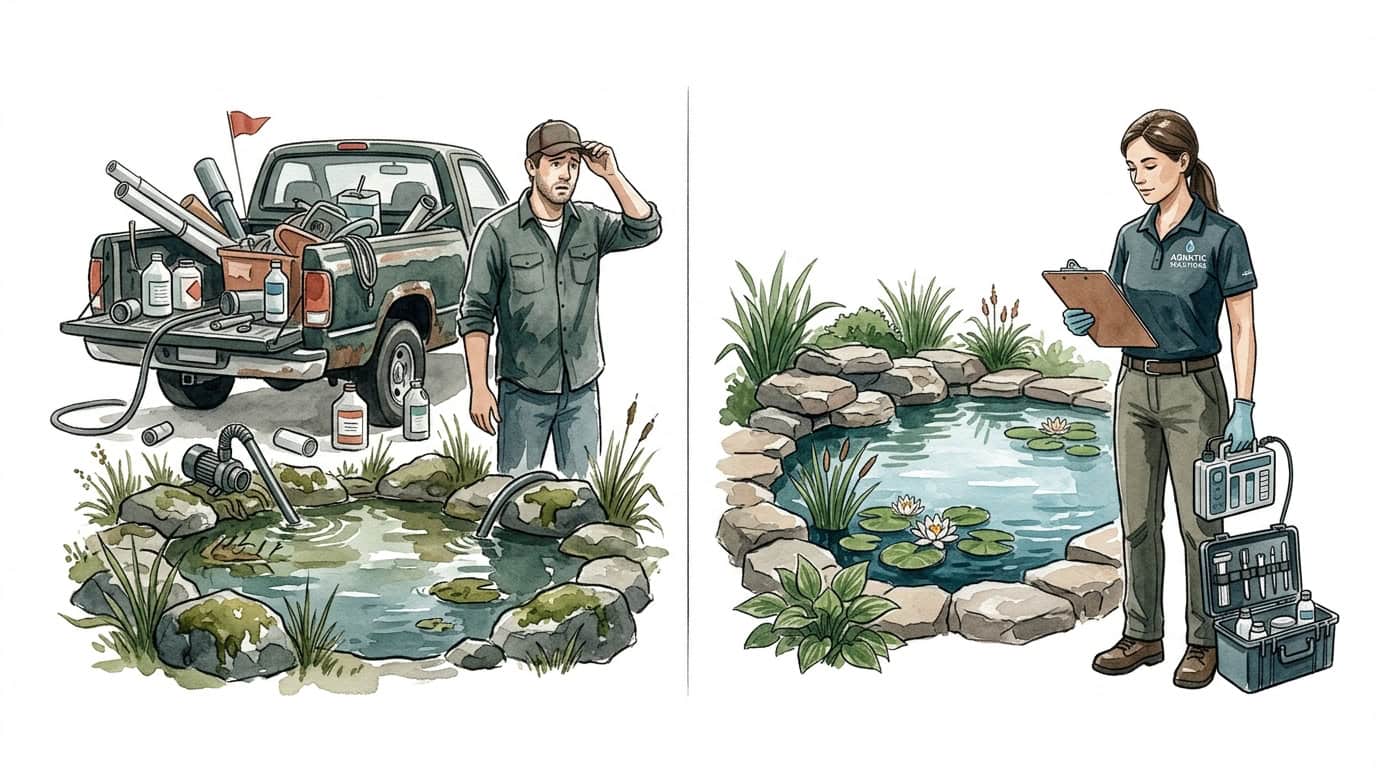
How to spot a pond disaster before it starts. Bad pond management doesn’t just waste money—it can destroy your ecosystem for years. If you see these signs, it’s time to find a new provider immediately.
Effective aquatic management is a high-stakes technical discipline. A pond is not merely a basin of water; it is a complex biological reactor governed by chemical cycles, mechanical efficiency, and thermodynamic variables. When these systems fail, the resulting degradation is rarely limited to aesthetics. It often involves systemic collapses such as massive fish kills, structural breaches, or permanent soil contamination.
Understanding the mechanical and biological indicators of pond health allows an asset manager or homeowner to distinguish between professional-grade service and amateur maintenance. The difference often lies in the data: an aquatic professional relies on digital monitoring and chemical titration, whereas the ‘guy with a truck’ relies on visual guesswork.
Red Flags To Watch For When Hiring A Pond Service Provider
Identifying a subpar provider requires looking beyond their marketing materials and examining their technical protocols. In the field of aquatic restoration, specific red flags indicate a high probability of future system failure.

A primary red flag is the absence of water quality testing. If a provider proposes a treatment plan without first establishing baseline metrics for dissolved oxygen (DO), pH, and nutrient concentrations (phosphorus and nitrogen), they are guessing rather than diagnosing. Professionals use calibrated DO meters and spectrophotometers to determine the precise requirements of the water body.
Lack of licensure and specialized insurance is another critical indicator. Aquatic management often requires the application of regulated herbicides and algaecides. In most jurisdictions, this requires a state-certified pesticide applicator license. Using an unlicensed contractor shifts the legal and environmental liability for misapplication directly onto the property owner.
Finally, watch for providers who prioritize “quick fixes” like heavy algaecide dosing without addressing the underlying nutrient load. Rapidly killing algae without removing the resulting organic sludge leads to a massive biological oxygen demand (BOD) spike, which frequently triggers a total ecosystem collapse.
How Aquatic Ecosystem Management Works
Maintaining a stable water body requires the synchronization of three primary systems: mechanical filtration, biological conversion, and chemical stabilization. Each must be optimized based on the specific volume and thermal profile of the pond.
The Nitrogen Cycle and Biological Filtration
Biological filtration relies on nitrifying bacteria to convert toxic ammonia (NH3)—produced by fish waste and decaying organic matter—into nitrites (NO2-) and eventually into less harmful nitrates (NO3-). This process is aerobic, meaning it requires significant concentrations of dissolved oxygen. If the biological filter media lacks sufficient surface area or if the DO levels drop below 2.0 mg/L, this cycle stalls, leading to ammonia toxicity.
Mechanical Separation and Nutrient Export
Mechanical systems, such as skimmers and bottom drains, are designed to remove physical debris before it enters the biological cycle. Efficiency here is measured by the turnover rate—the time it takes for the entire volume of the pond to pass through the filtration system. For most high-load ecosystems, a turnover rate of once per hour is the technical gold standard.

The Role of Dissolved Oxygen (DO)
Oxygen is the most critical limiting factor in any aquatic system. It enters the water through atmospheric diffusion and photosynthesis. Professional management utilizes sub-surface aeration systems or fountains to increase the gas-exchange surface area. Monitoring DO at various depths is essential, as thermal stratification can create “dead zones” at the bottom where anaerobic bacteria produce hydrogen sulfide gas.
Benefits of Professional Technical Management
Engaging a qualified aquatic professional provides measurable improvements in system performance and asset longevity.
The most significant advantage is ecosystem stability. By managing the nutrient budget—specifically limiting phosphorus and nitrogen—professionals prevent the “boom and bust” cycles of algae growth. This leads to consistent water clarity and prevents the accumulation of muck (organic sludge) on the pond floor.
Technical management also protects mechanical assets. Regular inspection of pumps, impellers, and aeration compressors prevents premature failure due to mineral scaling or debris ingestion. A proactive maintenance schedule can extend the service life of an expensive pump from 2-3 years to over 8 years.
- Data-Driven Decisions: Treatments are based on titration results, not visual estimates.
- Asset Protection: Prevents structural damage to liners, dams, and spillways.
- Legal Compliance: Ensures all chemical applications meet EPA and local regulatory standards.
- Biodiversity Support: Creates an environment where high-value fish species can thrive and reproduce.
Challenges and Common Mistakes
The most frequent error in pond management is the over-reliance on algaecides. While algaecides are effective at clearing water quickly, they do nothing to remove the nutrients that fueled the growth. When the algae dies, it sinks to the bottom, decomposes, and releases those same nutrients back into the water, creating a feedback loop of increasing degradation.
Another common mistake is incorrect pump sizing. Many amateurs install pumps that are either too weak to provide adequate circulation or too powerful for the filtration media, leading to “channeling” where water bypasses the biological treatment zones. This results in poor water quality despite high electricity consumption.
Ignoring the muck layer is also a critical oversight. As organic matter accumulates, it undergoes anaerobic decomposition, releasing phosphorus into the water column. This “internal loading” can sustain algae blooms even if external runoff is eliminated. Failure to manage this layer via mechanical dredging or biological augmentation (beneficial bacteria) will eventually lead to a shallow, stagnant pond.
Limitations and Environmental Constraints
Technical pond management is subject to the laws of thermodynamics and local ecology. There are situations where even the most advanced systems face limitations.
Thermal constraints play a major role. As water temperature increases, its ability to hold dissolved oxygen decreases. In extreme heatwaves, mechanical aeration may struggle to keep DO above critical levels (4.0 mg/L), necessitating emergency intervention or temporary system bypasses.
External nutrient loading from surrounding landscapes can also overwhelm a system. If a pond is located at the base of a heavily fertilized golf course or agricultural field, the sheer volume of phosphorus entering the water via runoff may exceed the capacity of any filtration system. In these cases, nutrient remediation tools like Phoslock or Alum may be required, but they are temporary solutions unless the external source is mitigated.
Comparison: Aquatic Professional vs. The ‘Guy With A Truck’
To visualize the difference in approach, consider the following technical comparison:
| Feature | The Aquatic Professional | The ‘Guy With A Truck’ |
|---|---|---|
| Diagnostic Tools | DO Meters, pH probes, Lab Testing | Visual observation |
| Algae Control | Nutrient mitigation & targeted treatment | Repeated copper sulfate dosing |
| Equipment Knowledge | Hydraulic head calculations & TDH | “One size fits all” pumps |
| Documentation | Detailed water quality reports | Handwritten invoices |
Practical Tips for Monitoring Pond Health
Asset managers can perform basic diagnostic checks to ensure their provider is maintaining the system according to technical standards.
Monitor the Dissolved Oxygen levels at dawn. This is when DO is at its lowest point in the 24-hour cycle. If levels are consistently below 5.0 mg/L, your aeration system is either undersized or failing.
Observe the secchi disk depth (water clarity). A sudden drop in visibility usually indicates a spike in chlorophyll-a (algae) or suspended solids. If your provider does not have an explanation for this change backed by a water test, they are likely missing a shift in the nutrient balance.
Check for mechanical efficiency by calculating the power consumption of your pumps. If the amperage draw is significantly higher than the manufacturer’s specifications, it indicates an impeller clog or bearing wear. Addressing this early prevents a total pump burnout.
- Perform monthly pH and ammonia tests during the peak summer months.
- Ensure the skimmer baskets are emptied at least twice weekly to prevent organic loading.
- Verify that any beneficial bacteria additives are “refrigeration-stable” or high-count concentrates to ensure viability.
Advanced Considerations: Nutrient Remediation and Mapping
For larger bodies of water or high-value fisheries, advanced techniques such as bathymetric mapping and sediment analysis are required. Bathymetric maps use sonar to create a 3D model of the pond bottom, allowing professionals to calculate exact water volumes and identify areas of excessive muck accumulation.
Nutrient remediation often involves the use of lanthanum-modified clay or aluminum sulfate. These substances bind with reactive phosphorus in the water column and lock it into an inert state in the sediment. This is a highly technical process; if the pH is not carefully buffered during application, the water can become acidic enough to kill all aquatic life within hours. Only practitioners with deep chemical training should oversee these operations.
Examples and Technical Scenarios
Consider a 500,000-gallon stormwater pond experiencing recurring cyanobacteria blooms.
An amateur might apply 50 pounds of copper sulfate to kill the bloom. However, a technical analysis reveals the pond has 2 feet of muck at the bottom with a phosphorus concentration of 500 mg/kg. The copper kills the algae, which then settles into the muck, fueling the next bloom within 14 days.
The aquatic professional, conversely, uses a nutrient budget approach. They identify that the muck is the primary source of phosphorus. They deploy a sub-surface aeration system to increase DO at the sediment-water interface, promoting aerobic decomposition. They then apply a phosphorus-binding agent to “lock” the nutrients in the soil. The result is a long-term reduction in algae growth without the need for toxic chemicals.

Final Thoughts
Professional pond management is defined by the transition from reactive maintenance to proactive optimization. By focusing on the core metrics of dissolved oxygen, nutrient loading, and mechanical efficiency, you ensure the longevity of your aquatic asset. A failure to recognize the red flags of amateur service often results in irreversible ecological damage and significant financial loss.
Applying these technical principles allows for the creation of stable, self-sustaining ecosystems. Whether you are managing a small decorative feature or a large industrial basin, the data remains the most important tool in your arsenal. Experiment with consistent monitoring and demand high-level technical accountability from your providers to keep your water body healthy for years to come.