

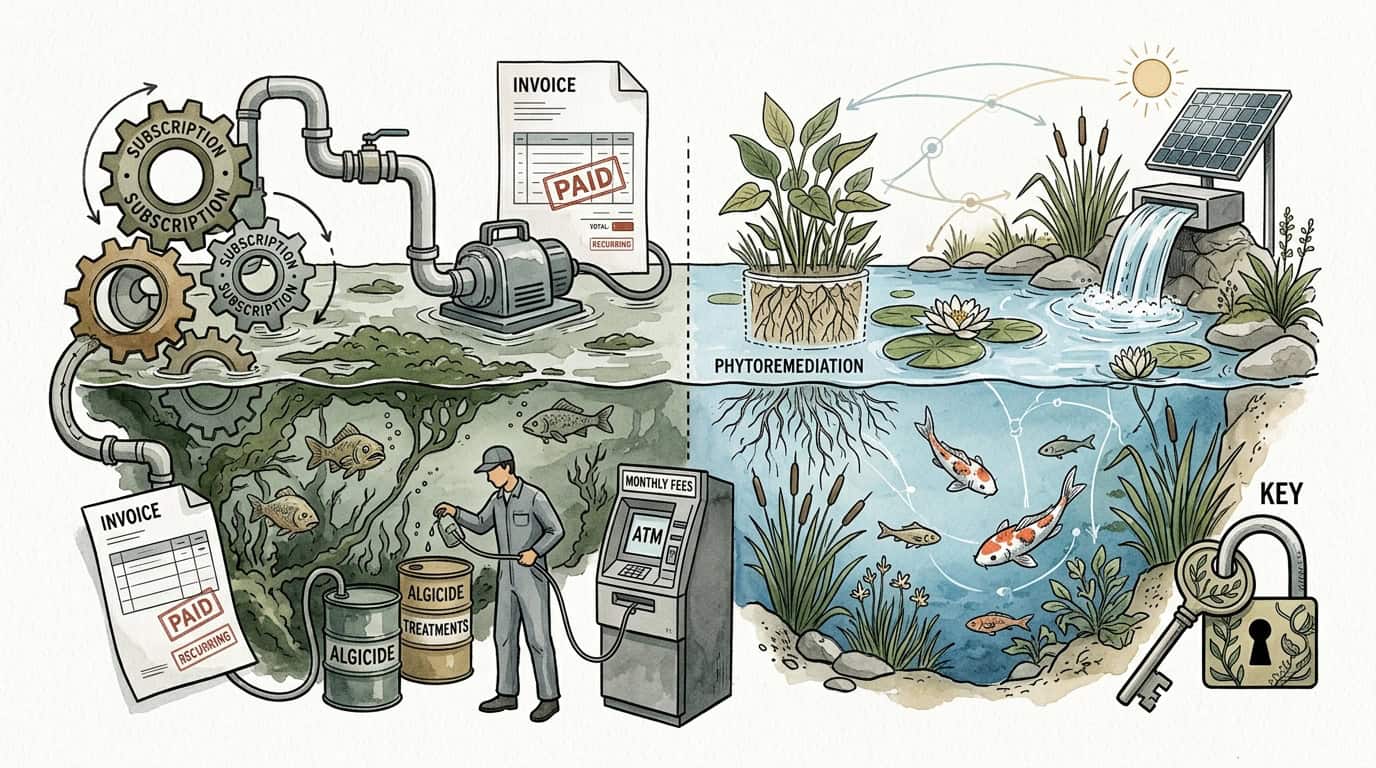
Don’t sign a contract until you ask these 10 questions. If your contractor isn’t working toward a self-sustaining system, they are just waiting for the next check. Use these 10 questions to find a partner who values your results more than your monthly fee.
Pond management often defaults to a cycle of reactive chemical application, which addresses symptoms rather than underlying biological and mechanical inefficiencies. This “Monthly Subscription Trap” prioritizes consistent billing over the achievement of a self-sustaining ecosystem. Shifting toward self-sustaining abundance requires a technical approach grounded in limnology, nutrient budgeting, and oxygenation efficiency.
Understanding the mechanics of water quality is the difference between an asset and a liability. A healthy pond functions as a biological processor that efficiently cycles nutrients and maintains high dissolved oxygen levels. When these systems fail, the result is eutrophication, sediment accumulation, and recurring algal blooms. Use the following technical inquiries to evaluate the engineering competence of any prospective pond management contractor.
10 Questions To Ask Before Hiring A Pond Management Contractor
Pond management is the application of physical, chemical, and biological controls to maintain a water body’s specific use-case, whether for stormwater retention, irrigation, or recreation. Most contractors focus on “optical clarity,” which is a superficial metric. Real success is measured by the reduction of internal nutrient loading and the stabilization of the nitrogen cycle.

1. What is your method for calculating the system’s Oxygen Transfer Rate (OTR) under field conditions?
Contractors often cite the Standard Oxygen Transfer Rate (SOTR), which is measured in clean water at 20°C. You need to know how they adjust for your specific water temperature, elevation, and organic load. A contractor who cannot calculate field OTR is guessing at the aeration requirements of your system.
2. How do you monitor and manage the internal nutrient loading from the benthic sludge layer?
Eutrophic ponds often have high “internal loading,” where phosphorus is released from anaerobic sediments back into the water column. Ask if they use chemical sequestration, such as lanthanum-modified clay, or if they rely on biological digestion via aerobic bacteria to reduce the muck layer.
3. Which specific strains of aerobic bacteria do you deploy for organic load reduction?
Generic probiotics are often ineffective. Inquire about the Colony Forming Units (CFU) per dose and whether the strains are specifically selected for cellulase or protease production. High-performance bio-augmentation is required to process complex organic matter like leaf litter and fish waste.
4. Do you utilize a phosphorus-sequestration strategy or rely on reactive algaecides?
Copper-based algaecides provide temporary visual relief but kill the algae, which then sinks and releases more phosphorus. This creates a feedback loop. A technical partner should prioritize phosphorus mitigation to starve the algae of its primary growth fuel.
5. What is the Standard Aeration Efficiency (SAE) of the hardware you recommend?
Aeration is the highest operational cost in pond management. SAE measures the pounds of oxygen transferred per horsepower-hour (lbs O2/hp·hr). Demand hardware that maximizes SAE to reduce long-term electrical overhead while meeting the system’s Biological Oxygen Demand (BOD).
6. How do you measure and report Biological Oxygen Demand (BOD) trends?
BOD indicates the amount of dissolved oxygen (DO) required by microorganisms to break down organic matter. If BOD increases while DO decreases, the system is heading toward a fish kill or an anaerobic crash. Professional contractors must monitor these metrics.

7. What is your protocol for mitigating the impact of high Total Suspended Solids (TSS)?
High TSS levels reduce the efficacy of chemical treatments and clog biological filters. Ask how they manage turbidity through mechanical filtration, flocculation, or the establishment of littoral shelf vegetation to act as a natural sediment trap.
8. Can you provide a mass balance analysis for nitrogen and phosphorus?
A pond is a system of inputs and outputs. If the nutrient influx from lawn runoff or waterfowl exceeds the pond’s processing capacity, the pond will fail regardless of treatment. A contractor should be able to estimate these inputs and design a system to offset them.
9. Is your system designed to reach a steady-state equilibrium?
The goal of a self-sustaining system is to minimize external inputs over time. If a contractor proposes a permanent, unchanging monthly chemical schedule, they are not working toward a solution; they are managing a dependency.
10. How do you evaluate the resilience of the nitrifying bacteria population?
Nitrogen cycling—converting ammonia to nitrite and then nitrate—is temperature-dependent. Ask how they adjust their biological strategies during seasonal shifts to prevent ammonia spikes that can be toxic to aquatic life.
The Mechanics of Pond Ecosystem Dynamics
A pond functions as a bioreactor. The primary objective of management is to maintain the aerobic state of the water column. When dissolved oxygen (DO) levels drop below 2–3 mg/L, the system becomes hypoxic. Hypoxia triggers the release of sequestered phosphorus from the sediment, a process known as internal loading.
Aerobic digestion is approximately 20 times faster than anaerobic digestion. By maintaining high DO levels (ideally >6 mg/L) at the sediment-water interface, you accelerate the breakdown of organic “muck.” This process is driven by the interaction between mechanical aeration, which provides the oxygen, and biological catalysts (enzymes and probiotics), which perform the degradation.
Mechanical efficiency is critical here. Diffused aeration systems are generally superior for deep ponds because they utilize the “airlift” effect to circulate the entire water column. Surface fountains, while aesthetically pleasing, often only aerate the top 2–3 feet of water, leaving the bottom in a state of stagnation and nutrient accumulation.
Benefits of a Systems-Engineering Approach
Choosing a contractor who views your pond as a mechanical system offers measurable advantages over a chemical-first approach. The most immediate benefit is the reduction in long-term operational expenditure (OPEX). While the capital expenditure (CAPEX) for high-efficiency aeration and nutrient sequestration may be higher, the reduction in monthly chemical costs often leads to a break-even point within 24 to 36 months.
Biological stability is another key advantage. Ponds that rely on natural nutrient cycling are more resilient to external shocks, such as heavy rain events or sudden temperature spikes. A system-engineered pond maintains its optical clarity and water quality through internal mechanisms, reducing the risk of sudden algal blooms that require emergency—and expensive—remediation.
Furthermore, mechanical and biological management avoids the accumulation of heavy metals. Frequent use of copper-based algaecides leads to copper buildup in the sediment, which can become toxic to beneficial invertebrates and complicate future dredging projects due to hazardous waste regulations.
Challenges and the Algaecide Feedback Loop
The most common mistake in pond management is the over-reliance on reactive algaecides. This creates a “feedback loop” that is difficult to break. When an algaecide is applied, the algae die and sink to the bottom. As this organic matter decomposes, it consumes dissolved oxygen, often leading to anaerobic conditions.
These anaerobic conditions trigger the release of phosphorus from the sediment. This newly available phosphorus, combined with the lack of competition from killed beneficial bacteria, fuels the next, more aggressive algal bloom. To the untrained eye, it appears the contractor is “solving” the problem every month, when they are actually feeding the conditions that cause the problem.
Another challenge is the misidentification of target species. Treating filamentous algae with a product designed for planktonic algae is inefficient and wasteful. Precision in species identification and chemical selection is mandatory for cost-effective management.
Limitations of Remediation
Remediation has physical and chemical boundaries. If a pond has reached its “terminal volume” due to decades of sediment accumulation, no amount of bacteria or aeration will restore its depth. In these cases, mechanical dredging is the only viable solution. Understanding when a system has exceeded its biological carrying capacity is a hallmark of an honest contractor.
Environmental factors such as high-velocity stormwater influx also limit management effectiveness. If a retention pond is receiving excessive nitrogen from upstream agricultural runoff, the internal systems will be overwhelmed. In these scenarios, management must include “source control” measures, such as shoreline buffers or upstream sediment forebays, which may fall outside the scope of a standard maintenance contract.
Reactive Subscription vs. Self-Sustaining Remediation
The following table compares the two primary philosophies in the industry across several technical metrics.
| Feature | Reactive Subscription | Self-Sustaining Remediation |
|---|---|---|
| Primary Goal | Short-term visual clarity | Long-term nutrient balance |
| Chemical Usage | High (Copper/Herbicides) | Minimal (Sequestration/Probiotics) |
| Aeration Strategy | Aesthetic fountains | High-efficiency diffused aeration |
| Nutrient Management | Ignored (Treated as symptom) | Targeted (P-sequestration/N-cycling) |
| Cost Structure | Fixed monthly fee (perpetual) | Decreasing fee as system stabilizes |
| Data Monitoring | Visual inspection only | DO, BOD, TSS, and P-levels |
Practical Tips for Technical Oversight
To ensure your contractor is performing at a high technical standard, you should request a quarterly water quality report. This report must include more than just pH and temperature. It should track Total Phosphorus (TP) and Dissolved Oxygen profiles at various depths. If the DO at the bottom of the pond is consistently below 3 mg/L, your aeration system is undersized or failing.
Check the mechanical components of your system yourself. Listen for changes in the compressor’s sound, which can indicate failing vanes or clogged air filters. Inspect the diffusers for “boil” consistency; an uneven surface boil indicates a leak in the weighted tubing or a clogged diffuser membrane. Efficiency is lost every day these components operate sub-optimally.
Establish a “no-mow” buffer zone of at least 10–15 feet around the pond perimeter. This strip of native vegetation filters out nitrogen and phosphorus from lawn runoff before it enters the water. This simple mechanical barrier can reduce the nutrient load by up to 50%, significantly decreasing the work required by your contractor and the chemicals required by the pond.
Advanced Considerations: The Math of Oxygenation
For serious practitioners, understanding the math of oxygenation is vital. The oxygen demand of a pond is the sum of the respiration of all aquatic life and the decomposition of organic matter (BOD). In a typical eutrophic pond, decomposition can account for over 80% of total oxygen consumption.

The formula for Oxygen Transfer (N) is often expressed as:
N = SOTR * ? * ( (? * C_salt * P) – C_L ) / C_s20
Where ? (alpha) and ? (beta) are correction factors for water quality and salinity. If your contractor cannot explain how they arrived at their aeration recommendations using these or similar principles, they are simply selling you a product rather than engineering a solution. Maximizing the alpha factor by reducing surfactants and organic pollutants is a key technical objective.
Scenario: Remediating a High-Nutrient Retention Pond
Consider a 1-acre retention pond with an average depth of 6 feet and a 2-foot sludge layer. The pond suffers from recurring blue-green algae blooms. A reactive contractor would apply copper sulfate every two weeks, costing approximately $400 per month indefinitely.
A technical contractor would first measure the phosphorus levels. Finding them at 150 parts per billion (ppb)—well above the 30 ppb threshold for algae growth—they would apply a lanthanum-modified clay to lock the phosphorus in the sediment. Simultaneously, they would install a 1/2 HP diffused aeration system to maintain DO at 7 mg/L.
Within the first year, the phosphorus levels drop to 20 ppb. The aerobic bacteria, now supplied with ample oxygen, begin digesting the muck layer at a rate of 2–3 inches per year. By year two, the copper sulfate applications are eliminated entirely. The owner’s monthly fee is reduced to a simple mechanical inspection, and the pond is now a self-sustaining asset.
Final Thoughts
Pond management is an exercise in applied limnology and mechanical optimization. The “Monthly Subscription Trap” persists because it is easy to sell and provides immediate, albeit temporary, visual results. However, it fails to address the underlying drivers of pond degradation, leading to a long-term increase in both cost and ecological instability.
By asking the 10 questions outlined above, you shift the power dynamic from a vendor-client relationship to a technical partnership. Focus on metrics like dissolved oxygen, phosphorus sequestration, and aeration efficiency. A contractor who can speak the language of data and engineering is a contractor who can deliver a self-sustaining system.
Invest in the biology and the mechanics of your water body. While the transition from a chemical-dependent system to a self-sustaining one requires an initial shift in strategy, the result is a resilient, low-maintenance ecosystem that adds genuine value to your property. Experiment with bio-augmentation and high-efficiency aeration to see the measurable impact on your water quality.