

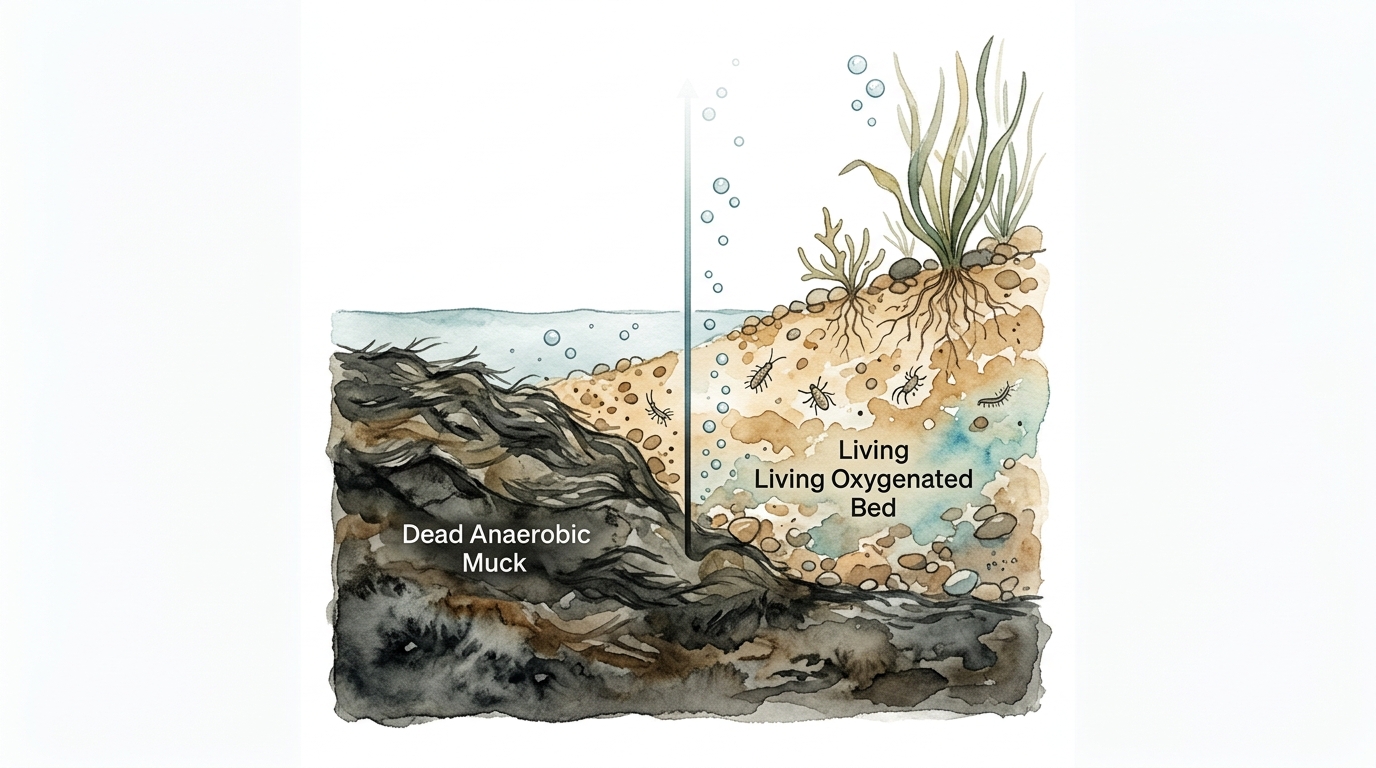
Is your pond floor suffocating your ecosystem from the bottom up? Silt isn’t just mud; it’s an oxygen thief. When organic matter rots at the bottom without oxygen, it creates a dead zone. Learn how to flip the switch from a dead system to a living one.
Pond management often focuses on the surface of the water because that is what is visible. However, the health of an aquatic ecosystem is dictated by the processes occurring at the benthic level. The accumulation of silt and muck represents a significant mechanical and chemical challenge to water quality. This material consists of fine mineral particles and organic detritus that settle out of the water column over time.
Organic material requires oxygen to decompose. In a healthy system, aerobic bacteria use dissolved oxygen to break down this waste into harmless byproducts like carbon dioxide and water. When silt buildup becomes excessive, it creates a physical barrier that prevents oxygen from reaching the deeper layers of the pond floor. This leads to a transition from a Living Oxygenated Bed to Dead Anaerobic Muck.
Understanding the transition between these two states is critical for any serious practitioner. Managing oxygen levels at the sediment-water interface is the primary defense against pond stagnation. This article provides a technical deep dive into the mechanics of silt, oxygen depletion, and the strategies required to restore ecological balance.

What Silt Buildup Does to Pond Oxygen Levels
Silt buildup acts as a massive sink for dissolved oxygen. In technical terms, this is referred to as Sediment Oxygen Demand (SOD). As organic matter accumulates, the biological oxygen demand (BOD) of the bottom layer increases exponentially. Microorganisms residing in the silt consume oxygen faster than it can be replenished from the surface or through photosynthesis.
Water depth and thermal stratification play a major role in this process. In many ponds, a thermocline develops during warmer months, separating the oxygen-rich surface water from the cooler, deeper water. Silt at the bottom of a stratified pond quickly consumes the remaining oxygen in the lower layer (the hypolimnion), leading to anoxic conditions where dissolved oxygen levels drop to 0 mg/L.
The physical presence of silt also limits the volume of the pond. As the depth decreases, the ratio of sediment surface area to total water volume increases. This means the sediment has a proportionally greater impact on the overall respiration rate of the pond. In shallow ponds, this effect is even more pronounced, as the oxygen supply is more easily overwhelmed by the demand of the muck layer.
Furthermore, silt interferes with the natural movement of water. Stagnation occurs when silt blocks inlets or creates uneven bottom contours that prevent effective circulation. Without movement, oxygen cannot be transported to the benthic zone, and toxic gases produced by anaerobic decomposition begin to accumulate in the water column.
The Mechanics of Anaerobic Decomposition
Decomposition changes fundamentally when oxygen is removed from the equation. In an aerobic environment, bacteria utilize oxygen as the terminal electron acceptor in the metabolic process. This allows for the rapid and complete oxidation of organic carbon. The chemical equation for this process is typically represented as C6H12O6 + 6O2 ? 6H20 + 6CO2.
Anaerobic decomposition occurs when oxygen concentrations fall below 1.5 to 2.0 mg/L. In this state, bacteria must use alternative electron acceptors, such as nitrate, manganese, iron, or sulfate. This process is significantly slower than aerobic digestion, leading to the rapid accumulation of muck that would otherwise have been processed by the ecosystem.

The byproducts of anaerobic metabolism are often toxic to aquatic life. Instead of carbon dioxide, these bacteria produce hydrogen sulfide (H2S), methane (CH4), and ammonia (NH4). Hydrogen sulfide is particularly problematic, as it is highly toxic to fish and macroinvertebrates even at low concentrations. It is also the source of the “rotten egg” smell frequently associated with disturbed pond muck.
Methane gas bubbles can often be seen rising from the bottom of an anaerobic pond. These bubbles carry nutrients and organic particles from the sediment back into the water column, further fueling the growth of algae. This internal recycling of nutrients creates a self-sustaining cycle of decline that is difficult to break without mechanical or biological intervention.
Nutrient Loading and Internal Eutrophication
Silt serves as a reservoir for nutrients, particularly phosphorus and nitrogen. In a Living Oxygenated Bed, phosphorus is often bound to iron in the form of ferric phosphate (FePO4). This compound is insoluble and stays trapped in the sediment, making the phosphorus unavailable for algae growth.
Anaerobic conditions trigger a chemical change known as reduction. When oxygen is absent, ferric iron (Fe3+) is reduced to ferrous iron (Fe2+). Ferrous iron compounds are soluble, which causes the bound phosphorus to be released back into the water column. This process is known as internal loading or internal eutrophication.
Internal loading explains why many ponds continue to suffer from massive algae blooms even after external sources of pollution have been mitigated. The sediment itself is “feeding” the algae from the bottom up. High concentrations of phosphorus in the water column provide the necessary fuel for cyanobacteria (blue-green algae) to flourish.
Nitrogen also undergoes complex transformations in the silt. Organic nitrogen is converted into ammonia through a process called ammonification. In an oxygenated environment, this ammonia would be converted into nitrate by nitrifying bacteria. In a Dead Anaerobic Muck layer, nitrification stops, and ammonia levels can rise to levels that are lethal to sensitive fish species.
How to Measure the Dead Zone
Quantifying the health of a pond floor requires specific technical measurements. The most direct method is the measurement of Dissolved Oxygen (DO) at various depths. Using a DO meter with a long cable, a manager can create a profile of the water column to identify the exact depth where oxygen levels begin to fail.
Oxidation-Reduction Potential (ORP), or Redox, is an even more sensitive indicator of benthic health. ORP measures the tendency of the water or sediment to gain or lose electrons, expressed in millivolts (mV). A high positive ORP (above 200 mV) indicates an oxidizing environment where aerobic processes dominate. A negative ORP (below -100 mV) indicates a highly reducing, anaerobic environment.
Measuring the physical depth of the silt is also essential. A “Sludge Judge” or a similar core sampler can be used to take a vertical slice of the pond floor. This allows the manager to see the thickness of the muck layer and determine its composition. Silt that is jet black and smells of sulfur is a clear sign of a Dead Anaerobic Muck system.
Chemical analysis of the sediment can reveal the concentrations of nitrogen and phosphorus. This data is vital for determining the potential for internal loading. If the sediment is highly enriched with phosphorus, simply adding oxygen may not be enough to prevent algae blooms in the short term, and phosphorus binders may be required.
Strategies for Oxygenating the Benthic Zone
Restoring a pond requires a strategy to move oxygen to the bottom. Diffused aeration is the most common mechanical solution for deeper ponds. This system uses an onshore compressor to pump air through weighted tubing to diffusers placed on the pond floor. The diffusers release thousands of tiny bubbles, which create a rising column of water.
Small bubbles are more efficient than large ones for gas transfer. This is because they have a higher surface-area-to-volume ratio, allowing more oxygen to dissolve into the water as they rise. Furthermore, the rising column of bubbles creates a “chimney effect” that pulls cold, oxygen-depleted water from the bottom and moves it to the surface where it can interact with the atmosphere.
Circulation is just as important as oxygenation. By breaking the thermocline and mixing the water column, an aeration system ensures that the entire pond stays oxygenated from top to bottom. This process is known as destratification. Maintaining a constant flow of oxygenated water over the silt layer encourages the growth of aerobic bacteria and helps to “breathe life” back into the pond floor.
Oxygenation Saturation Technology (OST) is an advanced method that injects pure oxygen directly into the bottom water without mixing the layers. This is often used in sensitive environments where maintaining a cool bottom temperature is necessary for specific fish species. OST can maintain oxygen levels well above 8 mg/L directly at the sediment-water interface.
Benefits of a Living Oxygenated Bed
Transitioning from an anaerobic system to an oxygenated one provides immediate and long-term benefits. The most significant benefit is the acceleration of muck decomposition. Aerobic bacteria can break down organic matter up to ten times faster than anaerobic bacteria. This process, often called “biological dredging,” can actually reduce the depth of the muck layer over time without the need for heavy machinery.
Water clarity typically improves as a result of oxygenation. When the bottom is oxygenated, the phosphorus release is curtailed, which reduces the frequency and severity of algae blooms. Furthermore, aerobic bacteria compete with algae for available nutrients, further limiting the growth of unwanted vegetation.
Fish health and growth rates are greatly enhanced in an oxygenated system. Removing the “dead zone” at the bottom expands the usable habitat for fish, allowing them to access the cooler, deeper water during the heat of the summer. Eliminating toxic gases like hydrogen sulfide also reduces stress on the aquatic population, leading to better survival rates and higher productivity.
Odors are eliminated almost immediately. Since the production of hydrogen sulfide and methane is an anaerobic process, maintaining an oxygenated benthic zone stops these gases from forming. This makes the pond much more pleasant for recreational use and improves property values for landowners.
Challenges and Common Mistakes
One of the most common mistakes in silt management is the sudden startup of an aeration system in a severely degraded pond. If a pond has a large accumulation of anaerobic muck and toxic gases, turning on a powerful aerator can cause a “turnover” event. This rapidly mixes the toxic bottom water with the surface water, which can lead to a sudden drop in total dissolved oxygen and a massive fish kill.
Sizing the aeration system incorrectly is another frequent error. A system that is too small will fail to break the thermocline or provide enough oxygen to satisfy the Sediment Oxygen Demand. Managers must calculate the total volume of the pond and the expected oxygen demand of the silt to ensure the compressor and diffusers are capable of the job.

Ignoring the source of the silt is a long-term failure. Even the best aeration system can be overwhelmed if the pond is receiving a constant influx of leaves, grass clippings, or agricultural runoff. Buffer strips and sediment traps should be used in conjunction with oxygenation to ensure the longevity of the pond.
Failing to monitor the system can lead to unexpected failures. Aeration compressors require regular maintenance, such as filter changes and vane replacements. If a system goes offline during a heatwave, the pond can revert to an anaerobic state in a matter of days, undoing months of progress in muck reduction.
Limitations of Silt Management Techniques
Mechanical aeration is highly effective but has practical boundaries. In very shallow ponds (less than 4-5 feet deep), diffused aeration is less efficient because the bubbles have a shorter distance to travel, limiting the amount of water they can move. In these cases, surface aerators or horizontal aspirators may be more effective.
Biological treatments, such as the addition of muck-eating bacteria, are also limited by temperature and oxygen. These bacteria are most active in water temperatures above 60°F. If the water is too cold or if oxygen levels are not maintained, the added bacteria will become dormant or die, rendering the treatment ineffective.
Heavy mineral silt, such as sand or clay from erosion, cannot be broken down by bacteria or oxygen. Only organic muck—composed of plant and animal remains—is subject to biological digestion. If a pond is filled with inorganic silt, mechanical dredging is the only viable option for restoring depth.
Dredging itself has significant limitations, primarily regarding cost and environmental disruption. It is a violent process that destroys the existing benthic habitat and can release buried pollutants into the water column. While it provides a “reset” for the pond, it does not solve the underlying issues of nutrient loading and low oxygen.
Comparison: Mechanical Dredging vs. Aerated Digestion
The following table compares the two primary methods for managing silt accumulation in ponds.
| Feature | Mechanical Dredging | Aerated Digestion (Bio-Dredging) |
|---|---|---|
| Primary Action | Physical removal of all sediment. | Accelerated biological breakdown of organic matter. |
| Initial Cost | High (Tens of thousands of dollars). | Moderate (Equipment and installation). |
| Disruption | Extreme; destroys benthic life and clarity. | Minimal; maintains existing ecosystem. |
| Effect on Depth | Immediate restoration of original depth. | Slow, gradual reduction of organic muck. |
| Long-term Maintenance | Low, until silt builds up again. | Continuous; requires electricity and maintenance. |
| Waste Management | Requires disposal of wet sediment. | Waste is converted to gas (CO2) and water. |
| Inorganic Silt (Sand/Clay) | Effective. | Ineffective. |
Practical Tips and Best Practices
Start an aeration system gradually if the pond is already in a degraded state. Begin by running the system for only 30 minutes on the first day, and double the runtime each day until it is running 24/7. This allows the pond to slowly degas and prevents a catastrophic turnover event.
Placement of diffusers should target the deepest areas of the pond. Since these are the areas most prone to anoxia, placing diffusers here ensures the maximum amount of water is moved and oxygenated. For irregularly shaped ponds, multiple diffusers may be necessary to ensure there are no “dead spots” with stagnant water.
Use a combination of aeration and bioaugmentation for the best results. Adding specialized aerobic bacteria “muck pellets” to the pond can speed up the decomposition process. These pellets sink into the silt and deliver a concentrated dose of bacteria directly to the target area.
Monitor water quality parameters at least once a month during the growing season. Testing for dissolved oxygen, pH, and phosphorus will provide early warning signs if the system is being overwhelmed by nutrient loading or weather conditions.
Advanced Considerations: Redox and Thermal Dynamics
Advanced practitioners should focus on the Redox potential of the sediment-water interface. Maintaining a Redox potential of +100 mV or higher at the very bottom of the pond is the gold standard for benthic health. Achieving this requires not just oxygen, but a balance of microbial activity and water movement.
Thermal dynamics also influence the efficiency of oxygenation. Cold water can hold significantly more dissolved oxygen than warm water. During the peak of summer, the oxygen-carrying capacity of the water is at its lowest, while the metabolic rate of the bacteria is at its highest. This “oxygen squeeze” is the most dangerous time for the pond ecosystem.
Scaling considerations are also vital for large-scale operations. For ponds larger than five acres, the cost of electricity for traditional aeration can become significant. In these cases, solar-powered aeration or high-efficiency nanobubble generators may provide a more sustainable long-term solution.
Technical Scenario: 1-Acre Pond Case Study
Consider a 1-acre pond with an average depth of 6 feet and 12 inches of accumulated organic muck. This represents approximately 1,600 cubic yards of sediment. If the muck is anaerobic, it is likely releasing enough phosphorus to support constant algae blooms throughout the summer.
Installing a 1/2 HP diffused aeration system with two dual-disc diffusers would provide approximately 2.5 CFM (cubic feet per minute) of airflow. This system would be capable of turning over the entire volume of the pond several times a day. Within the first 30 days, the ORP at the bottom would likely shift from -150 mV to +50 mV.
Over the course of one year, the accelerated aerobic decomposition could reduce the muck layer by 2 to 4 inches. This “biological dredging” would effectively remove 300 to 600 cubic yards of organic waste without the use of a single excavator. The reduction in internal phosphorus loading would significantly improve water clarity and reduce the need for algaecide treatments.
Final Thoughts
Managing silt is a fundamental requirement for maintaining a healthy and functional pond ecosystem. The shift from a Dead Anaerobic Muck floor to a Living Oxygenated Bed represents the difference between a stagnant, dying pond and a vibrant, productive one. By focusing on the chemistry of the benthic zone, managers can address the root cause of water quality issues rather than just treating the symptoms.
Mechanical aeration remains the most effective tool for delivering oxygen to the bottom of the pond. When combined with proper monitoring and biological treatments, it provides a comprehensive solution for muck reduction and nutrient management. Every pond is unique, but the underlying principles of oxygen demand and sediment chemistry are universal.
Commitment to a long-term management plan is essential. Silt does not accumulate overnight, and it cannot be eliminated overnight. However, through consistent application of oxygenation and proactive maintenance, any pond can be restored to its full ecological potential. Practitioners are encouraged to experiment with different diffuser placements and bacterial strains to find the optimal configuration for their specific environment.