

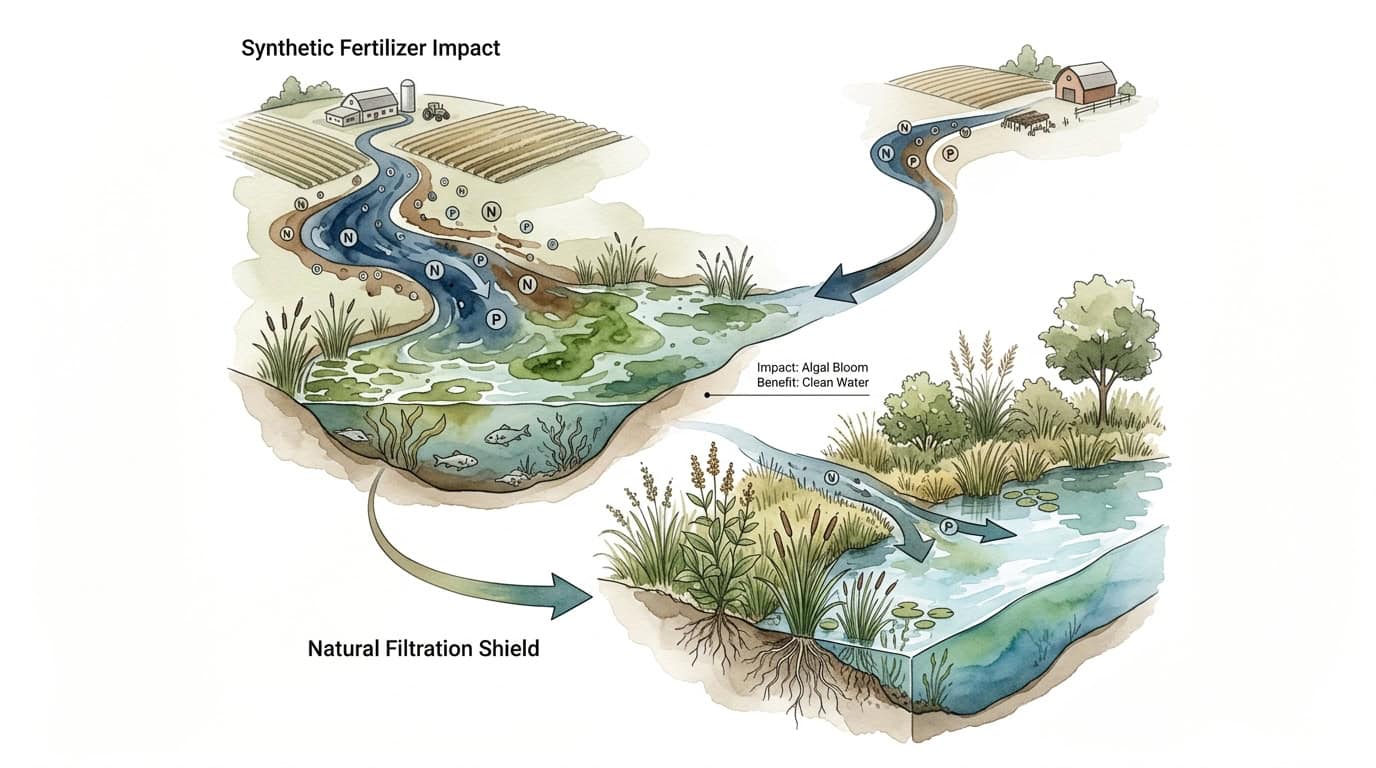
Is your farm field feeding your pond or killing it? Synthetic fertilizers create massive nutrient spikes that turn ponds into green soup. Transitioning to natural buffers protects your water quality and keeps your ecosystem in balance. Here is how to shield your pond.
How Farm Runoff Affects Pond Nutrient Levels
Farm runoff acts as a primary vector for the transport of concentrated nutrients from upland agricultural fields to lowland aquatic depressions. This process involves the movement of nitrogen, phosphorus, and potassium—collectively known as N-P-K—along with suspended solids and organic matter. Synthetic fertilizers are engineered for high solubility to ensure rapid uptake by crops, but this same characteristic makes them highly susceptible to leaching and surface transport during precipitation events.
When rainfall exceeds the infiltration capacity of the soil, surface runoff occurs. This water carries dissolved nutrients and sediment-bound minerals directly into the pond environment. In typical agricultural settings, nitrogen primarily moves in the form of nitrate (NO3-), which is highly mobile in water. Phosphorus, conversely, is often “sticky” and binds to soil particles, meaning it is transported largely through erosion and sediment movement.
Excessive nutrient loading triggers a process known as eutrophication. This biological enrichment causes a rapid shift in the pond’s trophic state. High concentrations of phosphorus, often the limiting nutrient in freshwater systems, catalyze explosive growth of cyanobacteria and filamentous algae. These blooms increase the turbidity of the water, preventing light from reaching submerged aquatic vegetation, and eventually lead to catastrophic dissolved oxygen depletion as the biomass decomposes.

How It Works: The Mechanism of Natural Filtration
Natural buffers, also referred to as riparian filter strips or vegetated buffers, function through a combination of physical, chemical, and biological processes to intercept and transform nutrients before they reach the water column. The efficiency of these systems is determined by their width, vegetation density, and soil hydraulic conductivity.
Physical filtration is the first line of defense. As runoff enters a vegetated zone, the physical resistance provided by plant stems and leaf litter reduces the velocity of the water. This decrease in kinetic energy allows suspended solids—and the phosphorus bound to them—to settle out of the water column and integrate into the soil profile. Research indicates that a 15-foot grass buffer can capture approximately 60% of sediment-bound phosphorus.
Chemical and biological transformations occur once the water infiltrates the soil. Nitrogen removal is primarily achieved through denitrification, a microbially mediated process where anaerobic bacteria convert nitrate (NO3-) into nitrogen gas (N2), which is then released into the atmosphere. This process is most effective in saturated, carbon-rich soils found in the root zones of riparian plants. Plants also provide direct nutrient uptake, sequestering nitrogen and phosphorus into their biomass during the growing season.
Benefits of Transitioning to Natural Buffers
Implementing natural buffers offers measurable improvements in water quality and ecosystem stability. Technical data suggests that properly designed filter strips can reduce total suspended solids (TSS) by over 75% and total phosphorus (TP) by 50% to 80%. These reductions directly correlate with increased water clarity and a decrease in the frequency of toxic algal blooms.
Natural buffers also provide thermal regulation. Tall vegetation and trees provide shade along the pond’s edge, which prevents solar radiation from excessively heating the shallow margins. Cooler water has a higher capacity for dissolved oxygen, which is critical for maintaining fish populations and supporting aerobic decomposition of organic matter at the pond bottom.
Stabilization of the shoreline is another significant mechanical advantage. The deep, fibrous root systems of native grasses and woody shrubs bind the soil together, preventing slumping and bank erosion caused by wave action or heavy inflow. This preservation of the pond’s structural integrity reduces the need for expensive dredging and mechanical repairs over the long term.

Challenges and Common Technical Mistakes
Failures in buffer performance often stem from hydraulic channelization. This occurs when runoff concentrates into narrow, high-velocity streams rather than flowing across the buffer as a broad “sheet.” When water channelizes, it bypasses the filtration capacity of the vegetation and carves rills or gullies through the buffer, delivering raw pollutants directly to the pond.
Inadequate width for the given slope is a frequent design error. Steeper slopes accelerate runoff, reducing the contact time between the water and the soil-plant interface. A buffer that is sufficient for a 2% slope will often fail on a 10% slope because the water moves too quickly to infiltrate. General engineering guidelines suggest adding 2 feet of buffer width for every 1% increase in slope.
Failure to manage the “saturation point” of the buffer can lead to nutrient breakthrough. Over time, the soil in a buffer strip can become saturated with phosphorus, especially if the upland application of synthetic fertilizer remains high. Once the soil’s cation exchange sites are full, the buffer stops sequestering phosphorus and may even begin to release it back into the runoff during storm events.
Limitations of Natural Buffers
Natural buffers are not absolute barriers and have specific operational limits. During extreme weather events, such as a 50-year or 100-year flood, the volume and velocity of water can overwhelm the system’s capacity to filter or slow the flow. In these scenarios, the buffer may be submerged, and pollutants will pass through with minimal attenuation.
Legacy phosphorus presents a significant constraint on water quality recovery. Even after a buffer is installed and synthetic fertilizer use is curtailed, phosphorus that has accumulated in the pond’s bottom sediments over decades can continue to fuel algae growth. This “internal loading” means that water quality improvements may take years to manifest as the pond slowly processes its existing nutrient bank.
Tile drainage systems pose a unique challenge. In many modern farm fields, perforated pipes are installed underground to remove excess soil moisture. This subsurface flow bypasses surface buffers entirely, carrying dissolved nitrates directly into the pond or receiving stream. Standard riparian buffers are ineffective against this specific hydrological pathway without additional engineering.
Technical Comparison: Synthetic Impact vs. Natural Shield
| Metric | Synthetic Fertilizer Impact | Natural Filtration Shield |
|---|---|---|
| Nutrient Release Profile | Rapid, pulse-like spikes post-application. | Slow, sustained release and sequestration. |
| Mobility (Nitrogen) | High; leaches easily into groundwater/runoff. | Moderate; transformed via denitrification. |
| Mobility (Phosphorus) | Surface transport via sediment erosion. | Trapped via sedimentation and adsorption. |
| Hydraulic Impact | Can increase runoff volume on compacted soil. | Reduces runoff velocity and increases infiltration. |
| Ecosystem Contribution | Promotes monoculture and algal dominance. | Increases biodiversity and habitat complexity. |
Practical Tips for Buffer Optimization
Selection of plant species should prioritize deep-rooted perennials that are adapted to the local climate and soil conditions. Native warm-season grasses, such as Switchgrass (Panicum virgatum) or Big Bluestem (Andropogon gerardii), provide excellent sediment trapping due to their dense basal growth and can tolerate the high nutrient loads common in agricultural runoff.
Maintenance is required to prevent the buffer from becoming a nutrient source. Harvesting the vegetation at least once per year and removing the clippings effectively “exports” the sequestered nutrients from the site. If the vegetation is allowed to die and rot in place, the nitrogen and phosphorus it absorbed will eventually return to the soil and potentially leach into the pond.
Conducting regular soil tests within the buffer zone helps monitor nutrient saturation levels. If tests show extremely high phosphorus levels in the buffer soil, it may indicate that the upland management needs adjustment or that the buffer requires mechanical rejuvenation. Level spreaders can be installed at the upslope edge of the buffer to ensure that water enters as a uniform sheet flow.
Advanced Considerations for High-Output Farms
Saturated buffers are an advanced engineering solution for fields with tile drainage. By installing a control structure in the tile line, drainage water is diverted laterally into the buffer’s subsoil through a perforated distribution pipe. This forces the tile water to move through the carbon-rich soil of the buffer, allowing for significant nitrate removal through denitrification before the water reaches the pond.
Woodchip bioreactors can be integrated into the drainage system for even higher nitrogen removal efficiency. These are essentially trenches filled with woodchips that treat tile water in an anaerobic environment. Bacteria in the bioreactor use the carbon in the woodchips as an energy source to convert nitrates into harmless nitrogen gas. These systems are highly effective in cold climates where biological activity in natural buffers may slow down during the spring thaw.
Saturation-excess runoff modeling can be used to determine the optimal width of a buffer based on the specific topography and soil type of the farm. High-resolution LiDAR data allows for the mapping of “flow accumulation paths,” ensuring that the widest parts of the buffer are placed exactly where the most water is likely to move. This targeted approach maximizes efficiency without taking unnecessary land out of production.
Scenario: Designing a Buffer for a 5-Acre Pond
Imagine a farm field with a 6% slope that drains into a 5-acre pond. The field is regularly treated with synthetic N-P-K. To protect the pond, the owner decides to install a two-zone buffer. Zone 1, closest to the water, is a 20-foot wide strip of woody shrubs and trees. Zone 2, bordering the field, is a 30-foot wide strip of dense native grasses.
Calculations for the slope adjustment require an additional 12 feet of width (2 feet for every 1% above the baseline). This results in a total buffer width of 62 feet. During a standard 2-inch rainfall event, the 30-foot grass strip slows the water velocity from 4 feet per second to less than 1 foot per second. This reduction allows 85% of the sediment-bound phosphorus to drop out.
The infiltrated water then moves through the root zone of Zone 1. Here, the anaerobic conditions and high organic matter content facilitate a 70% reduction in dissolved nitrates. By the time the water enters the pond, the nutrient concentration has been reduced to levels that the pond’s natural biological systems can process without triggering an algal bloom.
Final Thoughts
Protecting a farm pond from the unintended consequences of synthetic fertilizer requires a shift from reactive chemical treatments to proactive mechanical and biological design. Natural buffers provide a robust, self-sustaining shield that intercepts pollutants, stabilizes shorelines, and regulates water temperature. The data clearly shows that even modest investments in vegetated filter strips can yield significant returns in water quality and ecosystem health.
Successful implementation depends on understanding the local hydrology and selecting the right combination of vegetation and width. While natural buffers have limitations during extreme events, they remain the most effective long-term strategy for mitigating the impact of agricultural runoff. Landowners who prioritize these systems will ensure their ponds remain a functional and healthy asset for decades to come.
Experimentation with different grass mixes and advanced techniques like saturated buffers can further refine the system’s performance. Monitoring results through water testing and clarity observations will provide the necessary data to tune the buffer for maximum efficiency. Taking the steps to transition toward natural filtration is an essential commitment to sustainable land and water management.