

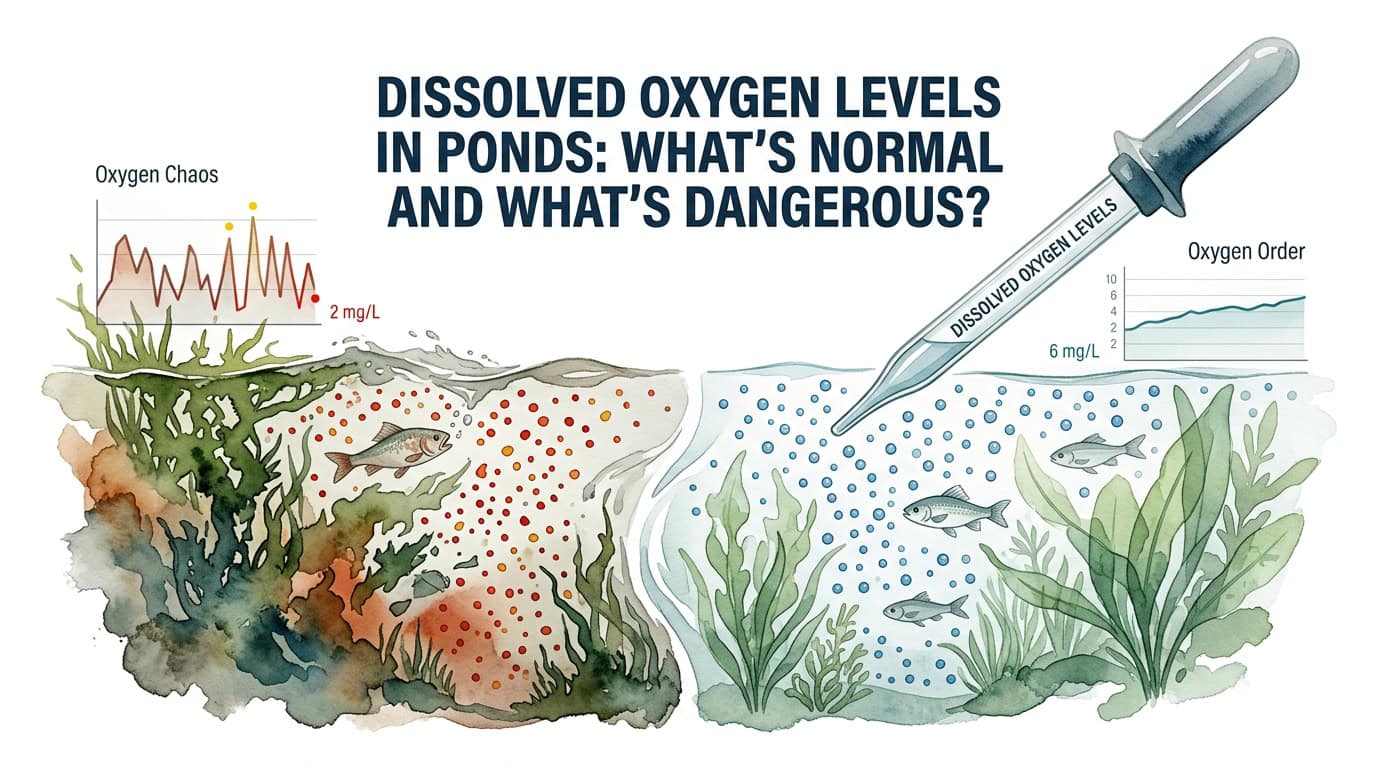
Your pond’s oxygen shouldn’t look like a heart attack. Oxygen levels fluctuate wildly based on plants and heat. If you aren’t monitoring the ‘Chaos’ of the 4 AM crash, you’re risking everything. Managing a pond environment requires more than a visual check of water clarity; it demands an understanding of gas solubility, metabolic rates, and the mechanical efficiency of your aeration systems.
Dissolved oxygen (DO) is the single most critical parameter in any aquatic system. While terrestrial animals have access to an atmosphere containing approximately 210,000 parts per million (ppm) of oxygen, aquatic organisms must survive on a fraction of that, typically between 5 and 10 mg/L. This narrow margin of safety means that even minor fluctuations can lead to physiological stress or mass mortality events.
This guide analyzes the technical mechanics of pond oxygenation. We will examine the diurnal cycle, the physics of gas transfer, and the specific metrics required to maintain what we call Oxygen Order—a stable, high-saturation environment—as opposed to the unpredictable Oxygen Chaos found in unmanaged systems.
Dissolved Oxygen Levels in Ponds: What’s Normal and What’s Dangerous?
Dissolved oxygen is the amount of gaseous oxygen (O2) dissolved in the water. It enters the pond through two primary pathways: atmospheric diffusion at the surface and photosynthesis from aquatic plants and algae. Conversely, it is consumed by fish respiration, bacterial decomposition of organic matter, and the nighttime respiration of those same plants.
In a technical context, we measure DO in milligrams per liter (mg/L) or parts per million (ppm). For most ornamental and aquaculture species, the following thresholds apply:

- 7.0 – 9.0 mg/L: Ideal range. Fish exhibit optimal metabolic activity, high immune response, and efficient feed conversion.
- 5.0 – 6.0 mg/L: Acceptable but sub-optimal. Growth rates begin to slow, and biological filtration efficiency may decrease.
- 3.0 – 4.0 mg/L: Stress zone. Fish may congregate near waterfalls or fountains. Chronic exposure leads to disease susceptibility.
- Below 2.0 mg/L: Critical/Lethal. Mass mortality is imminent, especially for larger specimens with higher metabolic demands.
The “normal” level of oxygen is a moving target because water has a finite capacity to hold gas, a state known as 100% saturation. This capacity is governed by Henry’s Law, which states that the amount of dissolved gas is proportional to its partial pressure in the atmosphere. In practical terms, temperature and altitude are the primary limiters. As water temperature increases, the kinetic energy of water molecules rises, making it harder for oxygen molecules to remain in solution.
A pond at sea level at 40°F (4.4°C) has a 100% saturation point of approximately 12.6 mg/L. If that same pond warms to 80°F (26.7°C), the saturation point drops to 8.0 mg/L. If you are operating at high altitude, such as 5,000 feet, your saturation levels are roughly 18% lower than at sea level due to decreased atmospheric pressure. This physical constraint means that in summer, a pond is often operating at the edge of its biological carrying capacity before the sun even sets.
How the Diurnal Oxygen Cycle Operates
The diurnal cycle is the 24-hour rise and fall of DO levels. It is driven by the interplay between photosynthesis and respiration. During daylight hours, algae and plants produce oxygen at a rate that often exceeds consumption, sometimes leading to “supersaturation” where DO levels exceed 100%. While this might seem beneficial, it is a precursor to the 4 AM crash.
As the sun sets, photosynthesis ceases. However, every living organism in the pond—fish, plants, algae, and billions of nitrifying bacteria—continues to respire. In a pond with a heavy “bloom” of algae or high organic load, this collective respiration creates a massive “oxygen sink.”
The Mechanics of the 4 AM Crash
The lowest point of oxygen concentration typically occurs between 4:00 AM and 6:00 AM, just before dawn. In unmanaged ponds, this is when DO levels can plummet from a daytime high of 12 mg/L to a lethal 1.5 mg/L. This volatility is what defines Oxygen Chaos. Without mechanical aeration to provide a “floor” for these levels, the system rely entirely on the volume of the water and the luck of the weather.
Biochemical Oxygen Demand (BOD)
BOD is a technical measurement of the amount of oxygen consumed by bacteria while breaking down organic matter. High levels of fish waste, decaying leaves, or overfed protein-rich pellets increase the BOD. When the BOD exceeds the rate of oxygen replenishment, the DO level enters a downward spiral. Managing BOD is just as important as adding air; you cannot aerate your way out of a pond filled with six inches of decomposing muck.
Benefits of Maintaining Constant Oxygen Order
Stability is the hallmark of a professionally managed pond. By maintaining Oxygen Order—keeping DO levels consistently above 7.0 mg/L regardless of the time of day—you unlock several mechanical and biological efficiencies.
Enhanced Nitrification: Nitrifying bacteria (Nitrosomonas and Nitrobacter) are aerobic. They require significant amounts of oxygen to convert toxic ammonia into nitrite and then into relatively harmless nitrate. If DO levels drop, the biofiltration process stalls, leading to ammonia spikes that further stress the fish.
Improved Feed Conversion Ratio (FCR): Data from aquaculture studies indicate that fish in high-DO environments digest food more efficiently. When oxygen is plentiful, the metabolic cost of digestion is lower, meaning more of the energy from the food goes into growth and tissue repair rather than basic survival. In low-oxygen environments, fish may stop eating entirely to conserve energy.
Pathogen Suppression: Many opportunistic pathogens, such as certain strains of Aeromonas, thrive in low-oxygen, high-organic environments. Furthermore, a fish’s immune system is an energy-intensive system. Consistent DO levels prevent the “stress-dip” that occurs during the 4 AM crash, keeping the fish’s natural defenses active.
Challenges and Common Mechanical Failures
The most common mistake in pond management is the “daylight-only” aeration strategy. Some operators turn off pumps or aerators at night to save energy or reduce noise. This is mathematically the worst possible time to reduce oxygen input, as it coincides with the peak respiration phase of the diurnal cycle.

Thermal Stratification: In deeper ponds (over 6 feet), water can separate into layers. The top layer (epilimnion) is warm and oxygen-rich, while the bottom layer (hypolimnion) is cold and often anoxic (zero oxygen). If a sudden storm or cold snap causes these layers to flip—a “turnover”—the anoxic water mixes with the surface water, instantly dropping the entire pond’s DO to lethal levels.
Orifice Clogging: Diffused aeration systems rely on small pores to create fine bubbles. Over time, calcium carbonate scaling or biofilm growth can clog these pores. This increases backpressure on the air pump, reducing its lifespan and significantly lowering the Oxygen Transfer Efficiency (OTE). Regular acid dipping of diffusers or replacement of membranes is a required maintenance task.
Limitations of Standard Aeration Methods
Aeration is not a magic fix; it is governed by the laws of physics. Understanding the limitations of different methods is crucial for scaling a system.
The Saturation Ceiling: You cannot easily force more oxygen into water than the saturation point allows using standard air. Since air is only about 21% oxygen, the pressure required to move DO levels above 100% saturation with a standard bubbler is immense and usually impractical for small systems. If your water is 85°F, your maximum DO will be around 7.5 mg/L regardless of how many air stones you add.
Depth Dependency: Diffused aeration is most efficient in deep water. As a bubble rises, the hydrostatic pressure decreases, and the bubble expands. In shallow ponds (less than 3 feet), the “dwell time” of the bubble is too short for significant gas transfer. In these cases, surface agitation or venture-style injectors are often more effective than bottom diffusers.
Oxygen Chaos vs. Oxygen Order
The following table compares the metrics of a pond in a state of chaos versus one managed for order.
| Parameter | Oxygen Chaos (Unmanaged) | Oxygen Order (Technical Management) |
|---|---|---|
| Diurnal DO Swing | 8.0 mg/L or greater | Less than 1.5 mg/L |
| Minimum DO (4 AM) | 2.0 – 3.5 mg/L | 7.0+ mg/L |
| Aeration Strategy | Surface splashing only | Sub-surface fine bubble diffusion |
| BOD Management | Reactive (cleaning when dirty) | Proactive (constant waste removal) |
| System Redundancy | None | Backup air/Oxygen injection |
Practical Tips for Optimizing Oxygen Levels
To move toward a state of Oxygen Order, implement these technical adjustments to your system.
- Monitor Saturation, Not Just mg/L: Use a high-quality DO probe that calculates percent saturation. Aiming for 80-90% saturation accounts for temperature changes automatically, giving you a more accurate picture of the water’s health.
- Strategic Diffuser Placement: Place diffusers in the deepest part of the pond to maximize the bubble-to-water contact time. However, ensure they are not placed directly on the bottom if there is heavy silt, as this will stir up organic matter and increase the BOD. Use a riser or a base plate to keep the diffuser 6-12 inches above the floor.
- Optimize Bubble Size: Smaller bubbles have a much higher surface-area-to-volume ratio. Moving from a coarse stone (6mm bubbles) to a ceramic micro-pore diffuser (1mm bubbles) can increase your Oxygen Transfer Efficiency by over 300%.
- Implement “Night Shift” Aeration: If energy costs are a concern, use a timer to increase aeration intensity from 10 PM to 8 AM. This targets the respiration peak and ensures the 4 AM crash never reaches critical levels.
Advanced Considerations: Oxygen Saturation Technology (OST)
For high-value koi collections or intensive aquaculture, standard air diffusion may be insufficient. Advanced practitioners often look toward Oxygen Saturation Technology or pure oxygen injection. Unlike standard aeration, which uses atmospheric air, these systems use concentrated O2 (often from an oxygen concentrator) and inject it into a pressurized chamber or via nanobubble generators.
Nanobubbles: These are bubbles less than 200 nanometers in diameter. Unlike standard bubbles, nanobubbles do not rise and pop. They remain suspended in the water column for weeks, providing a massive reservoir of available oxygen. They also carry a negative surface charge, which helps in the flocculation of fine suspended solids, improving water clarity as a secondary benefit.
Oxygen Injection and FCR: In professional trout or salmon farming, pure oxygen is used to maintain DO levels at 100% or even 110% saturation. This allows for significantly higher stocking densities and near-perfect feed conversion. While complex to set up, it represents the pinnacle of Oxygen Order.
Example Scenario: The July Heatwave
Consider a 5,000-gallon pond with twenty 20-inch koi. The water temperature is 82°F. At this temperature, 100% saturation is 7.9 mg/L. During the day, an algae bloom pushes DO to 10 mg/L (supersaturation). However, the BOD is high due to the heavy fish load and summer feeding schedule.
Without mechanical intervention, the respiration of the koi and the algae will consume roughly 1.0 mg/L of oxygen per hour starting at sunset. By 3:00 AM, the DO level has dropped to 3.0 mg/L. The koi begin to “pipe” at the surface. By 5:00 AM, the level hits 1.8 mg/L. The largest, most oxygen-hungry fish will be the first to die from hypoxia.
In a managed system, a 60-liter-per-minute air pump running fine-pore diffusers provides an OTE of approximately 2.5 lbs of O2 per horsepower-hour. This mechanical input counteracts the respiration rate, maintaining the “floor” at 6.5 mg/L. Even at the height of the 4 AM crash, the fish remain unstressed and continue their metabolic processes without interruption.
Final Thoughts
Managing dissolved oxygen is an exercise in applied physics and biology. Visual cues like gasping fish are signs of a system that has already failed. True Oxygen Order is achieved by understanding the saturation limits of your water, calculating the biological oxygen demand of your inhabitants, and deploying mechanical systems that maximize transfer efficiency.
Transitioning from Oxygen Chaos to Oxygen Order requires a shift in mindset from aesthetic maintenance to technical optimization. By focusing on data—specifically temperature-corrected saturation levels and the efficiency of your diffusion hardware—you create an environment where aquatic life can thrive rather than just survive.
As you refine your system, consider the integration of automated DO sensors and variable-speed air pumps. These tools allow for real-time adjustments, ensuring that your pond’s oxygen levels remain stable, efficient, and far removed from the unpredictability of a heart attack cycle.