

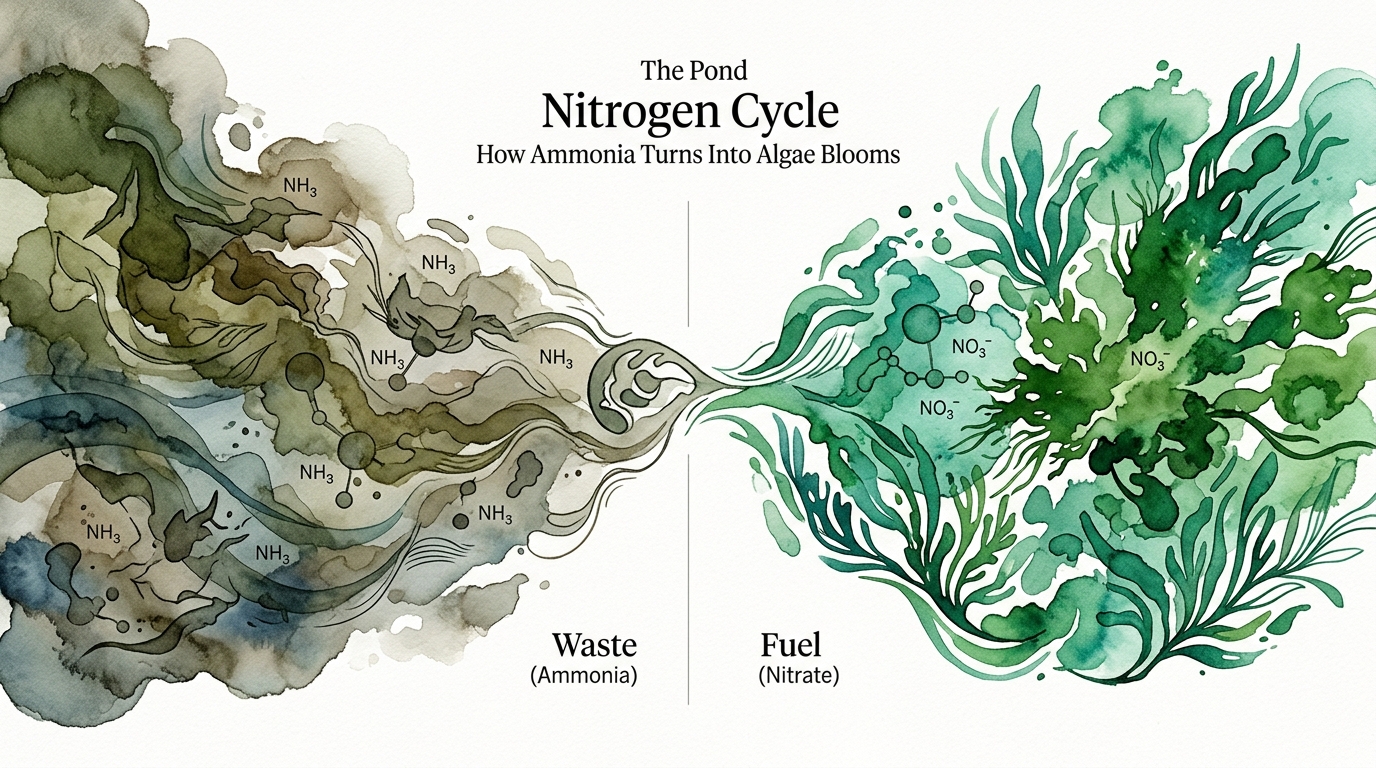
Nitrogen is either your pond’s greatest enemy or its best fuel. Ammonia is a byproduct of life, but left alone, it’s a bloom waiting to happen. Learn how to convert waste into a thriving ecosystem.
Biological management of an aquatic environment requires a precise understanding of the nitrogen cycle. Ammonia, excreted primarily through fish gills and the decomposition of organic matter, serves as the initial substrate for a complex microbial chain. Understanding how to facilitate this conversion is the difference between a stagnant, toxic pool and a self-regulating biological reactor.
This guide provides a technical breakdown of the mechanical and biological processes required to optimize nitrogen conversion. We will examine the specific bacterial agents, stoichiometric requirements, and hardware configurations necessary to achieve a stable equilibrium.
The Pond Nitrogen Cycle: How Ammonia Turns Into Algae Blooms
The nitrogen cycle in a pond is a continuous biochemical process where nitrogenous waste is converted into progressively less toxic forms. Total Ammonia Nitrogen (TAN) exists in two forms: un-ionized ammonia (NH3) and ionized ammonium (NH4+). NH3 is highly lipid-soluble and can pass through fish membranes, causing systemic toxicity, while NH4+ is significantly less harmful.
The ratio of toxic NH3 to non-toxic NH4+ is determined by the water’s pH and temperature. Higher pH levels and higher temperatures shift the equilibrium toward the toxic NH3 form. For instance, at a pH of 8.0 and a temperature of 25°C, approximately 5% of TAN is in the toxic NH3 form. If the pH rises to 9.0 at the same temperature, that percentage jumps to approximately 35%.

Without a functional biological filter, ammonia levels rise until they reach lethal thresholds for fish or fuel an explosion of single-celled algae, commonly known as a “green water” bloom. Algae are opportunistic; they consume ammonia and nitrate as primary fuel sources. While algae provide some nutrient removal, their growth is erratic and can lead to severe dissolved oxygen (DO) crashes during nocturnal respiration. Relying on nitrifying bacteria is a more stable engineering solution for nutrient management.
Mechanics of Nitrification: The Two-Step Biological Conversion
Nitrification is the aerobic oxidation of ammonia into nitrate. This process is carried out by specialized chemoautotrophic bacteria that utilize inorganic nitrogen as an energy source and carbon dioxide as their carbon source.
Stage 1: Ammonia Oxidation
Nitrosomonas species are the primary agents in the first stage. These bacteria oxidize ammonia into nitrite (NO2-). The chemical reaction is expressed as: 2NH4+ + 3O2 ? 2NO2- + 4H+ + 2H2O. This reaction is highly acidifying because it releases hydrogen ions (H+), which consume the system’s alkalinity.
Stage 2: Nitrite Oxidation
Nitrobacter and Nitrospira species perform the second stage, converting nitrite into nitrate (NO3-). The reaction is: 2NO2- + O2 ? 2NO3-. Nitrite is an intermediate toxin that interferes with the ability of fish blood to carry oxygen, a condition known as methemoglobinemia or “brown blood disease.” Efficient stage 2 conversion is critical because nitrites are often more dangerous than ammonia in high-pH environments.
Stoichiometric Requirements: Oxygen and Alkalinity Balance
Successful nitrification is not merely a matter of providing surface area. It is a resource-intensive process that demands specific inputs to maintain metabolic efficiency.
Oxygen Demand
Nitrification is an obligate aerobic process. For every 1 mg of ammonia-nitrogen (NH3-N) oxidized to nitrate-nitrogen (NO3-N), approximately 4.57 mg of dissolved oxygen (DO) is consumed. If DO levels drop below 2.0 mg/L, nitrification rates slow significantly. For optimal performance, DO levels should be maintained at 80% saturation or higher. High fish stocking densities increase the competition for oxygen, making supplemental aeration essential in the bio-chamber.
Alkalinity and pH Buffering
Nitrifying bacteria consume alkalinity as they process nitrogen. Theoretically, 7.14 mg of alkalinity (as CaCO3) is consumed for every 1 mg of ammonia-N oxidized. If the KH (carbonate hardness) of the water is too low, the pH will crash as the bacteria release hydrogen ions. A pH drop below 6.0 will completely inhibit nitrifying activity, leading to a total system failure and ammonia spike. Maintaining a KH level of at least 100-150 ppm ensures the pH remains stable within the 7.0 to 8.5 range preferred by these microbes.
Optimization of Bio-Filtration: SSA and Flow Dynamics
The efficiency of a biological filter is largely determined by its Specific Surface Area (SSA) and the hydraulic loading rate. Since nitrifying bacteria are sessile—meaning they must attach to a surface to grow—the amount of available surface area limits the maximum bacterial population.
Bio-Media Selection
Media is evaluated by its SSA, typically measured in square feet per cubic foot (ft²/ft³).
- Plastic Bio-Balls: SSA 150–300 ft²/ft³. Low risk of clogging but requires large volumes for high-load systems.
- Moving Bed Media (K1/K3): SSA 150–250 ft²/ft³. Self-cleaning and provides excellent oxygen transfer due to constant agitation.
- Ceramic/Sintered Glass: SSA 10,000–90,000 ft²/ft³. Extremely high surface area due to internal pores, but highly susceptible to clogging without rigorous mechanical pre-filtration.
Hydraulic Loading and Retention Time
Water must remain in contact with the media long enough for the bacteria to strip the ammonia. However, flow must also be fast enough to deliver fresh oxygen and nutrients. A common benchmark for koi ponds is a total system turnover rate of once per hour. Within the bio-chamber itself, avoiding “channeling”—where water bypasses the media—is critical. Diffused upflow or trickling designs are generally more efficient than static horizontal flow.
Denitrification: Mechanical Strategies for Nitrate Reduction
Nitrate (NO3) is the end product of nitrification. While it is significantly less toxic than ammonia or nitrite, high concentrations (above 50–100 ppm) can stunt fish growth and fuel filamentous algae (blanket weed).

Nitrogen removal occurs through three primary pathways:
- Water Exchange: The most predictable method. Replacing 10–20% of the pond volume weekly dilutes nitrate concentrations.
- Phytoremediation: Aquatic plants and bog filters consume nitrate as a primary fertilizer. High-growth plants like water hyacinth or anacharis are particularly effective at nutrient sequestration.
- Anoxic Denitrification: This is the biological reduction of nitrate to nitrogen gas (N2), which ??? escapes into the atmosphere. This occurs in oxygen-poor (anoxic) environments where heterotrophic bacteria use nitrate instead of oxygen for respiration.
Engineering an anoxic zone requires careful control. If the environment becomes truly anaerobic (zero oxygen and no nitrate), sulfate-reducing bacteria may produce hydrogen sulfide (H2S), which is highly toxic. Anoxic “plenum” systems or deep gravel beds are methods used to facilitate safe denitrification.
Environmental Variables: Temperature and pH Oscillations
Bacterial metabolic rates are heavily influenced by environmental temperature. Nitrification is most efficient between 25°C and 30°C (77°F–86°F). As temperatures drop, reproduction rates decrease significantly.
- Warm Water: Bacteria double every 15–24 hours. High oxygen demand.
- Cold Water: At temperatures below 10°C (50°F), nitrification efficiency drops by 50% or more. Below 4°C (40°F), the process virtually ceases.
Managing a pond during seasonal transitions requires adjusting feeding rates to match the reduced metabolic capacity of the bio-filter. Feeding high-protein food in early spring before the bacteria have “awakened” is a primary cause of New Pond Syndrome in established systems.
Challenges and Common Pitfalls
Bio-filter failure often results from mechanical or chemical disruptions rather than a lack of bacteria.
Mechanical Clogging
Bio-media that becomes coated in fish waste (fines) loses its functional surface area. The heterotrophic bacteria that break down solid waste grow much faster than nitrifying bacteria and will quickly outcompete them for space and oxygen if the media is not kept clean. Effective mechanical pre-filtration (sieves, drum filters, or brushes) is mandatory to protect the biological stage.
Chemical Inhibition
Many common pond treatments are detrimental to nitrifying colonies. Therapeutic levels of salt (0.3%+) are generally tolerated, but oxidative treatments like potassium permanganate or high doses of chloramine-heavy tap water can “sterilize” the filter. Always bypass the bio-filter or use a dechlorinator when performing large water changes.
New Pond Syndrome
Establishing a robust nitrifying colony takes time. Ammonia-oxidizing bacteria (Stage 1) usually establish within 7–14 days, but nitrite-oxidizing bacteria (Stage 2) can take 3–6 weeks to reach sufficient populations. Monitoring both parameters daily during the “cycling” phase is necessary to prevent livestock loss.
Comparison: Aerobic Nitrification vs. Anoxic Denitrification
The following table compares the two primary biological processes involved in nitrogen management.
| Factor | Aerobic Nitrification | Anoxic Denitrification |
|---|---|---|
| Primary Agent | Autotrophic (Nitrosomonas/Nitrobacter) | Heterotrophic (Pseudomonas, etc.) |
| Oxygen Requirement | High (>2.0 mg/L) | Very Low ( |
| pH Impact | Decreases (Acidifying) | Increases (Alkalizing) |
| End Product | Nitrate (Liquid) | Nitrogen Gas (Atmospheric) |
| Complexity | Standard/Essential | Advanced/Optional |
Practical Tips for System Optimization
Improving the performance of an existing nitrogen cycle involves fine-tuning the inputs and environment.
- Maintain Alkalinity: Test KH regularly. If KH is below 80 ppm, add sodium bicarbonate (baking soda) to buffer the system. 1 cup per 1,000 gallons typically raises KH by approximately 30–50 ppm.
- Increase Turbulence: Ensure the water entering the bio-filter is highly aerated. Use a venturi or air stones directly beneath the media.
- Stagger Cleaning: Never clean all bio-media at once. If you have multiple filter chambers, clean them on alternating weeks using pond water—never chlorinated tap water.
- Monitor TAN: Use a “Total Ammonia” test kit but interpret the results using a pH/Temperature chart. A 1.0 ppm reading at pH 7.0 is manageable; at pH 9.0, it is a crisis.
Advanced Considerations: The Role of Carbon to Nitrogen (C:N) Ratio
In intensive aquaculture and high-end koi keeping, the C:N ratio is a key metric for bio-filter health. Heterotrophic bacteria, which consume organic carbon (sludge/waste), are much more aggressive than autotrophic nitrifiers. If the water has a high organic load (low C:N ratio), the heterotrophs will dominate the biofilm, physically smothering the nitrifiers and reducing ammonia conversion rates.
Advanced practitioners utilize “biofloc” techniques or extremely high-efficiency mechanical filtration to keep the water “lean” of organic carbon, ensuring that the biofilm remains dominated by nitrifying species. This mechanical optimization allows for much higher fish stocking densities and superior water clarity.
Scenario: Sizing a Bio-Reactor for a Koi Pond
Consider a 3,000-gallon pond with 10 adult koi (approx. 20 lbs of fish biomass). If fed 2% of their body weight daily with 40% protein food, they will produce roughly 0.06 lbs (27 grams) of ammonia per day.
To process 27 grams of ammonia, you need a specific amount of surface area. Using a standard moving bed media with a protected SSA of 250 ft²/ft³ and a conservative conversion rate of 0.5 grams of ammonia per square meter of surface area, the calculation requires approximately 10–12 cubic feet of media. Oversizing this by 20% to account for peak summer loads and temperature fluctuations ensures the ammonia and nitrite levels remain at zero.
Final Thoughts
The nitrogen cycle is the fundamental mechanical engine of any pond. Converting ammonia into nitrate is not a passive event but a resource-intensive biological reaction that requires oxygen, alkalinity, and physical surface area. Mastering this cycle involves moving beyond simple water testing and into the realm of system management.
Maintaining a stable nitrifying colony requires consistency. Monitoring the chemical parameters, protecting the media from organic fouling, and ensuring adequate aeration are the primary tasks of the pond keeper. When these variables are balanced, the pond transitions from a maintenance-heavy liability into a self-sustaining ecosystem.
Continued education on water chemistry and microbial ecology will further enhance your ability to troubleshoot issues before they manifest as fish stress or algae blooms. Precise control over the nitrogen cycle is the hallmark of a successful aquatic system.