

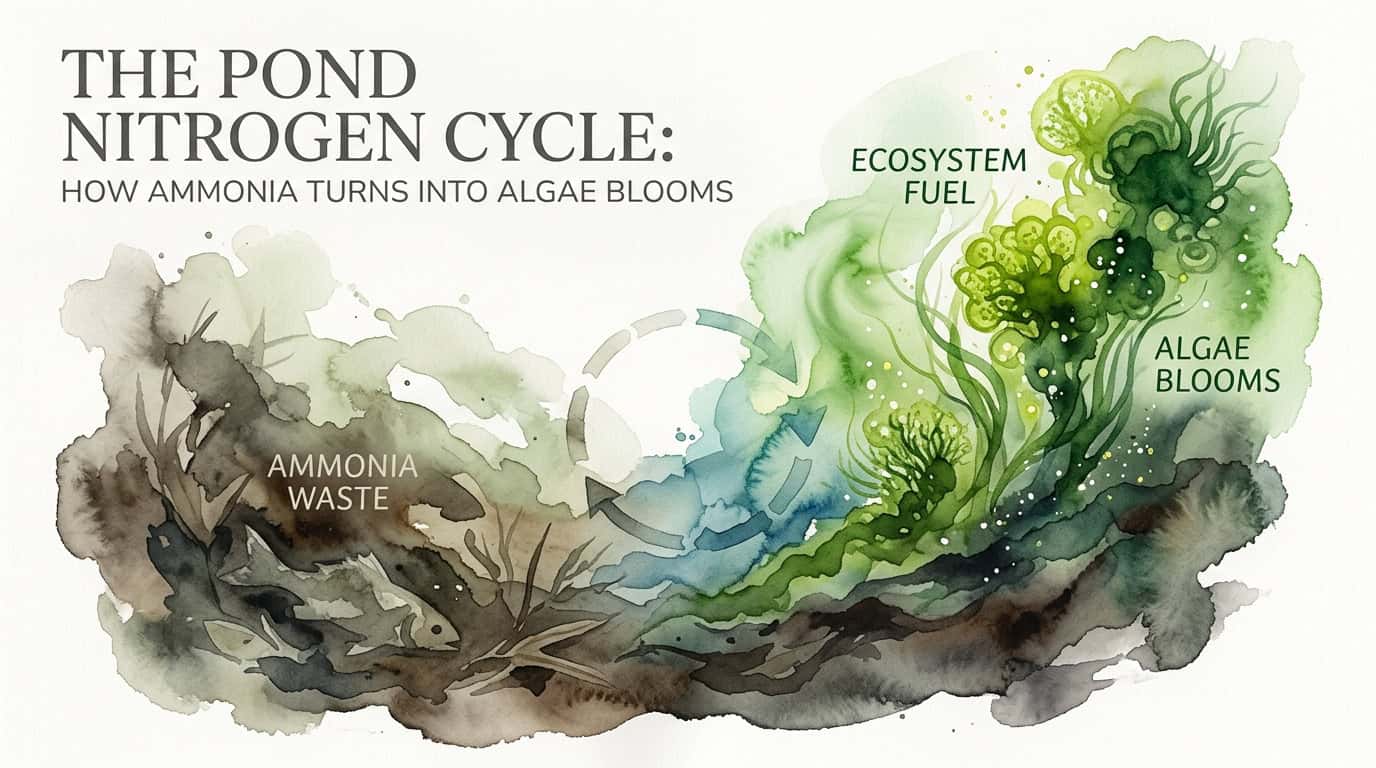
Stop fighting the algae and start feeding the plants. It’s the same fuel. and Ammonia isn’t just waste—it’s a high-octane fertilizer. If you don’t give it ‘good’ plants to grow, nature will choose ‘bad’ algae for you.
Managing a pond ecosystem requires a transition from reactive chemical intervention to proactive nutrient channeling. In a closed aquatic system, nitrogenous compounds are inevitable byproducts of biological activity. Treating these compounds solely as toxins to be removed ignores their utility as the primary energy source for primary producers. A technical understanding of how nitrogen moves through the water column allows for the intentional cultivation of higher plants, which outcompete opportunistic microalgae for resources.
This approach centers on the concept of Ammonia Waste vs Ecosystem Fuel. Instead of deploying mechanical filters and UV clarifiers to kill algae, the focus shifts to maximizing the uptake efficiency of vascular plants and beneficial microbial colonies. Establishing this balance requires precise data on nitrogen loading, pH-dependent toxicity, and the surface-area-to-volume ratios of various biological filters.
The Pond Nitrogen Cycle: How Ammonia Turns Into Algae Blooms
The nitrogen cycle in a pond is a series of biochemical transformations that convert organic waste into various nitrogenous ions. Proteins from fish feed and decaying organic matter contain approximately 16% nitrogen by weight. When fish metabolize these proteins, they excrete the majority of the nitrogen as ammonia ($NH_3$) directly through their gills. Bacteria and fungi also produce ammonia as they decompose solid waste in a process called ammonification.

Total Ammonia Nitrogen (TAN) exists in two forms: un-ionized ammonia ($NH_3$) and ionized ammonium ($NH_4^+$). The ratio between these two forms is governed strictly by the pH and temperature of the water. High-alkalinity environments (pH > 8.0) shift the equilibrium toward the toxic $NH_3$ form, whereas acidic conditions favor the relatively benign $NH_4^+$. For example, a TAN reading of 1.0 mg/L at pH 7.0 and 70°F results in a toxic $NH_3$ concentration of approximately 0.004 mg/L. Increasing the pH to 9.0 at the same temperature raises the $NH_3$ concentration to 0.29 mg/L, which exceeds the lethal threshold for many sensitive aquatic species.
Algae blooms occur when the rate of nitrogen production exceeds the sequestration capacity of the system’s “good” plants. Microalgae have significantly higher surface-area-to-volume (SA:V) ratios compared to macroalgae or vascular plants. This morphological advantage allows microalgae to absorb nutrients much faster per unit of biomass, particularly in the presence of high nitrate levels. Without a dominant population of higher plants to lock up these nutrients, microalgae rapidly multiply, leading to the green water or filamentous mats commonly identified as “algal blooms.”
Mechanisms of Nutrient Competition and Plant Uptake
Vascular aquatic plants, also known as macrophytes, utilize several strategies to dominate the nitrogen supply. Scientific studies indicate that the majority of aquatic plants prefer ammonium ($NH_4^+$) over nitrate ($NO_3^-$) because ammonium requires less metabolic energy to assimilate into plant tissue. In many species, the presence of ammonium at concentrations as low as 0.02 mg/L can actively inhibit the uptake of nitrates.
Floating plants like Eichhornia crassipes (Water Hyacinth) and Lemna minor (Duckweed) are hyperaccumulators of nitrogen. Water Hyacinth can remove up to 2,161 mg of nitrogen per square meter per day under optimal conditions. These plants utilize leaf uptake from the water column rather than relying solely on root systems in the sediment. This direct extraction method makes them formidable competitors against microalgae, which occupy the same niche.
Secondary mechanisms including allelopathy and shading further suppress algal growth. Certain macrophytes release biochemical compounds that inhibit the growth of specific algae species. Simultaneously, large floating leaves reduce the Photosynthetically Active Radiation (PAR) reaching the deeper water layers, effectively starving microalgae of the energy required for photosynthesis. Utilizing these dual-pathway suppression techniques creates a stable environment where the “high-octane fertilizer” of ammonia is channeled exclusively into desirable biomass.
Technical Benefits of Ecosystem-Based Management
Adopting an ecosystem-focused approach provides measurable improvements in water stability and clarity. Biological sequestration of nitrogen reduces the reliance on mechanical filtration, which often fails to address dissolved nutrients. High-efficiency biofilters using media with high Specific Surface Area (SSA)—such as sand (7,836 $m^2/m^3$) or specialized plastic beads—facilitate the nitrification process, converting ammonia into nitrites and then nitrates.

Integrating hyperaccumulating plants into the system provides a physical sink for these nutrients. Periodic harvesting of plant biomass removes the accumulated nitrogen from the ecosystem permanently. This “nutrient export” prevents the eventual recycling of nitrogen that occurs when algae die and decompose within the pond. Systems that employ regular biomass harvesting maintain significantly lower Total Nitrogen (TN) and Total Phosphorus (TP) levels than those relying on chemical algaecides.
Oxygenation is a critical benefit of a well-planted system. During daylight hours, submerged plants contribute dissolved oxygen (DO) to the water column. This elevated DO supports the aerobic bacteria responsible for nitrification. Nitrosomonas and Nitrobacter bacteria require approximately 4.57 grams of oxygen to oxidize 1 gram of ammonia into nitrate. A robust plant population ensures that the oxygen demand of the nitrogen cycle is met without taxing the aeration systems intended for fish.
Challenges and Technical Pitfalls
Seasonal variations represent a major challenge for biological nutrient management. As water temperatures drop in autumn and winter, the metabolic rates of both plants and nitrifying bacteria decrease. Cold-water conditions slow the conversion of ammonia, often leading to elevated TAN levels. Since fish immune systems are often suppressed at lower temperatures, even moderate ammonia spikes during winter can be catastrophic.
Oxygen depletion during the nocturnal period or after an “algae crash” is another frequent error in system design. While plants produce oxygen during the day, they consume it via respiration at night. In overly dense planted environments, the combined respiration of plants, fish, and bacteria can drive DO levels below 3.0 mg/L, causing acute stress. Decomposing organic matter from dead algae or unharvested plants further exacerbates this problem by increasing the Biochemical Oxygen Demand (BOD).
Nutrient lock-in occurs when certain trace elements become unavailable, halting the growth of macrophytes despite high nitrogen levels. If a pond is deficient in iron or potassium, the “good” plants will stop growing, leaving the remaining nitrogen to be consumed by less-demanding algae species. This requires careful monitoring of the Redfield Ratio (C:N:P), which in freshwater systems often aligns closer to 141:22:1 or 166:20:1. Ensuring that phosphorus and carbon are available in the correct proportions is essential for maintaining nitrogen uptake efficiency.
Limitations of Biological Nutrient Management
Oversaturation of the nitrogen load limits the effectiveness of phytoremediation in certain scenarios. In high-density aquaculture or overstocked decorative ponds, the daily ammonia excretion rate may exceed the maximum uptake velocity ($V_m$) of the available plant biomass. When the system reaches this saturation point, excess nitrogen will inevitably fuel algae blooms regardless of plant presence.
Extreme environmental variables can also inhibit biological function. Ponds with very low carbonate hardness (KH Ecosystem Fuel vs. Mechanical Waste Management
The choice between mechanical and biological management involves trade-offs in complexity, cost, and long-term stability.
| Factor | Mechanical / Chemical Approach | Ecosystem Fuel Approach |
|---|---|---|
| Nutrient Handling | Physical removal of solids; UV sterilization of algae. | Biological sequestration and plant biomass export. |
| Energy Requirement | High (pumps, UV lights, pressurized filters). | Low (natural sunlight, optimized aeration). |
| System Stability | Prone to sudden spikes if equipment fails. | Self-buffering; high ecological resilience. |
| Main Labor Task | Filter cleaning and backwashing. | Plant thinning and biomass harvesting. |
| Chemical Use | Frequent use of algaecides and binders. | Minimal; focused on mineral balance. |
Practical Tips for Optimizing Nitrogen Sequestration
Focusing on species diversity improves the resilience of the nutrient-uptake network. Utilizing a combination of floating, submerged, and emergent plants ensures that nitrogen is being extracted from different depths and across various environmental conditions. Anacharis (Elodea) is highly effective for increasing the surface area for nitrifying bacteria, while Water Lettuce and Duckweed focus on rapid ammonia extraction from the surface.
Maintaining a plant coverage of approximately 60–70% of the pond surface is a standard metric for effective algae suppression. This coverage provides sufficient shading to inhibit microalgae while leaving enough open water for gas exchange. For the best results, install plants in “zones” where water flow is highest, such as near the outlet of a waterfall or filter return. This ensures a constant supply of nitrogen-rich water passes through the root zones and leaf surfaces.
Implementing supplemental aeration is non-negotiable in highly productive systems. While plants contribute oxygen, the risk of nocturnal hypoxia remains. The use of bottom-diffused aeration systems ensures that DO levels remain high throughout the entire water column, supporting both the fish and the aerobic bacteria in the biofilter. Aim for a DO level above 6.0 mg/L at all times to maximize nitrification rates.
Advanced Considerations: Kinetics and Equilibrium
Serious practitioners should understand the Michaelis-Menten kinetics of nutrient uptake. The rate of nitrogen absorption is described by the equation $V = V_m [S] / (K_s + [S])$, where $V$ is the uptake rate, $V_m$ is the maximum rate, $[S]$ is the nutrient concentration, and $K_s$ is the half-saturation constant. Plants with a low $K_s$ have a high affinity for nutrients and can outcompete others at low concentrations. This data helps in selecting species for specific water conditions.
The relationship between TAN and pH is logarithmic. Implementing a CO2-driven pH control system can manage ammonia toxicity more effectively than simple water changes. During the day, photosynthesis consumes $CO_2$, which typically causes pH to rise. If the pH rises too high, the toxicity of the existing TAN increases tenfold for every unit increase. Managing this “diurnal pH swing” through carbonate buffering or controlled aeration prevents the system from entering the danger zone for un-ionized ammonia.
Dissolved Organic Carbon (DOC) also influences the efficiency of the nitrogen cycle. High levels of DOC can coat biofilter media, reducing the available surface area for nitrifying bacteria and promoting the growth of heterotrophic bacteria instead. Heterotrophs grow much faster than nitrifiers and can “smother” the biofilter if the system has high levels of sludge or uneaten food. Maintaining a clean substrate and efficient mechanical pre-filtration is essential to keep the biological filter focused on nitrogen conversion.
Example Calculation: Nitrogen Loading and Plant Sequestration
To illustrate the application of these principles, consider a 1,000-gallon pond with a stock of 10 koi, each weighing approximately 1 kilogram. If the fish are fed 20 grams of a 40% protein feed daily, the nitrogen input can be calculated. Protein is roughly 16% nitrogen, meaning 40% protein feed contains 0.064 grams of nitrogen per gram of feed.
A daily feeding of 20 grams introduces 1.28 grams of nitrogen into the system. Approximately 75% of this nitrogen (0.96 grams) will be excreted as ammonia into the water. To sequester this 0.96 grams of nitrogen, we can look at the uptake rates of Eichhornia crassipes. With an average uptake of 1,500 mg (1.5 grams) of nitrogen per square meter per day, the system requires approximately 0.64 square meters (roughly 7 square feet) of healthy Water Hyacinth coverage to neutralize the daily nitrogen input.
This calculation demonstrates that even a relatively small area of highly efficient plants can handle the metabolic waste of a moderately stocked pond. If the plant area is smaller than this requirement, the remaining nitrogen will accumulate as nitrate or trigger an algae bloom. Adjusting the feeding rate or increasing the plant biomass allows the manager to maintain a zero-sum nitrogen balance.
Final Thoughts
Mastering the pond ecosystem requires looking beyond the superficial “problem” of algae and addressing the underlying chemical drivers. Treating ammonia as a high-octane fertilizer rather than a waste product allows for the design of systems that are more resilient, clearer, and ecologically balanced. The transition from mechanical reliance to biological optimization is a data-driven process that depends on understanding nutrient kinetics and chemical equilibrium.
Implementing these technical strategies—such as maximizing specific surface area, managing the TAN-pH relationship, and calculating nitrogen loading—provides the tools necessary for precise control. Practitioners who embrace this approach will find that the system begins to manage itself, with plants and bacteria doing the heavy lifting of nutrient processing. The result is a stable, self-sustaining environment where the fuel of the ecosystem is channeled into growth, not green water.