

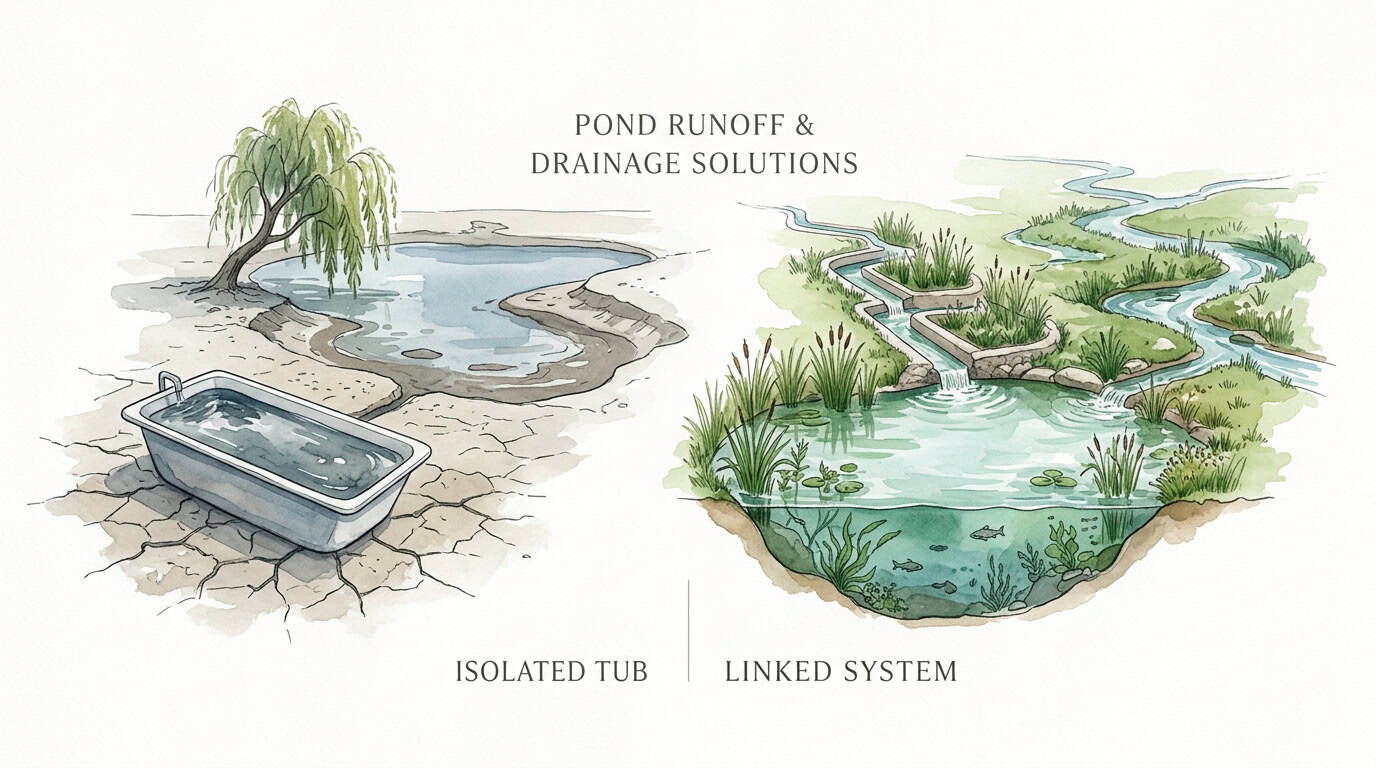
When the spring rains come, is your pond a source of erosion or the heart of a garden irrigation system? A pond should never be an island. When you integrate your pond’s overflow with a rain garden, you turn a potential erosion disaster into a self-watering paradise. Here is how to map your garden’s hydrology for a maintenance-free spring.
Integrating a pond with a rain garden requires a shift from viewing water as a waste product to treating it as a pressurized resource. Modern stormwater management emphasizes the “slow it down, spread it out, soak it in” principle. This approach replaces high-velocity discharge with controlled infiltration.
The following technical guide outlines the mechanics of pond runoff, sizing calculations for infiltration basins, and the integration of hydraulic systems to optimize residential water cycles.
Pond Runoff And Drainage Solutions
Pond runoff and drainage solutions refer to the engineered systems designed to manage excess water volume once a pond reaches its maximum storage capacity. In a standard pond setup, water levels are maintained at a “normal pool” elevation. When precipitation exceeds the evaporation and infiltration rates, the pond must discharge this excess to maintain structural integrity.

Traditional systems often rely on a single outlet that dumps water into a storm drain or onto a lawn. This creates a point-source discharge, which often leads to localized soil saturation and channel erosion. Integrated drainage solutions, however, link the pond’s overflow to a secondary infiltration area, such as a rain garden or a bioswale.
This integration serves as a mechanical buffer. The pond acts as the initial retention basin, capturing sediment and heavy debris. The rain garden acts as a polishing filter and infiltration zone. This two-stage system is used in civil engineering for large-scale developments but is increasingly applied in high-efficiency residential landscaping to manage peak flow rates during 10-year and 24-hour storm events.
The Mechanics of Integrated Overflow Systems
The primary objective of an overflow system is to move water from the pond to the rain garden without causing scouring or hydraulic bypass. This is achieved through three main mechanical configurations: standpipes, siphons, and spillways.
Standpipes are vertical conduits installed within the pond. When the water level reaches the top of the pipe, gravity forces the excess into the pipe and through a horizontal lead to the discharge point. To prevent clogging, these are often fitted with trash racks or vortex-preventing hoods.
Siphon systems utilize an inverted “V” or “U” shaped pipe that passes through the pond embankment. Siphons are particularly efficient because they can draw water from the cooler, nutrient-rich bottom layers of the pond. Siphoning action begins when the water level seals the air vent on the intake side. Once the pipe is fully primed, it moves water at a much higher velocity than a standard gravity pipe, allowing for a smaller pipe diameter to handle the same volume.
Auxiliary or emergency spillways are wide, shallow channels lined with riprap or reinforced turf. These are designed to handle extreme weather events where the primary pipe system is overwhelmed. In an integrated system, the primary pipe feeds the rain garden, while the emergency spillway serves as a secondary path to a safe exit point.

Sizing Calculations for Infiltration Efficiency
Sizing a rain garden to handle pond overflow requires calculating the catchment area and the expected runoff volume. A common mistake is sizing the garden based only on the pond’s surface area. Instead, calculations must include the entire “impervious surface” area that feeds into the pond, such as rooftops, driveways, and the pond surface itself.
A standard engineering rule is the 10/20 rule. For a rain garden with a 3-inch ponding depth, the surface area of the garden should be approximately 10% of the impervious area being treated. If the garden is 6 inches deep, this can be reduced to 5%. In regions with heavy clay soils (Hydrologic Soil Group D), these sizes must be increased to allow for slower infiltration rates.
The hydraulic conductivity (Ksat) of the soil determines how fast the water disappears. A perc test is mandatory. Dig a hole 12 inches deep, fill it with water, and measure the drop over 24 hours. If the water remains after 48 hours, the soil is unsuitable for a standard rain garden without significant amendments like sand and compost to increase pore space.
Benefits of Linked Hydrological Systems
Linking a pond to a rain garden provides measurable improvements in water quality and site stability. While an isolated pond may suffer from stagnant edges during low-flow periods, a linked system ensures constant water movement during rain events.
Nutrient sequestration is a primary benefit. Pond water often contains high levels of nitrogen and phosphorus from fish waste or decaying organic matter. By routing this “waste” water through a rain garden, these nutrients are captured by the root systems of hydrophilous (water-loving) plants, preventing them from entering the local watershed where they could cause algae blooms.
Erosion control is another advantage. By distributing the overflow across a wide, shallow basin rather than a narrow pipe exit, the kinetic energy of the water is dissipated. This protects the soil structure and prevents the formation of rills and gullies. Furthermore, these systems contribute to groundwater recharge, which stabilizes the local water table and supports the surrounding vegetation during dry spells.
Challenges and Technical Pitfalls
The most frequent challenge in pond drainage integration is sedimentation. As water moves from the pond to the rain garden, it carries fine silt and organic particles. Over time, these particles can clog the pores of the rain garden soil, significantly reducing the infiltration rate. To mitigate this, a “pretreatment” zone or a sediment forebay is recommended at the intake point of the rain garden.
Hydraulic bypass occurs when the inflow rate into the rain garden exceeds the soil’s infiltration capacity and the basin’s storage volume. If the overflow pipe is too large or the rain garden too small, the garden will simply fill and spill over immediately, defeating its purpose. Precision in pipe sizing—ensuring the pipe matches the 1-year storm flow—is critical.
Vegetation management is a continuous requirement. While plants are necessary for bioretention, invasive species or overgrowth can block the inflow and outflow points. Regular inspection of the “control structures” (the points where the water enters and leaves the system) is necessary to ensure they remain clear of debris and root blockages.
Limitations and Environmental Constraints
Integrated pond and rain garden systems are not suitable for every site. Topography is the primary constraint. These systems rely on gravity; the rain garden must be at a lower elevation than the pond overflow point. On flat sites, this requires significant excavation, which may be cost-prohibitive.
Slopes exceeding 12% present a risk of slope failure or rapid erosion. On steep sites, the water gains too much velocity, and the rain garden may act as a catalyst for a landslide if not properly engineered with check dams or terracing.
Soil type also dictates feasibility. In areas with a high water table (within 2 feet of the surface), a rain garden will remain permanently saturated. This prevents the “aerobic” processes necessary for nutrient filtration and can lead to anaerobic soil conditions, which produce hydrogen sulfide gas and kill most terrestrial plants. In these scenarios, a constructed wetland or a “wet pond” extension is a more viable alternative to a dry infiltration basin.
Isolated Tub vs. Linked System Comparison
| Factor | Isolated Pond (Isolated Tub) | Integrated System (Linked) |
|---|---|---|
| Water Efficiency | Low; excess is lost to storm drains. | High; excess is reused for irrigation. |
| Erosion Risk | High at the point of discharge. | Low; energy is dissipated across the garden. |
| Maintenance | Low frequency, but higher repair costs. | Moderate frequency (weeding/sediment removal). |
| Filtration | Minimal; discharges unfiltered water. | High; bioretention removes up to 90% of pollutants. |
| Initial Cost | Lower; simpler plumbing. | Higher; requires excavation and plants. |
Practical Tips for System Optimization
Optimizing an integrated system requires attention to the physical interface between the pond and the garden. Use a 4-inch or 6-inch PVC pipe for the overflow to ensure it can handle sudden surges. Corrugated black pipe is prone to clogging and is difficult to clean; smooth-bore PVC is the professional standard.
Planting should follow the “moisture gradient” of the basin. The center of the rain garden, which stays wet the longest, should be planted with obligate wetland species like Juncus (rushes) or Carex (sedges). The slopes of the basin can handle facultative species that tolerate both wet and dry conditions, while the berm should be planted with drought-tolerant species to stabilize the soil.
Apply a 2-to-3-inch layer of hardwood mulch to the rain garden. Unlike pine bark, hardwood mulch is heavy and will not float away during a heavy rain event. Mulch is essential for maintaining soil moisture and preventing the surface from “crusting,” which blocks infiltration.
Advanced Considerations in Hydrology Mapping
For serious practitioners, integrating smart technology can significantly increase efficiency. Soil moisture sensors installed in the rain garden can be linked to automated valves on the pond’s drainage line. This allows for “active” management, where the pond is only drained into the garden when the soil has the capacity to absorb it.
Variable Rate Irrigation (VRI) principles can be applied by using a series of smaller, linked rain gardens (a “train”). This allows the first garden to handle the most polluted “first flush” of runoff, while the subsequent gardens handle the cleaner, high-volume flow. This tiered approach extends the life of the system by concentrating sediment in a single, easy-to-clean area.
Calculating the “Time of Concentration” (Tc) is an advanced metric that helps prevent flooding. Tc is the time it takes for water to travel from the furthest point in the catchment area to the rain garden. Matching the pond’s discharge rate to the rain garden’s Tc ensures the system never reaches a “bottleneck” where water backs up into the pond.
Example Scenario: Sizing for a 500-Square-Foot Roof
Consider a property with a 500-square-foot roof section draining into a 1,000-gallon pond. During a 1-inch rain event, that roof produces approximately 311 gallons of water. If the pond is already at its normal pool level, all 311 gallons must be discharged into the rain garden.
If the soil is a silty loam with an infiltration rate of 0.5 inches per hour, a 6-inch deep rain garden is chosen. Using the 5% rule for a 6-inch depth, the rain garden needs to be 25 square feet (500 x 0.05). However, to provide a safety factor for back-to-back storms, a 35-square-foot garden would be more resilient.

The overflow pipe should be set exactly at the desired water line of the pond. A 4-inch pipe can handle approximately 50 gallons per minute at a 1% slope, which far exceeds the flow from a 500-square-foot roof, ensuring the pond level remains stable even during a cloudburst.
Final Thoughts
Designing a pond to work in tandem with a rain garden transforms a static water feature into a dynamic hydrological system. This approach mimics natural watershed processes, providing a mechanical solution to the common problems of erosion, nutrient buildup, and water waste. By calculating the specific hydraulic needs of your site and selecting the appropriate overflow mechanics, you create a garden that manages itself during the most volatile weather.
Success in this integration depends on accurate data—specifically percolation rates and catchment volumes. While the initial investment in excavation and plumbing is higher than a standard pond installation, the long-term reduction in maintenance and the increase in garden health provide a high return on investment.
Experimenting with different plant species and monitor the infiltration performance over several seasons. As the root systems of your rain garden mature, the infiltration capacity of the soil will actually improve, making the system more efficient over time. This is the hallmark of a well-engineered, linked hydrological system.