

Pond Talk is an Amazon Associate. As an Amazon Associate we earn from qualifying purchases.
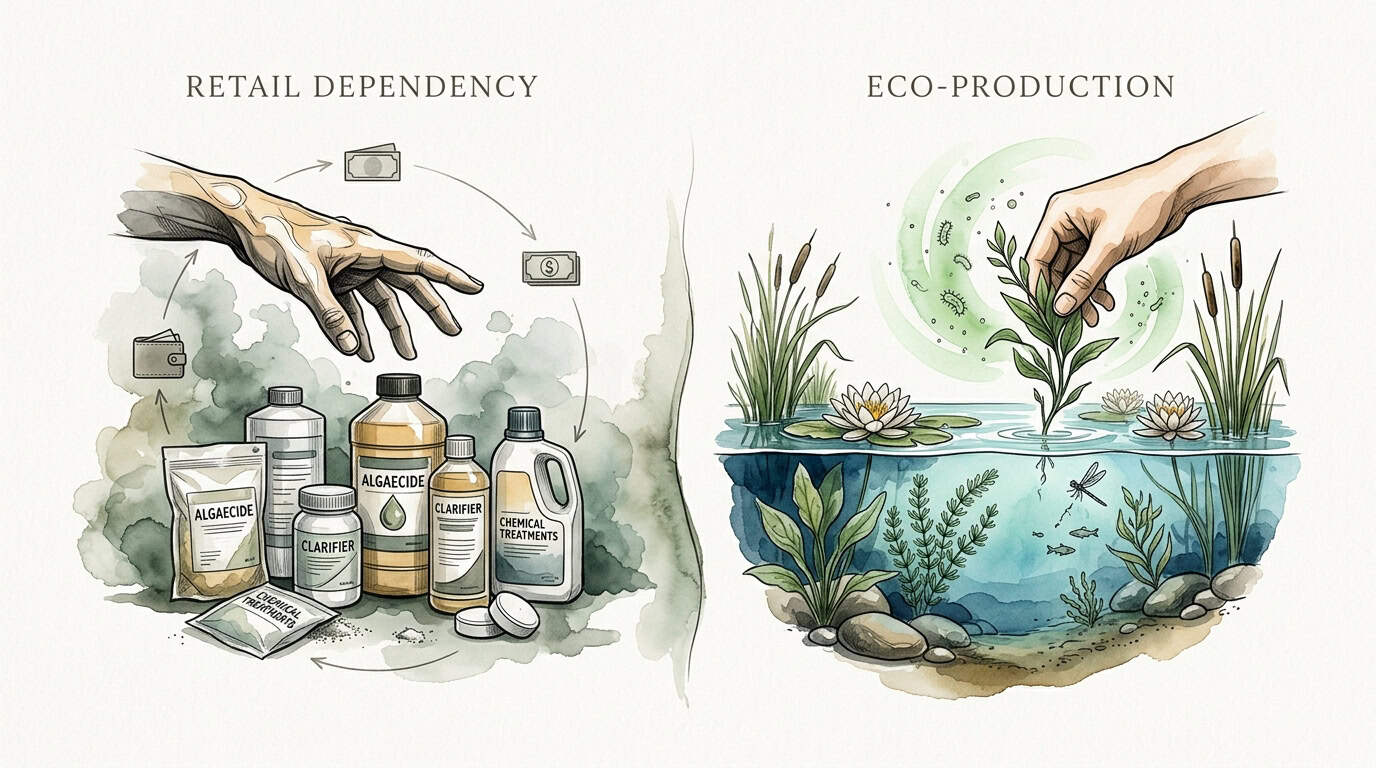
The moment you stop being a customer for clear water, you become the producer of a thriving ecosystem. Retail solutions want you to come back every month. A producer-mindset pond owner creates a system that generates its own clarity and even exports valuable biomass for the garden. It’s time to shift from consuming solutions to producing results.
Managing a pond often feels like a constant battle against nature. Most owners spend years purchasing bottled bacteria, algaecides, and expensive replacement filter cartridges. This cycle creates a dependency on external inputs that mask symptoms rather than addressing the underlying biological mechanics. When you transition to an ecosystem production model, you stop fighting natural processes and start optimizing them. This guide provides the technical framework required to engineer a self-sustaining aquatic system.
Producing Clean Pond Water Naturally
Natural water production is the process of utilizing biological and mechanical cycles to maintain water chemistry within specific parameters without synthetic intervention. This approach treats the pond as a bioreactor. In a typical retail-driven setup, clarity is achieved through sterilization or chemical binding. In a production-based setup, clarity is a byproduct of efficient nutrient cycling and microbial activity.

Biological filtration serves as the engine of this system. It exists wherever surface area and oxygenated water meet. In the wild, this happens in stream beds, wetlands, and the upper layers of soil. In a managed pond, we concentrate these natural processes into smaller, high-efficiency zones. This allows a closed-loop system to handle higher fish loads and organic inputs than a standard body of water of the same volume.
Real-world applications of these principles range from small backyard koi ponds to massive aquaculture facilities and wastewater treatment plants. The fundamental physics remain the same regardless of scale. The goal is to convert ammonia, which is toxic to aquatic life, into nitrite and then into nitrate. Nitrate is then either removed through water changes or, more efficiently, consumed by aquatic plants and harvested as biomass.
Mechanics of Ecosystem Engineering
Creating a self-cleaning system requires a deep understanding of the nitrogen cycle and hydraulic efficiency. Every component must be sized according to the biological load of the system. The process begins with mechanical separation and ends with nutrient sequestration.
The Nitrogen Cycle as a Mechanical Process
Nitrogen enters the system primarily through fish food and decaying organic matter. This protein breaks down into ammonia (NH3/NH4+). Specialized aerobic bacteria, specifically Nitrosomonas, oxidize ammonia into nitrite (NO2-). Nitrite is equally toxic to fish and must be further oxidized by Nitrobacter and Nitrospira into nitrate (NO3-).
Nitrate is significantly less toxic but acts as a primary fuel source for algae. A production-minded owner views nitrate not as a waste product to be diluted, but as a resource to be harvested. High nitrate levels indicate that the biological filter is working, but the nutrient export phase is failing.
Mechanical Separation Strategies
Mechanical filtration must occur before biological filtration to prevent the “blinding” of bio-media. Blinding happens when solid waste coats the surface of the media, depriving the beneficial bacteria of oxygen. Effective mechanical separation includes:
- Settlement Chambers: These use gravity to allow heavy solids to drop out of the water column before reaching the pump.
- Sieve Filters: These utilize a fine stainless steel mesh to mechanically remove particles as small as 200 microns.
- Skimmers: These remove floating debris, such as leaves and pollen, before they sink and begin the decomposition process.
Bio-Media Optimization
The efficiency of a biological filter is determined by its Specific Surface Area (SSA). SSA is measured in square feet of surface area per cubic foot of volume. High-performance media, such as fluidized K1 or specialized ceramic blocks, provide thousands of square feet of space for bacterial colonies to thrive.
Oxygen levels are the limiting factor for these bacteria. Total ammonia nitrogen (TAN) removal rates drop significantly when dissolved oxygen levels fall below 5.0 mg/L. Ensuring high turbulence or air injection within the filter chamber maximizes the metabolic rate of the nitrifying bacteria.
Benefits of Natural Eco-Production
Shifting to an eco-production model offers measurable advantages in terms of stability and cost-efficiency. While the initial setup requires more technical planning, the long-term operational metrics are superior to retail-heavy methods.
Stability is the primary technical benefit. Chemical interventions create “yo-yo” water chemistry, where pH and oxygen levels fluctuate wildly as the system reacts to additives. A balanced ecosystem maintains steady parameters. This reduces stress on the livestock and prevents the opportunistic outbreaks of parasites or pathogens that thrive in unstable environments.
Operational costs decrease over time. Once the biological colonies are established and the plant biomass is mature, the need for bottled supplements vanishes. The primary costs shift from recurring chemical purchases to simple electricity for water circulation and occasional mechanical maintenance.

Environmental impact is also minimized. Water discharged from a naturally balanced pond is rich in nitrates and phosphates, making it an excellent fertilizer for terrestrial gardens. Instead of dumping chemically treated water into the sewer, you are exporting liquid gold for your landscape.
Common Engineering Mistakes
Many pond owners fail to achieve clarity because of fundamental design flaws. These errors often stem from a misunderstanding of how bacteria and water move through a system.
One frequent mistake is the “undersized filter syndrome.” Retail filter ratings are often based on “ideal conditions” with zero fish load. A producer knows that the filter must be sized for the maximum anticipated feeding rate, not the water volume alone. If the surface area of the media cannot support enough bacteria to process the daily ammonia spike, the water will never be truly clean.
Inadequate flow dynamics also cause system failure. Dead zones, where water stagnates, allow anaerobic bacteria to produce hydrogen sulfide. This gas is toxic and can cause sudden fish mortality. A well-engineered pond ensures that the entire volume of water is turned over through the filtration system at least once per hour.
Over-cleaning the biological media is another critical error. Scrubbing bio-media with chlorinated tap water kills the very bacteria that keep the pond alive. Maintenance should focus on removing solid waste from the mechanical stage while leaving the bio-film on the media undisturbed.
Limitations and Environmental Constraints
While natural production is highly effective, it is not a magic solution for every scenario. Certain constraints can limit the effectiveness of biological systems.
Extreme temperatures affect bacterial metabolism. Nitrifying bacteria become sluggish as water temperatures drop below 50°F (10°C) and virtually stop functioning near freezing. In cold climates, the system’s capacity to process waste diminishes in winter, requiring a significant reduction in fish feeding.
Space is a physical limitation. A robust phyto-filter (plant filter) or bog filter requires significant surface area—often 10% to 30% of the pond’s total surface area. In small urban lots, finding the space for a large enough biological zone can be challenging. Without sufficient plant biomass, the system must rely more heavily on frequent water changes to export nitrates.
Heavy metal accumulation or high baseline mineral content in source water can also complicate matters. If the tap water used for top-offs is exceptionally high in phosphates or silicates, even the most efficient biological filter may struggle to prevent persistent algae blooms.
Comparing Retail Dependency vs. Eco-Production
The following table breaks down the fundamental differences between a consumer-based approach and a producer-based approach.
| Feature | Retail-Centric (Consumer) | Eco-Production (Producer) |
|---|---|---|
| Primary Clarity Tool | UV Sterilizers & Algaecides | Bio-filtration & Phyto-sequestration |
| Nutrient Management | Chemical Binding Agents | Biomass Harvesting (Plants) |
| Maintenance Focus | Replacing Cartridges/Adding Liquids | Managing Flow & Thinning Plants |
| System Resilience | Low (Crashes if power fails) | High (Biological buffers exist) |
| Long-Term Cost | High (Recurring purchases) | Low (Initial CAPEX, minimal OPEX) |
Best Practices for System Optimization
Optimizing a pond for natural production requires attention to detail and consistent monitoring. Follow these technical guidelines to maximize system efficiency.
Regularly test for KH (Carbonate Hardness). Nitrifying bacteria consume carbonates as they process ammonia. If the KH drops too low, the pH will crash, and the biological filter will fail. Maintaining a KH level of at least 100-150 ppm ensures the system has enough “fuel” to keep the nitrogen cycle running smoothly.
Implement a staggered planting strategy. Use a variety of plants, including submerged oxygenators, floating plants, and marginals. Different plants have different nutrient uptake rates and peak growing seasons. This diversity ensures that nutrient sequestration happens from early spring through late autumn.
Monitor the flow rate through the bio-filter. Water must stay in contact with the media long enough for the bacteria to act, a concept known as “dwell time.” However, the flow must be fast enough to deliver a constant supply of oxygen and nutrients. A common benchmark is a 2-to-5-minute dwell time within the filter chamber.
Advanced Considerations: Redox and DOC
For the serious practitioner, understanding Redox potential and Dissolved Organic Carbon (DOC) is essential. These metrics provide a deeper look into the “cleanliness” of the water at a molecular level.
Redox potential, or ORP (Oxidation-Reduction Potential), measures the water’s ability to cleanse itself. A high ORP indicates that there is plenty of oxygen available to break down organic waste. If the ORP drops, it suggests that the system is overloaded with decaying matter, often referred to as “mulm.” Increasing aeration or improving mechanical filtration will usually raise the ORP.
Dissolved Organic Carbon (DOC) is the “tea-colored” tint that water sometimes develops. These are tannins and organic acids that are too small for mechanical filters to catch. While not always toxic, high DOC levels can inhibit bacterial growth and reduce light penetration for plants. Utilizing a protein skimmer or small amounts of activated carbon can manage DOC levels without disrupting the biological balance.
Scenario: The 2,000-Gallon Managed Ecosystem
Consider a 2,000-gallon pond with a moderate load of 10 large koi. To move this system into a production mindset, we calculate the requirements based on daily inputs.
If the fish are fed 100 grams of 40% protein food daily, they will produce approximately 3.2 grams of Total Ammonia Nitrogen. To process this, the biological filter requires a minimum of 150 square feet of active surface area. Using a media like K1 (which has roughly 250 sq ft of SSA per cubic foot), you would need at least 0.6 cubic feet of media. However, to account for safety margins and peak loads, an experienced producer would likely use 2.0 cubic feet.
The pump should be rated for a minimum of 2,500 GPH at the required head height to ensure the entire pond volume passes through the filter every 48 minutes. A 400-gallon bog filter or “veggie filter” would be attached to the return line. This bog would be packed with fast-growing plants like Water Iris or Pickerel Rush. Every month, the owner harvests 5 pounds of excess plant growth, effectively removing the nitrogen that the bacteria converted from the fish food.
Final Thoughts
Transitioning from a consumer of pond products to a producer of clean water is a fundamental shift in perspective. It requires moving away from “quick fix” chemicals and toward a deeper understanding of biological systems. By engineering the environment to support microbial and botanical growth, you create a system that is more resilient, more affordable, and more rewarding to manage.
The keys to success are mechanical efficiency, adequate surface area for bacteria, and consistent nutrient export through plant harvesting. When these elements are in balance, the pond ceases to be a chore and becomes a self-regulating asset. Clarity is no longer something you buy at a store; it is something your ecosystem produces every day.
Experiment with your system’s flow rates and plant varieties. Observe how the water reacts to changes in feeding and temperature. As you master these variables, you will find that nature is a far more efficient water purifier than any bottled solution. Apply these principles, and you will eventually find that your biggest challenge isn’t keeping the water clear, but managing the massive amount of healthy plant growth your system generates.
Amazon and the Amazon logo are trademarks of Amazon.com, Inc, or its affiliates.