

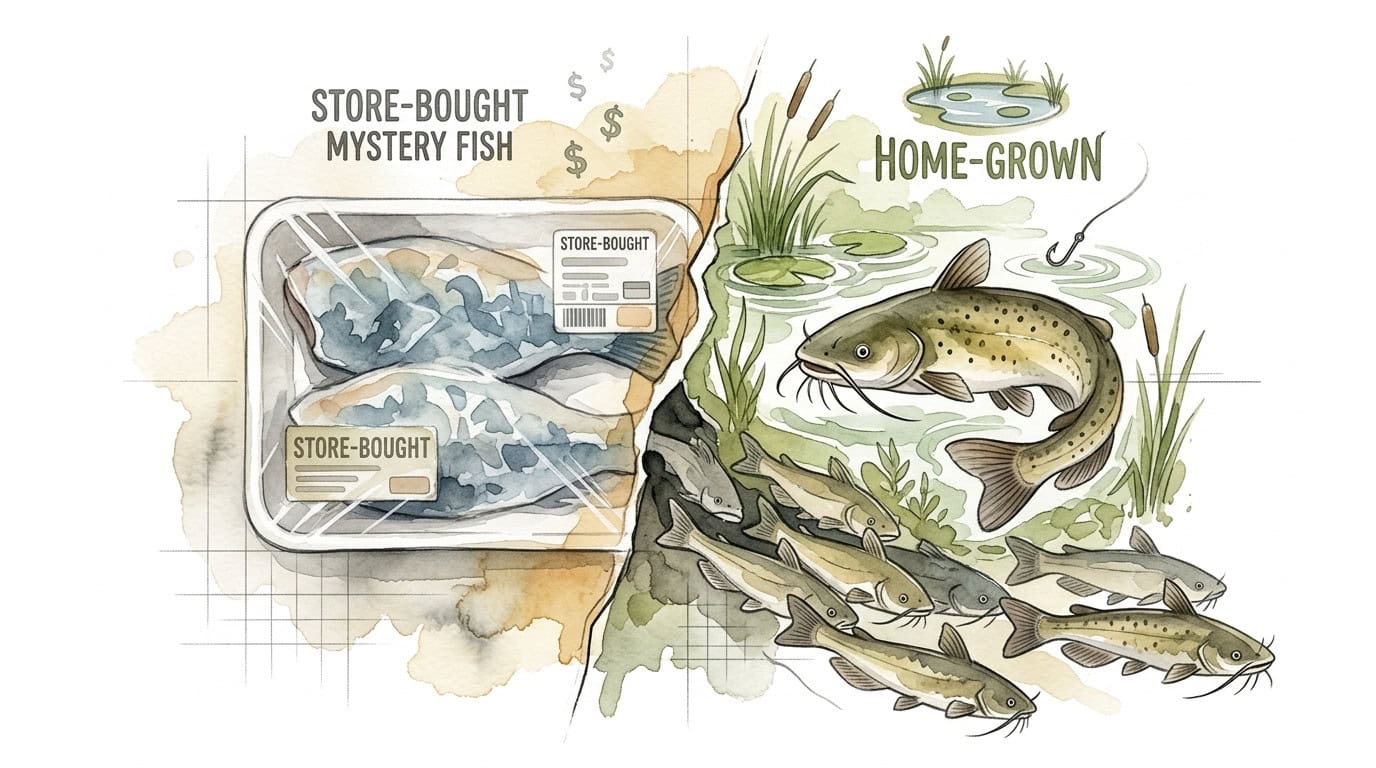
Stop buying frozen “product of…” labels. Turn your backyard water source into a self-replenishing protein harvest. Are you relying on global supply chains for your protein? A well-stocked farm pond can provide hundreds of pounds of fresh, organic catfish every year. Learn the exact science of stocking rates, species selection, and feeding to create a resilient home food system. It is time to move from consumer to producer.
To stock catfish in farm ponds, you must determine your management intensity; for unmanaged ponds, stock 50–100 channel catfish fingerlings per acre, while managed systems with daily feeding can support 500–1,000 per acre. Selection of 4- to 6-inch fingerlings ensures survival against existing predators. Implementation requires balancing dissolved oxygen levels, monitoring pH between 6.5 and 9.0, and providing high-protein feed to achieve a 1.8:1 feed conversion ratio.
How To Stock Catfish In Farm Ponds
Catfish stocking is the mechanical process of introducing specific Siluriformes species into a controlled aquatic environment to establish a harvestable biomass. In a farm pond context, this usually involves the Channel Catfish (Ictalurus punctatus) due to its high feed conversion efficiency and tolerance for varied water quality parameters. Unlike recreational “catch and release” systems, a food-production pond operates on a “put-and-take” logic where fish are stocked, grown to a target weight, and harvested systematically.
This process exists to bypass the inefficiencies of natural recruitment. In most small farm ponds, catfish do not reproduce successfully because of egg predation by bluegill or lack of suitable cavity-nesting sites. Therefore, the pond owner must act as the primary biological regulator, calculating the exact number of individuals the water volume can support based on dissolved oxygen (DO) availability and nutrient loading.

Real-world applications range from small 0.25-acre “meat holes” designed for maximum family food security to multi-acre lakes where catfish provide both forage control and supplemental harvest. The system relies on the conversion of low-value inputs, such as commercial soy-based pellets, into high-value protein. Visualization of this system should focus on the pond’s “carrying capacity,” which is the maximum weight of fish the environment can sustain without a collapse in water quality.
Technical Procedures for Stocking Success
Successful stocking begins with site preparation and the procurement of healthy fingerlings. The depth of the pond should ideally exceed five feet in at least 25% of its area to prevent winter-kill and provide thermal refugia during peak summer temperatures. If the pond is new, ensure it has been filled for at least two weeks to allow for chlorine dissipation (if using municipal sources) and the stabilization of the microscopic food web.
Step one is species selection. The Channel Catfish is the industry standard for its growth rate and disease resistance. While Blue Catfish (Ictalurus furcatus) are an alternative for larger ponds due to their predatory nature and increased size potential, they require higher dissolved oxygen levels. Avoid “Bullheads” (Ameiurus species) as they tend to overpopulate and stunt, leading to a pond filled with thousands of 4-inch fish that are useless for consumption.
Step two involves calculating density. In an unpetted, unfertilized pond, the carrying capacity is low—approximately 50 to 100 fish per acre. If you implement a fertilization program to stimulate phytoplankton growth, you can increase this to 200 fish per acre. For those committed to daily feeding with high-protein pellets, densities of 500 to 1,000 fish per acre are achievable, provided supplemental aeration is available to handle the nightly oxygen dip caused by fish respiration and waste decomposition.
Step three is the physical introduction. Fingerlings should be 4 to 6 inches long if the pond contains established largemouth bass; smaller fish will be consumed immediately as forage. Acclimation is critical. Do not dump the fish directly into the water. Instead, float the transport bags for 20 to 30 minutes to equalize temperature. If the temperature difference exceeds 5 degrees Fahrenheit, gradually mix pond water into the bags over a 30-minute period before release to prevent thermal shock.
Yield Advantages and System Efficiency
The primary benefit of a dedicated catfish stocking program is the predictable and high-volume protein yield. Channel catfish are exceptionally efficient at converting feed into muscle. In a managed system, a 1.8:1 feed conversion ratio (FCR) is the technical benchmark, meaning 1.8 pounds of feed results in 1 pound of fish gain. This efficiency surpasses most terrestrial livestock, including poultry and cattle.

Controlled stocking allows for “size-class management.” By stocking a known number of fingerlings of uniform size, the harvest window becomes predictable. A 6-inch fingerling stocked in the spring can reach 1 to 1.25 pounds by the following autumn if fed a 32% protein diet daily. This rapid turnover ensures the pond remains a productive asset rather than a stagnant water body.
Mechanical simplicity is another advantage. Unlike more sensitive species like trout, catfish can tolerate lower dissolved oxygen levels and higher turbidity. This resilience reduces the risk of total crop loss during minor environmental fluctuations. Furthermore, catfish serve as “biological cleaners” to some extent, consuming organic matter and insect larvae that would otherwise contribute to nutrient stagnation in the pond’s benthic zone.
Critical Errors and Mechanical Failures
The most frequent failure in catfish stocking is overstocking without a corresponding increase in aeration capacity. A pond’s oxygen supply is finite. At night, photosynthesis stops, and the oxygen consumed by fish, plants, and decomposing waste can drop below the critical threshold of 3.0 mg/L. When this occurs, fish experience acute respiratory distress, leading to massive “die-offs” usually discovered at dawn.
Improper species identification is another common pitfall. Many pond owners inadvertently stock Flathead Catfish (Pylodictis olivaris), which are obligate carnivores. A single large flathead can decimate a pond’s entire bluegill and fingerling catfish population within a season. Similarly, stocking bullheads leads to a competitive imbalance where the undesirable species out-competes the channel catfish for resources, resulting in a pond of stunted, non-marketable fish.
Feeding errors also compromise the system. Overfeeding leads to uneaten pellets sinking to the bottom, where they decompose and spike ammonia levels. High ammonia (NH3) is toxic to fish and inhibits growth even at sub-lethal levels. Conversely, failing to feed during the peak growing season (water temperatures between 70°F and 85°F) significantly extends the time to harvest, increasing the “maintenance energy” the fish consumes and reducing overall efficiency.
Environmental Constraints and Risk Factors
Atmospheric and geological conditions dictate the boundaries of catfish production. Temperature is the primary regulator of metabolism. Catfish growth slows significantly when water temperatures drop below 60°F and effectively ceases below 45°F. Therefore, in northern latitudes, the “growing season” may only be 4 to 5 months, whereas southern regions can maintain growth for 8 to 10 months. This dictates different stocking cycles and harvest expectations.
Pond chemistry acts as a secondary constraint. Waters with low alkalinity (less than 20 mg/L) lack the buffering capacity to prevent wild pH swings during heavy algae blooms. If pH exceeds 9.5 or drops below 6.0, the fish enter a state of chronic stress, making them susceptible to Aeromonas or “Ich” infections. Owners must test for total alkalinity and hardness, often requiring the addition of agricultural limestone to stabilize the system before stocking.
Water transparency, often measured by Secchi disk depth, indicates the density of the plankton bloom. If visibility is less than 12 inches, the risk of a nightly oxygen crash is high. If visibility exceeds 24 inches, there is insufficient natural food, and the fish will rely entirely on expensive commercial feed. Maintaining a “green water” bloom with 18 to 24 inches of visibility is the optimal balance for growth and safety.
Species Selection: Comparison of Pond-Suitable Catfish
Selecting the correct subspecies is the most critical decision in the stocking process. The table below outlines the measurable differences between the three most common species encountered by pond owners.
| Metric | Channel Catfish | Blue Catfish | Bullhead (Black/Yellow) |
|---|---|---|---|
| Growth Rate | High (1lb/year) | High (Max size potential) | Low (Stunting prone) |
| Dietary Type | Omnivorous/Opportunistic | Predatory/Piscivorous | Benthic Scavenger |
| O2 Requirement | Moderate (>3mg/L) | High (>5mg/L) | Very Low (>1mg/L) |
| FCR Efficiency | 1.8:1 | 2.2:1 | 4.0+:1 |
| Harvest Ease | High (Takes pellets) | Moderate (Live bait preferred) | High (Small size) |
For most food-focused farm ponds, the Channel Catfish is the superior choice for maintenance and efficiency. Blue catfish should only be considered if the pond exceeds 5 acres and has active aeration, as they require more space and higher water quality to reach their trophy potential.
Operational Best Practices
To optimize the system, implement a “floating feed” protocol. Using sinking pellets prevents you from monitoring the fish’s appetite. Floating pellets allow you to see the “feeding response.” If the fish do not consume the feed within 15 minutes, you have over-applied, and the application rate should be reduced for the next cycle. This observation serves as a daily health check for the entire population.
Maintain a records log. Track the weight of feed applied versus the weight of fish harvested. This data allows you to calculate your specific Feed Conversion Ratio and identify if your system is losing efficiency due to disease, theft, or predation. If your FCR exceeds 3.0:1, it indicates a significant failure in the system, such as high mortality rates that were not observed or severe feed wastage.
Strategic harvesting is also essential. Do not wait for all fish to reach maximum size before beginning harvest. Use a “staggered harvest” approach, removing 1.5-pound fish as they reach size to reduce the total biomass and oxygen demand in the pond. This “thinning” allows the remaining fish to grow faster by reducing competition for feed and space.
Advanced Engineering for Intensive Systems
For those looking to exceed standard stocking rates (more than 1,000 fish per acre), mechanical aeration is no longer optional—it is the central component of the system. Electric paddlewheel aerators or diffused “bubbler” systems must be sized to provide at least 1.0 horsepower per surface acre. This equipment should be set on a timer to activate from midnight until sunrise, which is the window of maximum oxygen deficit.
Consider “bio-manipulation” through polyculture. Stocking Fathead Minnows (Pimephales promelas) alongside catfish provides a secondary, self-replicating forage source that reduces the total cost of commercial feed. Additionally, if the pond is prone to vegetation overgrowth, introducing sterile Triploid Grass Carp (Ctenopharyngodon idella) at a rate of 5 to 10 per acre will prevent weeds from choking the water and consuming vital nutrients.
In highly intensive systems, monitoring the nitrogen cycle becomes paramount. As fish density increases, total ammonia nitrogen (TAN) and nitrites (NO2) can accumulate. If nitrites reach dangerous levels, adding common salt (NaCl) at a rate of 50 lbs per acre can prevent “brown blood disease,” a condition where nitrite prevents the fish’s hemoglobin from carrying oxygen. This is a common advanced tactic used in commercial aquaculture to prevent losses in high-density ponds.
Production Scenario: The 0.5-Acre “Protein Plot”
Consider a 0.5-acre pond with a mean depth of 6 feet located in the mid-latitudes. The goal is a 500-pound annual harvest. To achieve this, the owner stocks 500 Channel Catfish fingerlings (6 inches long) in April.
The management plan includes feeding a 32% protein floating pellet once daily at dusk. Initially, the fish require very little feed, but as they grow, the rate increases to approximately 3% of their total body weight. By July, the total biomass in the pond is approximately 250 pounds, requiring 7.5 pounds of feed per day. By September, the fish average 1.2 pounds each.
The owner begins harvesting in late September, taking 50 pounds of fish per week. This staggered removal maintains the pond’s carrying capacity within safe limits. By the end of the season, the owner has harvested roughly 450 pounds of fish, having utilized approximately 810 pounds of feed. This results in a localized, organic protein source produced at a fraction of the cost of store-bought “mystery fish.”
Final Analysis
Establishing a catfish production system in a farm pond is a mechanical exercise in balancing biological demand with environmental supply. By selecting Channel Catfish, maintaining conservative stocking rates, and prioritizing water quality—specifically dissolved oxygen and alkalinity—you create a reliable and high-yield food system. This approach moves beyond the unpredictability of recreational fishing and into the realm of disciplined homestead production.

Success requires consistent monitoring and a willingness to adjust inputs based on the pond’s feedback. Whether managing a small pond for family subsistence or a larger lake for commercial-scale yields, the principles of density, feeding efficiency, and oxygen management remain the same. Implementing these technical protocols will ensure your backyard water source becomes a permanent pillar of your food security strategy.
Frequently Asked Questions About How To Stock Catfish In Farm Ponds
What is the best time of year to stock catfish fingerlings?
The optimal window for stocking is during the spring (March to May) or autumn (September to November) when water temperatures are between 55°F and 70°F. Stocking during these periods minimizes thermal stress on the fingerlings, which are highly susceptible to “handling shock” if moved during the extreme heat of summer. Spring stocking is generally preferred for food production as it allows the fish to take full advantage of the peak growing season, reaching harvestable size by late autumn. If you stock in the fall, the fish will likely overwinter with minimal growth and begin their primary development the following spring.
Can I stock catfish in a pond that already has bass and bluegill?
Yes, catfish are excellent additions to a bass-bluegill pond, but the size of the fingerlings is the critical factor. If the pond has an established population of Largemouth Bass, you must stock catfish fingerlings that are at least 4 to 6 inches long. Any fish smaller than this will be viewed as forage by the bass and will be consumed within days, resulting in a 0% survival rate for your stocking effort. In a mixed-species pond, the catfish should be stocked at a lower density (50–100 per acre) to ensure there is enough natural forage and space for all species to thrive without crashing the oxygen levels.
How much feed should I give my catfish daily?
The standard industry guideline is to feed approximately 3% of the total fish biomass daily during the peak growing season (water temperatures above 70°F). However, the most accurate method is the “15-minute rule”: apply only as much floating feed as the fish can completely consume within 15 minutes. This ensures that you are meeting the nutritional needs of the fish without over-applying feed, which would otherwise sink and decompose, leading to ammonia spikes and oxygen depletion. As water temperatures drop below 60°F in the autumn, reduce feeding to 1% of body weight or every other day, and stop feeding entirely once temperatures consistently stay below 50°F.
Do I need an aerator to stock catfish?
The necessity of an aerator depends entirely on your stocking density. If you stock at low densities (under 100 fish per acre) and do not feed heavily, the natural oxygen exchange at the pond’s surface is usually sufficient. However, if you intend to stock 500 to 1,000 fish per acre for intensive food production, an aerator is mandatory. High densities create a high biological oxygen demand (BOD), especially during the night when plants consume oxygen instead of producing it. Without mechanical aeration to “off-gas” carbon dioxide and infuse oxygen, you risk a total pond kill during the hot, stagnant nights of July and August.
Why are my catfish not growing even though I am feeding them?
Several technical factors could be inhibiting growth. First, check your water chemistry; low alkalinity (below 20 mg/L) or extreme pH levels cause chronic stress that diverts energy away from growth and toward metabolic survival. Second, ensure you are using a high-quality “floating catfish pellet” with at least 32% protein; supplemental grains like corn or low-protein “pond snacks” do not provide the amino acids necessary for muscle development. Finally, evaluate your density. If you have overstocked or if “wild” bullheads have invaded the pond, the competition for resources may be too high, resulting in “stunting,” where the fish remain small regardless of the feed provided.