

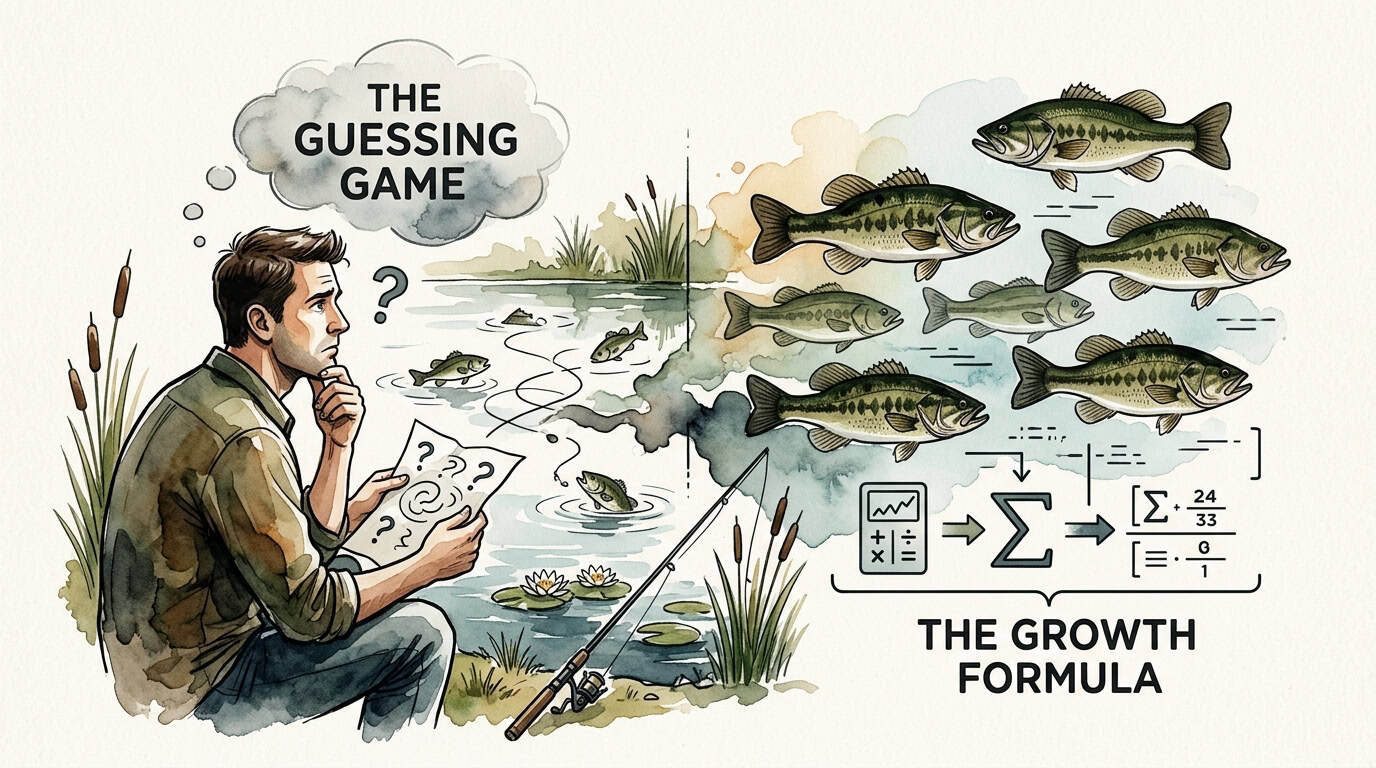
Stocking too many bass is the fastest way to ruin a pond. Do you know your number? More isn’t always better. Overstocking leads to stunted fish and collapsed ecosystems. Use these precision metrics to grow trophy bass in any size pond.
Pond management relies on the fundamental principle of carrying capacity. Every body of water has a finite biological limit on the total weight of fish it can support. This limit, known as biomass, is dictated by available dissolved oxygen, nutrient levels, and the volume of the forage base. When stocking a pond, the objective is to optimize the distribution of this biomass to meet specific performance goals, whether that is a high catch rate or the production of trophy-class individuals.
The transition from a casual hobbyist to a serious pond manager requires shifting from “The Guessing Game” to “The Growth Formula.” Success is not measured by the number of fish introduced, but by the efficiency of energy transfer from the bottom of the food chain to the top-tier predators. This article provides the technical framework required to calculate, implement, and maintain the correct stocking densities for largemouth bass based on empirical data and fisheries science.
How Many Bass Should You Stock Per Acre Of Pond?
The standard stocking rate for largemouth bass in a new or renovated pond typically ranges between 50 and 100 fish per acre. This specific range is calculated to balance the predator population with a corresponding forage base of 500 to 1,000 bluegill or redear sunfish per acre. This 1:10 ratio serves as the baseline for a “balanced” pond, where both the predator and prey species exhibit healthy growth and consistent recruitment.

In a technical context, stocking rates are not static. They are variables that must be adjusted based on the pond’s primary productivity. Productivity is the measure of a pond’s ability to produce organic matter, usually driven by the concentration of phosphorus and nitrogen which fuels phytoplankton growth. A highly fertile, fertilized pond can support a higher biomass, potentially allowing for 100 bass per acre. Conversely, an infertile “clear water” pond with low nutrient input should be limited to 50 bass per acre to prevent immediate stunting.
Real-world applications of these numbers change when the objective shifts toward trophy management. In trophy scenarios, the goal is to maximize the individual growth rate of every bass. To achieve this, the stocking density is often reduced to 25 to 50 bass per acre while simultaneously increasing the forage-to-predator ratio to 20:1 or even 40:1. This reduction in competition ensures that each predator has a surplus of high-calorie forage, leading to rapid weight gain and the attainment of trophy sizes within a shorter timeframe.
How It Works: The Mechanics of Stocking Densities
The efficacy of a stocking plan depends on the timing of introduction and the age class of the fish. Effective pond establishment follows a sequential process to ensure the food chain is robust before the top-tier predators are introduced. The following steps outline the mechanical optimization of a new fishery.
Step 1: Establishing the Forage Base
Forage species, such as bluegill, redear sunfish, and fathead minnows, must be stocked at least six months prior to the introduction of largemouth bass. This lead time allows the forage fish to reach sexual maturity and complete at least one or two spawning cycles. Without this head start, the initial stocking of bass will consume the original forage population before it can reproduce, leading to a permanent collapse of the food web.
Step 2: Calculating Initial Mortality Rates
Fisheries biologists account for an initial mortality rate when stocking fingerlings. It is common to see a 10% to 20% loss within the first 30 days due to transport stress and immediate predation. If a target population of 80 adult bass per acre is desired, the manager may stock 100 fingerlings to compensate for these anticipated losses. Using precision metrics ensures the final population density aligns with the pond’s carrying capacity.
Step 3: Managing Energy Transfer Efficiency
Biological energy transfer is inherently inefficient. It takes approximately 10 pounds of forage for a largemouth bass to gain one pound of body weight. Therefore, if a pond has a carrying capacity of 100 pounds of bass per acre, the ecosystem must be capable of producing and sustaining at least 1,000 pounds of forage annually. If the stocking density of bass exceeds the pond’s ability to generate this forage, growth rates will plateau, and the fish will enter a “stunted” state.

Benefits of Precision Stocking Metrics
The primary advantage of data-driven stocking is the predictable optimization of fish growth. By maintaining a lower predator density, each individual bass experiences less competitive stress. This results in a higher Relative Weight (Wr), a metric used by biologists to compare the actual weight of a fish to the standard weight for its length. A precision-stocked pond consistently produces fish with a Wr of 95 to 110.
Ecological stability is another significant benefit. Ponds stocked with the correct number of bass maintain a healthy balance of aquatic vegetation and water clarity. Overstocked ponds often suffer from a “top-heavy” food chain where the depletion of forage species leads to an explosion of mid-level organisms or an increase in turbidity as bass forage aggressively in the substrate. Precision metrics prevent these systemic imbalances.
Finally, a controlled stocking rate simplifies long-term maintenance. When the initial population is set correctly, the manager can more easily track recruitment and determine harvest quotas. It is much easier to remove a surplus of fish from a balanced pond than it is to fix a pond that was ruined by extreme overstocking in its first year.
Challenges and Common Mistakes
The most frequent error in pond management is the “more is better” fallacy. Pond owners often believe that stocking 200 bass per acre will result in twice as much fishing fun. In reality, this leads to a population of 10-inch bass that never grow larger because they have exhausted the forage base. This condition is known as “bass crowding” and is difficult to reverse once established.
Another challenge is the failure to account for natural recruitment. Largemouth bass are prolific spawners. After the initial stocking, a pond will quickly produce thousands of sub-adult bass. If the pond manager does not implement a harvest strategy to remove these new arrivals, the density will quickly exceed the carrying capacity. Successful management requires viewing the initial stocking as a starting point, not a permanent population count.
The mistake of stocking “advanced” bass (fish over 8 inches) into a pond without an established forage base is also common. Large bass have higher caloric requirements than fingerlings. If they are introduced to a pond that only contains small minnows, they will lose weight rapidly and may die from stress. Technical optimization requires matching the size of the predator to the size and volume of the available prey.
Limitations and Environmental Constraints
Pond size is a critical limitation. Managing for trophy largemouth bass in a pond smaller than one acre is statistically difficult. Small impoundments are more susceptible to environmental swings, such as dissolved oxygen crashes and temperature spikes. In a quarter-acre pond, the removal of just three or four large bass can represent a massive shift in the predator-to-prey ratio, making it nearly impossible to maintain a stable balance.
Water quality and depth also dictate stocking boundaries. A pond that is shallow (less than 6 feet deep in most areas) will have a lower carrying capacity due to limited thermal refuge and lower oxygen levels in the summer months. Stocking densities must be reduced by 20% to 30% in shallow ponds to account for this reduced habitat volume. Similarly, ponds with high organic loading and low alkalinity may not support the same biomass as a deep, spring-fed impoundment.
Geographic location influences the metabolic rates of the fish. Bass in southern climates have a longer growing season but also experience higher metabolic demands during the heat of summer. In northern climates, the growing season is shorter, and the carrying capacity may be lower due to the extended period of winter dormancy. Stocking rates must be calibrated to the local climate to ensure sustainable growth.
Comparison: Standard vs. Trophy Stocking Models
Selecting the right model depends on the owner’s specific objectives and the available budget for supplemental management. The following table compares the two primary stocking strategies.
| Factor | Standard Balanced Model | Trophy Management Model |
|---|---|---|
| Bass Stocking Rate | 80–100 per acre | 25–50 per acre |
| Forage Ratio (BG:LMB) | 10:1 | 20:1 to 48:1 |
| Growth Rate | Moderate (0.5 lb/year) | Rapid (1.5–2.0 lbs/year) |
| Catch Frequency | High (Many small fish) | Low (Fewer, larger fish) |
| Maintenance Required | Low to Moderate | High (Feeding/Harvesting) |
The Standard Model is ideal for family ponds where high catch rates of 1–2 pound fish are the goal. The Trophy Model is a high-performance system designed for the serious angler who is willing to sacrifice catch quantity for the chance at a 10-pound fish. The Trophy Model often requires supplemental forage stockings of threadfin shad or crawfish to maintain the necessary caloric surplus.
Practical Tips and Best Practices
To maintain a high-performance bass pond, keep detailed harvest records. Track the length and weight of every bass caught. If you notice that the Relative Weight (Wr) of 12-inch bass is dropping below 90%, it is an objective signal that the pond is becoming overpopulated and more fish need to be harvested. Data collection is the only way to accurately monitor the health of the fishery without expensive professional surveys.
Use a Secchi disk to measure water clarity. A reading of 18 to 24 inches indicates a healthy phytoplankton bloom, which supports a larger forage base and therefore allows for a higher stocking density. If the water is too clear (readings over 48 inches), the pond lacks the nutrients to support a heavy fish population, and you should consider reducing your bass numbers or implementing a fertilization program.
- Stock forage fish in the fall and predators in the following spring.
- Avoid stocking “unauthorized” species like crappie or green sunfish, which compete with bass for forage.
- Maintain at least 20% to 30% of the pond’s surface area as cover (submerged timber, rock piles, or vegetation) to provide ambush points for bass.
- Implement a mandatory harvest of all bass under 12 inches once the pond is three years old to prevent stunting.
Advanced Considerations: Proportional Stock Density (PSD)
Serious practitioners use Proportional Stock Density (PSD) to evaluate the balance of their pond. PSD is calculated by taking the number of “quality” size fish (12 inches or larger for bass) and dividing it by the number of “stock” size fish (8 inches or larger). A balanced pond typically has a bass PSD between 40 and 60.
Another advanced metric is the Relative Stock Density (RSD). This breaks the population down into size categories: Preferred, Memorable, and Trophy. For example, an RSD-P (Preferred) would look at the percentage of the population that is 15 inches or larger. By tracking these percentages over several years, a manager can identify whether the population is shifting toward a trophy structure or a stunted structure and adjust harvest or stocking accordingly.
Consider the Biological Oxygen Demand (BOD) when pushing the limits of stocking density. As you increase the biomass of fish through supplemental feeding and fertilization, the oxygen required to sustain those fish also increases. High-density ponds require aeration systems to prevent catastrophic “summer kills” where oxygen levels drop below 3.0 mg/L during hot, still nights. Mechanical aeration is a mandatory component of any pond stocked at the upper limits of its carrying capacity.
Example Scenario: The 1-Acre Managed Pond
Consider a 1-acre pond in a moderate climate with average fertility. The owner’s goal is a mix of good fishing and the potential for a few 5-pound bass. The technical stocking plan would look like this:
In October, the owner stocks 1,000 bluegill fingerlings and 5 pounds of fathead minnows. These fish are allowed to overwinter and spawn in the early spring. In June of the following year, the owner stocks 75 largemouth bass fingerlings. By the end of the second year, the original 75 bass will have reached 12–14 inches in length, and the bluegill population will be providing a sustainable food source through multiple spawns.
In the third year, the owner begins catching “wild” bass—the offspring of the original 75. To maintain the growth of the original “stock” fish, the owner must now begin harvesting these 8–10 inch wild bass. Removing 20 to 25 pounds of these smaller fish per year ensures that the remaining 75 “original” bass continue to have enough food to reach their 5-pound potential. This cycle of measurement and harvest is what separates a successful fishery from a failed one.
Final Thoughts
Successful pond management is an exercise in mechanical optimization. The number of bass stocked per acre is a foundational variable that dictates the trajectory of the entire ecosystem. By adhering to the scientific limits of carrying capacity and maintaining a strict forage-to-predator ratio, you can avoid the common pitfalls of stunting and resource exhaustion. Data, not guesswork, is the key to a healthy fishery.

Remember that a pond is a dynamic system. The stocking numbers provided here are the starting parameters, but the long-term success of the pond depends on your willingness to monitor growth and adjust the population through selective harvest. If you maintain the energy balance of the water, the result will be a stable, high-performance ecosystem that provides trophy-class fishing for years to come.
Experimenting with different forage species or supplemental feeding can further enhance your results, but these should always be implemented on top of a solid, mathematically sound stocking foundation. Precision in the beginning saves countless hours of corrective management in the future.