

Stop pouring money down the drain. Learn why some dyes vanish and others endure. Tired of your pond dye disappearing after the first rain? Understanding concentration and UV degradation is the key to a 3-month blue. Check out our guide on maximizing your pond’s color longevity.
Pond dye typically lasts between four to eight weeks, although high-quality concentrated formulations can maintain therapeutic color levels for up to three months in static water environments. The effective lifespan depends heavily on UV radiation intensity, water turnover rates from rainfall or springs, and the initial chemical concentration applied. Maintaining consistent light-blocking properties usually requires periodic “top-off” doses every four to six weeks to compensate for natural degradation and hydraulic dilution.
How Long Does Pond Dye Last?
Pond dye is a concentrated aquatic colorant, typically formulated from food-grade pigments such as Acid Blue 9 (Brilliant Blue FCF) and Acid Yellow 23 (Tartrazine). Its primary function is to alter the optical properties of the water column, creating a physical filter that limits the penetration of specific wavelengths of sunlight. In a closed hydraulic system with zero outflow, these pigments remain suspended and visible for extended periods, often exceeding sixty days.
In real-world applications, however, a pond is rarely a closed system. Environmental variables constantly act upon the dye molecules, leading to a gradual reduction in parts per million (ppm) concentration. The duration of effectiveness is defined not just by the presence of color, but by the dye’s ability to maintain a “shading effect” that suppresses photosynthesis in the benthic zone. Once the concentration drops below a specific threshold—often 1 ppm—the biological utility of the dye diminishes significantly.

Examples of usage include recreational lakes, golf course hazards, and private fishing ponds. In these settings, the dye serves as the first line of defense in an integrated pest management (IPM) strategy. By understanding the timeline of degradation, operators can move away from reactive “slug dosing” toward a stabilized maintenance schedule that ensures consistent performance throughout the growing season.
The Mechanics of Dye Degradation
The lifespan of an aquatic colorant is dictated by two primary mechanisms: photolytic degradation and hydraulic displacement. Understanding these processes at a technical level allows for more accurate prediction of reapplication needs. Photolysis occurs when high-energy ultraviolet (UV) photons strike the dye molecules, breaking the chemical bonds that produce the specific light-absorbing properties of the pigment. This process is most aggressive during the summer solstice when the UV index is at its peak.
Hydraulic displacement, or “washout,” is a purely mechanical process. Every volume of water that enters the pond through a stream, spring, or surface runoff must displace an equal volume through the spillway or overflow pipe. If a pond receives one inch of rain, it effectively replaces a portion of its dyed water with clear, untreated water. In ponds with a high “watershed-to-surface-area” ratio, a single heavy storm can reduce dye concentration by 20% or more in a matter of hours.
Secondary factors include adsorption and microbial breakdown. Dye molecules can bond to suspended clay particles or organic detritus (muck) at the bottom of the pond. This “strips” the dye from the water column, making it unavailable for light filtration. While most aquatic dyes are resistant to rapid microbial digestion, certain specialized bacteria can gradually metabolize organic pigments, contributing to a slower, secondary rate of fade over several months.
Benefits of Sustained Pigmentation
Maintaining a consistent dye concentration offers measurable advantages for pond thermodynamics and biological stability. By filtering out the red-orange and blue-violet spectra of light, the dye limits the energy available for photosynthesis in the photic zone. This prevents the germination of filamentous algae and submerged macrophytes that typically begin their life cycles on the pond floor.
Thermal regulation is another critical benefit. Clear water allows sunlight to penetrate deep into the water column, heating the lower layers and potentially disrupting the thermal stratification required by certain fish species. A well-dyed pond absorbs solar energy at the surface, which can then be dissipated by wind action or surface aeration. This keeps the deeper “refuge” areas of the pond cooler and higher in dissolved oxygen during extreme heat events.

Additionally, sustained color provides a visual barrier against avian and terrestrial predators. For serious fish managers, particularly those stocking high-value species like koi or trophy bass, the opacity of the water is a mechanical defense mechanism. When the dye fades prematurely, these fish become highly visible targets from the air, often leading to significant biomass loss before the operator notices the color change.
Challenges and Common Mistakes
One of the most frequent errors in pond management is the underestimation of pond volume. Many operators calculate dosage based on surface acreage alone, ignoring the “acre-foot” metric (one acre of surface area covered by one foot of water). If a pond has a high average depth, a standard surface-area dose will result in a diluted concentration that lacks the opacity required to block UV rays effectively.
Timing is another critical failure point. Applying dye after a massive algae bloom has already reached the surface is largely ineffective. At that stage, the algae are already accessing direct sunlight and atmospheric carbon dioxide. The dye must be present *before* the growing season begins to intercept light at the sediment-water interface where germination occurs. Traditional Rapid Fade products often fail here because they lack the stability to survive the early spring rains that precede the first major blooms.
Over-application can also lead to unintended consequences. While “more is better” might seem logical for longevity, excessive dye can suppress the growth of beneficial phytoplankton. Phytoplankton form the base of the aquatic food web; removing them entirely can lead to a “crash” in the insect and small fish populations, eventually starving the apex predators. Precision dosing based on Secchi disk readings is the professional standard for avoiding these pitfalls.
Environmental Limitations
Pond dye is not a universal solution and faces practical boundaries in specific environments. In systems with a high volumetric turnover—such as flow-through trout raceways or ponds fed by large, active springs—dye is economically non-viable. The cost of continuously treating incoming water to maintain a 1 ppm concentration outweighs the benefits, as the dye is flushed out faster than it can provide a shading effect.
Water chemistry also plays a role in limitation. High levels of suspended solids (turbidity) can interfere with the dye’s performance. In “muddy” ponds, the dye molecules may be absorbed by clay particles, or the brown color of the silt may mix with the blue dye to create an unattractive muddy-green hue. In these scenarios, flocculants or clarifiers must be used to settle the suspended solids before the dye can effectively manage light penetration.
Finally, chemical interactions can shorten dye lifespan. High concentrations of chlorine (often found in municipal water used to top off decorative fountains) or strong oxidizing algaecides (like sodium percarbonate) can chemically “bleach” the dye molecules. If you are treating an active algae bloom with oxidizers, it is standard practice to wait 48 to 72 hours before applying or replenishing the pond dye.
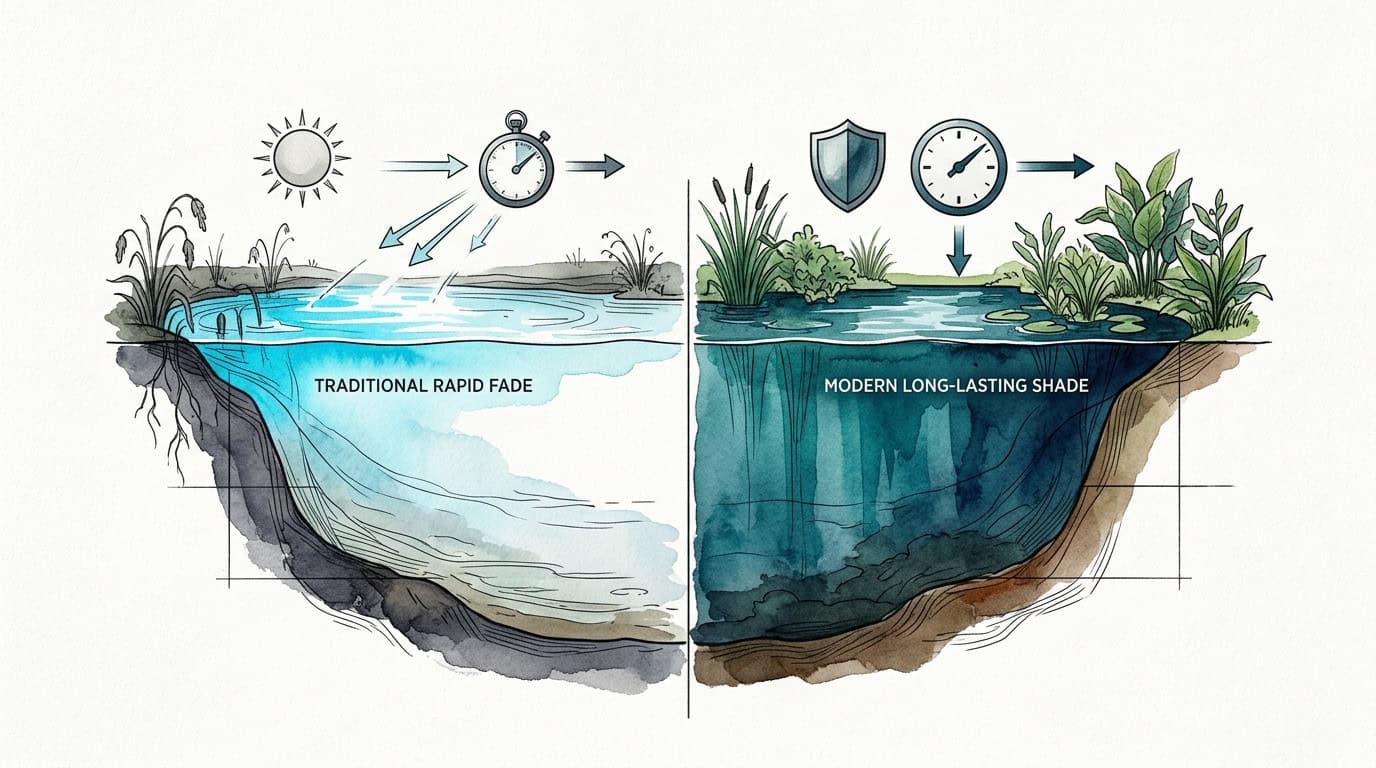
Traditional Rapid Fade vs Modern Long-Lasting Shade
The distinction between Traditional Rapid Fade and Modern Long-Lasting Shade formulations usually comes down to pigment purity and the presence of specialized dispersants. Older formulations often relied on lower-grade food dyes that were highly susceptible to rapid UV degradation. These products might look vibrant for the first ten days but experience a 50% loss in opacity by week three, even in static conditions.
| Feature | Traditional Rapid Fade | Modern Long-Lasting Shade |
|---|---|---|
| UV Resistance | Low; breaks down in 2-4 weeks. | High; remains stable for 8-12 weeks. |
| Concentration | High water content; requires larger volumes. | Super-concentrated; lower dosage per acre-foot. |
| Suspension | Prone to settling in low-flow areas. | Uses advanced dispersants for uniform coverage. |
| Spectral Profile | Basic aesthetic color change. | Optimized to block 100% of PAR wavelengths. |
Modern long-lasting shade products use highly refined pigments that are “shielded” or concentrated to resist the photolytic impact of the sun. While the initial cost per gallon may be higher, the maintenance cost over a six-month season is typically 30% to 50% lower because the reapplication interval is significantly extended.
Practical Tips for Maximizing Longevity
To extend the interval between treatments, operators should implement a structured monitoring protocol. The most effective tool for this is the Secchi disk—a simple black-and-white disk lowered into the water on a calibrated line. By measuring the depth at which the disk disappears, you can objectively determine when the dye concentration has fallen below the threshold for effective light suppression.
- Apply during periods of low flow: If possible, avoid dosing the pond immediately before a forecasted multi-day rain event. Wait for a window of stable weather to allow the dye to fully disperse and bond within the water column.
- Use Water Soluble Packets (WSP) for consistent dosing: Unlike liquid dyes that can be spilled or unevenly poured, WSPs allow for exact mathematical dosing. Tossing packets into the windward side of the pond ensures natural wave action handles the dispersal without concentrated “hot spots.”
- Combine with Aeration: Surface fountains or bottom-diffused aeration systems move the dye molecules throughout the entire volume of the pond, preventing stagnant clear spots where sunlight could penetrate to the bottom.
- Seal the Pond: If your pond has a mechanical drain or overflow, ensuring it is properly sealed and not leaking “dyed dollars” is the easiest way to prevent premature fade.
Advanced Considerations for Large Systems
For systems exceeding five surface acres, the logistics of dye maintenance become more complex. In these large water bodies, the “edge effect”—where shallow water along the shoreline receives more sunlight and experiences faster warming—becomes a primary site for algae growth. Strategically over-dosing the shallow perimeter during application can provide a buffer against the higher rates of UV degradation occurring in these areas.
Serious practitioners also account for the “internal loading” of nutrients. While dye blocks light, it does not remove nitrogen or phosphorus. If a pond has high nutrient levels, even a slight fade in the dye can lead to an explosive algae bloom because the “fuel” is still present. Combining long-lasting pond dye with nutrient binders or beneficial bacteria creates a synergistic effect that maintains clarity even as the dye naturally degrades over its 60-day lifecycle.
Example Scenario: The 1-Acre Storm Event
Consider a 1-acre pond with an average depth of 4 feet, totaling 4 acre-feet of water (approximately 1.3 million gallons). A standard application of 1 gallon of professional-grade blue dye is used to achieve a 1 ppm concentration. Under cloudless summer conditions, photolysis will degrade this concentration by roughly 1% per day. Without rain, the dye would remain functionally effective for about 60 to 70 days.
However, if the region receives a 3-inch rain event, and the pond’s watershed is 10 acres of hardened surface, the pond could receive nearly 800,000 gallons of runoff. This influx forces 800,000 gallons of dyed water out of the spillway, replacing it with clear water. In this single event, the dye concentration drops from 1 ppm to approximately 0.4 ppm. At this level, the “shading effect” is compromised, and the operator must immediately apply a 0.6-gallon “top-off” dose to restore the system’s integrity.
Final Thoughts
Pond dye is an essential mechanical tool for aquatic management, but its effectiveness is not “set and forget.” The reality is that environmental forces—specifically UV radiation and hydraulic turnover—constantly work to dilute and degrade the pigment. By planning for a 4-to-8-week lifecycle and monitoring the photic zone with a Secchi disk, operators can maintain a stable environment that suppresses algae and protects fish.
Investing in higher-quality, concentrated dyes often yields a better return on investment than cheaper, diluted alternatives. These modern formulations provide the stability required to withstand the rigors of a high-UV summer while reducing the labor costs associated with frequent reapplication. Ultimately, consistency is the hallmark of a healthy pond; keeping the color steady is the key to preventing the “boom and bust” cycles of algae growth.
Frequently Asked Questions About How Long Does Pond Dye Last?
How does rainfall specifically impact the lifespan of my pond dye?
Rainfall is the most aggressive factor in dye depletion due to hydraulic displacement. Ponds operate on a volumetric balance; every gallon of runoff that enters the system displaces a gallon of existing water through the overflow or spillway. If your pond has a large surrounding drainage area, even a moderate storm can “flush” out a significant percentage of your dye in a single afternoon. In high-flow environments, you may need to reapply dye immediately after heavy rains to maintain the target concentration required for light suppression. Conversely, in static ponds with no outflow, the dye remains until it naturally degrades via UV exposure.
Can I use a Secchi disk to tell exactly when I need to add more dye?
Yes, using a Secchi disk is the most accurate technical method for determining reapplication timing. Professional pond managers aim for a “visibility threshold” where the disk disappears at a depth of 18 to 24 inches. When the dye begins to fade and the disk remains visible at depths greater than 30 inches, it indicates that sunlight is penetrating deeply enough to reach the pond floor and trigger algae germination. By taking weekly Secchi readings, you can identify the exact point of “spectral failure” and add a small maintenance dose rather than waiting for the water to turn completely clear and allowing an algae bloom to take hold.
Do different colors like black or blue last longer in the sun?
While the chemical base of blue and black dyes is similar, black dyes often appear to last slightly longer because of their higher light-absorption capacity. Black pond dye is typically a blend of blue, yellow, and red pigments, creating a denser spectral filter that is less prone to showing subtle shifts in “fading” compared to a vibrant royal blue. However, at a molecular level, the rate of photolytic degradation—the breakdown of dye by UV rays—is relatively consistent across food-grade pigments. The perceived longevity of black dye is often due to its ability to maintain a reflective surface even as the internal concentration begins to diminish.
Is it possible for the dye to be absorbed by the pond muck or weeds?
Adsorption is a real phenomenon where dye molecules bond to organic matter, suspended solids, or clay particles. If your pond has high turbidity (cloudiness) or a significant amount of suspended “marine snow,” the dye may “stick” to these particles and settle out of the water column, effectively disappearing much faster than expected. This is common in newly excavated ponds or those with high-activity bottom-feeders like carp. To maximize dye lifespan in these conditions, it is often necessary to use a clarifier to settle the suspended solids before applying the dye, ensuring the pigment remains suspended in the liquid phase where it can filter light.

Will my fountain or aerator make the pond dye fade faster?
Aeration does not chemically destroy the dye, but it can accelerate its disappearance through two secondary mechanisms. First, fountains increase the surface area of the water, exposing more of the dye molecules to direct UV radiation and increasing the rate of photolysis. Second, aeration keeps the water column thoroughly mixed, ensuring that any dye that might have “settled” is brought back to the surface where the sun can break it down. However, this is a necessary trade-off; without the circulation provided by an aerator, the dye may not disperse evenly, leaving “clear pockets” where algae can thrive. The benefits of uniform light blocking far outweigh the slight increase in fade rate caused by aeration.