

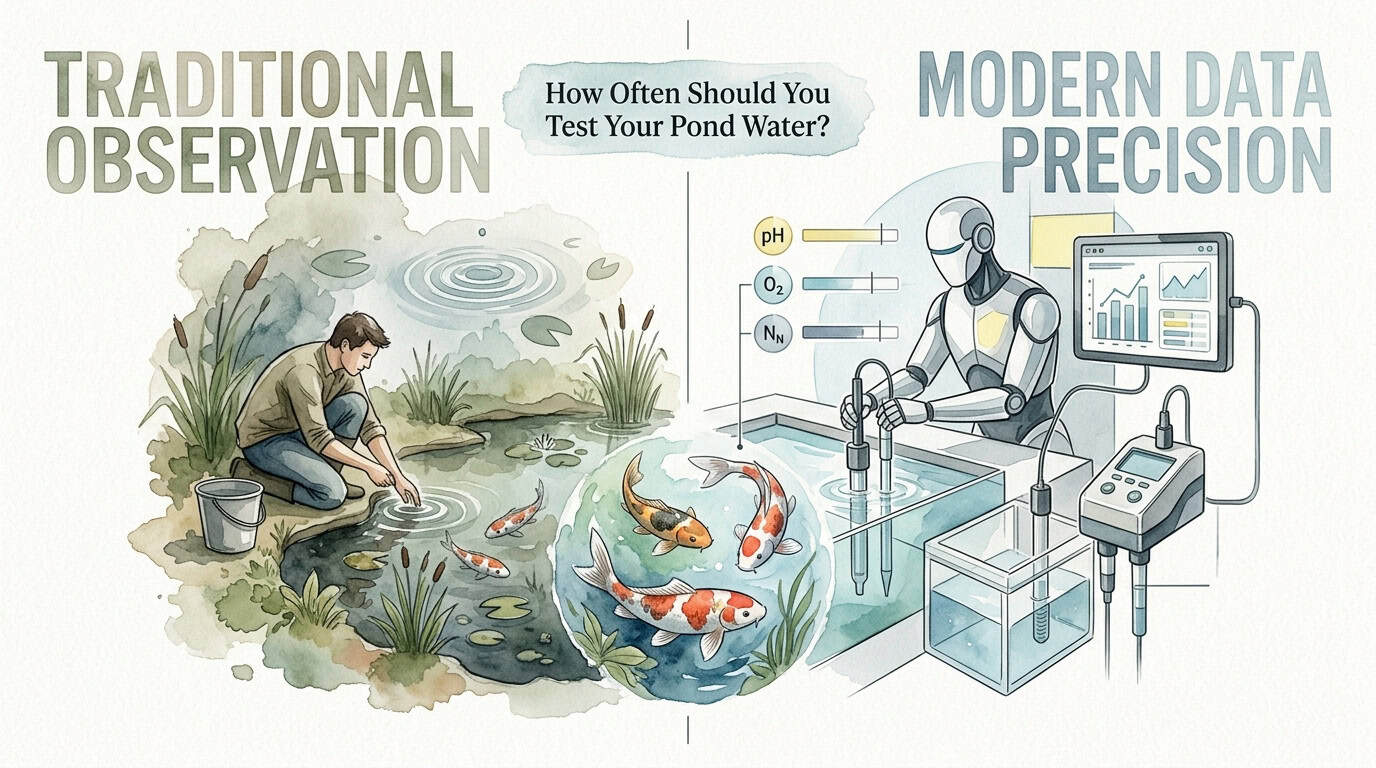
Are you managing your pond based on ‘gut feeling’ or real data? Guessing can be a fatal mistake for your fish. Old-school methods relied on intuition, but today’s ponds face modern pressures. Learn the exact frequency you need to test your water to prevent disasters before they happen.
To maintain optimal chemical stability, new ponds require testing every 24 to 48 hours for ammonia and nitrite until the nitrogen cycle is fully established. Once a biological equilibrium is reached, established ponds should be tested weekly during peak growing seasons and every two to four weeks during winter dormancy. Immediate testing is mandatory following heavy precipitation, significant water changes, or any mechanical filtration failure.
How Often Should You Test Your Pond Water?
Pond water testing is the systematic measurement of chemical parameters to ensure the survival and growth of aquatic organisms. In a closed recirculating system, metabolic waste products such as ammonia and nitrite can accumulate to toxic levels if biological filtration is insufficient. Testing provides the empirical data required to adjust filtration rates, feeding schedules, and water change volumes.
Mechanical optimization of a pond depends on maintaining specific ranges for several variables. Ammonia (NH3) and Nitrite (NO2) must remain at 0 ppm, as even trace amounts cause physiological stress and gill damage. Nitrate (NO3) should be managed below 60 ppm, though high-density koi systems often aim for sub-20 ppm to prevent long-term health issues. Carbonate Hardness (KH) acts as a pH buffer and should be maintained between 100-200 ppm to prevent lethal pH crashes.

Real-world application of testing varies by system load. A high-density koi pond with significant protein input via feeding requires more rigorous monitoring than a sparsely populated wildlife pond. In commercial aquaculture or intensive hobbyist setups, data precision is the only reliable method for preventing “Old Tank Syndrome” or sudden system collapse.
Standard Testing Protocols and Technical Procedures
Effective water management utilizes a tiered approach to testing frequency based on the developmental stage of the biological filter. The nitrogen cycle is a biochemical process where Nitrosomonas bacteria convert ammonia to nitrite, and Nitrobacter bacteria convert nitrite to nitrate. Until these bacterial colonies are mature, the system is unstable.
For new installations or systems restarting after winter, daily testing is the technical standard for the first 4 to 6 weeks. This frequency allows for the detection of “ammonia spikes” and “nitrite peaks,” enabling the operator to intervene with water changes or chemical binders before lethal thresholds are reached. Once both ammonia and nitrite consistently measure 0 ppm, the testing frequency can be reduced.
Established systems require weekly monitoring during spring and summer when water temperatures exceed 15°C (59°F). Higher temperatures increase fish metabolic rates and decrease the solubility of dissolved oxygen, putting maximum strain on the biological filter. During this period, testing should include pH, KH, ammonia, nitrite, and nitrate. pH should be tested at the same time each day—ideally early morning and late afternoon—to monitor the diurnal pH swing caused by photosynthetic activity.
Winter protocols shift toward maintaining buffer capacity. Cold-water bacteria operate at reduced efficiency, and while ammonia production slows, the risk of a pH crash remains if KH is depleted by acidic precipitation or organic decomposition. Monthly or bi-weekly testing of KH and pH is sufficient for most dormant systems.
Advantages of Data-Driven Management
The primary benefit of frequent testing is the ability to identify trends before they manifest as physical symptoms in fish. Visual observation of fish behavior is a lagging indicator; by the time fish are gasping at the surface or “flashing” against the liner, the water chemistry has likely been toxic for hours or days.

Data-driven management allows for precise chemical dosing. For example, knowing the exact KH level enables an operator to add the specific amount of sodium bicarbonate required to reach a target alkalinity of 150 ppm, rather than guessing and causing a rapid pH shift. This precision reduces chemical waste and prevents osmotic shock in sensitive species.
Furthermore, long-term record-keeping provides a baseline for the system. By tracking nitrate accumulation over time, a pond manager can calculate the exact percentage of weekly water changes required to maintain a steady-state environment. This mechanical efficiency reduces the volume of water used and minimizes the energy required for heating or treating source water.
Common Technical Errors and Misunderstandings
One frequent pitfall is the use of expired chemical reagents. Liquid test kits rely on precise chemical reactions that degrade over time, particularly when exposed to heat or direct sunlight. Using reagents past their expiration date often results in false negatives for ammonia or inaccurate pH readings, leading to catastrophic system mismanagement.
Another common error is the failure to account for “Total Ammonia Nitrogen” (TAN) versus “Unionized Ammonia” (NH3). Most standard test kits measure TAN, but the toxicity of ammonia is highly dependent on pH and temperature. At a higher pH and temperature, a larger fraction of TAN exists as unionized ammonia, which is significantly more toxic. Operators who ignore these variables may underestimate the danger of a 0.5 ppm TAN reading in a warm, alkaline pond.
Incorrect sampling technique also compromises data integrity. Water samples should be taken from approximately 12 inches below the surface and away from any filter returns or waterfall aerators to ensure a representative sample of the bulk water column. Testing water taken directly from a surface skimmer or near a fresh water fill-in will produce skewed results that do not reflect the environment the fish are actually inhabiting.
Systemic Limitations and Boundary Conditions
Standard titration-based test kits have inherent limitations in precision. Human error in color matching can lead to a variance of +/- 0.25 ppm in ammonia or nitrite readings. In high-performance systems where zero tolerance is required, these kits may not provide the resolution necessary for advanced optimization.
Environmental factors can also interfere with chemical indicators. For instance, high levels of therapeutic salts or water conditioners can produce false positives in some salicylate-based ammonia tests. In such cases, the operator must use Nessler-based reagents or digital ion-selective electrodes to obtain accurate data.
Electronic sensors, while highly precise, are limited by “sensor drift.” Probes for pH, Dissolved Oxygen (DO), and Oxidation-Reduction Potential (ORP) require regular calibration against known standard solutions. Failure to calibrate a digital meter can result in readings that are more inaccurate than a basic liquid test kit, creating a false sense of security for the operator.
Traditional Observation vs. Modern Data Precision
The transition from traditional methods to modern data precision represents a shift from reactive to proactive maintenance. Traditional observation relies on the “eye of the master,” where water clarity and fish behavior are the primary metrics. While experienced keepers can often detect issues through intuition, this method is unquantifiable and prone to failure in high-load modern systems.
Modern data precision utilizes spectrophotometers, digital probes, and automated controllers to maintain tight tolerances. This approach treats the pond as a chemical reactor, prioritizing the stability of dissolved gases and ionic concentrations. The following table compares the two methodologies across key operational metrics.
| Metric | Traditional Observation | Modern Data Precision |
|---|---|---|
| Reaction Time | Reactive (after symptoms appear) | Proactive (trend-based) |
| Reliability | Low to Moderate (Subjective) | High (Empirical) |
| Technical Skill | Experience-dependent | Protocol-dependent |
| Cost | Minimal | Moderate to High (Hardware) |
| Scalability | Poor | Excellent |
Best Practices for Accurate Results
Optimal testing requires a standardized workflow to minimize variables. Always rinse test vials with the pond water to be tested three times before taking the final sample. This ensures that any residue from previous tests or tap water rinsing does not contaminate the new sample.
Maintain a dedicated logbook or digital spreadsheet to record every measurement. Include columns for date, time, water temperature, and air temperature. Over several seasons, this data will reveal the “carrying capacity” of the pond, showing how the system responds to seasonal biological loads and helping to predict when additional aeration or filtration may be required.
Compare your pond water results against your source water (tap or well water). Significant deviations in pH or hardness between the source and the pond can indicate that the system is “drifting” due to high evaporation or excessive organic loading. Understanding the chemistry of your fill water is essential for planning safe water changes.
Advanced Chemical Considerations
For serious practitioners, monitoring the Oxidation-Reduction Potential (ORP) provides a comprehensive metric of water quality. ORP measures the “cleanliness” of the water or its ability to break down organic waste. A stable ORP between 250mV and 400mV indicates a healthy, aerobic environment with high oxidative capacity. Sudden drops in ORP often precede ammonia spikes by 12 to 24 hours.
Another advanced metric is the measurement of Carbon Dioxide (CO2) levels. In heavily planted ponds or systems with low surface agitation, CO2 can accumulate overnight, driving the pH down and stressing fish. While few hobbyist kits measure CO2 directly, it can be calculated using the relationship between pH and KH. Maintaining a balance where CO2 remains below 20 ppm ensures that oxygen saturation is not inhibited by gas interference.
Total Dissolved Solids (TDS) monitoring is useful for tracking the accumulation of “background” pollutants that standard kits miss. As water evaporates and is replaced, minerals and organics concentrate. A TDS reading that is more than 50-100 ppm higher than the source water baseline suggests that water changes are insufficient to maintain long-term system health.
Scenario Analysis: The Heavy Rain Event
Consider a scenario where a 5,000-gallon koi pond experiences 3 inches of rain over 6 hours. Rainwater is often acidic (pH 5.0-5.6) and contains zero hardness. This event introduces a significant volume of low-pH, zero-KH water into the system.
A proactive operator tests the KH immediately following the storm. If the KH has dropped from 150 ppm to 80 ppm, the operator knows the system is at risk of a pH crash. By adding a calculated dose of calcium carbonate or sodium bicarbonate, the operator stabilizes the buffer before the pH can drop. Without testing, the operator might assume the “fresh” rainwater is beneficial, only to find the fish dead from acidosis the following morning.
In a second scenario, a filter pump fails overnight. Ammonia levels will begin to rise as soon as the water stops circulating through the bio-media. Testing every 4 hours during the repair process allows the operator to determine if chemical ammonia binders are necessary or if the fish can tolerate the temporary spike. This data prevents the over-use of chemicals which can itself stress the fish.
Final Thoughts
Maintaining a pond without a rigorous testing schedule is a high-risk strategy that ignores the fundamental biochemistry of aquatic environments. Consistent data collection is the only way to verify that mechanical and biological filtration systems are operating at peak efficiency. By shifting from subjective observation to empirical measurement, pond owners can ensure long-term stability and health for their aquatic stock.

The frequency of testing must be viewed as a dynamic requirement that responds to the age of the system, seasonal fluctuations, and external environmental shocks. A commitment to weekly testing during the active season, combined with immediate response to weather events, forms the foundation of modern pond management.
Precision in water chemistry leads to efficiency in maintenance. When you understand the data, you stop fighting the pond and start managing it. Implementing these technical protocols will transform a hobbyist’s gut feeling into a professional’s certainty.
Frequently Asked Questions About How Often Should You Test Your Pond Water?
Is it possible to test pond water too often?
While testing too often does not physically harm the pond, it can lead to “over-correction.” Water chemistry exists in a state of dynamic equilibrium and minor fluctuations are normal. For example, pH naturally rises and falls throughout the day due to CO2 consumption by plants and algae. An operator who tests too frequently might see a slight dip in the morning and add buffers unnecessarily, causing a spike in the afternoon that stresses the fish. The goal is to identify trends and maintain stability within a safe range, rather than chasing a specific decimal point every few hours. Testing once or twice a week is generally the maximum required for an established, healthy system.
Do I need to test for phosphate and oxygen levels as well?
Dissolved oxygen (DO) is arguably the most critical parameter for fish survival, especially in warm weather. Testing for DO is highly recommended when water temperatures exceed 25°C (77°F), as warm water holds less oxygen while fish metabolism is at its peak. Phosphate testing is less critical for fish health but vital for managing nuisance algae. High phosphate levels (above 0.05 ppm) act as a primary fertilizer for blanket weed and green water. For a high-performance system, monitoring DO and phosphate provides a more complete picture of the ecosystem’s health beyond the basic nitrogen cycle parameters.
Can I use aquarium test kits for my outdoor pond?
Most freshwater aquarium test kits use the same chemical reagents as pond-specific kits and are technically compatible. However, pond-specific kits often provide larger volumes of reagents and color charts calibrated for the specific ranges found in outdoor systems. Furthermore, some pond kits use different titration methods to account for the higher organic loads or mineral content often found in outdoor water features. Always ensure the kit is designed for freshwater, as saltwater (marine) kits use different reagents for ammonia and pH that will produce wildly inaccurate results in a freshwater pond environment.
Why did my ammonia levels spike even though the water is crystal clear?
Water clarity is a measure of suspended solids and mechanical filtration efficiency; it has no direct correlation with chemical toxicity. Ammonia is a dissolved gas that is invisible to the naked eye. Clear water can be lethal if the biological filter is crashed or overwhelmed. This often occurs when a pond owner cleans their filter media with chlorinated tap water, killing the beneficial bacteria while leaving the mechanical pads clean. This “clear water trap” is why testing is mandatory even when the pond looks aesthetically perfect. Clear water simply means the UV clarifier and mechanical brushes are working; it does not prove the nitrogen cycle is functional.
When is the best time of day to perform water tests?
For consistent data tracking, you should test at the same time of day for every session. However, pH and Dissolved Oxygen (DO) should ideally be tested twice: once in the early morning before sunrise and once in the late afternoon. This captures the “diurnal swing.” During the day, plants and algae consume CO2 and produce oxygen, causing pH and DO to rise. At night, this process reverses, leading to a drop in both parameters. Testing only in the afternoon might give a false impression of high oxygen and stable pH, hiding a dangerous “oxygen crash” or pH dip that occurs at 4:00 AM.