

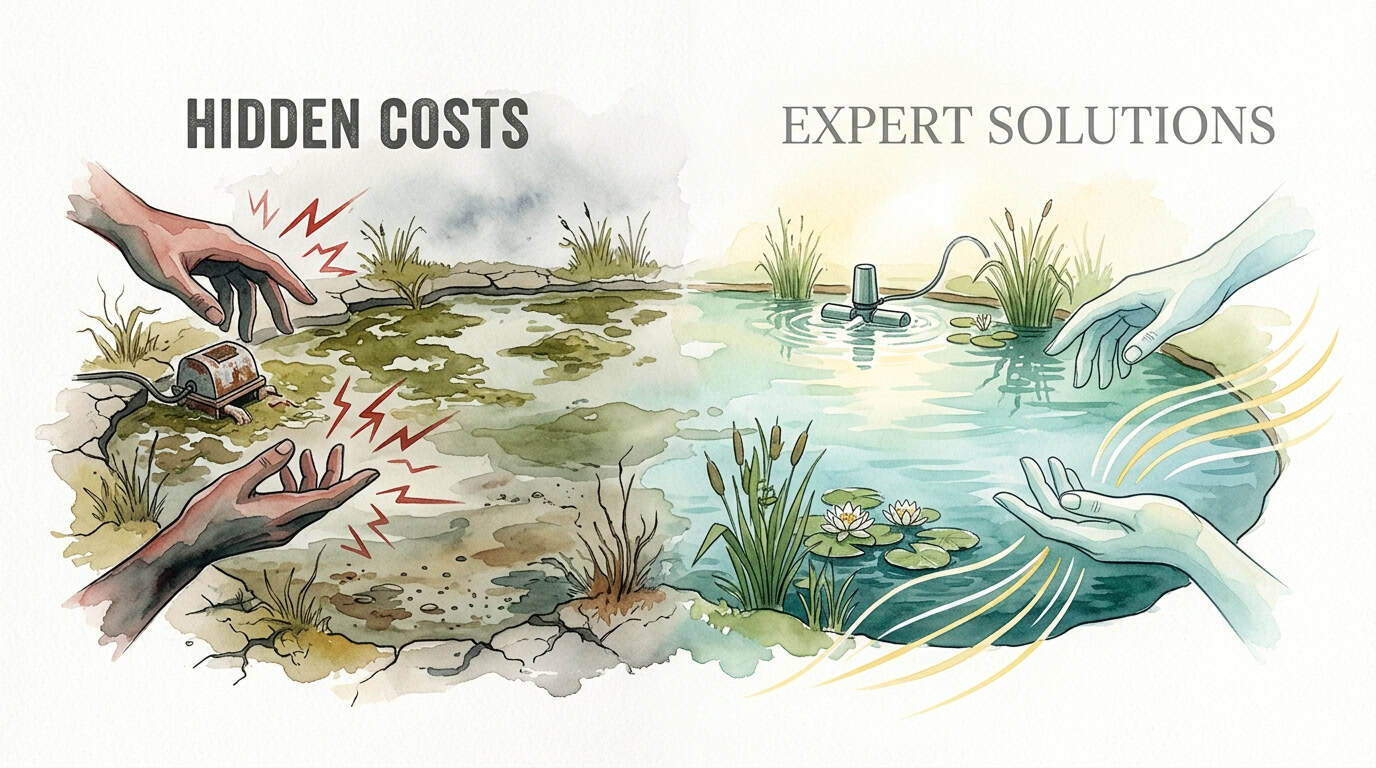
The ‘cheap’ quote leaves your ecosystem vulnerable. Real value is found in the protection that professional expertise provides. Choosing a pond company based solely on price is an invitation for disaster. From ecological collapse to equipment failure, the ‘exposed’ pond owner pays twice. See what true ‘sheltered’ management looks like.
Aquatic ecosystems are complex mechanical and biological systems that require precise calibration to remain stable. Many property owners view pond maintenance as a simple aesthetic task, comparable to lawn care. This misunderstanding leads to the selection of service providers based on the lowest hourly rate rather than technical competence.
Professional pond management involves the integration of limnology, mechanical engineering, and water chemistry. A failure in any of these areas creates a cascade of systemic issues. Inadequate oversight does not merely result in a less attractive pond; it creates significant financial and biological liabilities.
The Hidden Costs Of Hiring The Wrong Pond Management Company
Hiring an unqualified provider results in immediate and long-term financial drain. These costs often remain invisible until a catastrophic system failure occurs. Research indicates that remediation of a collapsed pond ecosystem can cost significantly more than the initial installation or years of proactive maintenance.

Biological liability is the most common hidden cost. Amateur providers frequently misdiagnose water quality issues or apply incorrect chemical treatments. Excessive algaecide application, for instance, causes rapid plant decay, which depletes Dissolved Oxygen (DO) levels and leads to mass fish mortality. The cost of replacing a mature koi population can range from several hundred to tens of thousands of dollars.
Mechanical degradation is a secondary financial burden. Unqualified technicians often overlook critical maintenance tasks such as cleaning pump intake screens or checking amp draw. A pump operating with a 30% increase in amp draw is a leading indicator of imminent failure. Replacing a high-end external centrifugal pump can cost over $1,000, excluding labor, while preventative maintenance only requires a fraction of that investment.
Structural risks also emerge when unskilled labor handles pond infrastructure. Inexperienced workers can puncture EPDM liners with improper footwear or tools. A slow leak often goes unnoticed for months, leading to inflated water bills and potential soil erosion around the pond’s foundation. Repairing such damage requires draining the system and professional leak detection services, adding thousands to the total cost of ownership.
Technical Operations: Defining Professional Oversight
Professional pond management is a data-driven process. It begins with an ecological baseline assessment to determine the specific needs of the waterbody. Technicians monitor parameters such as pH, ammonia, nitrites, nitrates, and phosphate levels to maintain the nitrogen cycle.
The nitrogen cycle is the primary biological process in any pond. Beneficial bacteria convert toxic ammonia into nitrites and then into less harmful nitrates. Professional management ensures that biological filtration media are properly colonised and oxygenated to support these bacteria. Without this technical oversight, ammonia spikes can occur, resulting in immediate stress or death for aquatic life.
Mechanical systems are managed through scheduled inspections. This includes backwashing bead filters, cleaning UV sterilizer sleeves, and inspecting impeller assemblies. Efficient mechanical filtration removes Total Suspended Solids (TSS) before they can decompose and contribute to the nutrient load of the pond. Professionals use flow capacity charts to ensure the pump GPH (Gallons Per Hour) matches the filter’s requirements and the pond’s total volume.

Measurable Advantages of Specialized Management
Longevity of equipment is a primary benefit of technical oversight. Routine maintenance extends the lifespan of external pumps from an average of 5 years to over 15 years. This tripling of service life represents a significant Return on Investment (ROI) for the property owner.
Energy efficiency is another quantifiable advantage. Modern variable-speed pumps can reduce electricity consumption by 40% to 70% compared to standard models. A professional company will calculate the optimal flow rate to maintain water clarity without wasting power. This optimization can save a pond owner $400 or more annually on utility costs.
Ecological stability prevents the “bloom and bust” cycles typical of amateur-managed ponds. By maintaining a stable nutrient balance and high DO levels, professionals prevent the massive algae blooms that plague neglected systems. This results in crystal-clear water and a healthy environment for fish and plants without the constant need for emergency chemical interventions.
Systemic Failure Points and Technical Oversight
One frequent mistake is the over-reliance on algaecides. While these chemicals provide a quick visual fix, they do not address the underlying cause of algae growth, which is typically excessive phosphates. Professionals focus on phosphate sequestration and nutrient management to provide a permanent solution.
Improper winterization is another common failure point. In colder climates, failing to properly shut down a system or install a de-icer can lead to ice damage in plumbing and anaerobic conditions under the ice. This often results in “spring kill,” where fish die as the ice thaws due to accumulated toxic gases. Expert technicians understand the thermodynamics of winter pond management and take steps to ensure a safe transition through the seasons.
Another error involves the sizing of filtration systems. Many budget contractors install filters that are rated for the total pond volume but fail to account for the “fish load.” A pond with a high population of koi requires significantly more biological filtration than a water garden of the same size. Professionals use biomass calculations to determine the correct filtration capacity.
Real-World Constraints and Ecological Boundaries
Technical pond management is limited by the initial design of the system. If a pond was built without a bottom drain or an adequate skimmer, even the best management company will face challenges in maintaining water clarity. In these cases, retrofitting or intensive manual cleaning may be required.
Environmental factors also play a role. Ponds located under heavy tree canopies or in areas of high agricultural runoff will always have higher nutrient loads. Management strategies must be adjusted to account for these external inputs. There is no “one-size-fits-all” solution; every ecosystem has specific carrying capacities that cannot be exceeded without risk of collapse.
Performance Comparison: Technical vs. Manual Approaches
The following table illustrates the differences between professional technical management and a standard “unskilled” approach.
| Metric | Professional Management | Unskilled Provider |
|---|---|---|
| Pump Lifespan | 10–15 Years | 2–5 Years |
| Water Clarity | Consistent / Year-round | Frequent Algae Blooms |
| Chemical Usage | Targeted / Minimal | Heavy / Reactive |
| Fish Health | Proactive Monitoring | High Mortality Risk |
| Annual Cost | Predictable / Stable | Volatile / High Repair Costs |
Optimization Protocols for System Longevity
Regular inspection of the pump’s electrical signature is a critical best practice. Technicians use multimeters to check for voltage drops or increases in amperage, which indicate mechanical wear. Early detection allows for the replacement of a $20 seal instead of a $600 motor.
Biological filters must be cleaned using pond water, not tap water. Chlorine in municipal water kills the beneficial bacteria living on the filter media, effectively resetting the nitrogen cycle and causing an ammonia spike. Professionals always use dechlorinators or pond water during the cleaning process to preserve the biological colony.
Aeration should be continuous, especially in summer months. Warm water holds less dissolved oxygen than cold water, and fish respiration increases with temperature. Installing a dedicated aeration system as a backup to the main pump ensures that fish remain safe even if the primary circulation system fails.
Advanced Hydro-Biological Management
Serious practitioners often use Oxidation-Reduction Potential (ORP) meters to measure the water’s ability to break down waste. A high ORP reading indicates healthy, well-oxygenated water, while a low reading suggests an accumulation of organic pollutants. This metric provides a more nuanced view of pond health than simple visual inspection.
Phosphate management through lanthanum-modified clay or specialized resins is another advanced technique. These products bind to phosphates, making them unavailable for algae growth. This “bottom-up” approach to nutrient control is more effective and sustainable than the “top-down” approach of using algaecides.
Integration of UV sterilization requires precise flow control. If the water passes through the UV chamber too quickly, the radiation dose will be insufficient to kill algae spores or pathogens. Professionals calculate the “dwell time” to ensure the system is operating at peak efficiency.
Financial Model: Maintenance vs. Remediation
Consider a 2,000-gallon koi pond. Professional maintenance might cost $1,800 annually. This includes monthly visits, all necessary water treatments, and routine equipment service. Over five years, the total investment is $9,000.
In contrast, an unskilled provider might charge $800 annually for superficial cleaning. However, this lack of expertise leads to a pump failure in Year 2 ($800 replacement), a major leak in Year 3 ($2,500 repair), and an ecological collapse in Year 4 resulting in the loss of $2,000 worth of koi and a $1,500 deep-cleaning fee. The total cost over five years for the “cheap” option rises to $10,800, plus the stress of a failing system.
Systemic neglect often results in a 20% to 30% higher total cost of ownership. The data clearly shows that paying for expertise upfront is the most efficient way to manage a pond as a long-term asset.
Final Technical Synthesis
The health and efficiency of a pond are directly linked to the technical competence of its management. Choosing a company based on price alone ignores the complex biological and mechanical realities of aquatic ecosystems. True value is found in the protection of the investment and the stability of the environment.
Reliable pond management requires a commitment to data, regular mechanical audits, and an understanding of nutrient cycles. Property owners should seek providers who use scientific metrics rather than guesswork. This approach ensures the longevity of equipment and the well-being of all aquatic life.

Application of these professional standards transforms a pond from a potential liability into a thriving, low-maintenance asset. Experimenting with advanced filtration or monitoring tools can further enhance system performance. Professional expertise provides the shelter necessary for an ecosystem to flourish over the long term.