

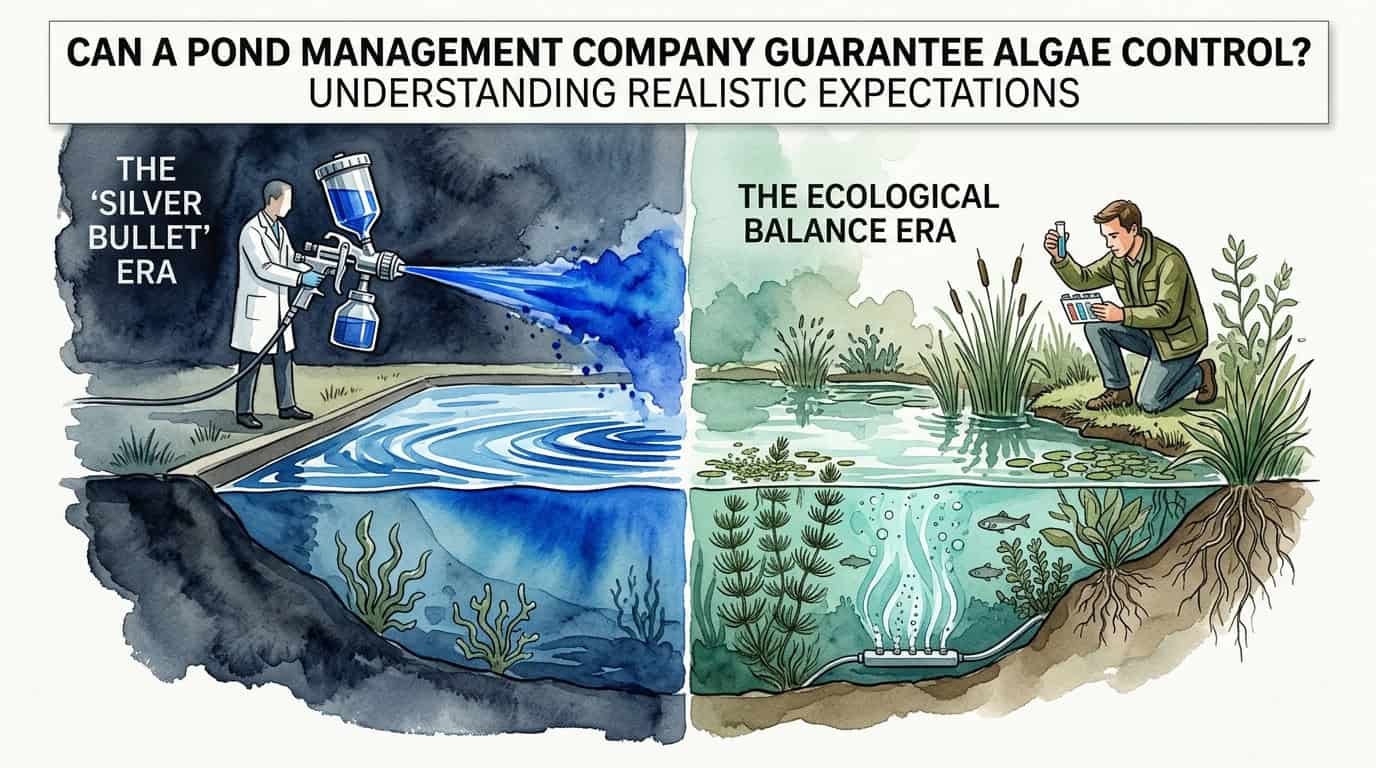
In the old days, we ‘guaranteed’ results with heavy chemicals. Today, we understand that nature doesn’t follow a contract. Back then, we thought we could dominate nature with a spray rig. Now, we know better. True algae control is about management, not ‘elimination.’ Here is why a guarantee might be a red flag for your pond’s health.
Managing an aquatic ecosystem requires a shift from the ‘Silver Bullet’ Era to the Ecological Balance Era. Modern pond management relies on data-driven interventions rather than brute-force chemistry. When a provider promises 100% eradication, they often overlook the complex biological variables that govern water quality.
Effective pond stewardship involves monitoring nutrient loading, dissolved oxygen levels, and microbial activity. This guide provides a technical breakdown of why management is the only scientifically sound approach to algae control. We will examine the mechanics of eutrophication and the strategies used to maintain a stable aquatic environment.
Can A Pond Management Company Guarantee Algae Control? Understanding Realistic Expectations
Pond management is the systematic regulation of an aquatic ecosystem to maintain specific aesthetic and biological standards. It exists because ponds are rarely closed systems; they are dynamic catchments for nutrients, sediments, and organic matter. In real-world situations, a pond acts as a biological reactor where sunlight, temperature, and nutrient concentrations drive primary production.

Guarantees in this field are problematic because algae are an essential, opportunistic component of the aquatic food web. Planktonic algae serve as the base of the food chain, supporting zooplankton and fish populations. Total elimination is not only impossible but biologically catastrophic, as it would lead to a collapse of the higher trophic levels.
Realistic expectations focus on ‘management’—reducing the frequency, duration, and intensity of algae blooms. A professional firm uses Integrated Pest Management (IPM) to balance the system. This approach acknowledges that factors like record-breaking heatwaves or heavy rain-driven nutrient runoff are outside of human control.
Think of a pond like a garden in a windstorm. A landscaper can pull weeds and fertilize the soil, but they cannot guarantee a weed will never sprout if the wind carries in new seeds. Similarly, a pond manager handles the internal environment, but external ‘nutrient seeds’ arrive with every rain event.
How Integrated Algae Management Works
Modern management utilizes a multi-tiered strategy to disrupt the life cycle of nuisance algae. The process begins with identifying the specific species, such as filamentous algae, planktonic algae, or macroalgae like Chara. Each type requires a different technical approach based on its cellular structure and nutrient requirements.
Nutrient Mitigation and Sequestration
Phosphorus is the primary limiting nutrient for algae growth in most freshwater systems. Management companies use nutrient binders such as Aluminum Sulfate (Alum) or Lanthanum-modified clay to sequester reactive phosphorus. These compounds bind with phosphate ions in the water column and lock them into the sediment, making them biologically unavailable to algae.
Mechanical Aeration and Circulation
Aeration systems, including submersed diffusers and surface fountains, increase dissolved oxygen (DO) levels throughout the water column. Higher DO levels support aerobic bacteria that decompose organic muck at the bottom. This process, known as oxidative decomposition, prevents the anaerobic release of phosphorus from the sediment, a phenomenon called internal loading.

Biological Augmentation
Introducing specific strains of beneficial bacteria and enzymes can accelerate the breakdown of organic matter. These microbes compete with algae for available nutrients like nitrogen and phosphorus. By ‘starving’ the algae of its food source, managers can suppress bloom formation without relying solely on chemical intervention.
Benefits of the Management Approach
Choosing a management-based strategy over a ‘guaranteed’ elimination model provides several long-term advantages for the pond owner. This methodology prioritizes the structural health of the ecosystem rather than just the visual symptoms.
- Ecosystem Stability: Gradual management prevents the ‘boom-bust’ cycle common in chemical-heavy programs, where massive algae die-offs lead to oxygen depletion and fish kills.
- Reduced Chemical Dependency: By addressing the root cause (nutrients), the need for copper-based algaecides decreases over time, reducing heavy metal accumulation in the sediment.
- Improved Water Clarity: Consistent nutrient sequestration and aeration result in lower turbidity and higher Secchi disk readings.
- Fisheries Health: Balanced planktonic algae levels ensure a healthy food web for game fish like bass and bluegill.
- Regulatory Compliance: Professional management ensures that treatments stay within the limits of National Pollutant Discharge Elimination System (NPDES) permits and local environmental laws.
Challenges and Common Mistakes in Algae Control
The most frequent pitfall in pond care is the ‘spray and pray’ mentality. This occurs when owners or inexperienced contractors treat algae blooms with heavy doses of copper sulfate without addressing the underlying nutrient load.
A common mistake is ignoring the pond’s watershed. If a pond receives runoff from a fertilized lawn or a cattle pasture, no amount of algaecide will provide lasting results. The continuous influx of nitrogen and phosphorus will simply fuel the next bloom as soon as the chemical dissipates.
Another challenge is the failure to maintain aeration systems. When compressors fail or diffusers clog, the pond’s bottom becomes anoxic. In an anaerobic state, the sediment releases massive amounts of stored phosphorus back into the water column, often resulting in a ‘catastrophic bloom’ that appears overnight.
Finally, many fail to identify the species correctly. Treating macroalgae like Chara with a product designed for planktonic algae is ineffective and wastes resources. Precise identification is the prerequisite for any successful management intervention.
Limitations of Professional Algae Management
Environmental constraints often dictate the success of a management program. Serious practitioners must acknowledge these boundaries to maintain credibility with their clients.
Environmental factors like extreme thermal stratification can limit the effectiveness of surface-level treatments. During peak summer, the thermocline prevents oxygen-rich surface water from reaching the bottom, creating a ‘dead zone’ where nutrients accumulate. Even the best management plans can be challenged by persistent temperatures exceeding 90°F.
The size and topography of the watershed also pose limitations. A small pond with a massive drainage basin will experience frequent ‘flushing’ events. During heavy rain, management efforts like dye or bacterial treatments are physically washed out of the system, requiring a complete restart of the management cycle.
Comparison: The ‘Silver Bullet’ vs. Ecological Management
The following table compares the outdated ‘guaranteed’ chemical approach with modern ecological management.
| Feature | ‘Silver Bullet’ (Outdated) | Ecological Management (Modern) |
|---|---|---|
| Primary Goal | 100% Eradication | Nuisance Level Suppression |
| Primary Tool | Copper Sulfate / Heavy Algaecides | Aeration, Bio-augmentation, Binders |
| Long-term Impact | Sediment toxicity / Resistant species | Improved biodiversity / Stable DO |
| Cost Structure | Low upfront, high recurring cost | Moderate upfront, lower maintenance |
| Success Metric | Visual ‘Cleanliness’ | Water Chemistry (N:P Ratios, DO) |
Practical Tips for Pond Owners
Immediate improvements in algae control can be achieved by focusing on the ‘low-hanging fruit’ of pond maintenance. These steps reduce the strain on the biological system.
- Establish Buffer Zones: Maintain a 15-to-50-foot strip of tall, native vegetation around the pond perimeter to filter out nutrients from lawn runoff.
- Monitor Muck Levels: Use a sludge judge to measure organic accumulation; if muck exceeds 6 inches, consider biological muck-digesting pellets.
- Implement Testing: Conduct seasonal water tests for Orthophosphate (PO4) and Nitrate (NO3) to predict bloom potential.
- Optimize Aeration: Ensure diffusers are placed in the deepest parts of the pond to maximize the volume of water being moved.
- Limit External Inputs: Stop using high-phosphorus fertilizers near the pond and discourage waterfowl, which contribute significant nutrient loads through waste.
Advanced Considerations: The Redfield Ratio and Ultrasonic Tech
Advanced practitioners look beyond simple visual cues and analyze the stoichiometry of the water. The Redfield Ratio (106 C : 16 N : 1 P) provides a baseline for the nutrients required by aquatic life. When the nitrogen-to-phosphorus ratio drops below 16:1, conditions become favorable for Cyanobacteria (blue-green algae), which can fix their own nitrogen from the atmosphere.
Ultrasonic algae control is another advanced tool. These devices emit specific sound frequencies that cause structural damage to the gas vesicles within blue-green algae cells. Without these vesicles, the algae lose buoyancy and sink to the bottom, where they cannot access sunlight for photosynthesis. This technology is particularly useful in large-scale applications where chemical costs are prohibitive.
Scaling these solutions requires an understanding of water volume (Acre-Feet) and flow rates. High-tech monitoring systems now use IoT-enabled sensors to track pH, ORP (Oxidation-Reduction Potential), and Chlorophyll-A levels in real-time, allowing managers to intervene before a bloom becomes visible.
Example Scenario: Managing a Eutrophic 2-Acre Pond
Consider a 2-acre pond with a maximum depth of 8 feet and a 10-year history of heavy algae growth. The ‘Silver Bullet’ approach would involve monthly applications of copper sulfate. While the pond would look clear for 10 days, the dead algae would sink, decay, and release more phosphorus, fueling a thicker bloom 20 days later.
Under an Ecological Management plan, the practitioner would:
1. Install a 1/2 HP submersed aeration system to eliminate the anoxic zone.
2. Apply a lanthanum-modified clay treatment to lock down the existing 0.5 mg/L of reactive phosphorus.
3. Introduce a maintenance dose of aerobic bacteria to digest the 4-inch muck layer.
Within one season, the dependence on algaecides would likely drop by 70%. The water remains stable because the ‘fuel’ for the algae has been removed from the reactor.
Final Thoughts
The era of ‘guaranteed’ algae elimination is over, replaced by a more sophisticated and sustainable era of management. True success in pond care is not found in a single bottle of chemical, but in the careful balancing of oxygen, nutrients, and biology.
By focusing on the root causes of eutrophication—primarily phosphorus loading and low dissolved oxygen—pond owners can achieve lasting results. While nature remains unpredictable, a data-driven management strategy provides the most reliable path to a healthy, functional water body.
We encourage pond owners to prioritize long-term ecosystem health over short-term visual fixes. Implementing these technical strategies today will ensure your pond remains a vibrant resource for years to come, rather than a cycle of chemical dependency.
