

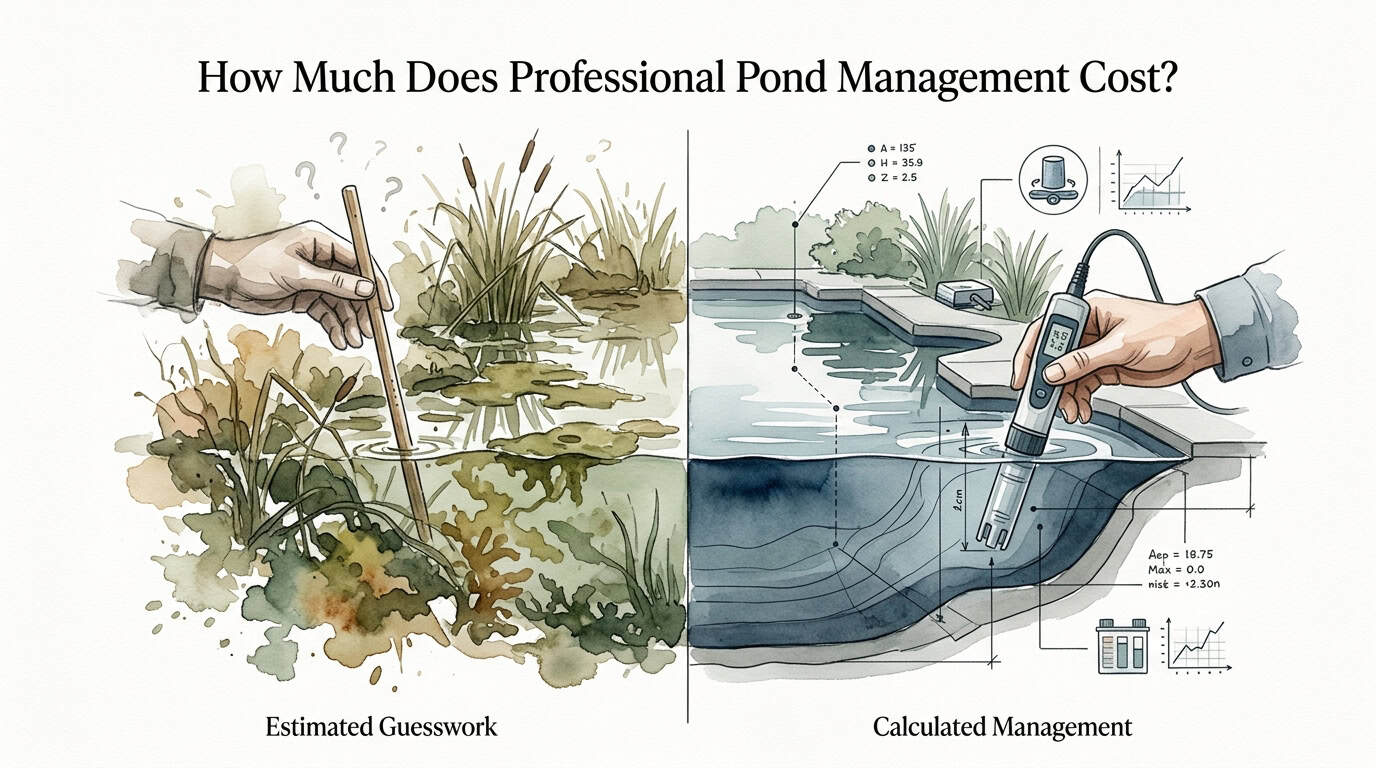
Stop paying for ‘average’ and start paying for ‘actual’. Wondering where your money goes? Professional pond management isn’t just about chemicals; it’s about data. We break down the costs of maintaining a healthy lake vs. the cost of neglect.
Aquatic ecosystems are dynamic biological reactors. Managing them requires a shift from visual assessments to empirical data. Most property owners view a pond as a static feature, but it is a complex system of nutrient cycling, gas exchange, and thermal stratification. When management is ignored, these systems default toward eutrophication, a state of excessive nutrient enrichment that leads to system failure.
Professional pond management utilizes technical precision to stabilize these environments. This guide examines the financial and mechanical requirements of professional-grade maintenance. We contrast the controlled costs of proactive management with the catastrophic, unforecasted expenses associated with ecosystem collapse. For the serious practitioner, understanding these metrics is the difference between an asset and a liability.
How Much Does Professional Pond Management Cost?
The cost of professional pond management is a function of acreage, biological load, and desired water quality parameters. On average, a standard annual contract for a 1-acre pond ranges from $2,000 to $5,000. This figure scales based on the intensity of the management required. For smaller residential ponds, monthly service fees typically fall between $170 and $450, while complex lake systems can exceed $10,000 annually.

These costs are not arbitrary. They are distributed across three primary categories: technical labor, chemical/biological inputs, and mechanical maintenance. Labor involves specialized technicians performing bathymetric surveys, water quality profiling, and biomass assessments. Input costs include high-purity algaecides, herbicides, and nutrient binders. Mechanical costs cover the operation and depreciation of aeration systems and fountains.
In real-world applications, a well-managed pond serves as a stormwater detention system or a high-value aesthetic asset. If the management budget is underfunded, the system accumulates organic “muck” at a rate of 1–3 inches per year. This accumulation eventually necessitates dredging, a mechanical intervention that costs between $20,000 and $75,000 per acre. Professional management is, fundamentally, an insurance policy against large-scale capital expenditures.
Mechanical and Chemical Implementation Strategies
Effective management begins with an audit of the pond’s physical and chemical status. This process moves beyond simple observation and into the realm of Calculated Management. The following systems form the core of a professional maintenance regime.
Water Quality Profiling
Technicians measure 14 to 20 distinct parameters to establish a baseline. Key metrics include Dissolved Oxygen (DO) levels, pH, alkalinity, and nutrient concentrations (Nitrogen and Phosphorus). Professional testing kits and lab analysis generally cost $200 to $432 per assessment. These data points dictate the precise dosage of treatments, preventing the waste of expensive chemical inputs.
Mechanical Aeration Systems
Subsurface aeration is the primary mechanical tool for maintaining aerobic conditions. These systems use shore-based compressors to push air through weighted tubing to diffusers on the pond floor. Installation costs for a 1-acre system range from $1,500 to $4,000. Operating costs are calculated based on motor amperage and local kilowatt-hour rates, typically totaling $15 to $60 per month for continuous 24/7 operation.
Nutrient Remediation
Chemical management focuses on limiting the bioavailability of phosphorus. Phosphorus is the primary driver of cyanobacteria (blue-green algae) blooms. Professional-grade binders, such as lanthanum-modified clay or aluminum sulfate, are applied based on volumetric calculations. This prevents the “Estimated Guesswork” approach of simply killing algae after it appears, which only recycles nutrients back into the sediment.

Benefits of Data-Driven Management
The primary advantage of professional management is the stabilization of the Nitrogen-to-Phosphorus (N:P) ratio. When this ratio is optimized, the ecosystem favors beneficial green algae over toxic cyanobacteria. This stabilization provides measurable benefits for the property owner.
Infrastructure longevity is significantly increased through proactive management. Stormwater ponds that are properly maintained maintain their designed volume for longer periods, deferring the multi-thousand-dollar cost of dredging for decades. Furthermore, professional management ensures compliance with local environmental regulations, avoiding municipal fines that can reach $500 per day for non-compliant discharge.
Property value preservation is another quantifiable benefit. Statistical analysis of waterfront properties indicates that frequent toxic algae blooms can reduce sale prices by up to 22%. Consistent management maintains the aesthetic and functional utility of the water body, protecting the underlying real estate investment.
Challenges and Common Pitfalls
The most common mistake in pond management is the “Reactive Cycle.” This occurs when a pond owner only applies treatment after a massive algae bloom is visible. This approach is inefficient and biologically dangerous. Killing a large volume of algae simultaneously leads to a rapid drop in Dissolved Oxygen as the organic matter decomposes. This often results in a total fish kill, an event that can cost thousands in restocking and disposal fees.
Another challenge is the misidentification of aquatic species. Applying a herbicide designed for submerged weeds to an emergent species is a waste of capital and can lead to chemical resistance. Professional management utilizes specific identification keys to ensure that the correct active ingredient—whether it be Diquat, Fluridone, or Glyphosate—is used at the minimum effective concentration.
Thermal stratification represents a physical barrier to health in deeper ponds. During summer, the top layer of water (epilimnion) becomes warm and oxygen-rich, while the bottom layer (hypolimnion) remains cold and becomes anoxic. This anoxic layer releases trapped phosphorus from the mud. Without mechanical destratification (aeration), the pond remains on the brink of a “turnover” event, which can crash the entire ecosystem in a matter of hours.
Limitations and Environmental Constraints
Pond management is not a cure-all for poor watershed planning. If a pond receives high-velocity runoff from heavily fertilized agricultural fields or golf courses, no amount of chemical treatment can fully stabilize the system. The phosphorus loading rate must be lower than the remediation rate for the pond to remain healthy. In these scenarios, the management plan must include upstream interventions like bioswales or buffer strips.
Environmental regulations also limit the types of interventions allowed. Some jurisdictions prohibit the use of copper-based algaecides due to their persistence in the sediment and toxicity to macroinvertebrates. In these areas, managers must rely on more expensive biological controls or ultrasonic technology, which increases the annual budget. Understanding these local boundaries is essential for any serious practitioner.
Estimated Guesswork vs. Calculated Management
The distinction between these two approaches determines the long-term viability of the aquatic asset. Below is a comparison of the technical outputs and cost efficiencies of each method.
| Feature | Estimated Guesswork | Calculated Management |
|---|---|---|
| Assessment Method | Visual inspection (color, clarity) | Multi-parameter lab analysis |
| Treatment Strategy | Reactive (kill after bloom) | Proactive (nutrient binding) |
| Cost Efficiency | High waste due to over-application | Optimized dosing based on volume |
| Equipment Life | Run to failure | Predictive maintenance schedule |
| Risk Profile | High (fish kills, toxic blooms) | Low (stabilized parameters) |
Practical Tips for Pond Optimization
To maximize the efficiency of a management plan, start by establishing a staff gauge or electronic sensor for water level monitoring. Evaporation and seepage change the total volume of the pond, which directly affects the concentration of any applied treatments. Adjusting dosages based on current volume rather than “design volume” can save 10–15% on chemical costs annually.
Install a 24-hour timer or a variable frequency drive (VFD) on your aeration system. While continuous operation is ideal for muck reduction, some systems can be pulsed during cooler months to reduce electricity consumption without sacrificing oxygen levels. Monitoring DO levels at dawn—the point of lowest daily oxygen—will tell you if your aeration runtime is sufficient.
Implement a “no-mow” buffer zone of 5 to 10 feet around the pond perimeter. This strip of native vegetation acts as a biological filter, trapping nitrogen and phosphorus before it enters the water column. This simple mechanical barrier can reduce the need for nutrient-binding chemicals by up to 30%, significantly lowering the annual management bill.
Advanced Considerations in Aquatic Engineering
For large-scale or high-sensitivity environments, advanced technologies like nanobubble generators and ultrasonic algae control are becoming the standard. Nanobubbles are extremely small (sub-micron) gas bubbles that remain suspended in the water column for weeks, providing a massive surface area for oxygen transfer and directly oxidizing organic matter in the sediment. While the initial investment is higher—often $10,000 to $25,000—the reduction in chemical dependency provides a long-term ROI.
Sonochemistry, or the use of specific ultrasonic frequencies, disrupts the cellular structure of algae without harming fish or higher plants. This is particularly effective for large reservoirs where chemical application is logistically difficult or prohibited. Serious practitioners should evaluate these technologies based on a 10-year Total Cost of Ownership (TCO) model rather than initial capital outlay.
Scenario: 3-Acre Lake Management Model
Consider a 3-acre community lake with a maximum depth of 12 feet. Under a “Neglect” scenario, the lake develops a 40% coverage of filamentous algae and invasive pondweed. The HOA faces a choice: pay for remediation or ignore the issue. Neglect leads to a 20% property value drop on $10 million of total waterfront value—a $2 million loss in community wealth.
Under a “Calculated Management” model, the annual budget is structured as follows: $3,500 for monthly inspections and lab work, $2,200 for nutrient binders and targeted herbicides, and $1,200 for aeration electricity and maintenance. The total annual spend is $6,900. Over 20 years, the community spends $138,000 to maintain a healthy lake, effectively preventing a multi-million dollar asset devaluation and a $150,000 dredging bill.
Final Thoughts
Professional pond management is a discipline defined by precision and foresight. Moving away from the era of “Estimated Guesswork” allows property owners and HOAs to treat their water bodies as controlled environments rather than unpredictable hazards. The data shows that the cost of proactive maintenance is a fraction of the cost of ecological restoration or property value loss.
By investing in aeration, regular water profiling, and nutrient remediation, you ensure that the system remains aerobic and balanced. These mechanical and chemical inputs work in tandem to extend the lifespan of the pond and maximize its utility. Whether you are managing a small backyard feature or a large municipal reservoir, the principles of data-driven management remain the same: monitor, measure, and mitigate.
We encourage you to audit your current maintenance spend. If your budget is focused primarily on “killing weeds” rather than “balancing nutrients,” you are paying for symptoms rather than solutions. Transitioning to a calculated approach will provide a more stable ecosystem and a more predictable financial future for your aquatic assets.