

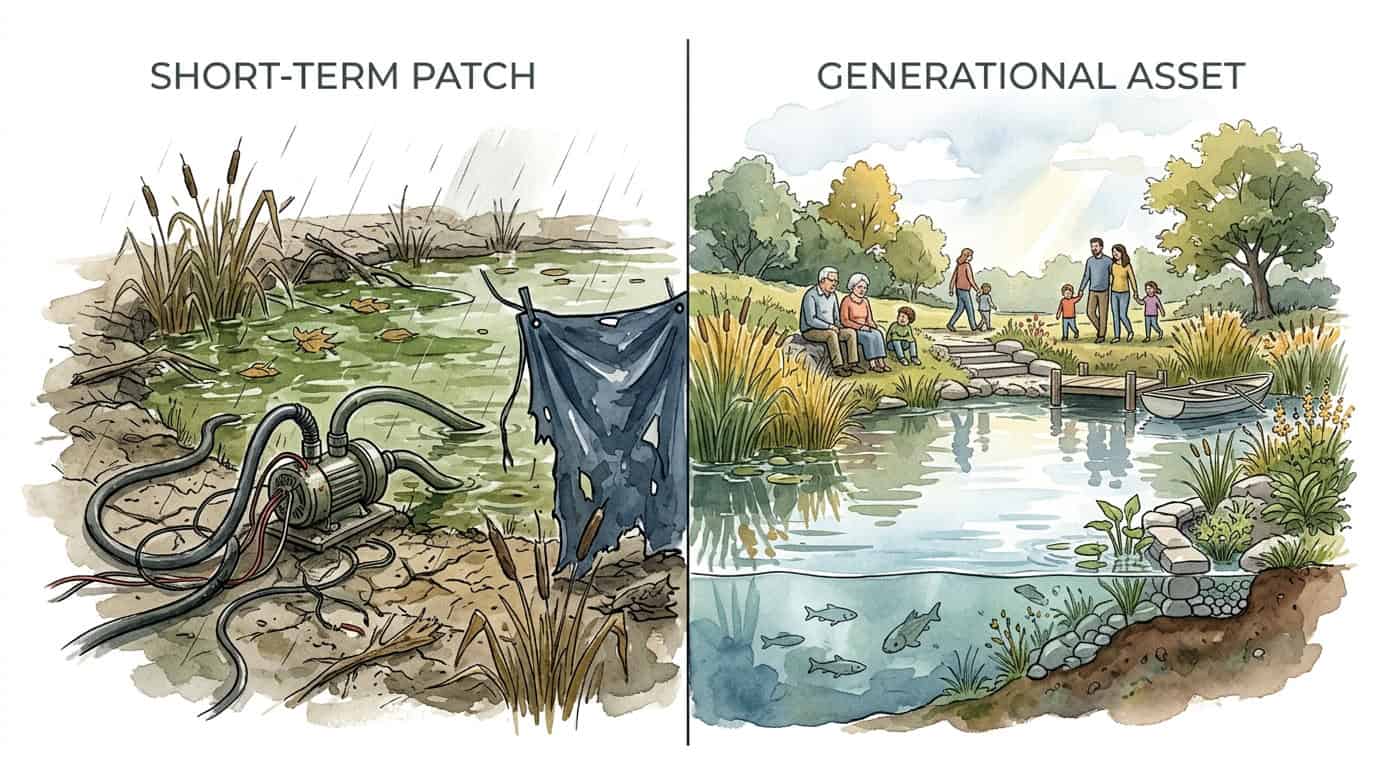
Is your contract for today’s fix or tomorrow’s future? Most pond contracts are designed to keep you paying. A legacy-minded contract is designed to make the pond healthy enough to need less help over time. Here’s what to look for.
A pond is not a static feature but a complex biological reactor. Standard management agreements often focus on aesthetic suppression—the removal of visible algae or weeds—rather than the stabilization of the underlying ecosystem. This reactive approach creates a dependency on chemical inputs, as the root causes of pond degradation remain unaddressed.
A technical, legacy-minded approach prioritizes the long-term structural and biological integrity of the waterbody. By focusing on nutrient sequestration, mechanical aeration, and biological augmentation, property managers can transition a pond from a liability into a generational asset.
Pond Management Contracts Explained: What You Should Know Before Signing
Pond management contracts are service agreements that define the scope, frequency, and technical methodology of aquatic maintenance. These contracts typically exist to manage stormwater compliance, recreational fishing health, or aesthetic standards for residential and commercial properties. In real-world applications, they range from simple “mow and blow” style aquatic weed control to high-level ecological restoration plans.

The standard contract structure is often “Reactive.” In this model, a technician visits the site, identifies a nuisance growth such as filamentous algae or duckweed, and applies a chemical herbicide or algaecide. This provides an immediate reduction in biomass but fails to address why the biomass appeared in the first place. This cycle typically repeats monthly, leading to a “chemical treadmill” where the pond requires increasing amounts of treatment as it matures and accumulates organic sediment.
A “Legacy-Minded” or “Proactive” contract focuses on the system’s trophic state. Trophic state refers to the total weight of biomass in a given waterbody at any time. High-nutrient (eutrophic) ponds are prone to frequent blooms and rapid sediment accumulation. Legacy contracts include provisions for water quality testing, nutrient remediation, and mechanical system maintenance to shift the pond toward a more stable, mesotrophic state.
How Proactive Pond Management Functions
Implementing a legacy-minded system requires a multi-faceted technical strategy that addresses the physics, chemistry, and biology of the water.
Initial Site Assessment and Data Baseline
Comprehensive management begins with a baseline assessment of physical parameters. This includes mapping the surface area and depth (bathymetry) to calculate the precise volume of the waterbody. Understanding volume is critical for accurate dosing of any biological or chemical inputs. Furthermore, a watershed analysis identifies external nutrient sources, such as lawn fertilizer runoff or agricultural drainage, that contribute to the pond’s nitrogen and phosphorus load.
Water Chemistry Calibration
Technicians must monitor specific chemical indicators to maintain a balanced environment. Dissolved Oxygen (DO) is the most critical metric; levels below 3.0 mg/L can trigger fish kills and shift decomposition from aerobic to anaerobic processes. pH levels should be maintained between 6.5 and 8.5 to ensure biological stability. Alkalinity and Hardness are measured to determine the water’s buffering capacity against pH swings, which can be caused by heavy rainfall or massive algae die-offs.
Biological Augmentation
Legacy contracts often utilize biological augmentation, which involves the regular introduction of specialized beneficial bacteria and enzymes. These microbes consume excess nutrients (nitrogen and phosphorus) and accelerate the decomposition of organic “muck” on the pond floor. This process reduces the available fuel for nuisance algae and can extend the time between required mechanical dredging operations by years or decades.

Mechanical Aeration Systems
Maintaining high DO levels throughout the water column often requires mechanical intervention. Submersed diffused aeration systems use a shore-based compressor to pump air to diffusers on the pond bottom. As bubbles rise, they create a vertical current that breaks up thermal stratification and ensures that oxygen reaches the sediment-water interface, where bacterial decomposition is most active.
Technical Benefits of the Legacy Approach
Choosing a legacy-minded contract over a reactive one provides measurable advantages in system stability and financial predictability.
Reduction in Chemical Dependency
By addressing nutrient loading, the system naturally supports less nuisance biomass. This leads to a significant reduction in the volume of algaecides and herbicides required. Over time, the cost of chemical inputs decreases, and the pond avoids the accumulation of heavy metals or synthetic compounds often found in cheaper treatment options.
Extended Infrastructure Lifespan
Standard ponds accumulate organic sediment at a rate of 0.5 to 1.0 inches per year. Without proactive management, this leads to shallowing, increased water temperatures, and eventually, the need for mechanical dredging. Dredging is the single most expensive maintenance event in a pond’s lifecycle. Legacy contracts that utilize muck-reducing bacteria can effectively “digest” this organic material, maintaining depth and delaying dredging indefinitely.
Asset Value Protection
Clear, well-managed waterbodies significantly impact property values. Technical data suggests that properties adjacent to high-quality waterbodies maintain higher resale values and lower vacancy rates in commercial settings. A healthy pond also provides better stormwater management, reducing the risk of localized flooding or infrastructure failure during extreme weather events.
Challenges and Common Contractual Mistakes
One of the most frequent errors in pond management is prioritizing the lowest monthly bid without reviewing the technical scope.
Failure to Specify Frequency
A contract that specifies “as needed” visits often leads to reactive treatments. Effective proactive management typically requires a minimum of two visits per month during the growing season to catch nutrient spikes and biological shifts before they manifest as visible problems.
Ignoring Mechanical Maintenance
Many contracts focus solely on the water, ignoring the pumps, fountains, and aeration systems. If a compressor fails and remains offline for several weeks, the resulting drop in DO can undo months of biological progress. Ensure the contract includes a preventative maintenance schedule for all mechanical components, including filter cleanings and vane replacements.
Misidentifying Vegetation
Applying a general algaecide to a pond infested with invasive vascular plants like Hydrilla or Parrotfeather is a common mistake. These plants require specific systemic herbicides. If the contract does not require a certified aquatic biologist or specialist to perform ID, the treatments may be ineffective, leading to wasted expenditure and continued plant spread.
Limitations and Environmental Constraints
Legacy-minded management is not a universal solution and faces specific realistic boundaries.
Structural Design Flaws
A pond built too shallow (less than 4 feet deep) will naturally reach higher temperatures, which limits oxygen solubility and promotes rapid plant growth. No amount of biological augmentation can fully compensate for a pond with poor physical geometry. In such cases, mechanical modification or intensive aeration is the only path to stability.
Extreme Nutrient Loading
If a pond receives direct runoff from a heavily fertilized golf course or a high-density livestock area, the influx of nutrients may exceed the biological capacity of the system to process them. In these scenarios, management must include “source control” measures, such as shoreline buffer strips or sediment forebays, to intercept nutrients before they enter the main waterbody.
Climatic Extremes
Prolonged heat waves or severe droughts can stress even the most well-managed systems. High water temperatures naturally hold less oxygen, and evaporation can concentrate pollutants. During these periods, the management plan must be flexible enough to increase aeration runtime or adjust biological dosing frequencies.
Reactive vs. Proactive Contract Comparison
The following table highlights the technical differences between a standard reactive agreement and a legacy-minded proactive agreement.
| Feature | Reactive Contract | Legacy/Proactive Contract |
|---|---|---|
| Primary Goal | Aesthetic suppression (clear surface) | Ecological stability (nutrient management) |
| Treatment Focus | Chemical algaecides/herbicides | Biologicals, aeration, and buffers |
| Data Collection | Visual inspection only | Full water quality lab analysis |
| Sediment Impact | Accumulates (increased muck) | Reduces (bacterial digestion) |
| Long-term Cost | High (due to eventual dredging) | Lower (deferred capital projects) |
Practical Tips for Evaluating a Contract
When reviewing a new management proposal, look for specific technical line items that indicate a commitment to long-term health.
- Demand a Bathymetric Map: Ensure the service provider has accurately calculated the pond’s volume. Estimates are insufficient for chemical or biological dosing accuracy.
- Verify Licensing: The technicians should hold state-specific certifications for aquatic pesticide application and, ideally, have an on-staff limnologist or aquatic biologist.
- Check the Service Log Requirements: The contract should mandate digital service reports for every visit, including Dissolved Oxygen readings at the surface and the bottom, Secchi Disk clarity measurements, and pH levels.
- Look for Nutrient Remediation: Specific mention of phosphorus-binding agents (like Lanthanum-modified clay or alum) or carbon-source biologicals indicates a proactive mindset.
- Assess Equipment Contingency: Determine the response time for aeration system failures. An oxygen crash can occur in as little as 24-48 hours in a eutrophic system.
Advanced Considerations in Aquatic Modeling
Serious practitioners should understand the role of Redox Potential (Reduction-Oxidation) at the sediment-water interface. In a pond with low oxygen, the sediment becomes anaerobic, which triggers the release of “legacy phosphorus” back into the water column—a process known as internal loading.
A sophisticated management plan uses high-efficiency aeration to keep the ORP (Oxidation-Reduction Potential) high, which keeps phosphorus locked in the sediment. This is often more effective than any surface treatment. Furthermore, managing the Nitrogen-to-Phosphorus (N:P) ratio can influence which types of algae dominate the system. For instance, a very low N:P ratio often favors the growth of cyanobacteria (blue-green algae), which can produce toxins. Proactive management seeks to balance these ratios to promote beneficial green algae and zooplankton, which serve as the base of a healthy food web.
Example Scenario: Remediation of a 1-Acre Retention Pond
Consider a typical 1-acre stormwater retention pond in a suburban development. After five years of reactive management (algaecide only), the pond has 6 inches of organic muck, frequent blooms, and a maximum depth that has decreased from 8 feet to 7.5 feet.
Scenario A: Continued Reactive Care
The HOA continues to spend $2,500 annually on chemical treatments. By year 10, the muck is 12 inches deep, and the pond is perpetually turbid. By year 20, the pond requires dredging, costing approximately $50,000 to $80,000.
Scenario B: Transition to Legacy Management
The HOA invests in a $4,000 diffused aeration system and shifts to a $3,500 annual legacy contract that includes biological augmentation. The bacteria digest 1 inch of muck per year. By year 10, the pond has returned to its original 8-foot depth. By year 20, the system remains stable, chemical use has dropped by 60%, and the $80,000 dredging expense is avoided. The total 20-year savings exceeds $40,000 while maintaining superior water quality throughout the period.

Final Thoughts
Pond management is an exercise in managing energy and nutrients. A legacy-minded contract recognizes that every chemical application is a temporary patch and that true stability comes from optimizing the system’s internal biological and mechanical processes. By focusing on data-driven metrics like dissolved oxygen and nutrient concentrations, property managers can ensure their waterbodies remain healthy and functional for decades.
Shift the focus from “killing weeds” to “building a healthy system.” This technical transition requires more effort in the assessment phase but delivers far greater efficiency and predictability in the long term. Experiment with biological augmentation and prioritize mechanical aeration to see how much more resilient a pond can become when it is managed for the future rather than just for today.