

Pond Talk is an Amazon Associate. As an Amazon Associate we earn from qualifying purchases.
Is your ‘clean’ pond actually a death trap for your ecosystem’s winter sleep? That fall ‘deep clean’ might be doing more harm than good. A sterile pond has no place for beneficial bacteria or hibernating amphibians to survive the frost. Learn why a little ‘mess’ is the secret to a thriving spring awakening.
Pond owners often equate cleanliness with health, but in the context of winter ecology, a sterile environment is a biological vacuum. When water temperatures drop below 10°C (50°F), the biological processes that maintain water quality do not stop; they merely shift in scale and metabolic pathway. Removing every trace of organic matter destroys the hibernacula required by amphibians and the carbon sources needed for winter-active microbes.
This article examines the mechanical and biological requirements of a winter pond through a technical lens. It focuses on the thermodynamics of ice cover, the gas exchange thresholds required for teleost fish survival, and the biochemical maintenance of a living biome. Understanding these variables is the difference between a successful spring awakening and a catastrophic “winter kill” event.

Winter Pond Ecology And Fish Survival
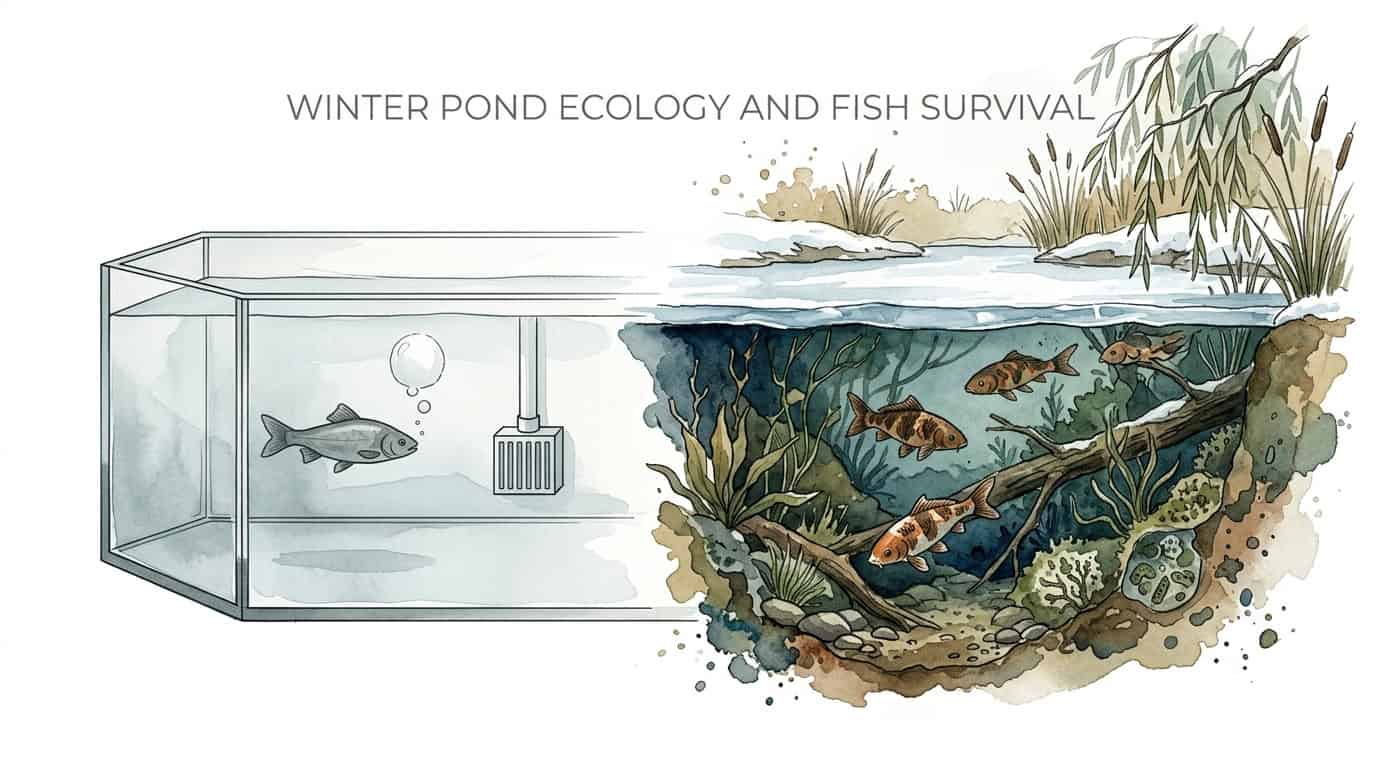
Winter pond ecology is governed by the unique physical properties of water and the poikilothermic nature of its inhabitants. Water reaches its maximum density at 3.98°C (39.16°F). This physical constant allows for thermal stratification, where the densest, “warmest” water sinks to the bottom, providing a thermal refuge for fish and invertebrates even when the surface is frozen.
Fish, such as Koi (Cyprinus rubiofuscus) and Goldfish (Carassius auratus), enter a state of torpor. In this physiological state, metabolic rates drop significantly, reducing oxygen demand and nutrient requirements. However, this metabolic suppression is not absolute. Fish still require a minimum dissolved oxygen (DO) concentration to maintain basal metabolic functions and must be able to vent metabolic byproducts like carbon dioxide ($CO_2$) and ammonia ($NH_3$).
The presence of ice cover creates a closed system. Without an interface for atmospheric gas exchange, the pond relies entirely on the initial dissolved oxygen bank and any supplemental aeration. If the rate of oxygen consumption by decomposing organic matter exceeds the replenishment rate, the system enters hypoxia. For most temperate freshwater fish, stress begins when DO levels fall below 5 mg/L, and mortality becomes probable below 2-3 mg/L.
Thermodynamics and Thermal Stratification
Maintaining the integrity of the thermocline is the primary objective of winter mechanical management. In a pond deeper than 1 meter, the bottom layer remains near 4°C. This temperature is sufficient for fish to survive the winter without metabolic collapse. Disruption of this layer through aggressive water movement can lead to “super-cooling,” where the entire water column approaches 0°C, leading to crystalline ice formation within the gill tissues of the fish.
Ice serves as an insulative barrier. While it prevents atmospheric gas exchange, it also shields the water from rapid temperature fluctuations caused by wind chill. A thick layer of snow on top of the ice further increases insulation but introduces a secondary risk: the blockage of photosynthetically active radiation (PAR). Without light, submerged plants and algae cannot produce oxygen, turning the pond from an oxygen producer to a net oxygen consumer via respiration and decomposition.
Mechanical optimization involves balancing the need for a “breathing hole” with the preservation of the thermal refuge. High-volume pumps that move water from the bottom to the surface are counter-productive in deep-freeze scenarios. Instead, specialized low-volume aerators or floating de-icers should be employed to maintain a small opening (typically 1-2% of the total surface area) without mixing the entire water column.
Dissolved Oxygen Dynamics and the Q10 Effect
The metabolic rate of aquatic organisms is often described by the $Q_{10}$ temperature coefficient, which suggests that for every 10°C decrease in temperature, the rate of biological processes decreases by a factor of approximately two to three. In winter, this means that while fish and bacteria are still active, they operate at a fraction of their summer efficiency.
Oxygen solubility is inversely proportional to temperature. Cold water can physically hold more oxygen than warm water. At 4°C, water at sea level can hold approximately 13 mg/L of DO at 100% saturation, compared to roughly 8 mg/L at 25°C. This increased “carrying capacity” is the biological safety net that allows fish to survive under ice. However, this safety net is rapidly depleted if the pond is overloaded with decaying organic matter (sludge).
Decomposition is an aerobic process. Heterotrophic bacteria consume oxygen as they break down leaves, fish waste, and dead algae. In a “sterile” tank, there is no buffer for these fluctuations. In a living biome, the established microbial colonies on the substrate and plant surfaces provide a more stable, albeit slower, rate of nutrient processing. The goal is not to remove all organic matter, but to manage the “biological oxygen demand” (BOD) to ensure it does not outpace the oxygen supply.
The Nitrogen Cycle in Cryogenic Conditions
The nitrogen cycle—the conversion of toxic ammonia ($NH_3$) to nitrite ($NO_2^-$) and then to relatively harmless nitrate ($NO_3^-$)—is temperature-dependent. The nitrifying bacteria, specifically Nitrosomonas and Nitrobacter, become significantly less active as temperatures drop below 10°C. By the time the water reaches 4°C, nitrification may be nearly at a standstill.
Ammonia toxicity is also influenced by pH and temperature. In cold water, ammonia primarily exists in its ionized form ($NH_4^+$), which is less toxic than the un-ionized form ($NH_3$). Furthermore, the suppressed metabolism of the fish means they excrete less ammonia than they do in the summer. These factors generally prevent ammonia spikes in well-maintained winter ponds, provided that the owner does not continue feeding the fish once temperatures drop below the 10°C threshold.

A “sterile” pond lacks the surface area (bio-media, gravel, rocks) for these bacteria to colonize in sufficient numbers to survive the winter. When the pond is “deep cleaned” in the fall, the beneficial biofilm is often stripped away. This leaves the pond vulnerable in the spring during the “New Pond Syndrome” phase, where fish activity increases before the nitrifying bacteria have had time to repopulate.
Hydrogen Sulfide and Anaerobic Toxicity
The most significant chemical threat in a winter pond is the accumulation of Hydrogen Sulfide ($H_2S$). This gas is a byproduct of anaerobic decomposition, occurring in the “dead zones” at the bottom of the pond where oxygen has been completely depleted. $H_2S$ is highly toxic to fish, with lethal concentrations as low as 0.002 mg/L—ten times more toxic than chlorine.
In a pond with excessive leaf litter and no gas exchange, the bottom layer becomes anoxic. Sulfate-reducing bacteria begin to process the organic muck, releasing $H_2S$ gas. Because the pond is sealed by ice, this gas cannot escape. It dissolves into the water column and eventually reaches the fish in the thermal refuge. This is a common cause of “spring melt” discoveries, where fish appear healthy but have died from gas poisoning.
Preventative measures include removing excessive (but not all) organic debris in the fall and ensuring constant, gentle aeration. An aerator placed 30-45 cm (12-18 inches) below the surface provides enough circulation to prevent $H_2S$ buildup without disturbing the bottom thermocline. If a “rotten egg” smell is detected when the ice begins to thaw, it is a definitive sign of anaerobic activity and $H_2S$ accumulation.
Hibernaculum Architecture for Amphibians
Frogs, toads, and salamanders do not survive the winter in a sterile environment. Many species, such as the Bullfrog (Lithobates catesbeianus) and Green Frog (Lithobates clamitans), overwinter underwater. They rely on cutaneous respiration—absorbing oxygen directly through their skin—while buried in the substrate or tucked into crevices.
A “clean” pond with a bare liner provides no insulation or protection for these animals. A living biome includes a layer of silt, leaf litter, or specialized “hibernaculum” structures. These structures provide a micro-environment where the temperature is stable and the animal is protected from predators. A small amount of deciduous leaf litter (e.g., oak or maple) provides the necessary cover without creating an overwhelming biological oxygen demand.
Amphibians are also sensitive to the same gas exchange requirements as fish. If the pond becomes completely anoxic, hibernating frogs will suffocate. Maintaining a hole in the ice is as critical for the local frog population as it is for the expensive Koi. The “mess” at the bottom of the pond is actually a complex architecture of survival for the ecosystem’s smaller inhabitants.
Mechanical Optimization: Aeration vs De-icing
Effective winterization requires a strategic choice between aeration and de-icing. While both aim to maintain an opening in the ice, they operate on different mechanical principles and provide different benefits to the ecosystem.
Floating De-icers: These are essentially heating elements (ranging from 100W to 1500W) designed to melt a small hole in the ice. They are highly reliable and “guarantee” an opening even in sub-zero temperatures. However, they do not actively oxygenate the water. They are most efficient in small to medium ponds where gas venting is the primary concern rather than oxygen saturation.
Pond Aerators (Bubblers): These use a compressor to push air through an air stone. The rising bubbles create a “chimney” effect, pulling warmer water from the mid-levels to the surface to keep a hole open. Aerators provide the dual benefit of gas venting and direct oxygenation. They are significantly more energy-efficient than heaters, often drawing only 10-40 watts.
The Hybrid Approach: For most climates, the optimal setup is a low-wattage aerator placed at a shallow depth (30-50 cm), paired with a thermostatically controlled de-icer. The aerator provides the bulk of the oxygenation and maintains the opening during moderate cold, while the de-icer acts as a fail-safe during extreme cold snaps when the aerator’s surface disturbance might not be enough to prevent freezing.
Benefits of the Living Biome Approach
Choosing a living biome over a sterile tank offers several measurable advantages for long-term pond health and maintenance efficiency. A balanced ecosystem is more resilient to environmental stressors and requires less chemical intervention.
- Microbial Buffering: Established biofilms on rocks and gravel provide a massive surface area for beneficial bacteria. These bacteria act as a biological filter that continues to process nutrients even at low temperatures, preventing the accumulation of toxic byproducts.
- Natural Habitat: Providing hibernacula for amphibians and invertebrates supports local biodiversity. These organisms return the favor in the spring by controlling pests like mosquitoes and contributing to the pond’s overall nutrient cycle.
- Spring Stability: Ponds that maintain a healthy biological balance over the winter experience fewer “algae blooms” in the spring. The existing microbial community is ready to expand as soon as temperatures rise, out-competing opportunistic algae for available nutrients.
- Reduced Mechanical Load: A healthy biome can handle a small amount of organic input without collapsing. This reduces the need for aggressive filtration and high-energy equipment, leading to lower operating costs.
Challenges and Common Mistakes
The most frequent error in winter pond management is the “Over-Cleaning” trap. Driven by aesthetic concerns, pond owners remove the very elements—silt, some leaf litter, and beneficial algae—that provide the ecosystem’s winter foundation. This creates a sterile environment that is highly susceptible to temperature swings and chemical imbalances.
Another common mistake is improper aerator placement. Placing an air stone at the very bottom of a deep pond will circulate the 4°C water to the surface, where it is chilled by the air and returned to the bottom. This “super-cools” the pond, effectively eliminating the thermal refuge and potentially killing the fish. Aerators should always be placed in the upper half of the water column during winter.
Feeding fish in cold water is a high-risk behavior. As metabolism slows, fish lose the ability to digest protein-rich foods. Undigested food can rot in the gut, leading to internal infections (Enteritis). Additionally, any uneaten food contributes directly to the ammonia load and BOD. Feeding should cease entirely when water temperatures consistently stay below 10°C (50°F).
Technical Comparison: Aeration vs. De-icing Systems
The following table compares the two primary mechanical strategies for maintaining gas exchange in a winter pond based on technical and operational metrics.
| Metric | Floating De-icer (Heater) | Pond Aerator (Bubbler) |
|---|---|---|
| Primary Function | Thermal ice melting | Oxygenation and Circulation |
| Energy Consumption | High (100W – 1500W) | Low (10W – 60W) |
| Oxygenation Efficiency | Passive (Surface Diffusion) | Active (Mechanical Diffusion) |
| Reliability in Deep Freeze | Excellent | Moderate (Surface may seal) |
| Risk of Super-cooling | Zero | Moderate (If placed too deep) |
| Initial Cost | Low to Moderate | Moderate to High |
Practical Tips for Winter Preparation
Immediate action can be taken to optimize a pond for winter survival. These steps focus on mechanical efficiency and biological stabilization before the first hard freeze.
- Install a Winter Aerator: Ensure the air stone is positioned roughly 30-45 cm below the water surface. This provides gas exchange while leaving the bottom 4°C layer undisturbed.
- Selective Organic Removal: Remove large debris and excessive sludge using a pond vacuum or net, but leave a thin layer of silt and a few handfuls of leaves for amphibian cover.
- Monitor Water Chemistry: Use a high-quality test kit to check Ammonia, Nitrite, and pH before the ice forms. High levels now will only become more dangerous under ice.
- Check Equipment Seals: Cold temperatures can cause gaskets and hoses to become brittle. Inspect all aeration lines for leaks and ensure the compressor is housed in a dry, ventilated area.
- Snow Management: After a heavy snowfall, clear a portion of the snow from the ice surface. This allows light to reach submerged plants, maintaining natural oxygen production.
Advanced Considerations: Monitoring and Metrics
For the serious practitioner, winter management can be enhanced through the integration of electronic monitoring. Utilizing sensors for Dissolved Oxygen (DO) and Oxidation-Reduction Potential (ORP) provides real-time data on the pond’s health status under the ice.
ORP Monitoring: ORP measures the “cleansing power” of the water. High ORP (above 250mV) indicates a healthy, aerobic environment where waste is being oxidized. A dropping ORP is an early warning sign of anaerobic activity and potential $H_2S$ production, often occurring weeks before any visible signs of distress in the fish.
Remote Temperature Sensing: Installing multiple temperature probes at different depths (surface, mid-level, bottom) allows the owner to monitor the stability of the thermocline. If the bottom temperature begins to drop toward 1°C or 2°C, it indicates that the aeration system is causing too much mixing and needs to be adjusted.
Automated De-icers: Utilizing a thermostatic switch that only activates the de-icer when the air temperature falls below freezing can significantly reduce energy costs. Modern “smart” pond controllers can manage these systems based on real-time weather data and water temperature trends.
Example Scenario: The 5,000-Liter Koi Pond
Consider a 5,000-liter (approx. 1,300 gallon) Koi pond in a climate where the surface stays frozen for three months. A “sterile” approach would involve a full fall cleanout, removing all rocks and substrate, and running a high-powered 1500W heater. This would cost approximately $150–$200 in electricity over the winter and leave the pond sterile and vulnerable in the spring.
The “Living Biome” approach for the same pond involves leaving the bottom gravel intact, removing 80% of the fallen leaves, and installing a 40W aerator with two air stones at a depth of 40 cm. Total electricity cost is less than $15. The fish remain in the 4°C bottom refuge, while the aerator maintains a 30 cm opening for gas exchange. In the spring, the established bacteria in the gravel quickly ramp up production as the water warms, resulting in clear water and healthy fish with zero chemical additives required.
Final Thoughts
The successful overwintering of a pond ecosystem requires a transition from aesthetic-driven maintenance to biology-driven management. A “perfectly clean” pond is a high-risk environment that lacks the thermal and biological buffers necessary for survival in extreme conditions. By preserving a living biome, pond owners can leverage natural processes to maintain water quality and support biodiversity.
Mechanical optimization, specifically the careful placement of aeration equipment and the strategic use of de-icers, ensures that gas exchange is maintained without compromising the thermal refuge of the fish. Understanding the technical metrics of dissolved oxygen, hydrogen sulfide toxicity, and the nitrogen cycle allows for a proactive approach to pond health.
As spring approaches, the benefits of this balanced approach become evident. A pond that has “slept” in a living biome will awaken with a robust microbial community, a thriving population of amphibians, and healthy, unstressed fish. This stability is the hallmark of a truly successful water feature, proving that in nature, a little “mess” is often the foundation of life.
Amazon and the Amazon logo are trademarks of Amazon.com, Inc, or its affiliates.