

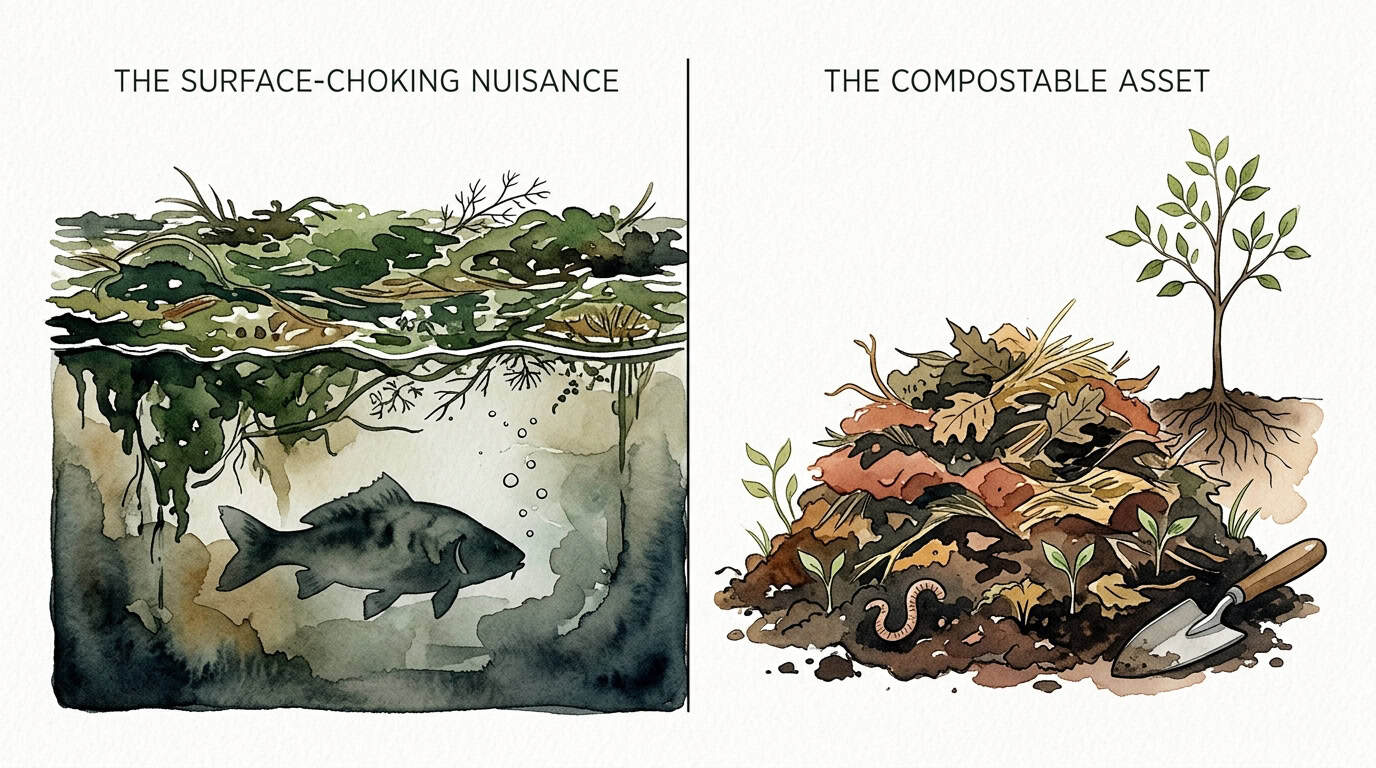
The green blanket killing your fish is actually ‘green gold’ for your garden. If you manage it right. Floating weeds like Duckweed act like a lid on a jar, trapping gases and blocking oxygen. Learn how to clear it and use the waste for your soil. #Duckweed #PondCare #OrganicGardening
Pond management frequently involves the mitigation of Lemnaceae, a family of small, free-floating aquatic plants commonly referred to as duckweed. While these organisms provide significant ecosystem services in controlled environments, their rapid biomass accumulation in ornamental or agricultural ponds often leads to severe ecological imbalance.
The transition from a healthy aquatic system to a hypoxic environment occurs rapidly due to the exponential growth rates of these plants. Understanding the mechanical and biological drivers of this process is essential for any practitioner looking to transform a pond nuisance into a high-value agricultural input.
This guide analyzes the technical specifications of duckweed growth, the mechanical requirements for efficient removal, and the biochemical transformation necessary to utilize the resulting biomass as a nutrient-dense soil amendment.

Floating Pond Weeds: Why Surface Coverage Can Lead To Fish Kills
The presence of a continuous layer of floating macrophytes creates a physical barrier at the air-water interface, effectively sealing the pond. This “lid” effect disrupts the primary mechanisms of oxygenation that are critical for the survival of teleost fish and other aerobic aquatic organisms.
Atmospheric oxygen typically enters pond water through diffusion and mechanical agitation, such as wind-driven surface ripples. A dense mat of duckweed—which can reach thicknesses of several centimeters—attenuates wind energy and creates a stagnant boundary layer. Data suggests that dense floating macrophyte coverage can reduce gas exchange rates by over 50%, significantly limiting the replenishment of dissolved oxygen (DO).
Simultaneously, this green canopy acts as a highly efficient light filter. Duckweed possesses a high concentration of chlorophyll and other pigments that absorb Photosynthetically Active Radiation (PAR) in the 400–700 nm range. When surface coverage reaches 100%, light penetration into the water column is effectively terminated.
This lack of light halts the photosynthesis of submerged aquatic vegetation (SAV) and phytoplankton. In a healthy pond, these organisms are the primary internal producers of oxygen. Without light, they switch to a net respiratory mode, consuming the remaining oxygen while producing carbon dioxide. The resulting hypoxia is often compounded by the accumulation of methane (CH4) and hydrogen sulfide (H2S), which become trapped under the weed mat and further toxify the environment for fish.
The Proliferation Kinetics of Lemnaceae
Managing duckweed requires a precise understanding of its doubling time and biomass production capacity. Under optimal conditions—characterized by high nitrogen availability, water temperatures between 20°C and 30°C, and sufficient light—duckweed is among the fastest-growing vascular plants on Earth.
Exponential growth is the standard for these organisms. Studies on Lemna minor and Spirodela polyrhiza indicate doubling times ranging from 1.34 to 4.54 days. This means a negligible population of 100 fronds can colonize an entire pond surface within two to three weeks if nutrient levels are high.

Relative growth rates (RGR) are typically measured in grams of dry weight per square meter per day (g/m²/d). Documented yields for harvested systems range from 17.9 to 24 tons of dry biomass per hectare per year. This high productivity is driven by the plant’s simplified morphology; because it lacks structural tissue like stems or complex root systems, nearly all absorbed energy is directed into frond replication.
Nitrogen and phosphorus uptake is the primary mechanical fuel for this growth. Duckweed acts as a highly efficient biological filter, capable of removing up to 90% of ammonia and 60-80% of phosphorus from nutrient-rich runoff or wastewater. However, once the available surface area is saturated, the plant enters a density-dependent growth phase where older fronds die and sink, contributing to the Biological Oxygen Demand (BOD) at the pond bottom.
Mechanical Harvesting and Skimming Efficiency
Effective management necessitates the removal of biomass before it reaches a critical density. Mechanical removal is the preferred method for practitioners who intend to use the weed as a resource, as chemical herbicides render the biomass toxic for garden or livestock use.
Manual skimming is the most accessible method for small-scale operations. Using a fine-mesh net or a modified pond rake allows for the collection of surface fronds. However, the labor-to-yield ratio is high. For larger systems, automated or semi-automated skimmers provide a more efficient solution.
Flow-based collection systems utilize the pond’s existing circulation. Strategic placement of aeration jets or water pumps can create surface currents that drive the duckweed toward a fixed collection point. A weir-style skimmer—similar to those used in swimming pools but scaled for pond volumes—can continuously capture floating biomass.
Efficiency metrics for mechanical harvesters are determined by the capture rate per kilowatt-hour or man-hour. Automated systems are most effective when they operate on a 25% to 50% harvest protocol. Removing half of the surface coverage at regular intervals keeps the remaining plants in their peak exponential growth phase, maximizing both nutrient removal from the water and biomass yield for the garden.
Biomass Characterization: The Chemical Profile of ‘Green Gold’
The value of duckweed as “green gold” is found in its biochemical composition. When harvested from nutrient-rich waters, the dry matter of duckweed is an exceptional source of nitrogen and minerals.
Protein content in duckweed typically ranges from 20% to 45% of its dry weight. This is significantly higher than many terrestrial forage crops and is comparable to soybean meal. This protein is rich in essential amino acids, particularly lysine and methionine, which are often limiting factors in organic fertilizers and animal feeds.
The NPK (Nitrogen-Phosphorus-Potassium) ratio of dried duckweed is approximately 4-1-3 or 5-1-2, depending on the water chemistry of the source pond. This makes it a balanced, slow-release fertilizer. It also contains significant concentrations of trace elements, including iron, manganese, and zinc, which are often depleted in garden soils.
Wet biomass consists of approximately 95% water. This high moisture content is the primary challenge in processing. For every 100 kilograms of harvested wet weed, only 5 kilograms of usable dry matter is recovered. Optimization of the drying or composting process is therefore critical to making the resource management viable.
The Composting Protocol: Converting High-Moisture Biomass
Direct application of wet duckweed to soil can lead to anaerobic conditions and unpleasant odors due to rapid decomposition. A structured composting protocol is necessary to stabilize the nutrients and reduce the volume of the material.
The Carbon-to-Nitrogen (C:N) ratio of fresh duckweed is approximately 8:1 to 10:1. This is “too hot” for efficient composting, as the ideal starting ratio for microbial activity is 30:1. If composted alone, the excess nitrogen will be lost as ammonia gas, and the pile will become sludgy and anaerobic.
Successful composting requires the addition of carbon-rich “brown” materials. Straw, shredded cardboard, or dried leaves should be mixed with the harvested duckweed at a volume ratio of roughly 3 parts carbon to 1 part duckweed. This balances the C:N ratio and provides the structural porosity needed for oxygen to reach the center of the compost pile.
Moisture management is the second technical hurdle. Since duckweed is 95% water, the compost pile can easily become oversaturated. Spreading the harvested weed on a mesh screen for 24 hours to air-dry before adding it to the compost pile can remove up to 30% of the surface moisture, significantly improving the aerobic decomposition rate.
Challenges: Heavy Metal Bioaccumulation and Pathogen Vectors
Practitioners must account for the phytoremediation capabilities of duckweed when planning its use in a garden. These plants are hyperaccumulators, meaning they actively absorb and concentrate heavy metals such as lead, cadmium, and chromium from the water.
If the pond receives runoff from industrial areas, treated lumber, or old lead-painted structures, the harvested duckweed may contain concentrations of metals that are unsafe for food-producing gardens. Testing the pond water for contaminants is a necessary step for those using duckweed as a primary fertilizer.
Pathogen management is also a consideration. Ponds that serve as watering holes for livestock or are frequented by high volumes of waterfowl may harbor E. coli or Salmonella. While the composting process—specifically the thermophilic phase where temperatures reach 55°C to 65°C—is generally sufficient to neutralize these pathogens, cold-composting or direct mulching carries a higher risk of transfer.
Limitations: When This Method May Not Be Ideal
Resource recovery from duckweed is not suitable for every environment. Spatial constraints and climate play significant roles in the viability of the system.
Low-temperature environments significantly reduce the growth rates of Lemnaceae. Most species enter a dormant state or produce starch-filled fronds called turions that sink to the bottom when water temperatures drop below 7°C. In regions with short growing seasons, the biomass yield may not justify the mechanical investment required for harvesting.
Deep, low-nutrient (oligotrophic) ponds are also poor candidates for duckweed cultivation. Because these plants require high levels of dissolved nitrates and phosphates, they will not thrive in clean, clear water. Attempting to force growth by adding fertilizers to such a pond can lead to unwanted algal blooms or the degradation of water quality for native species.

Comparison: The Surface-Choking Nuisance vs. The Compostable Asset
The following table compares the impact of unmanaged duckweed growth versus a managed harvesting system.
| Factor | Unmanaged (Nuisance) | Managed (Asset) |
|---|---|---|
| Dissolved Oxygen | Depleted ( | Maintained (5-8 mg/L) |
| Fish Survival | High mortality risk | Optimal health |
| Nutrient Export | Zero (Nutrients recycle internally) | High (Manual/Mechanical export) |
| Biomass Utility | Forms anaerobic muck | High-quality fertilizer/feed |
| Water Clarity | Poor/Turbid | Improved (Bio-filtration) |
Practical Tips for Pond and Garden Integration
Immediate application of these principles can significantly improve both pond health and garden productivity.
- Monitor surface coverage: Never allow duckweed to cover more than 50% of the pond’s surface. This ensures enough open water for gas exchange and light for submerged plants.
- Use floating booms: Install inexpensive floating barriers or pool noodles to corral duckweed into specific “harvest zones.” This prevents the wind from scattering the plants and makes skimming much faster.
- Thin the “herd” regularly: Harvesting small amounts weekly is more effective than large-scale removal once a month. Regular thinning keeps the remaining plants in the exponential growth phase.
- Sheet mulching: If composting is too labor-intensive, duckweed can be used as a “green” layer in sheet mulching (Lasagna gardening). Sandwich a thin layer of wet duckweed between thick layers of straw or wood chips to prevent odors.
Advanced Considerations: Industrial Scalability and Biorefineries
Serious practitioners may consider scaling duckweed production for commercial or high-intensity agricultural use. The concept of a “duckweed biorefinery” involves the systematic extraction of proteins, starches, and pigments from the biomass.
Optimizing for protein yield involves maintaining the water’s ammonia-nitrogen levels at specific thresholds. If nitrogen is limited, the plants will naturally transition to starch production (up to 75% dry weight), which is ideal for ethanol production but less valuable for soil amendment or feed.
Mechanical dewatering is the most critical component of a scaled system. Using a screw press or centrifuge can reduce the water content from 95% to 60% almost instantaneously. This makes the biomass significantly easier to transport and accelerates the composting or drying process by several weeks.
Implementation Scenario: Calculating Yield
Consider a 1/4-acre pond (approximately 1,000 square meters). If the pond is maintained at 50% duckweed coverage with an average growth rate of 15 g/m²/d of dry matter, the daily yield would be approximately 7.5 kilograms of dry biomass.
Over a 180-day growing season, this results in 1,350 kilograms of dry fertilizer. Given an average nitrogen content of 4%, this single small pond exports 54 kilograms of pure nitrogen from the water into the garden. This is equivalent to approximately 117 kilograms of high-quality urea fertilizer, achieved entirely through biological recovery.
Final Thoughts
Managing floating pond weeds requires a shift in perspective from viewing them as a nuisance to seeing them as a functional component of a closed-loop nutrient system. The risk of fish kills and ecosystem collapse is high when duckweed is left uncontrolled, but the rewards of a managed system are substantial.
By employing regular mechanical harvesting and structured composting, practitioners can protect their aquatic environments while producing a sustainable, high-protein organic input for their land. The data confirms that these simple plants are indeed “green gold” for those willing to manage the mechanics of their growth.
Experimentation with different harvesting intervals and compost mixtures will help refine the process for specific local conditions. Transforming waste into a resource is the hallmark of efficient land management.