

Rain shouldn’t be a ‘growth trigger’ for weeds. Here is how to stop the runoff cycle. Heavy rain washes nitrogen and phosphorus from the surrounding land into your pond. It’s a feast for weeds! Learn how to buffer your pond from storm-driven nutrient spikes.
Manage an aquatic ecosystem as a hydraulic and chemical system rather than a decorative landscape feature. Every significant precipitation event functions as a nutrient delivery vehicle, transporting dissolved and particulate contaminants from the catchment area directly into the water column. Without a mechanical or biological interceptor, this loading creates a spike in bioavailable nitrogen and phosphorus, triggering rapid biomass production in the form of filamentous algae and invasive macrophytes.
Understanding the mechanics of nutrient transport and sequestration allows for the transition from reactive “spray and pray” maintenance to proactive system optimization. This article examines the technical infrastructure required to decouple rainfall from weed growth.
Why Pond Weeds Grow Faster After Heavy Rain
Nutrient loading is the primary driver of post-storm weed surges. Surface runoff acts as a solvent and a transport medium for terrestrial pollutants. In residential and agricultural settings, this runoff contains high concentrations of nitrogen (N) and phosphorus (P). Data indicates that mean concentrations of total nitrogen in residential runoff can reach 10.9 mg/L, while total phosphorus averages around 1.3 mg/L.

Phosphorus is typically the limiting nutrient in freshwater systems. This means the total volume of plant growth is restricted by the amount of phosphorus available. When a storm event introduces orthophosphates—which can account for 75% of the total phosphorus in runoff—it effectively removes the growth ceiling for aquatic vegetation. The system moves from a state of nutrient limitation to a state of nutrient surplus, fueling exponential growth.
Nitrogen forms also play a critical role. Runoff introduces both nitrates and ammonium. Aquatic plants such as duckweed (Lemna minor) and Eurasian watermilfoil (Myriophyllum spicatum) demonstrate a significant preference for ammonium over nitrate. Research shows that ammonium uptake can be up to 38 times faster than nitrate uptake in certain species. Because storm events often flush ammonium-rich organic matter into the pond, the biological response is near-instantaneous.
Turbidity and sedimentation further complicate the issue. Heavy rain carries suspended solids which settle on the pond floor. This sediment often contains legacy phosphorus that remains “locked” until physical disturbance or anaerobic conditions at the sediment-water interface trigger a release. A heavy storm provides both the physical energy to stir the water and the organic load that consumes oxygen, creating the very conditions needed for this sediment reflux.
How the Buffering Process Works
Mitigating nutrient spikes requires a multi-stage approach to filtration and sequestration. The goal is to increase the hydraulic retention time (HRT) of incoming water while providing surfaces and chemical environments for nutrient removal.
Vegetative Interception
A vegetative buffer zone acts as a mechanical filter. It slows the velocity of incoming sheet flow, allowing suspended solids to settle out according to Stokes’ Law. When water velocity decreases, the carrying capacity of the flow drops, and heavier particles—often those with the highest phosphorus content—are deposited before reaching the pond.
Infiltration and Denitrification
Increasing the volume of water that infiltrates the soil before reaching the pond edge is essential. As water moves through the root zone of a buffer, microbes facilitate denitrification. This is a microbial process where nitrate (NO3-) is converted into nitrogen gas (N2), effectively removing it from the aquatic system entirely. Saturated buffer zones utilize a buried distribution pipe to ensure runoff interacts with the carbon-rich soil in the riparian area, maximizing this conversion.

Chemical Sequestration
In cases where biological buffers are insufficient, chemical binding agents are required to “lock” dissolved phosphorus. Substances such as aluminum sulfate (alum) or lanthanum-modified clay (LMC) react with orthophosphates to form stable, insoluble minerals.
- Alum Reaction: Al2(SO4)3 + 2PO4 -> 2AlPO4 + 3SO4. The resulting aluminum phosphate is a solid that settles to the bottom.
- Lanthanum Reaction: La + PO4 -> LaPO4 (Rhabdophane). This forms an exceptionally stable mineral that does not release phosphorus even under anaerobic conditions.
Benefits of an Integrated Buffering Strategy
Implementing a robust buffer system provides measurable improvements in pond stability and maintenance efficiency.
Reduced Chemical Dependency: By intercepting nutrients at the source, the frequency of algaecide and herbicide applications is reduced. Traditional treatments target the symptoms of eutrophication, but buffers address the root cause, leading to a 40% to 60% reduction in long-term chemical costs.
Shoreline Stabilization: Deep-rooted native vegetation, such as switchgrass (Panicum virgatum) or cordgrass (Spartina), provides structural reinforcement to the pond bank. This prevents the collapse of the shoreline, which is a major source of internal sediment loading. Stabilized banks reduce the need for future dredging, which is the most expensive maintenance task in pond management.
Enhanced Water Clarity: Buffers trap up to 90% of incoming sediment. By preventing the influx of silt and clay particles, the water maintains higher clarity levels, allowing for better light penetration which supports beneficial submersed plants over surface-clogging algae.
Biological Diversity: A diverse buffer zone creates a “filter strip” that supports beneficial insects and amphibians. These organisms provide natural predation for mosquitoes and midges, which often thrive in the stagnant, nutrient-rich environments created by uncontrolled runoff.
Challenges and Common Mistakes
Designing an effective buffer requires precision. Many attempts fail due to common oversight in hydraulic and biological planning.
The Mowed-to-Edge Problem: Maintaining turf grass (like Kentucky Bluegrass) up to the water’s edge is the most frequent mistake. Turf grass has shallow roots (usually 2-3 inches) and offers almost no resistance to runoff velocity. It acts as a “green concrete,” allowing nutrients to slide directly into the water.
Concentrated Flow Bypass: Buffers are designed to handle “sheet flow,” where water moves evenly across the land. However, runoff often forms concentrated channels or gullies. If the water enters the buffer in a channel, it bypasses the root systems and flows directly into the pond without being filtered. Managing these “concentrated flow” points with bioswales or rock rip-rap is necessary.
Neglecting Maintenance: While buffers require less maintenance than mowed lawns, they are not “maintenance-free.” Invasive species like Phragmites can take over, and sediment can build up to the point where the buffer becomes a source of pollution itself. Periodic harvesting of the buffer vegetation is required to physically remove the nitrogen and phosphorus that the plants have sequestered in their tissues.
Limitations of Buffer Systems
Buffers are powerful tools, but they have physical and environmental limits.
Slope is a primary constraint. On slopes greater than 10%, runoff velocity is often too high for a standard 15-foot buffer to be effective. In these scenarios, the width of the buffer must be increased by 4 feet for every 1% increase in slope to maintain filtration efficiency.
Volume and intensity also play a role. In extreme “100-year” storm events, the volume of water may exceed the infiltration capacity of even the best buffer zone. During these events, the system will experience “bypass,” where the buffering capacity is overwhelmed, and untreated water enters the pond.
Space availability is a practical boundary. In urban or high-density residential areas, there may not be enough land to install a 30-foot riparian zone. In these cases, managers must rely more heavily on mechanical filters (like catch basin inserts) and chemical sequestration to compensate for the lack of biological filtration.
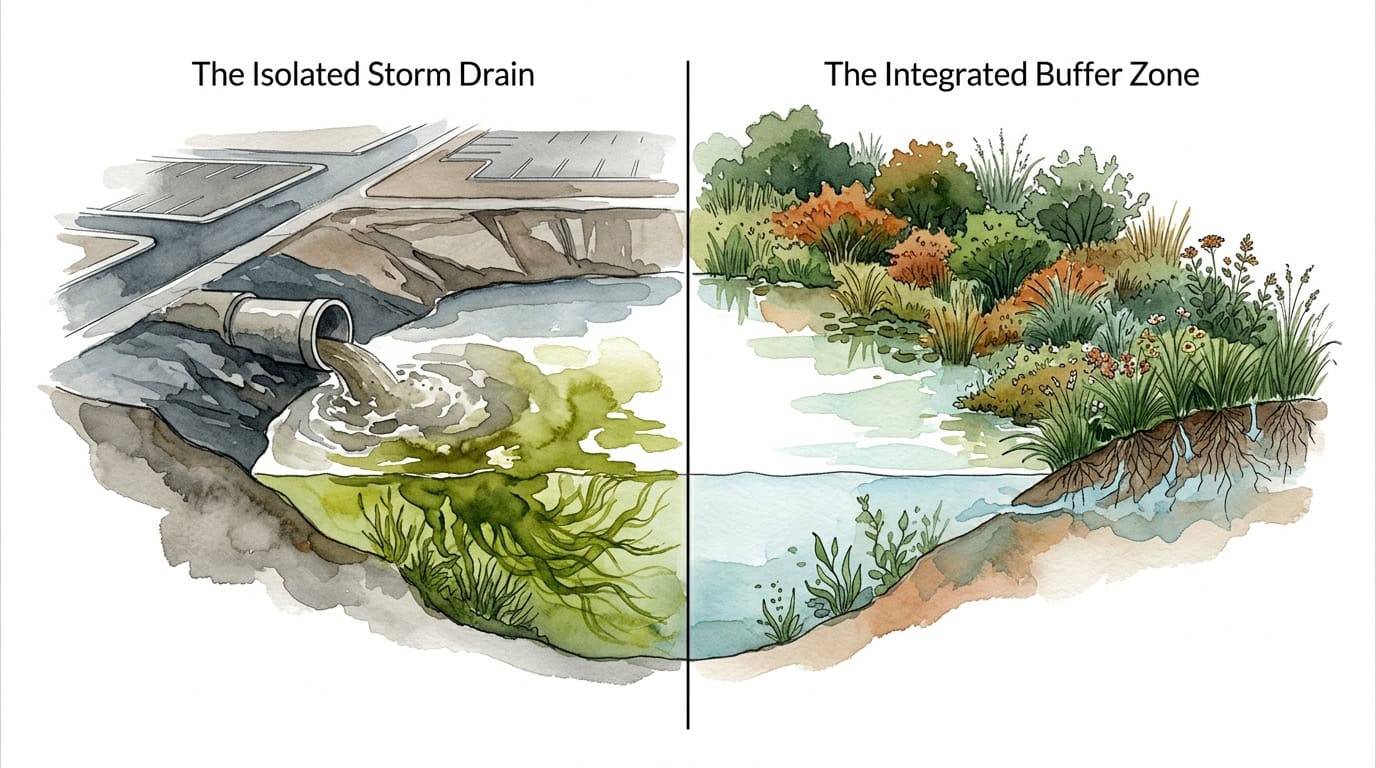
The Isolated Storm Drain vs. The Integrated Buffer Zone
Understanding the difference between these two systems is critical for modern pond design.
| Feature | Isolated Storm Drain | Integrated Buffer Zone |
|---|---|---|
| Nutrient Delivery | Direct injection into the pond. | Filtered through root zones. |
| Sediment Management | Rapid accumulation at the pipe mouth. | Settled in forebays or filter strips. |
| Chemical Cost | High (requires frequent algaecides). | Low (proactive sequestration). |
| Maintenance Level | Reactive/Emergency focused. | Scheduled/Preventative focused. |
An Isolated Storm Drain essentially functions as a funnel for pollution. In contrast, an Integrated Buffer Zone (IBZ) incorporates a small “forebay” or sediment pond followed by a vegetated filter bed. This combination ensures that particles settle first, and the remaining dissolved nutrients are processed by plants and microbes before reaching the main body of water.
Practical Tips and Best Practices
Optimizing a pond for storm-driven nutrient spikes requires specific, data-driven actions.
- Implement a 15-Foot “No-Mow” Zone: This is the minimum width required for effective sediment trapping. For nutrient removal, aim for 30 to 50 feet if space allows.
- Select “Feet Wet” Species: Use plants that can tolerate both drought and temporary flooding. Native sedges (Carex), Rushes (Juncus), and Bulrushes (Scirpus) are ideal for the transition zone.
- Perform Soil Testing: Before planting a buffer, test the soil for existing phosphorus levels. If the soil is already saturated with phosphorus, it may actually leak nutrients into the pond initially.
- Use Floating Treatment Wetlands (FTWs): If land-based buffers aren’t an option, FTWs provide a biological sponge directly in the water. These floating islands use hydroponic roots to strip nutrients from the water column, removing up to 1.41g of phosphorus per square meter per year.
- Monitor pH for Chemical Binding: If using Alum to clear storm-induced turbidity, ensure the water pH remains between 6.0 and 8.5. Dropping below pH 6.0 can make aluminum soluble and toxic to fish.
Advanced Considerations: Benthic Flux and Stoichiometry
Serious practitioners must look beyond the surface to the interactions at the bottom of the pond.
Benthic flux refers to the movement of nutrients from the sediment back into the water column. This is often driven by “Internal Loading.” Even if you stop all external runoff, the pond may continue to grow weeds because of phosphorus stored in the mud. A technical solution is to calculate the stoichiometric requirement for binding agents.
For example, Lanthanum-Modified Clay (LMC) has a typical binding ratio of 100:1. If your water testing shows a phosphorus concentration of 0.15 mg/L (150 ppb) and you have a 1-million-liter pond, you have 150 grams of phosphorus in the water. To neutralize this, you would need 15 kilograms of LMC. However, an advanced practitioner will also account for the “Active Sediment Layer” (the top 5-10cm of mud), which may contain 100 times more phosphorus than the water itself. Treating the sediment as well as the water is the only way to achieve long-term “nutrient lockdown.”

Aeration is another advanced variable. Dissolved oxygen levels at the bottom of the pond prevent the chemical reduction of iron-phosphorus bonds. If the pond remains aerobic, phosphorus stays bound to iron in the sediment. If the pond becomes anaerobic (which often happens after a storm due to organic loading), those bonds break, and phosphorus “re-loads” into the water. Constant bottom-diffused aeration is therefore a mechanical prerequisite for chemical stability.
Scenario: The Eutrophic Stormwater Pond
Consider a 0.5-acre stormwater pond in a suburban development. After every heavy rain, the pond turns bright green with filamentous algae within 48 hours.
Testing reveals that the storm drains from 10 surrounding lawns empty directly into the pond. The total phosphorus (TP) level after a rain event is 0.20 mg/L. To fix this system, a three-step intervention is applied:
1. Mechanical: The area around the two main storm drains is excavated to create “Integrated Buffer Zones.” These 20-foot wide bioswales are planted with Switchgrass and Iris versicolor to slow the water and trap sediment.
2. Chemical: A “Floc and Lock” treatment is performed. Alum is applied at 150 lbs per acre-foot to clear the current turbidity, followed by a maintenance dose of Lanthanum-Modified Clay (Phoslock) to create a permanent nutrient barrier on the sediment surface.
3. Biological: Floating Treatment Wetlands covering 5% of the pond’s surface area are installed to provide continuous nutrient “polishing” during the growing season.
Within one season, the post-storm algae spikes are eliminated. The buffer zones trap the initial nutrient surge, and the chemical barrier on the pond floor prevents the “sediment reflux” that previously fueled the growth.
Final Thoughts
The “growth trigger” effect of rainfall is not an inevitability but a symptom of a disconnected hydraulic system. By transitioning from isolated drainage to integrated buffering, pond managers can effectively starve weeds of the fuel they need to thrive.
The success of these systems relies on the synergy between mechanical filtration, biological uptake, and chemical sequestration. While a single buffer strip provides immediate benefits, the highest efficiency is achieved through a multi-layered approach that includes bottom-diffused aeration and sediment-level nutrient binding.
Practitioners are encouraged to start with a baseline water quality analysis and a survey of the catchment area. Identifying where the water enters the pond is the first step toward building the barrier that stops the runoff cycle forever. Experimenting with native species and monitoring the results will lead to a more resilient, low-maintenance aquatic environment.