

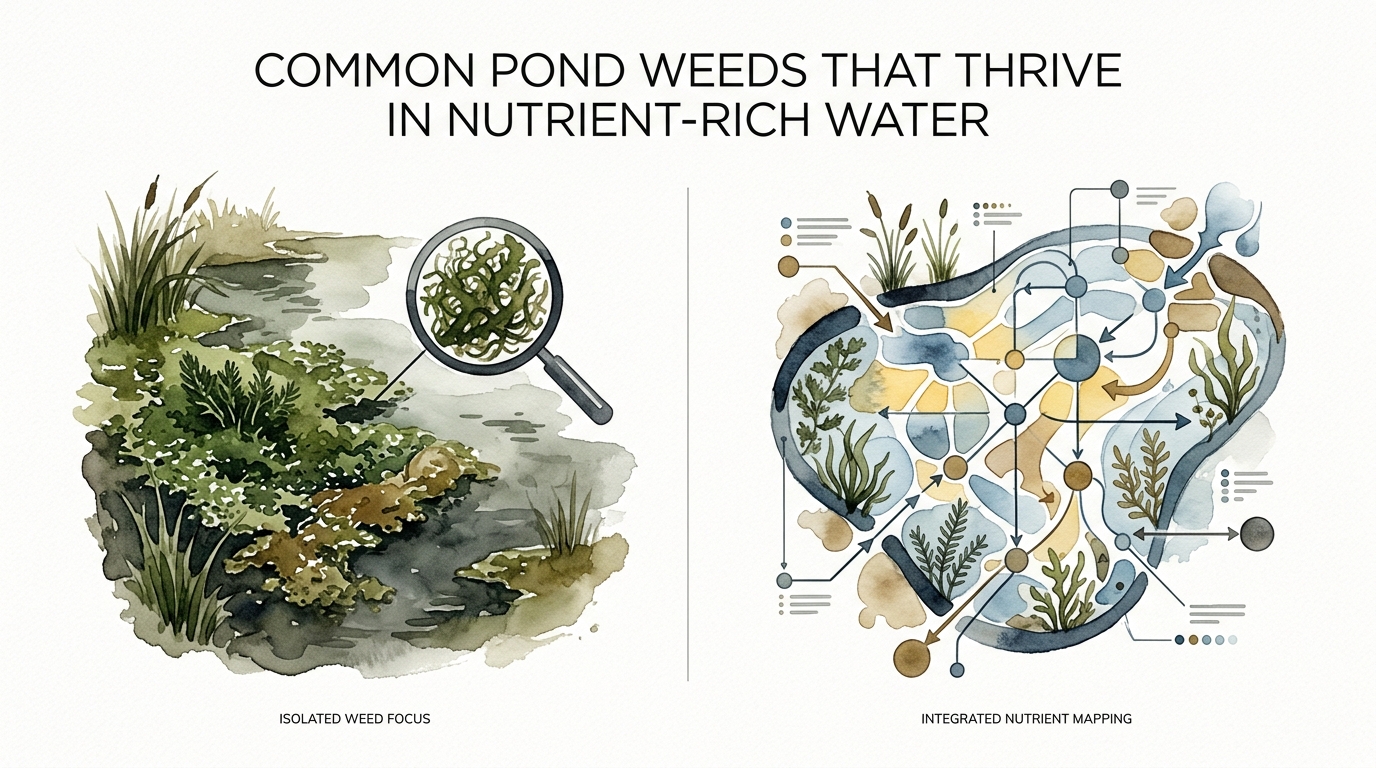
The weeds aren’t the problem; they are just the symptom of what’s happening on your land. and Nutrient-rich water is a magnet for invasive weeds. If you don’t fix the source of the runoff, the weeds will always come back. #Ecology #PondManagement #RunoffPrevention
Every pond functions as a biological and chemical sink for its surrounding watershed. When you see a pond choked with duckweed or obscured by a thick mat of filamentous algae, you are witnessing a massive surplus of nitrogen and phosphorus that has nowhere else to go. Managing these weeds through chemical applications alone is a temporary suppression of symptoms rather than a structural solution.
The transition from reactive weed killing to proactive ecosystem management requires a shift in perspective. Instead of viewing the pond as an isolated feature, successful practitioners treat it as the terminal point of a complex nutrient map. Understanding how nutrients move across your property is the only way to achieve long-term water clarity and ecological stability.
Common Pond Weeds That Thrive In Nutrient-Rich Water
Invasive and nuisance aquatic plants are specialized opportunistic organisms. They exist to stabilize nutrient spikes by rapidly converting dissolved chemicals into biomass. In a balanced system, these plants provide habitat, but in a nutrient-saturated environment, they become dominant monocultures that can eventually lead to pond failure.

Duckweed (Lemna minor) and Watermeal (Wolffia spp.)
Duckweed is a small, free-floating plant often mistaken for algae. It consists of a tiny leaf (frond) with a singular root hanging below. Watermeal is even smaller, appearing like green cornmeal or grains of sand on the water’s surface. Both species thrive in stagnant, high-phosphorus water. They can double their population in 16 to 48 hours under optimal conditions, eventually creating a light-blocking carpet that prevents photosynthesis in submerged plants and depletes dissolved oxygen.
Filamentous Algae
Often referred to as “pond scum” or “moss,” filamentous algae begins its growth on the pond bottom or on submerged rocks. As it photosynthesizes, oxygen bubbles get trapped in the filaments, causing the mats to rise to the surface. High concentrations of nitrates and phosphates are the primary drivers for these blooms. Unlike planktonic algae, which provides the base of the food chain, filamentous mats offer little ecological value and interfere with pond circulation.
Eurasian Watermilfoil (Myriophyllum spicatum)
This submerged invasive species is highly efficient at extracting nutrients from both the water column and the sediment. It forms thick, underwater forests that can reach the surface, making recreation impossible. Milfoil is particularly dangerous because it spreads through fragmentation; a single small piece of the plant can start a new colony. High nutrient loading accelerates its growth rate, allowing it to outcompete native pondweeds that require fewer resources.
Blue-Green Algae (Cyanobacteria)
Cyanobacteria are not technically plants but photosynthetic bacteria. They thrive in warm, stagnant water with high phosphorus levels. When phosphorus concentrations exceed 0.03 mg/L, the risk of harmful algal blooms (HABs) increases significantly. These blooms can produce toxins that are lethal to livestock, pets, and local wildlife, making them one of the most critical threats to pond health.
How Nutrient Loading Works
The process of a pond becoming over-enriched with nutrients is known as eutrophication. To manage this, you must distinguish between external and internal loading. External loading refers to the influx of nutrients from the surrounding landscape, typically during rain events. Internal loading refers to the recycling of nutrients already trapped in the pond’s bottom sediment.
Phosphorus is generally the “limiting nutrient” in freshwater systems. This means that the amount of weed and algae growth is directly proportional to the amount of phosphorus available. Nitrogen also plays a role, especially for floating plants, but phosphorus is the primary driver of pond degradation. When soil particles from erosion or fertilizer runoff enter the pond, they carry phosphorus that settles into the muck layer. Under low-oxygen conditions at the bottom, this phosphorus is released back into the water column, fueling a continuous cycle of weed growth even if external sources are cut off.

Benefits of Integrated Nutrient Management
Adopting an integrated approach—shifting from The Isolated Weed Problem to The Integrated Nutrient Map—offers measurable mechanical and financial advantages. Rather than allocating an annual budget for repeating herbicide treatments, resources are invested in structural improvements that reduce long-term labor.
- Reduced Chemical Dependency: Lowering nutrient levels naturally limits the carrying capacity of the pond for weeds, reducing the need for expensive copper-based algaecides or glyphosate treatments.
- Increased Dissolved Oxygen: Fewer decomposing weeds mean less “Biological Oxygen Demand” (BOD). This results in higher dissolved oxygen levels, which supports fish health and aerobic bacteria that break down organic muck.
- Extended Pond Lifespan: High nutrient loading leads to rapid sediment accumulation. By stopping runoff at the source, you significantly delay the need for costly mechanical dredging.
- Improved Water Safety: Reducing phosphorus spikes minimizes the probability of toxic cyanobacteria blooms, ensuring the water remains safe for livestock and irrigation.
Challenges in Runoff Prevention
Implementing a comprehensive runoff prevention strategy is not without obstacles. The primary challenge is the “legacy effect.” If a pond has been receiving agricultural or lawn runoff for decades, the sediment layer is likely saturated with phosphorus. Simply stopping the runoff today will not provide immediate results because the internal loading will continue to fuel weed growth for years.
Another challenge is the topography of the land. In many cases, the pond is situated at the bottom of a steep slope where water velocity is high. High-velocity water has significant erosive power, making it difficult for simple grass buffers to filter out nutrients effectively. In these scenarios, more complex engineering like sediment forebays or rock-lined swales may be required.
Limitations of Natural Methods
While biological and structural controls are superior for long-term health, they are not a “quick fix.” If you are currently facing a total pond occlusion that is threatening a fish kill, natural methods will not work fast enough. In such emergencies, a targeted chemical intervention is necessary to save the ecosystem before the long-term nutrient mapping can take effect.
Furthermore, if your pond is part of a larger watershed that you do not control—such as receiving runoff from a neighbor’s fertilized farm field or a municipal road—your ability to manage external loading is limited. In these cases, management must focus on in-pond “binding” agents or mechanical filtration at the point of entry.
Comparison: Reactive vs. Proactive Management
| Factor | Reactive (Chemical Suppression) | Proactive (Nutrient Mapping) |
|---|---|---|
| Initial Cost | Low (Herbicide cost) | Moderate to High (Landscaping/Buffers) |
| Time to Result | Fast (3-10 days) | Slow (1-3 seasons) |
| Labor Requirement | High (Repetitive application) | Low (Occasional buffer maintenance) |
| Eco-Impact | Risk of oxygen crashes/toxins | Restores natural biodiversity |
Practical Tips for Runoff Prevention
Effective management begins with structural changes to how water enters the pond. Implementing these steps creates a mechanical filter that strips nutrients from the water before they reach the main body of the pond.
1. Establish a Riparian Buffer
Stop mowing the grass directly to the water’s edge. A buffer strip of native grasses, sedges, and shrubs at least 15 to 30 feet wide is highly effective. These plants have deep root systems that can absorb up to 70% of dissolved nitrogen and trap over 80% of sediment-bound phosphorus. Forested buffers are even more effective at stabilizing banks and cooling water temperatures.
2. Diversion Swales and Bio-filters
If you have a specific point where water gushes into the pond after rain, install a shallow, vegetated swale. This slows the water down, allowing the heavier sediment to drop out. You can further enhance this by filling a section of the swale with limestone or specialized phosphorus-binding media to chemically strip nutrients on contact.
3. Use Aquatic Dyes
While not a nutrient filter, pond dyes (blue or black) block the specific wavelengths of sunlight needed for bottom-growing weeds and algae to photosynthesize. This is an excellent supplemental tool while waiting for your new buffer strips to mature. It effectively “starves” the weeds of energy even if nutrients are present.
Advanced Considerations: The Chemistry of the Bottom
Experienced practitioners monitor more than just the surface. The Redox Potential (reduction-oxidation) of the sediment-water interface determines whether phosphorus stays in the mud or dissolves into the water. When the bottom of the pond becomes anaerobic (lacks oxygen), chemical bonds between iron and phosphorus break, causing a “nutrient pulse” from the bottom.
Sub-surface aeration is the technical solution for this. By using a compressor and a diffuser to pump air into the deepest part of the pond, you maintain an aerobic environment at the sediment surface. This keeps phosphorus “locked” in the soil in a form that plants cannot easily use. Monitoring dissolved oxygen levels (maintaining at least 5 ppm) is the most reliable way to prevent internal loading cycles.
Scenario: The Impact of a Livestock Buffer
Consider a 1-acre farm pond used for livestock watering. In the “Isolated Weed Problem” scenario, cattle have direct access to the bank. They trample the vegetation, cause bank erosion, and deposit manure directly into the water. The pond remains permanently turbid and covered in duckweed. The owner spends $800 annually on herbicides, but the weeds return every July.
In the “Integrated Nutrient Map” scenario, the owner installs a perimeter fence 30 feet back from the water and provides a solar-powered trough for the cattle. Within two seasons, the native grass buffer has re-established. Soil testing shows a 60% reduction in phosphorus entering the pond. The need for herbicide drops to zero, and the pond water clarity increases from 12 inches to 5 feet. The initial $2,000 investment in fencing and water systems pays for itself in avoided chemical and labor costs within three years.
Final Thoughts
Managing a pond by only treating the weeds is a losing battle against the laws of chemistry. Nature will always fill a nutrient-rich void with whatever life form can grow the fastest. By shifting your focus to the watershed and mapping how nutrients move across your land, you stop the problem before it reaches the water.
Successful long-term pond management requires patience and a commitment to structural improvements. Start by establishing buffers, reducing fertilizer use in the watershed, and ensuring proper aeration. These steps create a resilient ecosystem that can manage its own nutrient load, leaving you with clear water and a stable environment for years to come.