

Technical parameters and mechanical optimization are the primary drivers of effective *Pistia stratiotes* (water lettuce) management. This article details the quantitative requirements for controlling biomass proliferation, maintaining water quality metrics, and executing precise chemical or mechanical removal strategies.
What starts as a ‘cute’ pond plant can starve your entire ecosystem of light. It looks like a floating cabbage, but it acts like a lid on your pond. When water lettuce takes over, the life beneath it dies. Here is how to keep it in check.
Effective management of *Pistia stratiotes* requires an understanding of its rapid reproductive cycle and its role as a high-efficiency nutrient sequestrator. Left unmanaged, its biomass dynamics can lead to catastrophic shifts in dissolved oxygen (DO) and light penetration, neutralizing the ecological stability of a water body.
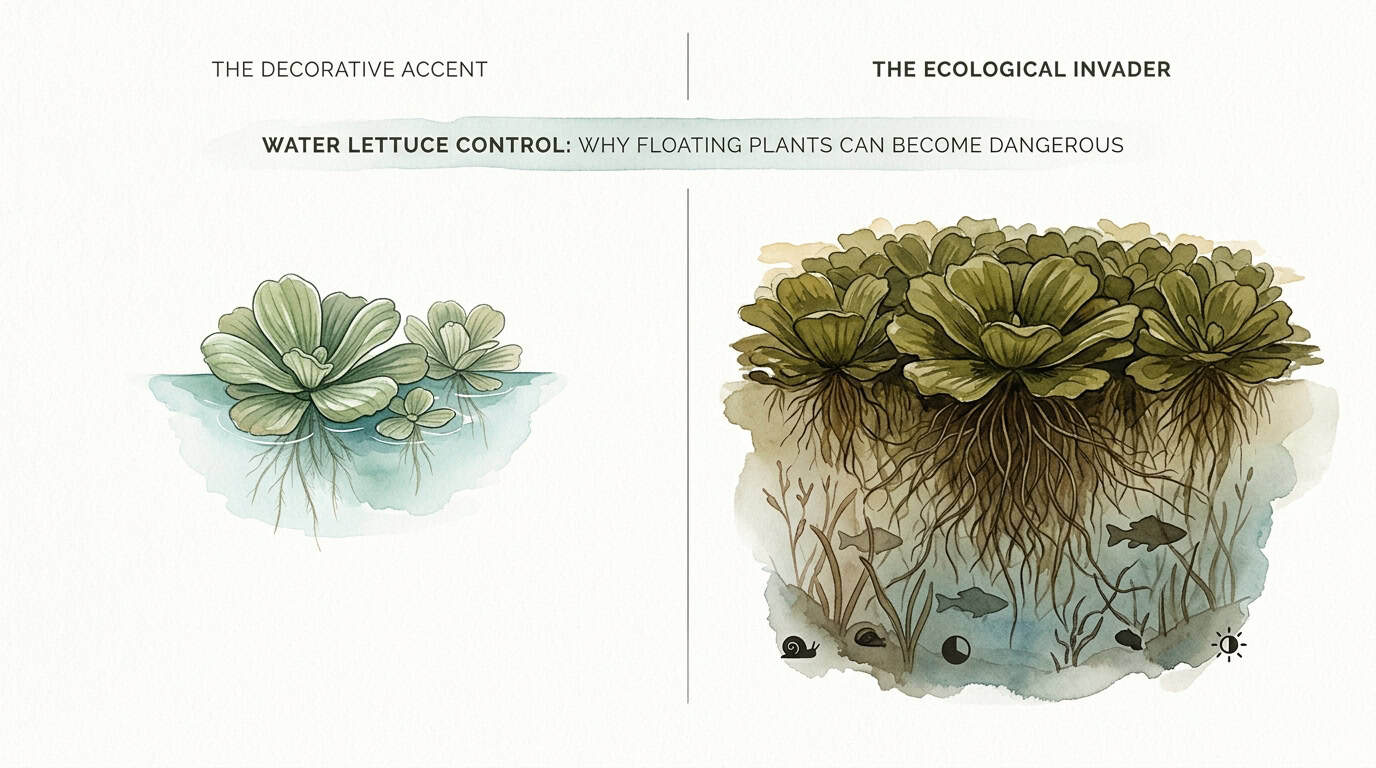
Water Lettuce Control: Why Floating Plants Can Become Dangerous
*Pistia stratiotes* is an invasive, free-floating macrophyte belonging to the Araceae family. While its rosette-like structure is aesthetically appealing, its growth rate and biomass density are among the highest in the aquatic world. Under optimal conditions, water lettuce can double its biomass in as little as 10 to 17 days, with some studies in wastewater environments showing doubling times near 32 days during the established phase.

The biological danger lies in the formation of dense, interlocking mats. These mats act as a physical barrier that prevents gas exchange at the air-water interface. This leads to severe hypoxia (low oxygen) or anoxia (no oxygen) in the water column. Furthermore, the canopy inhibits the penetration of photosynthetically active radiation (PAR), effectively shutting down the primary production of submerged native vegetation.
How Water Lettuce Control Systems Work
Managing *Pistia stratiotes* involves disrupting its vegetative and reproductive cycles through targeted interventions. These are categorized by their mechanical, chemical, or biological modes of action.
Mechanical Removal
Mechanical harvesting uses specialized machinery to physically extract biomass from the water. Harvesters are rated by their loading capacity (often measured in tons or cubic yards) and their extraction depth. This method is the most immediate in terms of light restoration but requires high operational energy.
Chemical Intervention
Herbicides for water lettuce are classified by their mobility within the plant.
- Contact Herbicides: Agents like Diquat or Flumioxazin work by disrupting cell membranes or photosynthesis on contact. They offer rapid “knockdown” but may require multiple applications if the root systems are not fully exposed.
- Systemic Herbicides: Agents like Imazapyr or Penoxsulam are absorbed and translocated throughout the vascular system, targeting the growing points (meristems). These are slower to act but provide a more thorough kill of the entire plant structure.
Biological Control
This involves the introduction of host-specific herbivores, most notably the water lettuce weevil (*Neohydronomus affinis*). The weevil larvae tunnel into the leaves and stolons, compromising the plant’s buoyancy and structural integrity.
Benefits of Strategic Control
The primary benefit of a managed water lettuce population is the preservation of aquatic biodiversity and water chemistry.

- Nutrient Removal: *Pistia stratiotes* is an efficient phytoremediator. In a controlled setting, it can remove up to 81.2% of phosphates and 88.6% of ammoniacal nitrogen from the water column.
- Temperature Regulation: A partial canopy (covering less than 15-20% of the surface) can lower water temperatures by providing shade, which increases the water’s oxygen-holding capacity.
- Habitat Provision: The feathery root systems of water lettuce provide complex micro-habitats for macroinvertebrates and small fish when the population is not overcrowded.
Challenges and Common Mistakes
The most frequent error in water lettuce control is reactive management rather than proactive monitoring. Waiting until the surface area coverage exceeds 50% often leads to secondary ecological issues during the treatment phase.
The Dissolved Oxygen Crash: When a massive population of water lettuce is killed simultaneously (especially via herbicide), the subsequent decomposition of the biomass consumes vast amounts of dissolved oxygen. This often results in a total fish kill.
Failure to Use Surfactants: The leaves of water lettuce are covered in dense, water-repellent hairs (trichomes). Applying herbicides without a high-quality aquatic surfactant leads to the chemical bead-rolling off the leaf surface, rendering the treatment ineffective.
Limitations: When Control is Difficult
Environmental variables significantly impact the efficacy of control measures.
- Temperature Sensitivity: While *Pistia stratiotes* thrives in warm climates, it is highly sensitive to frost. In temperate zones, winter kills may naturally manage the population, but seeds can remain dormant in the sediment.
- Flow Dynamics: In high-flow systems (canals or rivers), floating plants are constantly moving, making consistent chemical contact or biological establishment difficult.
- Water Chemistry: High pH (above 8.0) can deactivate certain herbicides like Flumioxazin, requiring the use of buffering agents to lower the spray tank pH.
The Decorative Accent vs. The Ecological Invader
In the context of pond management, it is useful to distinguish between the intended use and the biological reality.
| Factor | The Decorative Accent | The Ecological Invader |
|---|---|---|
| Surface Coverage | < 15% | > 70% |
| Management Cost | Low (Manual removal) | High ($300-$1,500 per acre) |
| Dissolved Oxygen | Stable (6.0 – 8.0 mg/L) | Hypoxic (< 2.0 mg/L) |
| Impact on Natives | Symbiotic / Neutral | Extirpation via light starvation |
Practical Tips and Best Practices
- Sector Treatment: If more than 50% of the pond is covered, only treat one-third of the area at a time. Wait 10-14 days between sectors to allow the ecosystem to process the decaying biomass without an oxygen crash.
- Morning Application: Apply herbicides in the morning when the plants are most metabolically active. This ensures maximum uptake and allows for daylight hours of oxygen production from remaining native plants.
- Use a Non-Selective Approach: Since water lettuce is a monocot, it is susceptible to broad-spectrum aquatic herbicides. Always verify that the chosen chemical is labeled for the specific water body use (e.g., irrigation vs. recreation).
Advanced Considerations for Practitioners
Serious practitioners should monitor the Carbon to Nitrogen (C:N) ratio of the biomass. High-nutrient environments produce “lush” plants with lower C:N ratios, which decompose faster and cause more rapid oxygen depletion.
Furthermore, consider the Integrated Pest Management (IPM) strategy. Combining a low-dose systemic herbicide with the introduction of *Neohydronomus affinis* weevils can provide long-term suppression with minimal chemical load. This “stress-and-kill” approach weakens the plant’s defense mechanisms, allowing the biological agents to more effectively colonize the population.
Example Scenario: A 1-Acre Infested Pond
In a 1-acre pond with 80% water lettuce coverage, the estimated wet biomass could reach 20 tons.
1. **Initial Assessment:** Measure DO levels. If below 4.0 mg/L, initiate aeration before any chemical treatment.
2. **Mechanical Pre-thinning:** Manually remove the perimeter 15 feet to create a buffer.
3. **Chemical Application:** Apply Diquat at a rate of 2 gallons per surface acre, mixed with a non-ionic surfactant.
4. **Post-Treatment Monitoring:** If DO levels drop below 2.0 mg/L, increase supplemental aeration immediately.
5. **Costing:** Expect a cost range of $350 to $700 for the chemical application and roughly $1,000 if using professional mechanical harvesters.
Final Thoughts
Maintaining *Pistia stratiotes* is a balance of biomass control and nutrient management. While the plant offers significant phytoremediation benefits, its aggressive growth requires a disciplined management schedule.
Successful practitioners rely on quantitative metrics—surface coverage percentages, dissolved oxygen readings, and precise herbicide dosing—rather than visual estimation. By treating water lettuce as a technical component of the pond’s nitrogen cycle rather than just a weed, you can maintain a clear, oxygenated, and biodiverse aquatic environment. Experiment with different control combinations to find the specific efficiency equilibrium for your unique water chemistry.