

The plant that used to be a staple of every fish tank is now a major pond nuisance. Elodea (Waterweed) is great for oxygen… until it isn’t. When it mats at the surface, it causes night-time oxygen crashes that kill fish. Here is how to treat it safely.
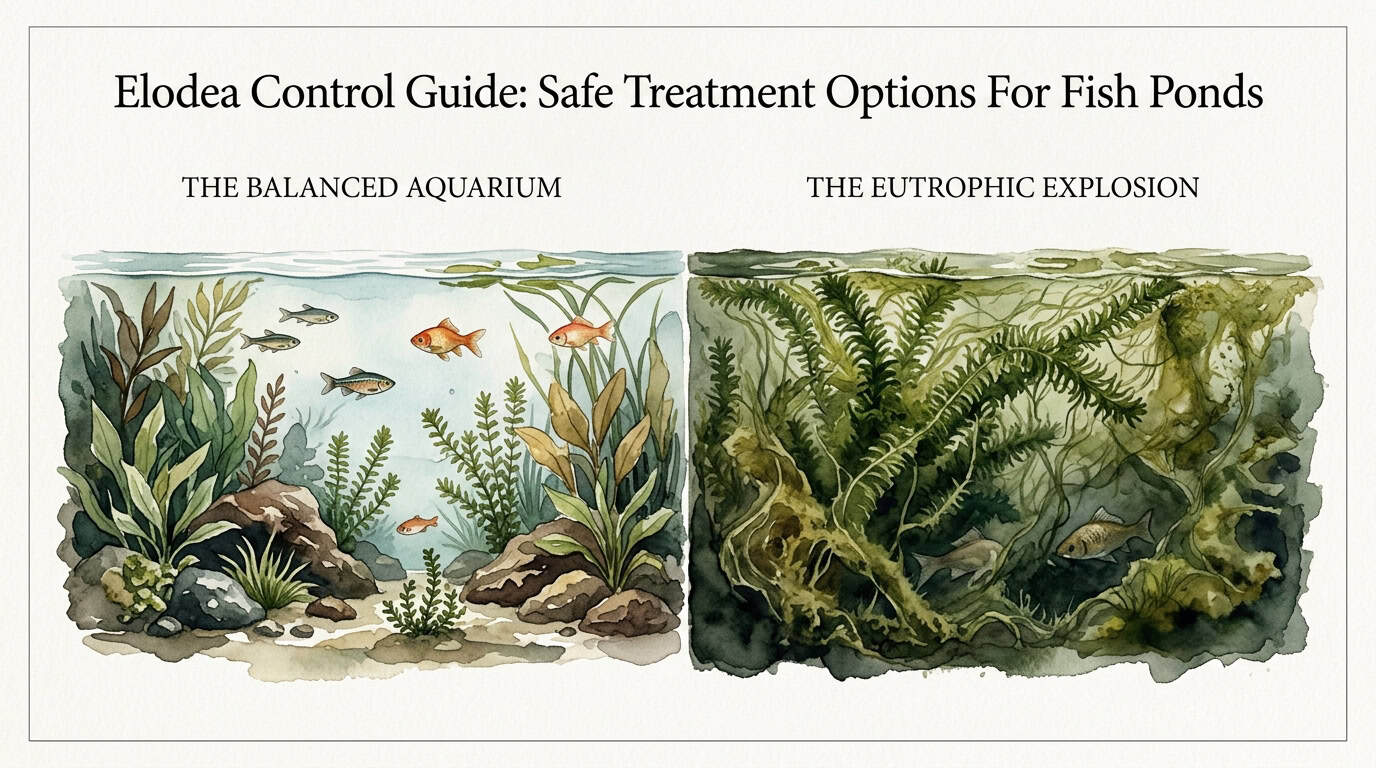
Managing a pond requires a transition from the hobbyist mindset of a “balanced aquarium” to the practical realities of industrial-scale aquatic management. In a small, controlled environment, Elodea serves as a nutrient sink and oxygenator. In a pond, particularly one receiving high nutrient runoff, Elodea shifts from a beneficial component to a driver of the Eutrophic Explosion. This article provides a technical framework for identifying, quantifying, and eliminating Elodea infestations without compromising the survival of your fish population.
Elodea Control Guide: Safe Treatment Options For Fish Ponds
Elodea, primarily represented by the species Elodea canadensis (Canadian Waterweed) and Elodea nuttallii (Nuttall’s Waterweed), is a submerged perennial monocot. It is characterized by green, translucent leaves arranged in whorls of three around a branched stem. While it lacks a complex root system—relying instead on slender adventitious roots for anchorage—it is a highly efficient competitor for dissolved phosphorus and nitrogen.
In a pond setting, Elodea exists in two states: the colonized state and the dominant state. In the colonized state, it occupies the littoral zone (the shallow perimeter), providing habitat for macroinvertebrates. In the dominant state, it fills the entire water column, reaching the surface to form dense mats. This dominance creates a biological paradox. During peak daylight, photosynthesis can drive dissolved oxygen (DO) to supersaturated levels (often exceeding 12 mg/L). However, during the nocturnal cycle, the massive biomass of the Elodea population consumes oxygen through respiration. Furthermore, when these mats die off naturally or through improper chemical treatment, the resulting Biochemical Oxygen Demand (BOD) from aerobic bacteria decomposing the plant matter can drop DO levels below 2 mg/L, leading to catastrophic fish kills.

The most common species encountered in North American and European ponds include:
- Elodea canadensis: Typically found in whorls of three; leaves are blunt and relatively wide.
- Elodea nuttallii: Also in whorls of three, but the leaves are narrower, pointed, and often spirally twisted.
- Egeria densa (Brazilian Waterweed): Often confused with Elodea, but much larger, with leaves in whorls of four to eight.
The Mechanics of Pond Volume Calculation and Herbicide Application
Effective treatment begins with precise mechanical and mathematical calculations. Applying herbicides based on “best guesses” of pond size is the primary cause of either treatment failure or toxic overdosing.
The first metric required is **Acre-Feet**. To calculate this, determine the surface acreage of the pond (Length x Width / 43,560 for rectangular ponds) and multiply it by the average depth. Average depth is calculated by taking a grid of depth measurements across the pond and averaging the sum.
Formula: Surface Acres × Average Depth = Acre-Feet.
One acre-foot of water equals 325,851 gallons. Most technical herbicide labels specify dosages in either “quarts per surface acre” for contact herbicides or “parts per million (ppm)” for systemic treatments. For example, Diquat dibromide, a common contact herbicide for Elodea, is typically applied at a rate of 1 to 2 gallons per surface acre, provided the average depth does not exceed 4 feet.
Mechanical Methods
Mechanical harvesting involves the physical removal of the plant mass. While this provides immediate relief from the biomass, it carries a high risk of “fragmentation spread.” Elodea reproduces vegetatively; a single stem fragment as small as one inch can settle in a new area and establish a new colony. Mechanical removal should only be used if the equipment includes a fine-mesh collection system to capture all debris.

Chemical Kinetics: Contact vs. Systemic
Chemical control is divided into two categories based on the mode of action:
- Contact Herbicides (e.g., Diquat, Endothall): These chemicals destroy the cell membranes of the plant parts they touch. They are fast-acting, often showing results within 3 to 7 days. They are ideal for “spot treatments” but pose the highest risk for oxygen depletion if applied to the whole pond at once.
- Systemic Herbicides (e.g., Fluridone): These chemicals are absorbed by the plant and translocated to the growing tips. Fluridone works by inhibiting carotenoid synthesis, which leads to the degradation of chlorophyll by sunlight. This process is slow (30 to 90 days), resulting in a gradual plant die-off that minimizes the risk of a DO crash.
Benefits of Strategic Elodea Management
The primary benefit of managing Elodea is the stabilization of the pond’s chemical profile. By reducing the total biomass of submerged vegetation, you narrow the “diurnal oxygen swing.” A managed pond will maintain DO levels within a narrower, safer band (e.g., 5 mg/L to 9 mg/L) compared to the 2 mg/L to 15 mg/L swings seen in infested waters.
Secondary benefits include:
- Nutrient Rebalancing: Removing Elodea allows nutrients to be utilized by more desirable species, such as native lilies or beneficial planktonic algae.
- Mechanical Efficiency: Dense Elodea mats interfere with pond infrastructure, including irrigation intakes, aerators, and overflow pipes. Control reduces maintenance costs for these mechanical systems.
- Predator-Prey Dynamics: In heavily infested ponds, forage fish (like Bluegill) have too many hiding spots, leading to overpopulation and stunted growth. Reducing Elodea cover to 15-20% of the surface area optimizes the hunting efficiency of predator species (like Largemouth Bass).
Challenges and Common Pitfalls
The most frequent error in Elodea control is **Treatment Timing**. Many pond owners wait until the Elodea has matted at the surface in July or August before acting. This is the period of highest risk. Warm water has a lower physical capacity to hold dissolved oxygen. Treating a massive biomass in 80°F (27°C) water is a recipe for a fish kill.
The Silt Binding Effect
Diquat dibromide, one of the most effective chemicals for Elodea, is a cation (positively charged molecule). It binds instantly to negatively charged particles, such as silt and clay. If the pond water is “muddy” or if a motorboat has recently stirred up the bottom sediment, the herbicide will bind to the soil particles rather than the plant tissue, rendering the treatment useless.
Fragmentation Escape
Attempting to pull Elodea by hand or rake often results in thousands of fragments drifting to untreated areas of the pond. Without a follow-up chemical treatment or a biological control agent, the pond will often return to its pre-treatment density within one growing season.
Limitations: When Control is Difficult
Environmental factors can limit the efficacy of standard treatments. High-flow environments, such as ponds with large “through-flow” from a stream, prevent systemic herbicides like Fluridone from maintaining the required concentration (usually 10-20 parts per billion) for the necessary 60-day contact time.
Furthermore, water chemistry impacts certain chemicals. Chelated copper, often used as an algaecide or herbicide booster, becomes more toxic to fish in soft water (low alkalinity). If your pond’s total alkalinity is below 50 ppm, copper-based treatments can be lethal to trout, koi, and grass carp. Always test alkalinity before selecting a copper-enhanced treatment plan.
The Balanced Aquarium vs. The Eutrophic Explosion
In the context of pond management, we must distinguish between the “Balanced Aquarium” model and the “Eutrophic Explosion.”
| Feature | The Balanced Aquarium | The Eutrophic Explosion |
|---|---|---|
| Nutrient Load | Controlled/Limited | Excessive (Runoff, Feed, Waste) |
| Plant Growth | Slow and Managed | Exponential (Matting) |
| Oxygen Cycle | Stable Diurnal Range | Extreme Fluctuations (Hypoxia at Night) |
| Maintenance | Manual/Low Tech | Chemical/Mechanical Optimization |
| Fish Carrying Capacity | Sustainable | At the Tipping Point |
When a pond enters the “Eutrophic Explosion” phase, Elodea acts as a biological accelerant. It sequesters massive amounts of phosphorus in its tissue. When that tissue dies, the phosphorus is released back into the water column, often fueling an immediate and toxic bloom of blue-green algae (cyanobacteria).
Practical Tips for Safe Treatment
To treat Elodea safely, follow the **”Rule of Thirds.”** Never treat more than one-third of the pond’s surface area at one time. This ensures that the oxygen demand of the decaying plants is localized, allowing fish to move to the untreated, oxygen-rich portions of the pond.
- Wait 10 to 14 days between sectional treatments to allow the BOD to subside.
- Apply treatments in the morning when DO levels are beginning their daily rise, rather than in the evening when levels are about to drop.
- Utilize bottom-diffused aeration during the treatment window to mechanically supplement oxygen levels.
- Identify the species correctly. If you are dealing with Hydrilla instead of Elodea, the treatment requires different chemicals (like Endothall) because Hydrilla produces tubers in the sediment that survive contact herbicides.
Advanced Considerations: Biological Control and Integration
For long-term management, the use of **Triploid Grass Carp (Ctenopharyngodon idella)** is a highly efficient mechanical optimization. These fish are sterile and consume Elodea as their preferred food source.
Technical stocking rates for Grass Carp are as follows:
- Slight Infestation (<30% cover): 2 to 5 fish per acre.
- Moderate Infestation (30-60% cover): 5 to 10 fish per acre.
- Heavy Infestation (>60% cover): 10 to 15 fish per acre.
Note that Grass Carp are “grazers.” They do not provide immediate results. It may take 12 to 24 months for a stocked population to significantly reduce Elodea density. The most effective strategy is an **Integrated Management Plan**: use a contact herbicide to knock down the initial biomass in the spring, and then stock Grass Carp to maintain the lower density.
Example Scenario: Treating a 1/2 Acre Pond
Consider a rectangular pond measuring 150 feet by 145 feet with an average depth of 4 feet.
Step 1: Calculate Surface Area.
150 x 145 = 21,750 square feet.
21,750 / 43,560 = 0.5 Acres.
Step 2: Calculate Acre-Feet.
0.5 Acres x 4 Feet = 2.0 Acre-Feet.
Step 3: Select Dosage (Diquat Dibromide).
Label rate for heavy Elodea: 2 gallons per surface acre.
For 0.5 acres, the total dose is 1 gallon of product.
Step 4: Execute the Rule of Thirds.
Mix 1/3 of a gallon of herbicide with enough water to ensure coverage (usually 10-20 gallons of carrier). Spray this mixture over the most heavily infested 1/6th of an acre. Monitor fish behavior for 10 days. If no piping (gulping at the surface) is observed, proceed to the next third.
Final Thoughts
Elodea management is not a one-time event but a continuous process of nutrient and biomass calibration. The goal is not necessarily the total eradication of the species, but the maintenance of a population density that does not threaten the oxygen stability of the pond. By moving away from emotional “quick fixes” and toward data-driven applications, you can ensure a healthy aquatic ecosystem.

Focus on early-season intervention. Treating Elodea when it is only 1-2 feet tall in April or May is significantly safer and more cost-effective than attempting to manage 6-foot mats in August. Use the mathematical formulas provided here to ensure your herbicide concentrations are precise, and always prioritize the preservation of dissolved oxygen above the speed of plant kill.
Experiment with integrated approaches. Combining low-dose chemical treatments with biological controls like Grass Carp often yields the most stable long-term results. As the pond’s nutrient load shifts, you may find that the “Eutrophic Explosion” subsides, leading back to a more manageable, balanced state.