

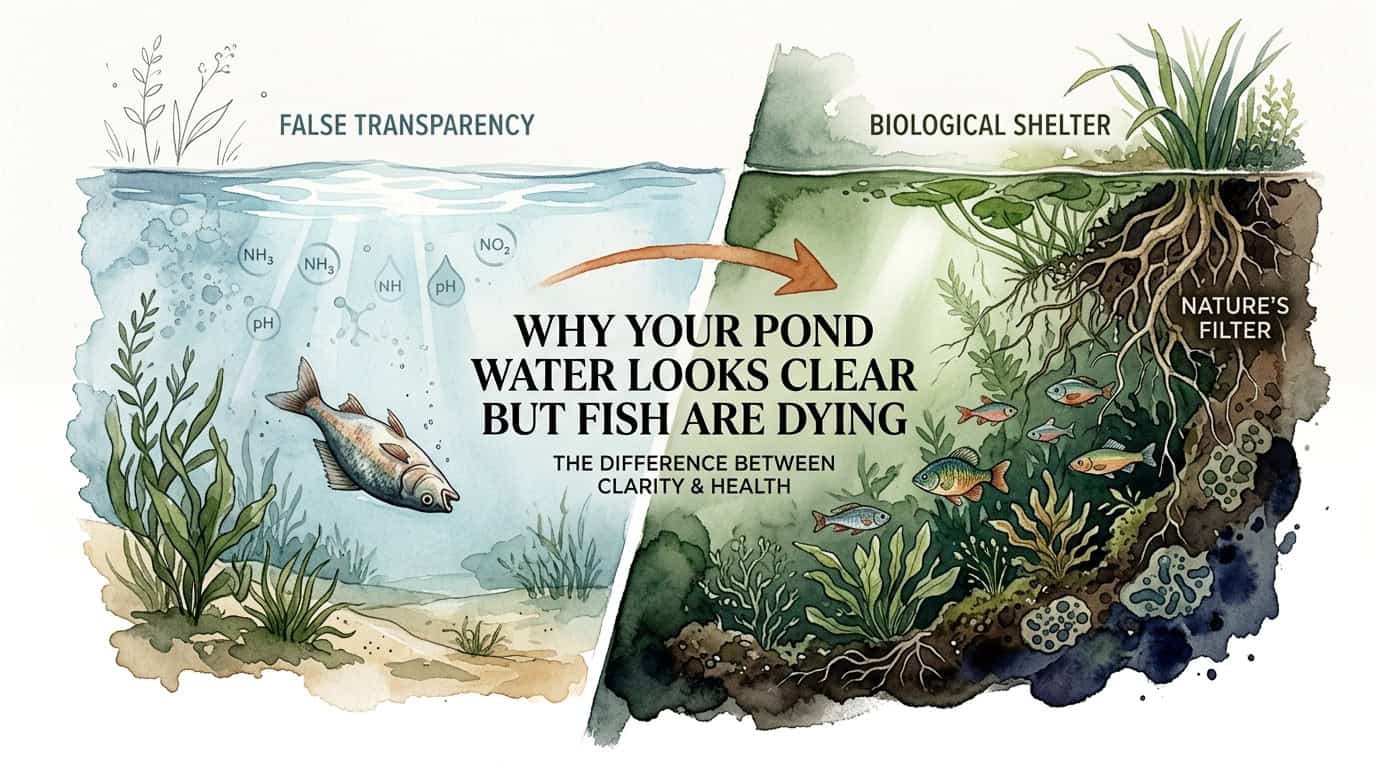
Don’t let the clarity fool you—perfectly clear water can be a biological desert. Clarity is not the same as health. High ammonia or low dissolved oxygen can hide behind a sparkling surface. Here is how to ‘read’ your water chemistry beyond what your eyes can see.
Optical transparency is frequently mistaken for biological stability. In many aquatic systems, a visual inspection suggests a pristine environment when, in reality, the chemical parameters are trending toward a lethal threshold. This discrepancy occurs because the most dangerous stressors in a pond environment—specifically un-ionized ammonia and dissolved nitrites—are colorless and odorless in solution.
Maintaining a healthy aquatic ecosystem requires a shift from aesthetic management to chemical management. This guide examines the mechanical and biological processes that govern water quality, focusing on data-driven metrics rather than visual cues. Understanding the underlying physics and chemistry of the water column is essential for preventing mass mortality events and optimizing fish metabolic efficiency.
Why Your Pond Water Looks Clear But Fish Are Dying
Chemical toxicity does not always manifest as turbidity. A pond can achieve high clarity through aggressive mechanical filtration or UV sterilization while simultaneously harboring lethal concentrations of nitrogenous waste. This phenomenon is often the result of a disconnect between the rate of waste production and the capacity of the biological filter.

Ammonia (NH3) is the primary metabolic byproduct excreted by fish through their gills. In a clear but toxic pond, the mechanical filters may be removing large solids effectively, but the microscopic nitrifying bacteria may not be sufficient to convert the dissolved ammonia into safer compounds. Because ammonia is highly soluble, it remains invisible to the naked eye while causing severe damage to fish gill tissues and internal organs.
Another factor is the relationship between pH, temperature, and toxicity. As water temperature and pH levels rise, a higher percentage of total ammonia shifts from the relatively harmless ionized form (NH4+) to the highly toxic un-ionized form (NH3). A pond that appears healthy at a pH of 7.0 can become a death trap if the pH swings to 8.5 during a summer heatwave, even if the ammonia concentration remains constant.
Low dissolved oxygen (DO) is a common “invisible” killer in clear water. While clear water allows for deeper light penetration, it often lacks the phytoplankton (algae) that provide a significant portion of oxygen through photosynthesis. If aeration systems are under-scaled for the biomass of the pond, fish may suffocate during the night when oxygen consumption peaks, leaving the water clear but the inhabitants dead by morning.
How the Nitrogen Cycle and KH Buffering Work
Biological filtration relies on the conversion of toxic waste through a two-stage oxidation process. This cycle is driven by aerobic bacteria, specifically Nitrosomonas and Nitrobacter. These microorganisms colonize the surfaces within the pond and filter media, forming a complex biofilm that serves as the engine of the ecosystem.
Stage one involves the oxidation of ammonia (NH3) into nitrite (NO2-). This process consumes significant amounts of dissolved oxygen and inorganic carbon. Stage two involves the further oxidation of nitrite into nitrate (NO3-), which is significantly less toxic to aquatic life. Nitrates are eventually removed through water changes or utilized by aquatic plants as a primary nutrient source.
Carbonate Hardness (KH) acts as the chemical “fuel” for these nitrifying bacteria. For every gram of ammonia oxidized, approximately 7.14 grams of alkalinity (as CaCO3) are consumed. If the KH levels drop too low, the bacteria cease to function, causing ammonia and nitrite spikes. Furthermore, KH serves as a pH buffer, neutralizing the hydrogen ions produced during nitrification to prevent a catastrophic pH crash.

Advanced systems often utilize Moving Bed Biofilm Reactors (MBBR) to maximize the surface area available for bacterial colonization. These reactors use specialized plastic media kept in constant motion by air diffusers. The motion ensures that the biofilm remains thin and active, preventing the buildup of anaerobic pockets and ensuring maximum gas exchange at the bacterial level.
Benefits of Maintaining Chemical Stability
Focusing on chemical health over optical clarity ensures a stable environment that supports long-term fish health and growth. When water parameters remain within optimal ranges, fish experience lower stress levels and maintain a robust immune response. This reduces the likelihood of secondary infections from opportunistic pathogens like Aeromonas or Pseudomonas.
Consistent water chemistry promotes efficient metabolic function. Fish are poikilothermic, meaning their metabolism is directly tied to their environment. Stable pH and oxygen levels allow for better nutrient absorption from feed, leading to faster growth rates and better coloration. In a production environment, this efficiency translates directly to improved feed conversion ratios (FCR).
Biological shelter, provided by a mature and stable biofilm, creates a resilient system that can absorb minor fluctuations in waste production. Unlike a sterile, “clear” pond that relies on constant chemical intervention, a biologically active pond has the internal capacity to self-regulate. This reduces the mechanical load on filtration components and minimizes the need for emergency water changes.
Data-driven management allows for proactive rather than reactive care. By monitoring trends in KH, DO, and ORP (Oxidation-Reduction Potential), operators can identify potential issues days before they become visible in fish behavior or water appearance. This precision is the hallmark of professional-grade pond management.
Challenges and Common Mistakes in Water Management
The most frequent error in pond management is relying on periodic, manual testing rather than continuous monitoring. Water chemistry is dynamic and can change significantly within a 24-hour cycle. A manual test conducted at noon may show a safe pH of 7.8, while the actual pH at midnight could be 6.5, leading to significant physiological stress that goes undetected.
Over-reliance on UV sterilizers and algaecides can create a “False Transparency” that masks biological failure. These tools are effective at killing suspended algae and pathogens, but they do nothing to remove dissolved toxins. In some cases, a massive algae die-off caused by chemical treatment can release a sudden surge of ammonia and consume all available oxygen as the dead organic matter decomposes.
Inadequate calibration of electronic probes is another critical failure point. Probes for pH, DO, and ORP require regular cleaning and calibration with standardized buffer solutions. Inaccurate data is often more dangerous than no data at all, as it leads to incorrect adjustments that can further destabilize the system.
Ignoring Carbonate Hardness (KH) is a common mistake among beginners. Many focus exclusively on ammonia and pH, not realizing that KH is the foundation upon which those parameters rest. Without a solid KH foundation (typically 100-200 ppm for koi ponds), the system is vulnerable to rapid acidity increases that can wipe out a fish population overnight.
Limitations and Environmental Constraints
High-density systems face physical limitations regarding gas exchange. Water can only hold a specific amount of dissolved oxygen based on its temperature and salinity. As temperatures rise, the saturation point for oxygen decreases. Even with maximum aeration, a pond may reach a point where it cannot support the oxygen requirements of a high fish load during summer peaks.
Biological filtration efficiency is temperature-dependent. Nitrifying bacteria are most active between 65°F and 85°F (18°C to 29°C). As water temperatures drop in the winter, the biological capacity of the system decreases significantly. Feeding rates must be adjusted downward to prevent ammonia accumulation, as the filter cannot keep pace with the waste production at lower temperatures.
Source water quality often imposes rigid constraints on pond chemistry. If the local water supply is naturally soft or high in nitrates, maintaining an ideal environment requires constant chemical amendment or pre-treatment systems like Reverse Osmosis (RO). These environmental factors determine the maximum carrying capacity and stability of the pond regardless of the filtration hardware used.
Comparison of Filtration Methodologies
| Feature | Mechanical Filtration | Biological Filtration | Chemical Treatment |
|---|---|---|---|
| Primary Function | Removal of suspended solids and debris. | Conversion of NH3 and NO2- via bacteria. | Direct neutralization or removal of toxins. |
| Effect on Clarity | High (removes visible particles). | Low (affects molecular health). | Variable (often clarifies through flocculation). |
| Maintenance | Frequent cleaning of pads or screens. | Minimal (requires steady flow and oxygen). | Consumable based (carbon, resins, zeolite). |
| Cost of Efficiency | Low operational cost; high manual labor. | Highest efficiency; low labor once established. | High cost due to recurring chemical purchases. |
Practical Tips for Optimizing Water Health
Establish a regular testing protocol using liquid titration kits or digital photometers. Test strips are often insufficiently accurate for identifying low-level ammonia spikes. Focus on monitoring Total Ammonia Nitrogen (TAN), Nitrite, KH, and pH at the same time each day to establish a baseline for your system.
Maximize aeration through redundant systems. Utilize both surface-breaking features like waterfalls and bottom-mounted air diffusers. Sub-surface aeration is more efficient at gas exchange in deeper ponds, as it increases the contact time between air bubbles and the water column, aiding in the stripping of CO2 and the addition of O2.
Incorporate a dedicated quarantine tank for all new arrivals. This allows you to monitor new fish in a controlled environment where water parameters can be easily manipulated. It also prevents the introduction of pathogens into the main display pond, where treatment is more difficult and expensive.
Utilize high-surface-area biological media. Materials like sintered glass, ceramic rings, or K1-style moving bed media provide exponentially more space for bacteria than traditional lava rock or gravel. Increasing the bio-surface area improves the system’s “nitrification headroom,” allowing it to process sudden waste increases from overfeeding or spawning.
Advanced Considerations: ORP and Conductivity
Oxidation-Reduction Potential (ORP) is a high-level metric used to measure the water’s “ability to clean itself.” Measured in millivolts (mV), ORP indicates the concentration of oxidizers in the water. A healthy pond typically maintains an ORP between 250mV and 400mV. Low ORP suggests a high organic load and low oxygen, while excessively high ORP (usually from ozone injection) can be toxic to fish tissues.
Conductivity measures the total amount of dissolved ions in the water. It is a useful proxy for Total Dissolved Solids (TDS). Rapid changes in conductivity indicate significant shifts in water chemistry, such as heavy runoff, massive evaporation, or large-scale mineralization. Monitoring conductivity helps determine the appropriate frequency and volume of water changes required to keep the system lean.
Free Ammonia (NH3) vs. Ammonium (NH4+) calculations are essential for high-precision management. Most test kits measure TAN, but only the NH3 portion is truly dangerous. Using a lookup table or digital calculator that incorporates pH and temperature allows you to determine if a 1.0 ppm TAN reading is a minor inconvenience or a lethal emergency.
Scenario: The “Invisible” Ammonia Spike
Consider a 5,000-gallon koi pond that appears crystal clear. The owner utilizes a drum filter (mechanical) and a UV sterilizer. The water is visually perfect, but the fish are lethargic and gasping at the surface. A manual test shows a TAN of 2.0 ppm, a pH of 8.2, and a temperature of 78°F.

In this scenario, the un-ionized ammonia (NH3) concentration is approximately 0.22 ppm—well above the 0.02 ppm threshold where damage starts to occur. Despite the visual clarity, the fish are suffering from chemical burns on their gills. The lack of a sufficient biological filter or a recent KH depletion has caused the ammonia to accumulate.
The solution involves an immediate 25% water change with a dechlorinator that also binds ammonia. Following this, the owner must test the KH. If the KH is below 80 ppm, adding sodium bicarbonate (baking soda) will stabilize the pH and provide the necessary carbon for the biological filter to restart. This illustrates that visual clarity was a distraction from the chemical reality of the system.
Final Thoughts
Mastering pond health requires looking past the surface. Optical clarity is an aesthetic achievement, but chemical stability is a biological necessity. By prioritizing the invisible parameters—ammonia, nitrite, oxygen, and KH—you create an environment where aquatic life can thrive rather than just survive.
Reliable data is the most powerful tool in your maintenance arsenal. Transitioning to professional monitoring systems and understanding the mechanics of the nitrogen cycle reduces the “guesswork” that often leads to fish loss. A truly healthy pond is one where the biological and mechanical systems work in synergy to maintain a state of equilibrium.
Consistency is more important than perfection. Small, frequent adjustments to water chemistry are always preferable to large, sudden changes. By following a rigorous monitoring protocol and maintaining the infrastructure of your biological filter, you ensure that your pond remains a healthy, living ecosystem for years to come.