

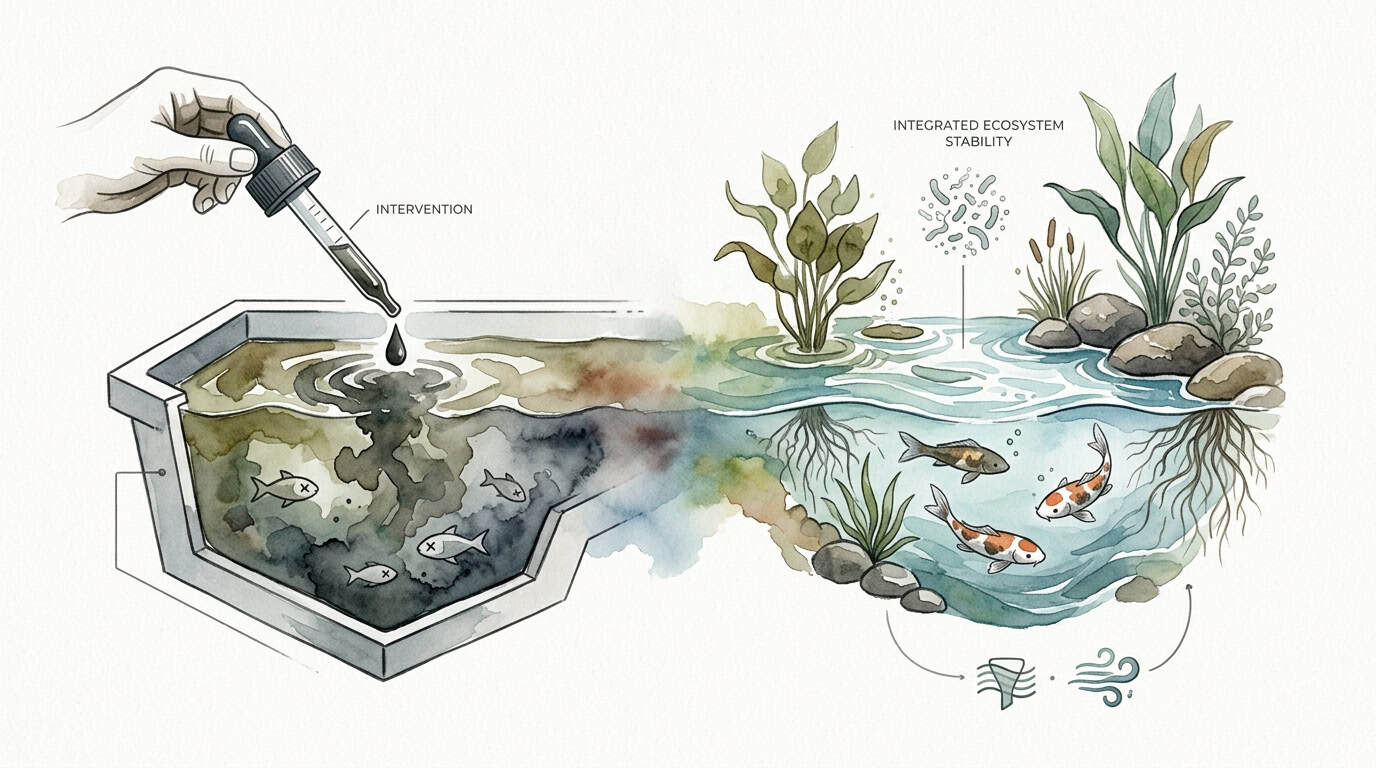
Are your ‘solutions’ actually the cause of your fish kills? Most fish die from things owners never even see. It’s rarely a disease—it’s usually an isolated mistake that breaks the ecosystem. Here is what you’re missing.
Pond ecosystems are governed by rigorous biological and chemical parameters. When these parameters deviate from their optimal ranges, the system faces rapid destabilization. Many owners treat symptoms rather than systemic imbalances, leading to recurring mortality events.
Understanding the mechanical and chemical drivers of a pond is essential for long-term stability. This article analyzes the technical causes of fish kills and provides data-driven strategies for optimizing aquatic environments.
Why Fish Keep Dying in Your Pond (7 Causes Most Owners Miss)
Fish mortality is seldom a random event. It is the result of specific mechanical or chemical failures within the pond’s infrastructure. Identifying these failures requires a shift from observational management to data-driven analysis.

1. Dissolved Oxygen (DO) Depletion
Dissolved oxygen is the most critical metric in any aquatic system. Fish typically experience severe physiological stress when DO levels drop below 3.0 mg/L (parts per million). While 5.0 mg/L is considered the baseline for safety, many ponds fluctuate wildly between daylight and nighttime. Photosynthesis drives oxygen production during the day, but at night, the process reverses. Both fish and plants begin consuming oxygen, often leading to a “morning crash” where levels bottom out just before dawn.
2. Ammonia and Nitrite Toxicity
Nitrogenous waste is a byproduct of protein metabolism. Fish excrete ammonia (NH3) directly through their gills. In a healthy system, nitrifying bacteria convert this into nitrite (NO2) and then into nitrate (NO3). However, un-ionized ammonia (NH3) is 300 to 400 times more toxic than its ionized form (NH4+). Toxicity is heavily influenced by pH and temperature; as these rise, the percentage of toxic NH3 increases exponentially. Nitrite is equally dangerous, as it enters the bloodstream and binds to hemoglobin, creating “brown blood disease” which prevents the transport of oxygen.
3. Thermal Stratification and Sudden Turnover
In ponds deeper than 6 to 8 feet, the water column separates into distinct layers based on density. The top layer (epilimnion) is warm and oxygen-rich, while the bottom layer (hypolimnion) is cold and anoxic. A sudden weather event, such as a cold rainstorm or high winds, can cause these layers to mix rapidly. This “turnover” introduces oxygen-depleted, toxin-heavy water from the bottom into the entire water column, often resulting in a total fish kill within hours.
4. Algal Bloom Crashes
Algae provide oxygen, but excessive nutrient loads (nitrogen and phosphorus) lead to hyper-dense blooms. If a bloom becomes too dense, the lower layers of algae die off due to lack of sunlight. Furthermore, a sudden change in weather or chemical intervention can cause the entire bloom to die simultaneously. The subsequent decomposition process by aerobic bacteria consumes massive quantities of dissolved oxygen, leading to rapid hypoxia.
5. Hydrogen Sulfide (H2S) Accumulation
Hydrogen sulfide is a highly toxic gas produced by sulfur-reducing bacteria in anaerobic (oxygen-free) sediment. It is detectable by a “rotten egg” odor. H2S is lethal at concentrations as low as 0.002 mg/L. In many ponds, this gas remains trapped in the bottom muck until it is disturbed by bottom-feeding fish or mechanical shifts, causing immediate localized mortality.
6. Biomass Overloading
Every pond has a finite carrying capacity determined by its surface area and aeration efficiency. Exceeding this capacity increases the biological oxygen demand (BOD) beyond the system’s ability to replenish it. High fish density also accelerates the accumulation of waste, creating a feedback loop of stress and increased susceptibility to secondary infections.

7. Isolated Chemical Intervention
The use of algaecides or herbicides to “fix” a pond often backfires. Killing large volumes of vegetation at once creates a massive spike in organic matter. As this matter decays, it strips the water of oxygen. Without an integrated approach that addresses the underlying nutrient load, chemical treatments often trigger the very fish kills they were intended to prevent.
How Aquatic Optimization Works: The Mechanical Approach
Stabilizing a pond requires managing the interface between gas exchange and microbial activity. This is achieved through three primary mechanisms.
Gas Exchange and Aeration Metrics
Atmospheric diffusion is the process by which oxygen enters the water surface. In stagnant ponds, this rate is insufficient to support high biomass. Mechanical aeration increases the surface area through agitation or bottom-diffused bubbles. A bottom-diffused system is technically superior because it breaks thermal stratification, ensuring the entire water column is oxygenated and preventing the buildup of anoxic zones.
The Nitrogen Cycle Efficiency
The efficiency of a pond’s biofilter is measured by its ability to process ammonia. This process is aerobic, meaning nitrifying bacteria require oxygen to function. If DO levels drop, nitrification slows down, leading to a spike in ammonia. Maintaining a stable pH (7.0 to 8.5) and high DO levels ensures that the conversion from toxic ammonia to relatively harmless nitrate remains constant.
Thermal Gradient Management
Preventing turnover requires active destratification. By moving water from the bottom to the surface, an aeration system eliminates the thermocline—the “curtain” that separates the temperature layers. This creates a uniform temperature and oxygen profile throughout the pond, removing the risk of a catastrophic turnover during summer storms.
Benefits of Integrated Ecosystem Stability
Transitioning from reactive treatments to proactive ecosystem management offers measurable improvements in water quality and fish health.
Integrating biological controls with mechanical systems reduces the need for frequent chemical applications. This approach stabilizes the system against external shocks, such as heavy rain or temperature spikes. A stable ecosystem exhibits lower fluctuations in DO and pH, which reduces the metabolic stress on fish.
Furthermore, efficient nutrient cycling prevents the accumulation of organic muck. This reduces the production of hydrogen sulfide and methane, keeping the substrate “healthy” and aerobic. Over time, this leads to clearer water and higher growth rates for fish, as they can spend more energy on growth and less on maintaining physiological homeostasis in a fluctuating environment.
Challenges and Common Biological Pitfalls
The most common mistake in pond management is the “quick fix” mentality. This often takes the form of over-applying algaecides. While the water may clear within 48 hours, the sudden increase in dead organic matter creates an oxygen debt that the system cannot pay.
Another challenge is the “lag time” associated with biological bioaugmentation. Beneficial bacteria do not work instantly. It can take weeks for a bacterial colony to establish itself and begin significantly reducing nutrient levels. Impatient owners often abandon biological treatments in favor of chemicals, resetting the ecosystem’s progress.
Mechanical failures also present a significant risk. If an aeration system fails during a hot summer night, the lack of gas exchange can lead to a fish kill by sunrise. Maintenance of compressors and diffusers is not optional; it is a critical component of the system’s life support.
Limitations of Physical and Environmental Constraints
Not all ponds can be saved through aeration alone. Small, shallow ponds in high-heat environments face physical limits. Warm water has a lower solubility for oxygen than cold water. At 86°F (30°C), water can hold approximately 7.5 mg/L of oxygen at saturation, whereas at 50°F (10°C), it can hold 11.3 mg/L.
Environmental runoff also provides a hard limit. If a pond is located at the bottom of a slope that receives heavy fertilizer runoff from a lawn or farm, the nutrient load will eventually exceed the capacity of even the best aeration and bacterial treatments. In these cases, physical intervention—such as creating a buffer zone or diverting runoff—is required before biological stability can be achieved.
Comparison: Isolated Chemical Intervention vs Integrated Ecosystem Stability
The following table compares the two primary philosophies of pond management based on technical performance metrics.
| Factor | Isolated Chemical Intervention | Integrated Ecosystem Stability |
|---|---|---|
| Response Speed | Rapid (24–48 hours) | Moderate (2–4 weeks) |
| Oxygen Impact | High Consumption (Risk of Kill) | Net Positive (Stabilization) |
| Nutrient Level | Remains High (Recycling) | Reduced (Sequestered/Processed) |
| Long-term Cost | High (Recurring cycles) | Lower (Maintenance focused) |
| Sustainability | Low | High |
Practical Tips for Aquatic Optimization
* Monitor DO at Dawn: Check your dissolved oxygen levels first thing in the morning. This is when they are at their lowest. If levels are below 4 mg/L, your aeration is insufficient.
* Manage the “Sludge” Layer: Use specialized bacterial pellets designed to sink into the muck. These aerobic bacteria digest organic matter from the bottom up, reducing the risk of H2S formation.
* Avoid Mid-Day Feeding: In high-heat conditions, fish metabolism is already strained. Feeding during the hottest part of the day increases oxygen demand (SDA – Specific Dynamic Action) when the water’s oxygen-carrying capacity is lower.
* Partial Herbicide Application: If you must use chemicals to control vegetation, never treat more than 25% of the pond at one time. Wait 10 to 14 days between treatments to allow the oxygen levels to recover.
* Check Carbonate Hardness (KH): Ensure your KH is above 100 ppm. This buffers the pH, preventing the wild swings that can increase ammonia toxicity.
Advanced Considerations: Substrate and Microbial Metrics
Experienced practitioners should look beyond water column metrics and evaluate the substrate. The “Redox Potential” of the sediment indicates whether the bottom is aerobic or anaerobic. A negative redox potential suggests an environment ripe for the production of methane and hydrogen sulfide.
Bioaugmentation strategies can be tuned by selecting specific bacterial strains. For instance, in ponds with high phosphorus loads, adding phosphorus-sequestering bacteria can “lock” nutrients into the sediment, making them unavailable for algal blooms. Similarly, the use of facultative anaerobes—bacteria that can function with or without oxygen—provides a safety net during temporary hypoxic events.
Case Study Scenarios: The Summer Turnover
Consider a 1-acre pond that is 10 feet deep. During a hot July, the top 4 feet are 85°F with 7 mg/L DO. The bottom 6 feet are 65°F with 0 mg/L DO and high levels of dissolved ammonia.
A sudden thunderstorm drops 2 inches of cold rain and brings 30 mph winds. The cold rain, being denser, sinks to the bottom, while the wind provides the mechanical energy to flip the water column. Within an hour, the 0 mg/L water from the bottom mixes with the surface water. The resulting average DO across the pond drops to approximately 2.8 mg/L.
Simultaneously, the ammonia that was trapped in the cold bottom water is now distributed throughout the warm, high-pH surface water, significantly increasing its toxicity. The fish, already stressed by the sudden temperature drop, are hit with a “double whammy” of hypoxia and ammonia poisoning. This scenario is the most frequent cause of “unexplained” mass mortality.

Final Thoughts
Preventing fish kills is a matter of mechanical and biological engineering. By focusing on dissolved oxygen stability, nutrient reduction, and thermal management, you can create a resilient system that withstands environmental stressors.
Most failures are the result of treating the pond as a static decoration rather than a dynamic biological reactor. Regular monitoring of oxygen, nitrogen, and pH levels provides the data necessary to make informed adjustments before mortality occurs.
Transitioning to an integrated management approach requires an initial investment in aeration and biological treatments, but the long-term payoff is a stable, self-regulating ecosystem that thrives without constant chemical intervention. Encourage a proactive mindset: if you can control the oxygen, you can control the pond.