

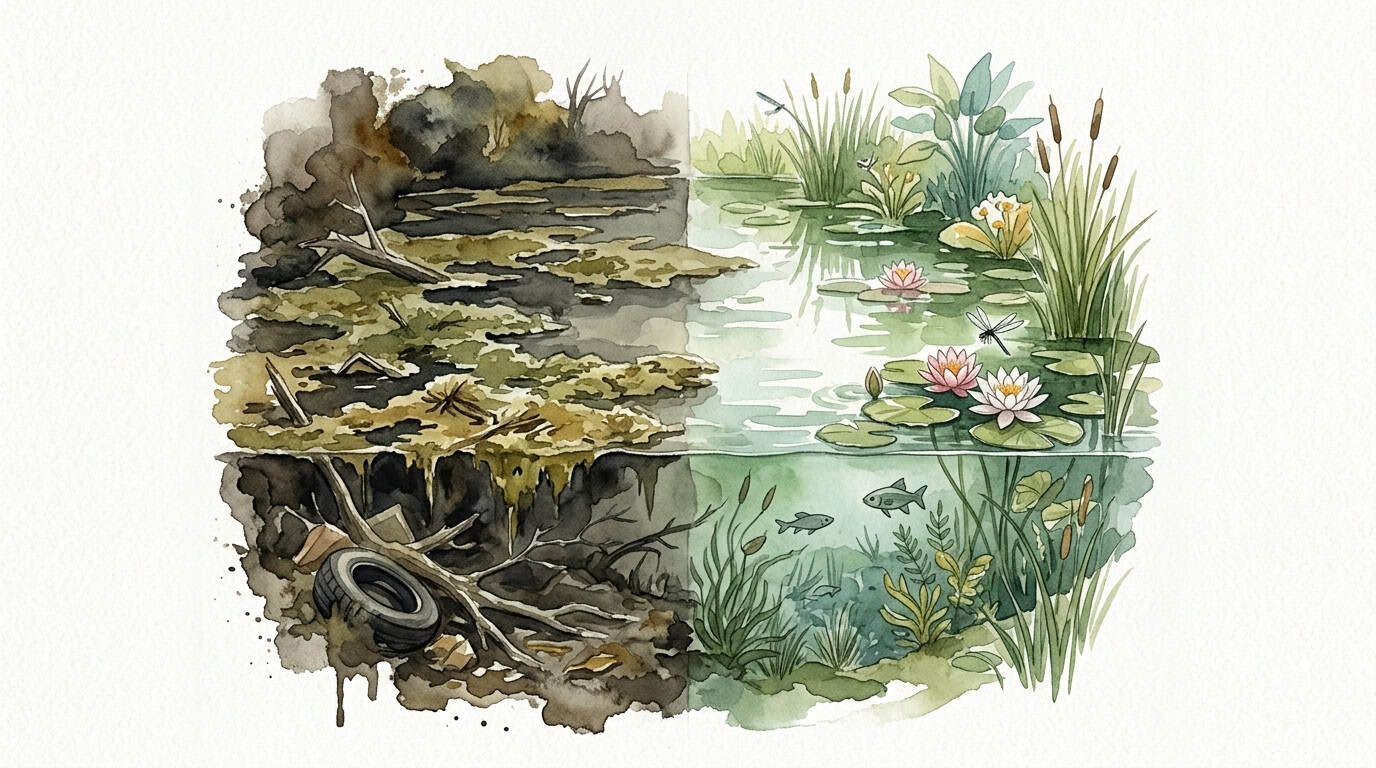
To save a neglected pond, you must restore its biological balance by removing excessive organic sludge, re-establishing dissolved oxygen levels above 5 ppm, and rebooting the nitrogen cycle. Begin by mechanically extracting debris to reduce the biological oxygen demand (BOD). Following debris removal, install an aeration system and introduce nitrifying bacteria to process ammonia and nitrites, ensuring that nutrient levels remain low enough to prevent recurrent algal blooms.
Is your pond a mosquito breeding ground or a biological sanctuary? That green, murky mess isn’t a lost cause—it’s just a broken ecosystem. Before you reach for the chemicals or the drain plug, learn how to reboot the biological cycle. We’re turning ‘dead’ water into a thriving wildlife haven using nature’s own filtration methods and oxygenation secrets.
Pond neglect is fundamentally a failure of nutrient management and gas exchange. When organic input exceeds a system’s processing capacity, the pond enters a state of eutrophication. This guide provides the technical protocols required to reverse this state and establish a stable, self-regulating aquatic environment.
How To Save A Neglected Pond
Saving a neglected pond involves a systematic transition from an anaerobic, nutrient-dense state to an aerobic, balanced state. In a neglected pond, the accumulation of “muck”—composed of decaying leaves, fish waste, and organic runoff—creates a high Biological Oxygen Demand (BOD). As bacteria consume oxygen to break down this matter, dissolved oxygen (DO) levels plummet, often falling below the 2–3 mg/L threshold required for most aquatic life.

This process exists in real-world environmental engineering and private aquaculture as “bioremediation.” It is used in everything from restoring small garden ponds to managing industrial wastewater lagoons. The core objective is to shift the pond from a state where it produces toxic byproducts like hydrogen sulfide and methane to one where it supports nitrifying bacteria and healthy oxygen saturation.
For example, a pond with 12 inches of sludge at the bottom is essentially a “carbon battery.” This carbon fuels massive algae growth and consumes the very oxygen needed to keep the water clear. By removing this carbon or facilitating its aerobic breakdown, the pond’s chemical profile stabilizes.
The Restoration Process: A Technical Protocol
Restoring a neglected pond requires a phased approach that prioritizes mechanical intervention followed by biological stabilization.
1. Mechanical Debris Extraction
The first phase is the physical removal of the “sludge” or benthic layer. This layer contains the majority of the pond’s stored phosphorus and nitrogen. Using a pond vacuum or a heavy-duty net, you must remove the bulk of decaying organic matter. However, it is critical not to “power wash” the basin to a sterile state. A thin layer of biofilm on rocks and liner houses the nitrifying bacteria populations (Nitrosomonas and Nitrobacter) essential for the nitrogen cycle.
2. Re-establishing Dissolved Oxygen (DO)
Once the primary load of decaying matter is reduced, you must address oxygen saturation. For ponds deeper than four feet, a bottom-diffused aeration system is the most efficient choice. This system uses a compressor to pump air to diffusers on the pond floor, creating a “bubble curtain” that moves water from the bottom to the surface (thermal destratification). The goal is to maintain DO levels at 5–8 ppm.
3. Biological Inoculation
After aeration is established, introduce concentrated beneficial bacteria. These microbes colonize the filter media and pond surfaces, beginning the conversion of toxic ammonia (NH3) into nitrite (NO2), and eventually into nitrate (NO3), which is a usable nutrient for aquatic plants.

4. Chemical Parameter Stabilization
Monitor the following metrics to ensure the system is recovering:
- Ammonia (NH3): Target 0 ppm. Levels above 1.0 ppm are lethal to most fish.
- Nitrite (NO2): Target 0 ppm. Levels over 0.15 mg/L inhibit oxygen absorption in fish.
- Nitrate (NO3): Target
- pH: Maintain between 7.0 and 8.5 to prevent ammonia from becoming increasingly toxic.
Benefits of Systematic Pond Restoration
Implementing a technical restoration protocol provides measurable improvements in water quality and ecological health.
Efficiency of Nutrient Cycling
A restored pond moves from a “leaky” system to a “circular” system. In a neglected state, nutrients remain suspended or trapped in sludge, fueling algae. In a saved pond, nutrients are rapidly sequestered by beneficial bacteria and aquatic plants (macrophytes). For instance, species like Juncus effusus can fix up to 13.5 grams of nitrogen per square meter annually.
Reduction in Pathogenic Pressure
Maintaining aerobic conditions (DO > 5 ppm) prevents the growth of anaerobic pathogens. “Aeromonas Alley”—a condition occurring between 42°F and 62°F in dirty ponds—leads to fish ulcers and septicemia. Restoration eliminates the low-oxygen environments where these bacteria thrive.
Mechanical Longevity
Properly managed ponds reduce the wear on pump impellers and filter mats. By removing sludge, you prevent the high-viscosity “slop” that causes pump cavitation and frequent motor failure.
Challenges and Common Mistakes
The most frequent error in pond restoration is the “Shock and Clean” approach, where a pond is drained completely and scrubbed with chemicals or high-pressure water.
Biofilm Eradication Syndrome
When you strip a pond to its liner, you destroy the established microbial community. This leads to a “New Pond Syndrome” crash. Upon refilling, the pond lacks the bacteria to process waste, causing a massive ammonia spike that kills any newly introduced wildlife.
Inadequate Aeration Placement
Placing a fountain in the center of a deep pond provides aesthetic value but does little for the bottom-dwelling “dead zones.” Surface splashing only oxygenates the top few inches of water, leaving the sludge layer to continue decomposing anaerobically.
Over-Chemicalization
Using algaecides to treat green water in a neglected pond often backfires. The chemicals kill the algae, which then sinks to the bottom, adds to the sludge layer, and releases its stored nutrients back into the water, triggering an even larger bloom two weeks later.
Limitations of Restoration
While most ponds can be saved, certain environmental and structural constraints can limit the effectiveness of remediation.
Eutrophication Point of No Return
If a pond has been neglected for decades and is over 50% filled with solid sediment, mechanical dredging is the only viable option. Biological additives cannot digest “soil” or heavy mineral sediment; they only process organic matter.
External Nutrient Loading
If a pond is located at the bottom of a hill where it receives constant runoff from fertilized lawns or agricultural fields, restoration will be a temporary fix. Without a buffer zone or diversion trench, the influx of nitrogen and phosphorus will consistently outpace the system’s filtration capacity.
Practical Comparison: Management Strategies
Choosing the right approach depends on the current state of the pond and the desired outcome.
| Factor | Passive/Neglected | Active/Restored |
|---|---|---|
| Dissolved Oxygen | 5–10 ppm (Aerobic) | |
| Primary Breakdown | Slow, produces H2S gas | Fast, microbial digestion |
| Algae Control | Chemical dependent | Nutrient competition |
| Maintenance Frequency | Emergency/High cost | Preventative/Low cost |
Practical Tips and Best Practices
For immediate application, follow these technical optimization steps:
- Harvest Plant Biomass: At the end of the growing season, cut back and remove aquatic plants. If they die and sink, they return 100% of the nutrients they absorbed back into the pond.
- Utilize High-Surface-Area Media: If upgrading a filter, use porous ceramic or sintered glass media. These have vastly more surface area per cubic inch than lava rock, supporting higher bacterial densities.
- Shade Implementation: Ensure 40% to 60% of the pond surface is covered by floating plants like lilies. This limits UV penetration, reducing the photosynthesis rate of suspended algae (green water).
- Use a Sludge Collector: When vacuuming, discharge the waste into a fine-mesh bag over your garden beds. This muck is high in phosphorus and nitrogen, making it an excellent fertilizer.
Advanced Considerations: Fluid Dynamics and Bio-load
Serious practitioners must calculate the “Turnover Rate” and “Oxygen Transfer Efficiency” (OTE) of their equipment. A healthy ecosystem pond should have its entire volume passed through the filtration system at least once every hour.
Oxygen transfer is governed by the gas transfer equation: dC/dt = KL(A/V)(Cs – Cm). This technical principle means that the rate of oxygenation depends on the surface area of the bubbles (A) and the difference between current oxygen (Cm) and saturation levels (Cs). Fine-bubble diffusers are superior to coarse bubbles because they create more surface area (A) for a given volume of air, maximizing the OTE.
Furthermore, consider the “Carbon-to-Nitrogen” (C:N) ratio of your inputs. If you feed high-protein fish food (which is high in nitrogen) without sufficient mechanical filtration, you are effectively “dosing” your pond for an algae bloom.
Example Scenario: The “Green Bowl” Recovery
Consider a 2,000-gallon pond with 6 inches of sludge and a visibility of 2 inches.
Step 1: Physical removal of 80% of visible sludge using a pond vacuum.
Step 2: Installation of an 80-watt bottom diffuser system.
Step 3: Dosing with 20,000 units of nitrifying bacteria weekly for one month.
Step 4: Addition of 15 bunches of Anacharis (submerged oxygenators) to compete for nitrates.
Result: After 21 days, ammonia and nitrite levels drop to 0 ppm, and water clarity increases to the pond floor as the biological cycle stabilizes.
Final Thoughts
Saving a neglected pond is an exercise in mechanical and biological synchronization. By focusing on the removal of the organic “fuel” (sludge) and the addition of the “engine” (oxygen and bacteria), you can reverse decades of decay in a single season. The transition from a stagnant, anaerobic pit to a vibrant ecosystem is not a matter of luck, but a result of adhering to the laws of aquatic chemistry.
Successful pond management requires consistent monitoring rather than dramatic intervention. Once the biological cycle is established, the system becomes remarkably resilient. We encourage pond owners to focus on data-driven decisions—measuring DO and nitrogen levels—to ensure their aquatic haven remains a biological sanctuary for years to come.

Frequently Asked Questions About How To Save A Neglected Pond
Can I save my pond without a pump or filter?
Technically, it is possible through the “natural pond” method, but it is significantly more difficult in a neglected system. To do this, you must achieve a specific plant-to-water ratio where approximately 70% of the surface is covered by plants. Without mechanical aeration, the removal of the sludge layer is even more critical because the system has no way to deal with the high biological oxygen demand (BOD) created by decaying matter. In the absence of a pump, you are relying solely on passive gas exchange and plant photosynthesis, which often fails in high-nutrient environments or during hot summer nights when plants stop producing oxygen and start consuming it.
How long does it take for a neglected pond to become clear?
In most cases, you will see a visible improvement in clarity within 48 to 72 hours of installing an aeration system. However, reaching full biological balance—where ammonia and nitrites are at 0 ppm and the water is crystal clear—typically takes 4 to 8 weeks. This timeline aligns with the natural reproductive cycle of nitrifying bacteria. You can accelerate this by adding concentrated bacterial starters and ensuring the water temperature is above 60°F, which is the optimal range for microbial activity. If the pond remains murky after two months, you likely have an unresolved external nutrient source or excessive fish bio-load.
Is it safe to use algaecides to speed up the cleaning process?
Algaecides are generally discouraged in the restoration phase of a neglected pond. While they provide an immediate “kill” of visible algae, they do not address the underlying cause: excess nutrients. The dead algae will sink to the bottom and contribute to the sludge layer, creating a “rebound effect” where the next algae bloom is more severe. Furthermore, a sudden mass-die-off of algae can lead to an oxygen crash as bacteria work overtime to decompose the dead matter, which can kill any fish or beneficial organisms currently in the pond. It is safer to use mechanical removal and biological competition.
Do I need to replace all the water in a neglected pond?
Draining and replacing all the water is rarely necessary and often counterproductive. Complete water replacement shocks the ecosystem and removes the established microbial community. A better approach is to perform a series of 20–30% water changes over the course of several weeks. This allows you to dilute high nutrient concentrations and remove tannins (the “tea-colored” water caused by leaves) without crashing the system’s biological stability. If the water is extremely toxic or has a foul “rotten egg” smell (indicating high hydrogen sulfide), a 50% change may be warranted, but always use a de-chlorinator if refilling with city water.
Why does my pond smell like rotten eggs during the cleaning process?
The “rotten egg” smell is caused by hydrogen sulfide gas (H2S), a byproduct of anaerobic decomposition occurring in the oxygen-deprived sludge layer. When you begin to disturb the muck or turn on an aerator for the first time, these trapped gases are released into the air. While unpleasant, this is a necessary part of the “off-gassing” process. To minimize the risk to fish, it is recommended to start your aeration system gradually (e.g., run it for 2 hours the first day, 4 hours the second) to allow these toxic gases to dissipate slowly rather than all at once, which could lead to a localized toxicity event.