

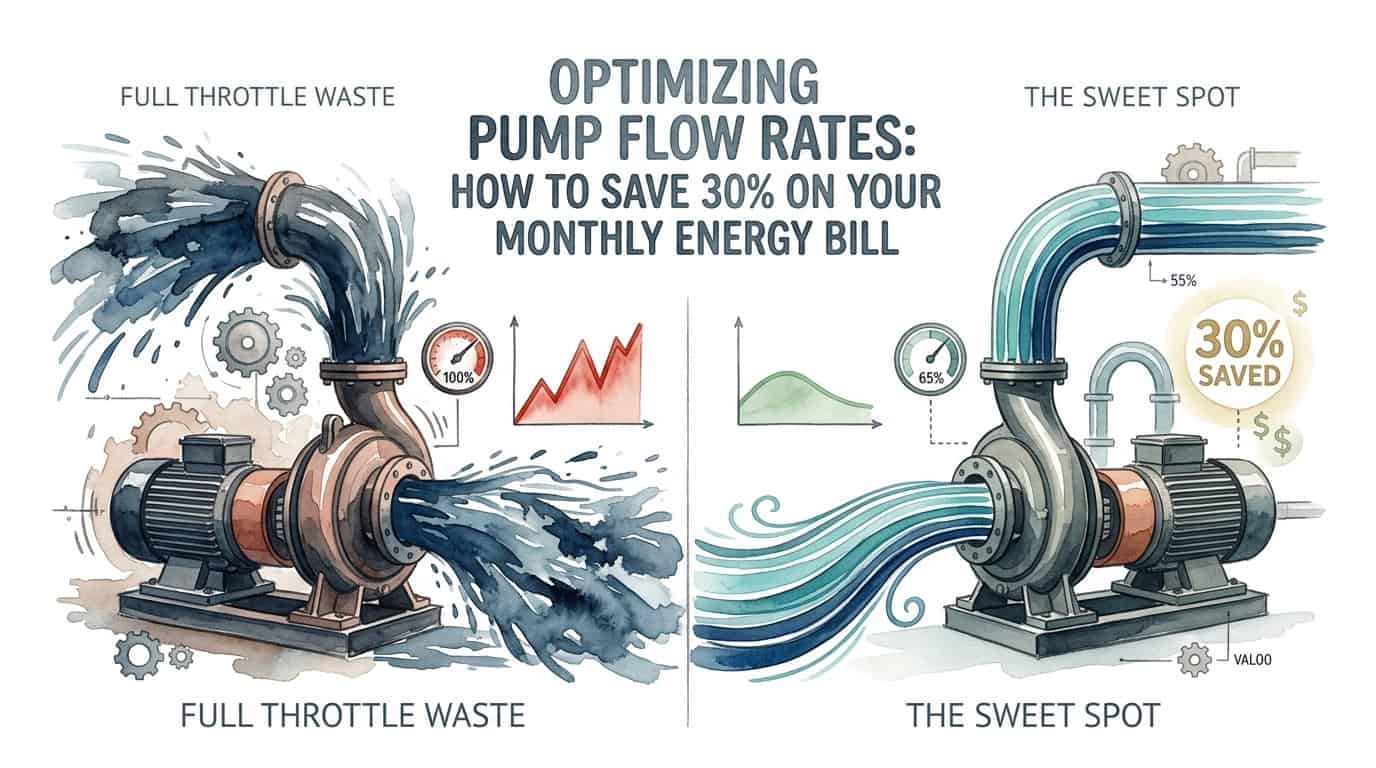
Most pond pumps are oversized and over-worked. Your wallet is feeling the friction. Pond turnover only needs to happen once per hour. If you’re pumping faster than that, you’re just heating up the wires and wasting money. Learn how to calculate your ‘Total Dynamic Head’ and dial in your savings.
Mechanical efficiency in aquatic systems is often sacrificed for the sake of “headroom.” Many operators install high-wattage pumps to ensure a waterfall looks sufficient, without accounting for the hidden energy costs of internal friction. Moving water is a matter of overcoming resistance, and understanding the math behind that resistance is the difference between a system that lasts a decade and one that burns out in three years.
Total Dynamic Head (TDH) is the sum of all resistance factors in a plumbing circuit. It is the real-world pressure the pump must push against to move water. When TDH is ignored, the pump operates at an inefficient point on its performance curve, leading to excessive heat and wasted electricity. Precision sizing allows for the use of smaller, more efficient motors that deliver the same visual results at a fraction of the cost.
Optimizing Pump Flow Rates: How to Save 30% on Your Monthly Energy Bill
Optimizing flow rates involves matching the pump’s output to the actual requirements of the pond’s biological and aesthetic needs. In most backyard ecosystems, the standard goal is a turnover rate of once per hour. This means a 3,000-gallon pond requires a flow of 3,000 Gallons Per Hour (GPH) at the specific Total Dynamic Head of the system.

If a system has 10 feet of TDH, but the owner installs a pump rated for 5,000 GPH at 0 feet of head, the actual flow might drop to 3,500 GPH once friction is added. However, the pump is still drawing the maximum wattage required to fight that resistance. If the plumbing is undersized, the friction increases exponentially, forcing the pump to work harder while delivering less water. This is essentially paying for energy that is converted into heat rather than movement.
Real-world optimization starts with reducing the work the pump has to do. A pump is a machine designed to move a specific mass of water against a specific resistance. By lowering that resistance—the TDH—you can often drop down to a lower-wattage pump model or use a variable speed controller to dial back the RPM. This reduction in electrical draw directly impacts the monthly utility bill, often resulting in savings of 30% or more.
The Mechanics of Total Dynamic Head
Total Dynamic Head is not just the height of a waterfall. It is a composite metric consisting of three primary factors: Static Head, Friction Head, and Velocity Head. For most residential and commercial pond applications, Velocity Head is negligible, so focus remains on Static and Friction.
Static Head is the vertical distance the water is lifted. Measure this from the surface of the pond water to the highest point of the discharge (usually the top of the waterfall spillway). If the pump is submerged 3 feet deep, but the waterfall is 4 feet above the water level, the Static Head is 4 feet. The depth of the pump does not increase the work required because the water pressure at the intake balances the weight of the water in the pipe up to the surface level.
Friction Head is the resistance created as water rubs against the inner walls of the pipe and turbulent forces at every fitting. This is where most efficiency is lost. Friction is influenced by the pipe’s internal diameter, the smoothness of the material, the length of the run, and the number of elbows or valves. Higher flow rates through narrow pipes create high-velocity friction, which dramatically increases the TDH.
Calculating Friction Loss: The Silent Efficiency Killer
Friction loss is measured in “feet of head.” Engineers use the Hazen-Williams equation to determine this, but pond owners can use simplified friction loss charts. These charts show how many feet of head are added for every 100 feet of pipe at a specific flow rate.

Pipe diameter is the most critical variable in this calculation. For example, pushing 3,000 GPH through a 1.5-inch PVC pipe creates approximately 4.16 feet of head loss per 100 feet. Swapping that to a 2-inch pipe for the same 3,000 GPH reduces the loss to just 1.15 feet per 100 feet. By simply increasing the pipe size, you have removed 3 feet of resistance without changing the pump.
Fittings must also be converted into “equivalent feet” of straight pipe. A standard 90-degree elbow creates turbulence that is equivalent to adding several feet of straight pipe to the system. A 2-inch 90-degree elbow is roughly equivalent to 5.7 feet of straight pipe. If a system has five elbows, that is nearly 30 feet of “invisible” pipe adding to the friction head. Using sweeping curves or flexible PVC (spa hose) reduces this turbulence and keeps the TDH low.
Reading Pump Performance Curves
Every professional-grade pump comes with a performance curve chart. This graph shows the relationship between Head (vertical axis) and Flow Rate (horizontal axis). To select the right pump, you must plot your calculated TDH on the graph to see what the actual GPH will be.
The “Duty Point” is the intersection of your system’s TDH and the pump’s curve. An efficient system operates in the middle of the curve, often called the “Best Efficiency Point” (BEP). If your duty point is at the far left of the curve (High Head, Low Flow), the pump is “dead-heading,” which causes internal recirculation, heat buildup, and premature seal failure.
Conversely, if the duty point is at the far right (Low Head, High Flow), the pump may be “run-out.” This can lead to cavitation and motor over-loading. The goal is to choose a pump where your required GPH at your calculated TDH falls within the manufacturer’s recommended operating range, ideally near the BEP for maximum energy savings.
Benefits of Mechanical Optimization
Precision sizing offers measurable advantages over the “bigger is better” approach. The primary benefit is a reduction in Total Cost of Ownership (TCO). While an oversized pump might cost less at the initial purchase, the cumulative electricity cost over five years often exceeds the price of the pump itself by five to ten times.
Optimized systems also experience significantly less mechanical wear. When a pump operates against appropriate resistance, the motor runs cooler. Heat is the primary enemy of electrical insulation and mechanical seals. By matching the pump to the TDH, you extend the lifespan of the equipment, reducing the frequency of expensive replacements and downtime.
Furthermore, quieter operation is a byproduct of efficiency. High-friction systems often produce a “rushing” sound in the pipes or a humming vibration from the motor. A correctly sized pump moving water through appropriately sized plumbing operates at a lower decibel level, enhancing the tranquility of the water feature.
Common Mistakes and Pitfalls
The most frequent error is sizing a pump based solely on the “Max Head” or “Max Flow” listed on the box. These numbers represent the extremes where the pump is doing almost no useful work. A pump with a 20-foot max head will move zero water at 20 feet. Always look at the curve, not the marketing specs.
Another mistake is using corrugated “ribbed” tubing. While easy to install, the internal ridges create massive amounts of turbulence. This can double or triple the friction head compared to smooth-wall PVC. If flexible tubing is necessary, use smooth-bore weighted airline or flexible PVC “spa hose” to maintain flow efficiency.
Neglecting to clean the pump intake or pre-filter is a common operational pitfall. Debris buildup creates “Suction Head,” a type of resistance on the intake side. This forces the pump to work harder to pull water in, which can lead to cavitation—the formation and collapse of vapor bubbles that can pit the impeller and damage the housing.
Limitations and Environmental Constraints
While the “once per hour” turnover rule works for most ponds, certain environments require higher flow rates. Heavily stocked koi ponds with high bio-loads often benefit from turnover rates of 1.5 to 2 times per hour to ensure adequate oxygenation and waste removal. In these cases, the energy-saving strategy shifts from reducing flow to maximizing plumbing efficiency to keep the TDH as low as possible.
Vertical lift constraints are another limitation. If a waterfall is 15 feet high, there is no way to avoid at least 15 feet of static head. In high-head applications, the savings must come from using larger diameter pipes (3-inch or 4-inch) to ensure that the friction head doesn’t add another 10 feet to an already challenging lift.
Environmental temperatures also play a role. In extremely hot climates, submersible pumps rely on the pond water to cool the motor. If the pump is undersized and working at the edge of its curve, it may struggle to dissipate heat even in the water. External pumps, which are air-cooled, may be more efficient in these scenarios but require protection from direct sunlight.
Comparing Full Throttle Waste vs. The Sweet Spot
| Metric | Full Throttle Waste | The Sweet Spot |
|---|---|---|
| Pipe Size (3000 GPH) | 1.5″ Corrugated | 2″ Schedule 40 PVC |
| Friction Head (per 100′) | ~10.0+ feet | 1.15 feet |
| Pump Wattage Draw | 450 Watts | 160 Watts |
| Estimated Monthly Cost ($0.16/kWh) | $51.84 | $18.43 |
| Equipment Longevity | 2-4 Years | 7-10 Years |
Practical Tips for Immediate Savings
If you cannot replace your entire plumbing system, there are still ways to optimize your current setup. Start by inspecting your pipe runs for any unnecessary 90-degree elbows. Replacing two 90-degree elbows with four 45-degree elbows or a single sweeping curve will noticeably reduce the friction head and may increase your visible flow at the waterfall.
Ensure your check valve is a “swing” type rather than a “spring” type. Spring check valves require the pump to overcome the tension of the spring just to open the flap, adding 1 to 2 feet of head. A high-quality swing check valve offers almost zero resistance once the water is moving, allowing the pump to dedicate all its energy to circulation.
Consider the intake side of the pump. If you are using a pump pre-filter cage, keep it clean. A restricted intake causes the pump to work harder (suction side friction), which increases the total work and decreases the volume of water moved. A clean intake ensures the pump stays within its optimal cooling and performance range.
Advanced Considerations: Variable Speed and Affinity Laws
For those looking for the ultimate in efficiency, variable speed (DC) pumps are the gold standard. These pumps allow you to electronically control the RPM of the motor. This is powerful because of the “Pump Affinity Laws,” which state that power consumption is proportional to the cube of the shaft speed.
In practical terms, if you reduce a pump’s speed by 20%, you don’t just save 20% on electricity. Because of the cubic relationship, a 20% reduction in speed can result in nearly a 50% reduction in power draw. Running a larger variable speed pump at 60% capacity is significantly more efficient than running a smaller pump at 100% capacity to achieve the same flow.
Variable speed pumps also allow for “Seasonal Tuning.” During the winter, when biological activity is low, you can dial the pump down to its minimum required turnover to keep the water from freezing, slashing your winter energy bills. In the summer, when oxygen demand is high, you can dial it back up to full power to support the fish and the bio-filter.

Scenario: A 3,000-Gallon System Audit
Let’s look at a typical backyard pond with 3,000 gallons of volume and a waterfall that is 5 feet high. The pipe run is 50 feet long, with three 90-degree elbows and one check valve.
Using 1.5-inch pipe, the friction loss at 3,000 GPH is 4.16 feet per 100 feet. For a 50-foot run, that is 2.08 feet. The three elbows add approximately 12 feet of equivalent pipe, and the check valve adds another 10 feet. The “Equivalent Length” is now 72 feet. 72 feet * (4.16/100) = 3 feet of friction head. Total Dynamic Head = 5 (Static) + 3 (Friction) = 8 feet TDH.
By upgrading to 2-inch pipe, the friction loss drops to 1.15 feet per 100 feet. The elbows and check valve also have lower equivalent lengths in larger diameters. The friction head drops to approximately 1 foot. Total Dynamic Head = 5 (Static) + 1 (Friction) = 6 feet TDH. This 2-foot difference in TDH might allow the owner to switch from a 350-watt pump to a 200-watt pump, saving $170 per year in electricity costs while maintaining the exact same waterfall appearance.
Final Thoughts
Optimizing a pond pump is a technical exercise that pays dividends in both reliability and operational cost. By understanding that most pumps are fighting unnecessary friction, you can take control of your system’s efficiency. Moving water does not have to be an expensive endeavor if the physics of the plumbing are respected.
Calculate your Total Dynamic Head accurately by measuring your vertical lift and accounting for every foot of pipe and every fitting. Use this data to plot your duty point on a pump performance curve to ensure you are operating in the “Sweet Spot.” This mechanical precision ensures that your pump is moving water, not just generating heat.
The transition from a “Full Throttle” mentality to an optimized approach often results in a 30% to 50% reduction in energy consumption. Whether you achieve this through larger pipe diameters, better fitting choices, or the adoption of variable speed technology, the result is the same: a healthier pond ecosystem and a significantly lower utility bill. Experiment with these calculations and watch how a few technical adjustments can transform the performance of your water feature. For more in-depth mechanical guides, consider reading our analysis on biological filtration surface area and dissolved oxygen saturation.