

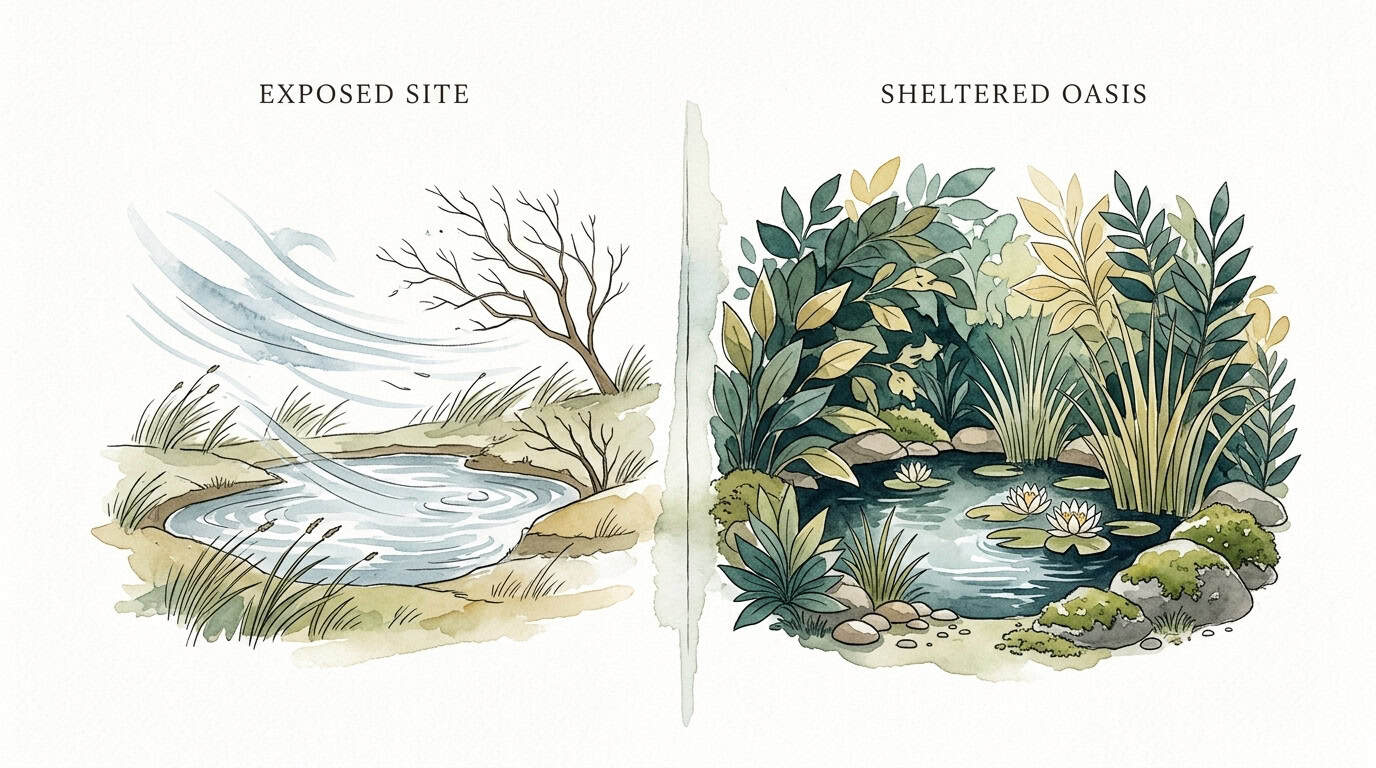
Is the sun stealing your pond’s water and oxygen while you sleep? A pond in the middle of a lawn is an easy target for wind-chill, evaporation, and heat spikes. By sheltering your water feature against a wall or under a living canopy, you create a thermal battery that stays stable through the hottest days and coldest nights.
The best location for small garden ponds is a level, sheltered site that receives four to six hours of morning sunlight while remaining protected from afternoon heat and prevailing winds. Placing the pond near a GFCI-protected power source and away from deciduous trees minimizes maintenance and mechanical strain. Strategic positioning against a wall or under a structure provides thermal stability, preventing rapid temperature fluctuations that stress aquatic life and accelerate water loss.
Establishing a small water feature requires precise spatial awareness and an understanding of local environmental variables. Small bodies of water lack the thermal inertia of larger lakes, making them susceptible to rapid atmospheric changes. Identifying the optimal coordinates for a pond involves balancing biological requirements for light with the mechanical necessity of shelter.
A pond serves as a closed-loop biological reactor. Every external input—from solar radiation to wind-driven debris—affects the chemical equilibrium of the system. Selecting a location is the first and most critical step in engineering a stable aquatic environment. This guide provides the technical data and mechanical protocols required to site a small garden pond for maximum efficiency and longevity.

Best Location For Small Garden Ponds
The best location for small garden ponds is defined as a zone where environmental stressors are minimized and maintenance accessibility is maximized. In technical terms, this location is a microclimate that maintains a consistent temperature range and prevents the accumulation of external pollutants. Small ponds, typically defined as those under 1,000 gallons, require more protection than larger systems because their lower volume-to-surface-area ratio leads to faster heating and cooling cycles.
Optimal siting prioritizes a level surface to prevent structural stress on the liner and ensures that the water level remains uniform across the perimeter. A location with a slight elevation relative to the rest of the garden prevents contaminated runoff from entering the system during heavy rain events. This runoff often contains lawn fertilizers, pesticides, and silt, which can cause catastrophic shifts in water chemistry, including ammonia spikes and oxygen depletion.
Solar exposure is a primary variable. While aquatic plants like water lilies require 5 to 6 hours of direct sun to bloom, excessive radiation in small ponds leads to thermal stratification and rapid algae proliferation. Therefore, the ideal spot often features morning sun and afternoon shade. This configuration allows for plant photosynthesis while protecting the water from the peak heat of the day, which can strip the water of dissolved oxygen.
Mechanical Integration and Site Selection Mechanics
Selecting a site involves more than observing shadows. It requires a systematic evaluation of the terrain and existing infrastructure. Follow these steps to determine the mechanical suitability of a potential location.
Evaluate the proximity to electrical utilities. Most pond pumps require a dedicated GFCI (Ground Fault Circuit Interrupter) outlet. Standard pump cords are approximately 25 feet long. Placing the pond within this radius eliminates the need for extension cords, which are prone to voltage drops and safety hazards in wet environments. Calculate the distance between the pond center and the nearest outdoor outlet to ensure electrical efficiency.
Analyze the soil composition and underground obstructions. Use a soil probe or test pit to identify the presence of bedrock, high water tables, or aggressive root systems. Roots from nearby trees can exert significant pressure on flexible liners, leading to punctures over time. Avoid areas with known utility lines for gas, water, or fiber optics. Contact local utility marking services before any excavation begins.

Measure the prevailing wind direction and intensity. Wind across the surface of a pond increases the rate of latent heat transfer, causing rapid evaporation. Strategic placement near a fence, wall, or dense evergreen hedge acts as a windbreak. This reduction in air velocity over the water surface preserves water levels and maintains thermal stability during cold fronts.
Assess the drainage patterns of the surrounding landscape. Observe the garden during a rain event to identify “low spots” where water pools. Positioning a pond in a natural drainage basin is a common engineering error. It exposes the system to nutrient-rich runoff and potentially overwhelms the pond’s capacity, causing fish to be washed out or the liner to float due to hydrostatic pressure from underneath.
Operational Benefits of Sheltered Siting
Placing a pond in a sheltered oasis rather than an exposed site offers measurable improvements in system performance. These benefits relate to water chemistry, mechanical wear, and biological health.
Thermal stability is the primary advantage. A sheltered pond experiences fewer temperature swings. In a small volume of water, a sudden 10-degree drop in air temperature can cause a significant shift in the water’s heat content. Consistent temperatures support the metabolic stability of fish and the growth cycles of beneficial nitrifying bacteria. These bacteria are essential for converting toxic ammonia into nitrates.
Evaporation rates are significantly lower in sheltered locations. Data suggests that wind speed and surface temperature are the two biggest drivers of water loss. Reducing wind exposure by placing the pond near a structural barrier can decrease evaporation by up to 30%. This conservation of water also prevents the concentration of dissolved solids, such as minerals and salts, which can become toxic if the water level drops too low.
Mechanical longevity for filtration systems is improved. Ponds located away from deciduous trees collect less organic debris. Heavy leaf litter clogs skimmer baskets and puts excess strain on pump motors. By reducing the intake of solids, the internal components of the pump experience less abrasive wear, extending the interval between required maintenance sessions.
Common Site Engineering Failures
Inappropriate siting leads to a variety of system failures that are difficult to correct once the pond is filled and landscaped. Recognizing these pitfalls during the planning phase is essential.
Underestimating the impact of the nitrogen cycle is a frequent mistake. Ponds placed directly under large trees receive a massive “nutrient load” every autumn. As leaves decompose, they release nitrogen and phosphorus. In a small pond, this creates an immediate imbalance, fueling massive algae blooms and depleting dissolved oxygen as the organic matter decays. This process can lead to winter fish kills if the pond freezes over with high levels of trapped gases.
Ignoring the “viewing angle” from the interior of the home is a common design oversight. While environmental factors are paramount, a pond that cannot be seen from the house provides no aesthetic or monitoring value. Positioning the pond within sight of a window allows for the early detection of equipment failure or predator activity. This visibility ensures that the system is integrated into the daily routine of the property manager.
Failure to account for overflow is another critical error. Every pond will eventually exceed its capacity during heavy rain. If the site is not graded to direct this overflow away from the house foundation or neighboring properties, structural damage can occur. An engineered overflow pipe or a designated “low point” in the pond’s edge should be directed toward a rain garden or a safe drainage zone.
Environmental and Structural Limitations
Certain sites are fundamentally unsuitable for small ponds regardless of the mitigation strategies employed. Understanding these boundaries prevents costly failures.
Steep slopes present significant structural challenges. Building a pond on an incline requires extensive retaining walls and grading to ensure the water remains level. The weight of the water—approximately 8.34 pounds per gallon—can cause soil shift on unstable slopes, leading to wall collapse or liner displacement. Level ground is the only reliable substrate for a small garden feature.
Areas with high water tables or heavy clay soil can cause “liner float.” When the groundwater level rises above the bottom of the pond, it exerts upward pressure on the liner. If the pond is not sufficiently full or if the weight of the water does not exceed the buoyant force of the groundwater, the liner will bulge or “whale,” potentially tearing and draining the pond. Such sites require specialized drainage systems beneath the liner.
Legal and safety constraints often dictate pond location. Many jurisdictions have specific setbacks from property lines and requirements for safety fencing if the pond exceeds a certain depth. Homeowners’ associations may also have restrictions on the visibility or placement of water features. Reviewing local building codes and property surveys is a mandatory prerequisite for site selection.
Exposed Site vs. Sheltered Oasis: A Technical Comparison
The choice between an exposed location and a sheltered site has direct implications for the maintenance budget and energy consumption of the system. The following table compares the two approaches across key performance metrics.
| Metric | Exposed Site (Lawn Center) | Sheltered Oasis (Near Wall/Canopy) |
|---|---|---|
| Evaporation Rate | High (Wind + Direct Sun) | Low (Protected Microclimate) |
| Thermal Stability | Low (High Diurnal Swings) | High (Thermal Battery Effect) |
| Debris Accumulation | Variable (Wind-blown) | Minimal (Reduced Vectors) |
| Algae Risk | High (Excess UV + Heat) | Moderate (Controlled Light) |
| Pump Efficiency | Lower (Higher Head Pressure) | Higher (Shorter Utility Runs) |
The data indicates that sheltered sites provide a more stable baseline for biological life. While an exposed site may offer more flexibility for plant variety, the operational cost in terms of water top-offs and algae treatments is significantly higher.
Practical Optimization Protocols
Once a general location is selected, refine the site using these optimization techniques to ensure maximum system efficiency.
- Utilize Sun Mapping: Observe the potential site every two hours for a full day. Record the exact times the area enters and exits full sun. This data allows for the precise placement of plants that have specific light requirements.
- Assess the Drip Line: Ensure the pond is outside the “drip line” of any overhanging structures. Rainwater cascading off a roof can hit the pond with enough force to damage plants or introduce large amounts of untreated water and roof debris.
- Check Level with Precision: Use a laser level or a long straight-edge with a spirit level to verify the perimeter. Even a one-inch difference in height across the pond will result in an unsightly exposed liner on one side and potential overflow on the other.
- Identify Utility Access: Map out the path for the electrical conduit and the water fill line. Ensure these paths are clear of future landscaping projects and are buried deep enough to avoid accidental damage from gardening tools.
Advanced Thermodynamic and Hydraulic Considerations
For the serious practitioner, understanding the physics of the pond site can lead to superior system design. Small ponds act as heat exchangers between the earth and the atmosphere.
Ground temperature at a depth of 24 to 36 inches remains relatively constant year-round. An in-ground pond utilizes this “geothermal” stability. By maximizing the surface area contact between the pond liner and the earth, you can buffer the water against extreme air temperatures. Above-ground or container ponds lack this advantage and are almost entirely dependent on ambient air temperatures, making shelter even more critical for these systems.
The specific heat capacity of water means that it takes a significant amount of energy to change its temperature. However, the small volume of a garden pond means this capacity is easily overwhelmed. A site located against a south-facing stone wall can benefit from “thermal mass” during the winter. The wall absorbs solar energy during the day and radiates it back to the pond at night, preventing the water from freezing solid in colder climates.

Hydraulic efficiency is influenced by the site’s elevation relative to the filtration equipment. If the filter is located uphill from the pond, the pump must work harder to overcome “head pressure.” Selecting a site where the filtration can be placed at or slightly above the water level reduces the energy consumption of the pump and increases the flow rate, leading to better aeration and water clarity.
Siting Scenarios and Performance Projections
To visualize these principles in practice, consider the following two scenarios for a 200-gallon garden pond.
Scenario A: The Exposed Lawn Placement. The pond is placed in the center of a flat backyard. It receives 10 hours of sun. The water temperature reaches 85°F in the summer, causing a 5% daily water loss through evaporation. Algae blooms require weekly chemical treatment. The pump runs at a higher wattage to compensate for the distance from the house.
Scenario B: The Sheltered Corner Placement. The pond is located 10 feet from the house in a corner formed by a fence and a trellis. It receives morning sun from 8:00 AM to 1:00 PM. The water temperature peaks at 74°F. Evaporation is negligible at less than 1% daily. The biological filter matures quickly due to the stable temperature, and no chemical treatments are necessary. The pump is plugged directly into a nearby outdoor outlet.
These scenarios demonstrate that the “best” location is the one that works with local physics rather than against them. Scenario B represents a high-efficiency system with lower operational costs and better outcomes for aquatic life.
Final Thoughts
Selecting the best location for a small garden pond is a technical decision that determines the success of the entire water feature. Prioritizing thermal stability, wind protection, and utility access creates a foundation for a low-maintenance, high-performance ecosystem. Small ponds are sensitive to their surroundings, and a well-chosen site acts as a protective buffer against environmental extremes.
Careful planning during the site selection phase prevents the most common causes of pond failure, including toxic runoff, excessive evaporation, and equipment strain. By treating the pond as a mechanical system integrated into the landscape, you ensure that it remains a functional and efficient part of the garden for years to come.
Prospective pond owners should take the time to map solar patterns and analyze soil conditions before digging. This analytical approach leads to a “sheltered oasis” that thrives with minimal intervention. Once the site is secured, the focus can shift to the biological and aesthetic elements that make a water feature truly rewarding.
Frequently Asked Questions About Best Location For Small Garden Ponds
How many hours of sunlight does a small pond actually need?
A small garden pond requires approximately four to six hours of direct sunlight per day, ideally during the morning. This duration provides enough energy for aquatic plants, specifically water lilies and lotus, to photosynthesize and bloom. However, exceeding six hours of sun—especially during the intense afternoon period—often leads to overheating in small water volumes. Excessive UV radiation also promotes the rapid growth of single-celled algae, which turns the water green. Balancing light is critical for maintaining clear water and stable dissolved oxygen levels, which naturally decrease as water temperatures rise.
Can I put my pond near trees if I use a skimmer?
While a mechanical skimmer can mitigate the impact of falling leaves, placing a small pond directly under or very near deciduous trees is generally discouraged. The “nutrient load” from organic debris like leaves, pollen, and twigs can quickly overwhelm a small system’s nitrogen cycle. Even with a skimmer, fine organic matter will settle at the bottom, creating a layer of anaerobic muck that releases toxic gases. Additionally, tree roots are a primary cause of liner failure, as they can grow under the pond and puncture the material through hydrostatic pressure or direct growth. A distance of at least 15 to 20 feet from the drip line of large trees is recommended.
Is an above-ground pond better for certain locations?
Above-ground ponds are suitable for sites where excavation is impossible due to bedrock, utility lines, or high water tables. However, they are more susceptible to ambient temperature fluctuations because they lack the geothermal insulation of the earth. In a sunny or exposed location, an above-ground pond will heat up much faster than an in-ground one, potentially reaching lethal temperatures for fish. If you must use an above-ground setup, it is essential to place it in a heavily shaded and sheltered area to compensate for its lack of thermal inertia. These systems are best used on level patios or decks in protected microclimates.
Does wind exposure really affect my pond’s health?
Wind is a major factor in pond health that is often overlooked. High wind speeds across the water’s surface increase the rate of evaporation through latent heat transfer. In small ponds, this can lead to significant water loss and a corresponding increase in the concentration of minerals and pollutants, effectively “shrinking” the habitable environment for fish. Furthermore, wind contributes to “wind-chill,” which can cause the water temperature to drop rapidly during a cold snap. A sheltered location near a wall, fence, or hedge acts as a windbreak, stabilizing the water level and temperature while reducing the amount of wind-blown debris that enters the system.
What is the biggest risk of placing a pond in a low spot of the yard?
The primary risk of a low-lying site is contaminated runoff. During heavy rain, water from the rest of the garden will naturally gravitate toward the lowest point, carrying with it silt, lawn fertilizers, pesticides, and animal waste. In a small pond, even a small amount of fertilizer can trigger a massive ammonia spike and subsequent algae bloom. Furthermore, high groundwater levels in low-lying areas can lead to hydrostatic pressure issues, where water trapped beneath the liner causes it to float or “whale.” To avoid this, always select a site that is slightly elevated or level, and ensure the edge of the pond is raised above the surrounding grade to deflect surface runoff.