

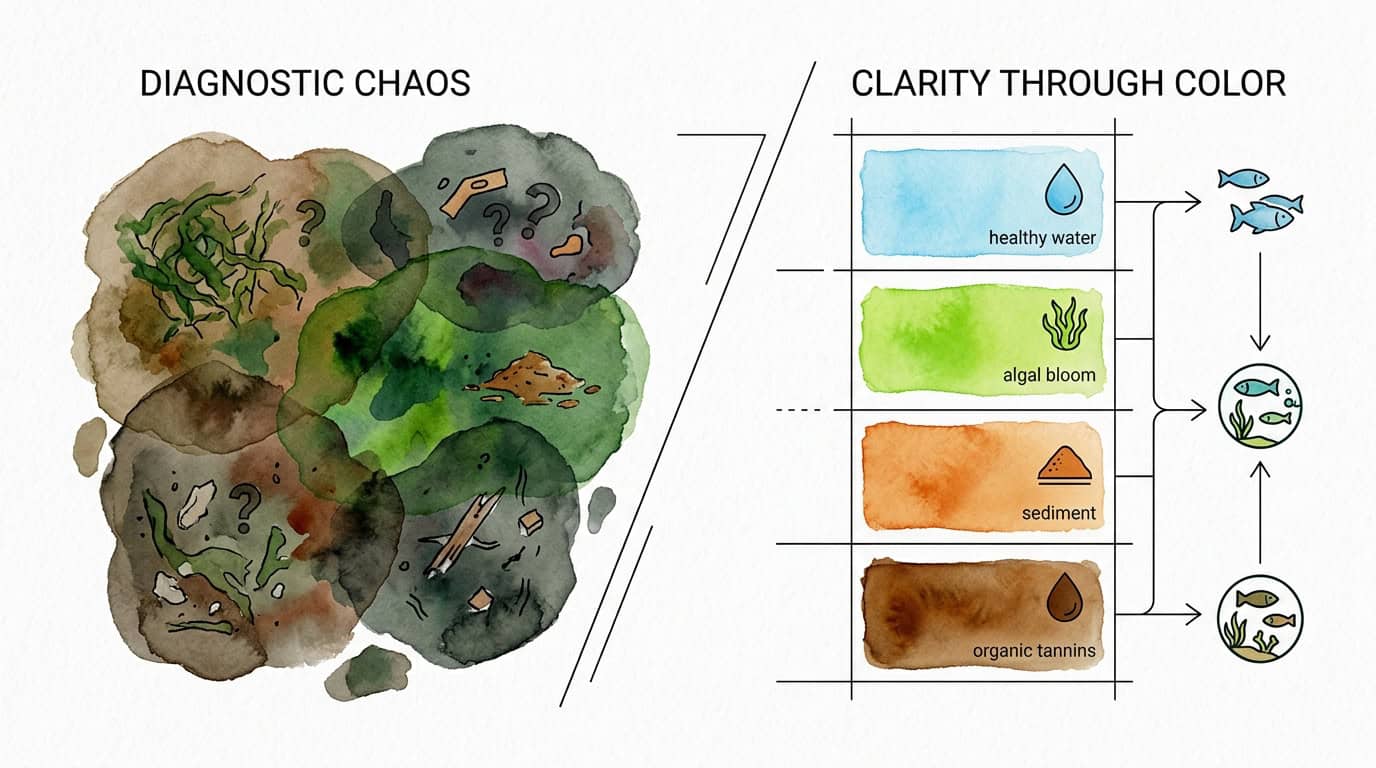
Your pond is trying to tell you something, but do you speak its language? Don’t guess what’s wrong with your water. Use our color-coding guide to identify algae blooms, tannin buildup, or oxygen crashes before they become a crisis.
Water clarity and color are the primary visual metrics used to assess the biological and chemical state of an aquatic ecosystem. In professional pond management, these visual cues act as a preliminary diagnostic layer, often preceding more intensive chemical analysis. Interpreting these signals correctly allows for the early detection of nutrient loading, anaerobic stratification, or pathogenic proliferation.
This guide provides a technical framework for evaluating pond health based on water coloration. We will examine the underlying mechanisms of light scattering, the biological contributors to specific hues, and the mechanical interventions required to maintain optimal water quality standards.
How To Identify Pond Problems By Water Color
Pond water color is a result of two primary factors: the absorption and scattering of light by suspended particles (turbidity) and the presence of dissolved organic or inorganic compounds. Natural, healthy water is rarely perfectly transparent; instead, it maintains a balance of microscopic life and minerals that reflect specific wavelengths of light.

Problems arise when the concentration of these substances shifts beyond the system’s buffering capacity. For example, a sudden increase in phosphorus may trigger a rapid expansion of planktonic algae, shifting the water from clear to a dense, opaque green. Similarly, the accumulation of organic debris at the pond floor can lead to anaerobic conditions, turning the water black and releasing toxic gases like hydrogen sulfide.
Understanding these shifts requires moving beyond “dirty water” as a general term. Technicians categorize water color into distinct spectra—green, brown, black, white, and red—each corresponding to specific environmental stressors or biological cycles. Proper identification is the first step toward achieving clarity through color rather than succumbing to diagnostic chaos.
The Physics of Apparent vs. True Color
Distinguishing between apparent color and true color is essential for accurate diagnosis. Apparent color is what the observer sees on the surface, which is influenced by bottom reflections, sky color, and suspended solids. True color is the hue of the water itself once all suspended particles have been removed through filtration or centrifugation.
Suspended solids, such as clay or silt, scatter light physically. Dissolved substances, such as tannins leached from fallen leaves, change the water’s chemical signature and absorb specific light frequencies. Professional monitoring often utilizes a Secchi disk or an NTU (Nephelometric Turbidity Unit) meter to quantify these observations and establish a data-driven baseline for the pond’s health.
Diagnostic Categories: Identifying the Hue
Water quality issues generally fall into one of the following color categories. Each requires a different remediation strategy, ranging from mechanical filtration to chemical nutrient binding.
Green Water: Planktonic Algae and Cyanobacteria
Green coloration typically indicates a bloom of planktonic algae. These are single-celled organisms suspended in the water column. While a light “green tea” hue is often desirable in aquaculture for providing shade and natural forage, a “pea soup” appearance indicates a hyper-eutrophic state.

Cyanobacteria, or blue-green algae, present a more significant risk. This organism often appears as a bright teal or metallic green film on the surface, resembling spilled paint. Cyanobacteria can produce hepatotoxins and neurotoxins that are hazardous to livestock and domestic animals. Immediate testing for microcystins is required if these visual markers are present.
Brown Water: Sediment vs. Tannins
Brown water is frequently confused with “dirt,” but the source is often more complex. If the water is opaque and muddy, the cause is usually suspended inorganic solids like clay or silt. This often follows heavy rain events where runoff carries terrestrial soil into the basin.
Tea-colored, transparent brown water indicates the presence of tannins. These are polyphenolic compounds leached from decaying organic matter, such as oak leaves or submerged wood. Tannins are not inherently toxic but can lower the water’s pH and inhibit light penetration, which affects the growth of beneficial submerged aquatic vegetation.
Black or Dark Gray Water: Anaerobic Failure
Black water is a critical indicator of oxygen depletion. When organic muck accumulates at the bottom without sufficient aeration, anaerobic bacteria begin the decomposition process. This produces hydrogen sulfide (the “rotten egg” smell) and manganese or iron sulfides, which tint the water a dark, somber gray or black.
This condition signals a pending or ongoing oxygen crash. Fish may be seen “piping” at the surface, gasping for air. If left unaddressed, the entire aerobic population of the pond will perish, leading to a total system collapse. Emergency aeration is the only viable intervention at this stage.
Milky or Cloudy Water: Bacterial and Mineral Shifts
Milky water often suggests a heterotrophic bacterial bloom. This occurs when there is a sudden spike in dissolved organic carbon, causing bacteria populations to explode. These bacteria consume vast amounts of oxygen, potentially leading to a crash.
Cloudiness can also result from mineral precipitation, such as a “calcite white-out,” where changes in temperature or pH cause calcium carbonate to fall out of solution. In new ponds, this may also indicate “New Pond Syndrome,” where the bio-filter has not yet matured to handle the ammonia load.
The Differential Diagnosis: The Jar Test
Correctly identifying the cause of discoloration prevents the waste of resources on ineffective treatments. Applying an algaecide to brown water caused by clay will yield zero results. Professionals utilize the “Jar Test” to confirm the source of the problem before intervening.
Collect a sample of the pond water in a clear glass jar and allow it to sit undisturbed for 24 hours. The results provide a clear diagnostic path:
- Sedimentation: If particles settle at the bottom and the water above becomes clear, the issue is mechanical (silt or clay). The solution involves flocculants or shoreline stabilization.
- Suspension: If the water remains uniformly green after 24 hours, the issue is biological (planktonic algae). The solution involves UV sterilization or nutrient management.
- Staining: If the water remains a clear, transparent brown (like tea), the issue is chemical (tannins). The solution involves activated carbon or water exchange.
Benefits of Proactive Color Monitoring
Early identification of water color shifts provides several measurable advantages for pond owners and managers. Monitoring visual data points allows for lower-cost interventions before the system reaches a point of total failure.
Maintaining awareness of color changes enables the prevention of fish kills. Oxygen crashes often follow heavy algae blooms; as the algae die off, their decomposition consumes all available dissolved oxygen. Spotting the shift from a healthy green to a “crashing” yellow-green allows for the activation of supplemental aeration systems before the DO (Dissolved Oxygen) levels drop below the critical 2.0 mg/L threshold.
Accurate diagnosis also reduces chemical dependency. Many pond owners reflexively apply copper-based algaecides at the first sign of cloudiness. If the cloudiness is actually caused by suspended clay, these chemicals serve no purpose other than to increase the heavy metal load in the sediment. Color-based diagnosis ensures that only necessary treatments are applied, preserving the long-term health of the benthic zone.
Challenges and Common Mistakes
Errors in interpreting water color often stem from a lack of historical baseline data. Every pond has a “normal” color based on its local geology and source water. Failing to establish this baseline makes it difficult to determine if a shift is a natural seasonal fluctuation or a developing crisis.
A frequent mistake is the misidentification of floating plants as algae. Duckweed and watermeal can cover a pond surface so densely that the water appears green from a distance. However, these are vascular plants, not algae. Treating them with standard algaecides will be ineffective and may lead to a nutrient spike as the plants die and release their stored nitrogen and phosphorus back into the water.
Another challenge is the “rebound effect” after treatment. If a manager uses a dye to mask green water, they may inadvertently block the light needed by beneficial bottom-rooted plants. These plants act as nutrient sponges; without them, the excess nutrients remain available, leading to a more aggressive algae bloom once the dye fades. Visualization must be paired with an understanding of the underlying nutrient cycle.
Limitations of Visual Identification
Visual identification is a powerful tool, but it has practical boundaries. Color cannot quantify specific chemical concentrations, such as ammonia, nitrite, or phosphate levels. A pond can appear perfectly clear while harboring lethal levels of ammonia (NH3) if the biological filter has crashed.
Environmental factors can also mask color indicators. High winds or heavy rain can stir up bottom sediments, creating temporary turbidity that obscures the “true” color of the water. In deep ponds, the surface may look healthy even as the bottom layers (the hypolimnion) become dangerously anaerobic.
Reliance on visual cues alone can be dangerous in the case of toxic cyanobacteria. Not all green blooms are toxic, and not all toxic blooms are green. Precise identification of Harmful Algal Blooms (HABs) requires microscopic analysis or specialized test strips that detect specific toxins. Professional managers should use color as a “check engine light”—a signal to perform deeper, more rigorous testing.
Comparing Mitigation Strategies
Once the color is identified, the choice of mitigation depends on the specific cause. The following table compares common approaches for the three most frequent color-related issues.
| Issue | Color Indicator | Primary Treatment | Mechanism of Action |
|---|---|---|---|
| Planktonic Algae | Opaque Green | UV Sterilization / Algaecide | DNA disruption or cellular lysis |
| Suspended Clay | Opaque Brown/Tan | Flocculants (Alum/Polymers) | Neutralizes ionic charge to clump particles |
| Tannin Buildup | Clear Tea-Brown | Activated Carbon / Water Exchange | Adsorption of organic molecules |
| Anaerobic Muck | Black / Dark Gray | Bottom Aeration / Sludge Bacteria | Oxidation and aerobic digestion |
Practical Tips for Maintaining Water Clarity
Implementing a consistent maintenance schedule is the most effective way to prevent radical color shifts. Managing the nutrient load at the source is significantly more efficient than treating the symptoms after a bloom has occurred.

- Establish a Shoreline Buffer: Planting a 3-to-5-foot wide strip of native grasses or sedges around the pond perimeter traps sediment and absorbs nutrient-rich runoff before it reaches the water. This reduces the frequency of “muddy” or “pea soup” events.
- Deploy Subsurface Aeration: Unlike surface fountains, which are primarily aesthetic, bottom-diffused aeration moves water from the bottom to the top. This prevents the stratification that leads to black, anaerobic water and encourages the growth of aerobic beneficial bacteria.
- Monitor Phosphate Levels: Phosphorus is the primary fuel for algae. Keeping phosphate levels below 0.05 mg/L significantly limits the potential for green water blooms. Using phosphate binders like lanthanum-modified clay can “lock” nutrients in the sediment.
- Utilize Beneficial Bacteria: Regular dosing of concentrated aerobic bacteria helps digest the “muck” layer at the bottom. This reduces the organic load that causes both tannins and anaerobic discoloration.
Advanced Considerations: Redox and Stratification
For serious practitioners, understanding the relationship between water color and Redox Potential (ORP) is vital. Oxidation-Reduction Potential measures the “cleansing power” of the water. A low ORP (below 150 mV) often correlates with dark, murky water and poor decomposition rates. Raising the ORP through aeration or ozone injection improves water clarity and shifts the color toward a healthy, transparent blue or light green.
Thermal stratification also plays a role in color dynamics. During summer, ponds divide into three layers: the epilimnion (warm, oxygenated top), the metalimnion (middle transition), and the hypolimnion (cold, oxygen-poor bottom). Color changes often start in the hypolimnion. If a “turnover” occurs—where wind or cold rain forces the bottom water to the surface—the entire pond can turn black overnight. Monitoring the temperature differential between the surface and the floor can help predict and prevent these catastrophic color shifts.
Automated sensors can now track Turbidity (NTU) and Chlorophyll-a in real-time. These devices provide an early warning system, sending alerts when the data deviates from the norm. Integrating these metrics into a pond management plan allows for mechanical optimization of filtration and aeration run-times based on actual demand rather than a fixed schedule.
Example Scenario: The Post-Storm Shift
Consider a 1-acre residential pond that is typically clear with a slight greenish tint. Following a 3-inch rainfall event, the owner notices the water has turned a deep, opaque chocolate brown. The first instinct might be to apply an algaecide, assuming the rain washed in fertilizers that triggered a bloom.
However, applying the Jar Test reveals that the particles settle to the bottom within 12 hours, leaving clear water above. This confirms the color is due to suspended silt and clay from an eroded drainage ditch nearby. Instead of chemicals, the owner installs a rock rip-rap in the ditch and applies a liquid flocculant to the pond. Within 48 hours, the water returns to its original state, and the source of the problem is permanently addressed.
Six months later, the same pond turns a clear, tea-colored brown during late autumn. The Jar Test shows no sedimentation. The owner identifies the cause as tannins from heavy leaf fall. By increasing the turnover rate of the pond’s mechanical filter and adding activated carbon, the tint is neutralized before the low pH can stress the resident koi population.
Final Thoughts
Water color is the most accessible diagnostic tool available to pond owners. By learning to differentiate between green algae, brown tannins, and black anaerobic conditions, you can move away from reactive “guesswork” and toward proactive ecosystem management. Each shade represents a specific set of chemical and biological variables that require a tailored response.
Maintaining a healthy pond requires a commitment to observation and a willingness to investigate the root causes of clarity loss. Whether you are managing a small decorative water feature or a large multi-acre lake, the principles of light scattering and nutrient cycling remain the same. Clear water is not just an aesthetic goal; it is a clinical indicator of a balanced and thriving environment.
Encourage the use of professional testing equipment for high-stakes environments, but never underestimate the power of a simple jar and a keen eye. Applying these identification techniques will ensure your pond remains a healthy asset rather than a diagnostic burden. As you become more familiar with your pond’s specific baseline, you will find it much easier to detect and resolve issues before they escalate into an ecological crisis.