

How To Harvest Euglena Algae Easily
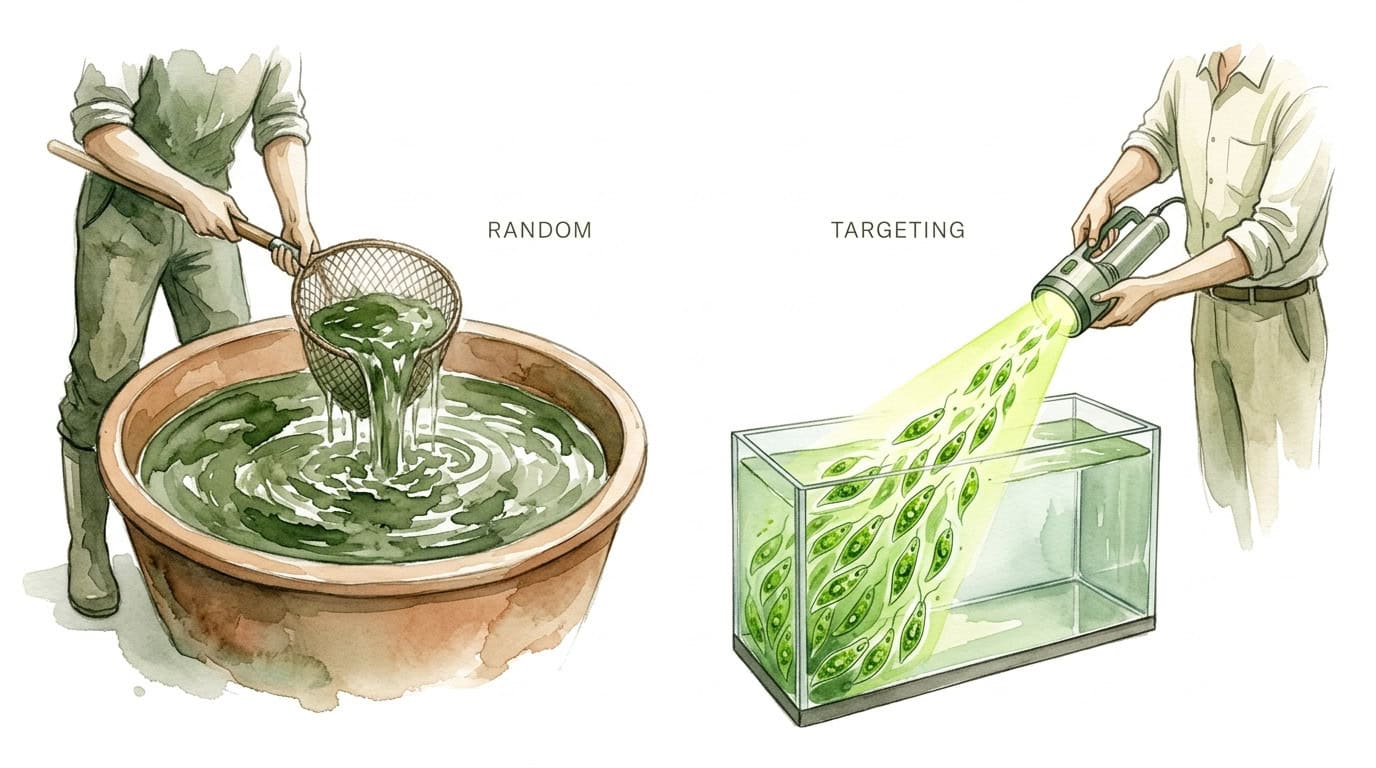
Stop fighting the water and start using the algae’s own instincts to harvest it for you. Euglena is unique because it can see light! Using a simple underwater LED, you can summon the algae to one spot for easy, pure harvesting. No more mud, no more debris—just pure green power.
To harvest Euglena algae easily, utilize their positive phototaxis by placing a high-intensity 450–470nm blue LED light at a specific collection point within the culture tank. The organisms migrate toward the light source, concentrating themselves into a dense cluster. This concentrated biomass is then extracted via siphon or localized filtration, significantly reducing the energy requirements and time associated with bulk water processing or mechanical centrifugation.
How To Harvest Euglena Algae Easily
Euglena algae, specifically Euglena gracilis, are unicellular flagellated eukaryotes that occupy a unique taxonomic position between plants and animals. These organisms are mixotrophic, meaning they can utilize photosynthesis via chloroplasts or ingest organic matter. In a practical industrial or laboratory context, harvesting these microorganisms is traditionally the most energy-intensive stage of production, often accounting for 20% to 30% of total operational costs.
The core principle behind “easy” harvesting lies in the organism’s sensory apparatus. Unlike many other microalgae that require chemical flocculants or high-speed centrifuges to separate from the water column, Euglena possesses a paraflagellar body (PFB) and a shading stigma (eyespot). This biological hardware allows the cell to detect light direction and intensity, leading to a behavioral response known as phototaxis. By manipulating the light environment, operators can induce the cells to concentrate themselves, effectively “self-harvesting” into a manageable volume.

Real-world applications for harvested Euglena include the production of paramylon (a ?-1,3-glucan used in nutraceuticals), high-quality lipids for biodiesel, and protein-rich biomass for aquaculture. Because Euglena cells lack a cellulose cell wall, they are more easily digestible than other algae like Chlorella, making the purity of the harvest critical for downstream processing.
The Mechanism of Phototactic Concentration
Successful harvesting requires an understanding of the phototactic response cycle. When a light source is introduced, the stigma periodically shades the PFB as the cell rotates during its helical swimming motion. This shading creates a signal that adjusts the flagellar beat, steering the organism toward the light (positive phototaxis). Research indicates that blue light wavelengths, specifically in the 460nm range, elicit the strongest positive response.
Implementation of this technique involves establishing a “collection zone.” In a dark or dimly lit tank, a localized high-intensity LED creates a steep light gradient. Euglena cells within the effective radius will begin migrating at speeds of approximately 0.1 mm/s. Over a period of 30 to 120 minutes, a significant percentage of the total biomass will aggregate around the light source, increasing the local cell density by a factor of 10x to 50x compared to the bulk culture.
Optimization of this process depends on managing light intensity. If the light is too intense, Euglena may exhibit negative phototaxis or a “shock reaction,” where they swim away from the source to avoid photodamage. Maintaining an irradiance level that satisfies the “positive” threshold without triggering avoidance is the primary technical challenge in this method.
Implementation: Steps for Easy Harvesting
- Step 1: Dark Adaptation. Ensure the culture is in a state of relative darkness or uniform low-intensity light for at least 30 minutes. This increases the sensitivity of the PFB to new light stimuli.
- Step 2: LED Deployment. Submerge a waterproof (IP68 rated) blue LED (450–470nm) into a specialized collection chamber or a corner of the tank. Using a focused beam rather than a diffuse glow helps create the necessary gradient.
- Step 3: Migration Period. Allow 60 to 180 minutes for the cells to migrate. Monitoring turbidity in the collection zone can help determine the optimal extraction time.
- Step 4: Localized Extraction. Use a low-suction peristaltic pump or a simple siphon to draw the concentrated “green cloud” from the collection zone. This prevents the redistribution of cells back into the bulk water.
- Step 5: Final Dewatering. The resulting concentrate is now much smaller in volume. It can be further processed using a simple mesh filter (20–40 micron) or a benchtop centrifuge with significantly reduced run times.
Benefits of Light-Targeted Harvesting
Traditional harvesting methods like centrifugation require massive electrical input to move large volumes of water against high G-forces. In contrast, light targeting uses the internal energy of the organism (ATP-driven flagellar motion) to perform the work of concentration. This results in a Net Energy Ratio (NER) that is far superior to mechanical separation.
Purity is another significant advantage. When scooping or filtering bulk water, debris, unconsumed nutrients, and dead cells are collected along with the live algae. Because phototaxis only affects motile, healthy cells, the resulting harvest consists almost entirely of viable Euglena. This biological “filtering” ensures a higher quality end product with lower levels of contamination.

Cost reduction is measurable in both capital and operational expenditures. Smaller pumps, lower power consumption, and the elimination of expensive chemical flocculants like Poly Aluminium Chloride (PAC) make this approach ideal for small-to-medium scale bioreactors and hobbyist setups.
Challenges and Common Mistakes
A frequent error is the use of white or broad-spectrum light. White light contains wavelengths that can trigger conflicting signals or promote the growth of competing non-motile algae, which will not respond to the light and will remain as contaminants in the tank. Sticking to narrow-band blue LEDs is technically superior for Euglena gracilis.
Saturation of the light source is another common pitfall. If the LED is too bright, the cells immediately surrounding it will move away (negative phototaxis), creating a “hollow” area around the light where the concentration should be highest. Calibration of the light intensity is essential. Operators should aim for a level where the cells “dance” around the light without retreating.
Thermal gradients can also interfere with the process. LEDs, even submersible ones, generate heat. If the light source significantly raises the local temperature, thermophilic responses may override the phototactic ones, causing the algae to disperse. Using efficient, low-heat LEDs or pulsed light systems can mitigate this effect.
Limitations and Practical Boundaries
Light-targeted harvesting is highly effective at low-to-moderate culture densities. However, as the culture becomes extremely dense (blooms), self-shading occurs. The cells closest to the light source block the light from reaching those further away, creating a “shadow zone” where the phototactic stimulus is lost. This limits the efficiency of the method in high-density industrial raceway ponds unless multiple light points are used.
Environmental constraints also play a role. In outdoor systems, ambient sunlight is much more powerful than any artificial LED. Harvesting must typically take place at dawn, dusk, or night to ensure the artificial light provides the dominant gradient. This restricts the operational window for the “easy” harvesting method in large-scale outdoor applications.
Scale is the final boundary. While phototaxis is perfect for laboratory volumes (10L–500L), scaling to millions of liters requires sophisticated light-distribution networks (fiber optics or internal LED arrays). At that scale, the complexity of the lighting system may begin to rival the cost of traditional mechanical methods.
Comparing Harvesting Techniques
| Feature | Phototactic Targeting | Centrifugation | Chemical Flocculation |
|---|---|---|---|
| Energy Demand | Extremely Low (LEDs only) | Very High (Mechanical) | Low (Mixing only) |
| Biomass Purity | Highest (Viable cells only) | Moderate (Collects debris) | Lowest (Chemical residues) |
| Cell Integrity | Excellent | Risk of Shear Damage | Variable (pH sensitive) |
| Scalability | Moderate (Shading issues) | High | High |
Practical Tips and Best Practices
To maximize efficiency, integrate the collection zone with a tapered vessel design. A conical bottom in the harvesting chamber allows the concentrated algae to settle further by gravity once they have reached the light source, creating a “sludge” that is extremely easy to pump out. This dual-action concentration (phototaxis + gravity) is the hallmark of a professional setup.
Maintain the culture temperature within the optimal range of 20°C to 25°C. Research into Euglena motility shows that while they can survive a wide range of temperatures, their swimming speed and phototactic precision peak within this narrow window. Cold cultures move sluggishly, extending the time required for a full harvest.
Use a staged lighting system for larger tanks. Instead of one big light, use a sequence of lights that turn on and off to “herd” the algae from the far reaches of the tank toward the final collection point. This overcomes the self-shading limitation and ensures that even cells at the opposite end of the bioreactor are successfully recruited into the harvest.
Advanced Considerations for Industrial Scaling
For those looking to go beyond basic setups, the integration of automated turbidity sensors is the next step. These sensors can detect when the cell density in the collection zone has reached a target threshold (e.g., 50g/L) and automatically trigger the extraction pump. This ensures the harvest happens at the point of maximum efficiency, preventing the energy waste of pumping water that is too dilute.
Genetic optimization is also on the horizon. Researchers are investigating CRISPR/Cas9 techniques to enhance the expression of rhodopsin-like proteins in the PFB. Engineering strains with heightened light sensitivity could allow for faster harvesting even in dense cultures or under lower-intensity (and thus cheaper) light sources. This would revolutionize the “self-harvesting” potential of Euglena on a global scale.
Consider the fluid dynamics of the collection zone. Designing “low-flow” extraction ports prevents the vortex effect, which can suck in dilute water from outside the concentrated cloud. Use wide-diameter intake nozzles with slow peristaltic action to keep the harvested biomass as thick and pure as possible.
Scenario: A 500-Liter Laboratory Harvest
Imagine a 500-liter tank of E. gracilis at a steady-state density of 1 gram per liter (total biomass 500g). Conventional centrifugation of the entire 500 liters would require significant time and electricity. Instead, the operator blacks out the tank at 2:00 AM and activates a 10W blue LED inside a 5-liter collection tube at the bottom center.
By 4:00 AM, the cells have migrated into the tube. The local density in the tube is now roughly 80g/L. The operator siphons out the 5 liters from the tube. They have now captured 400g of the 500g total biomass (80% efficiency) while only having to process 1% of the total water volume. The remaining 495 liters of water stay in the tank, containing the nutrients and the residual 100g of algae to serve as the “seed” for the next growth cycle.
Final Thoughts
Harvesting Euglena by leveraging their natural phototactic instincts is a masterclass in biological efficiency. It transforms a high-cost mechanical problem into a low-cost behavioral one. By focusing on the specific wavelengths and intensities that drive these organisms, practitioners can achieve high-purity harvests with minimal equipment.
The transition from bulk water processing to targeted biomass collection is the future of sustainable microalgal production. Whether for research, food, or fuel, the “easy” way—using light—is fundamentally aligned with the biology of the organism, leading to better results and lower overhead.
Experimentation with different collection vessel geometries and LED pulse frequencies will further refine this technique. As we move toward more automated and genetically optimized systems, Euglena’s ability to “walk” itself into the harvest bag will remain its most valuable industrial trait.
Frequently Asked Questions About How To Harvest Euglena Algae Easily
What is the best color of light for harvesting Euglena?
The most effective wavelength for inducing positive phototaxis in Euglena gracilis is blue light, specifically between 450nm and 470nm. This range corresponds to the absorption spectrum of the flavin-based photoreceptors located in the paraflagellar body. While green light is utilized for photosynthesis, it does not trigger the same directional swimming response. Red light is often ignored by the organism’s phototactic system, making it useful for observation without disturbing the collection process. Using a high-purity blue LED ensures that the signal is clear and that the algae migrate efficiently toward the harvest point.
Can I harvest Euglena in a tank that is exposed to sunlight?
Harvesting via light targeting is difficult in direct sunlight because the ambient solar radiation is much more intense than any artificial LED gradient you can create. For the algae to “see” your collection light, that light must be the strongest source in their environment. In outdoor or sunlit systems, it is best to perform the harvesting operation at night or to use a light-shielded “harvesting chamber” where you can control the light environment. Once the algae enter the shaded chamber, they will respond to the internal LED and concentrate for extraction.

How long does it take for the algae to concentrate?
The time required depends on the size of the tank and the distance the cells must travel. Euglena typically swim at a speed of about 0.1 mm per second. In a standard 100-liter laboratory tank, you can expect significant concentration around a light source within 60 to 90 minutes. For larger volumes, the process can take 3 to 4 hours. It is important to monitor the density and stop the process once the collection zone is saturated; otherwise, the cells may start to move away due to overcrowding or localized oxygen depletion in the dense “cloud.”
Does this light harvesting method kill or damage the algae?
No, one of the primary advantages of phototactic harvesting is that it is non-invasive and non-destructive. Unlike centrifugation, which subjects the cells to high G-forces and potential shear stress, or chemical flocculation, which can alter the cellular pH and leave toxic residues, light targeting relies on the organism’s natural movement. The cells remain viable and healthy throughout the process. This makes the method particularly ideal for “continuous culture” systems where you want to harvest some of the algae while leaving the rest alive to continue growing.
Why are my Euglena swimming away from the light?
If your algae are swimming away from the light source, they are exhibiting negative phototaxis. This usually happens because the light intensity is too high. Euglena move toward moderate light to optimize photosynthesis but will flee from extremely bright light to avoid damage from ultraviolet radiation or excessive photo-oxidation. To fix this, increase the distance between the light and the algae, use a lower-wattage LED, or use a dimmer to reduce the intensity until you see the cells begin to aggregate rather than disperse. Finding this “Goldilocks zone” is key to a successful harvest.