

When your pond turns blood red, it’s screaming for help. Here’s what Euglena is telling you. Is your pond changing colors? Euglena blooms are fascinating but dangerous. Learn what causes these shifts and how to fix them.
Pond water changes color due to the rapid proliferation of Euglena species, specifically Euglena sanguinea for red shifts and other euglenoids for green or brown hues. These microorganisms utilize carotenoid pigments, primarily astaxanthin, to shield their organelles from intense ultraviolet radiation, moving these pigments to the cell periphery during peak sunlight. This phenomenon indicates high concentrations of nitrogen and phosphorus, alongside potential risks of dissolved oxygen depletion and alkaloid toxicity.
Euglena Blooms in Ponds: Why the Water Turns Red, Brown or Green
Euglenoids represent a unique genus of single-celled eukaryotic protists that do not fit neatly into traditional plant or animal classifications. These organisms possess chloroplasts for photosynthesis yet lack a rigid cellulose cell wall, utilizing a flexible protein-based structure called a pellicle. This allows them to change shape and navigate water columns using a whip-like flagellum.
The sudden appearance of red, brown, or green coloration in a pond is the result of a “bloom,” which is a rapid increase in the population density of these microbes. While a healthy pond requires a baseline of planktonic activity to support the food web, a Euglena bloom signals a state of hypertrophic imbalance. These blooms are most common in stagnant or slow-moving freshwater bodies where organic matter has accumulated over time.

Real-world instances of these blooms often occur in agricultural ponds, golf course water hazards, and residential retention basins. In these environments, the water acts as a catchment for fertilizers and organic debris, providing the chemical foundation for microbial explosions. Understanding the biology of these organisms is the first step toward implementing an effective mechanical or chemical remediation strategy.
The Mechanism of Chromatic Shifts in Euglenoids
Color changes in euglenoid-infested ponds are dynamic and often occur within a single diurnal cycle. The transition from green to red is a physiological response to light intensity and environmental stress. This process is governed by the migration of cytoplasmic granules containing carotenoid pigments.
Chlorophyll a and b provide the standard green tint during periods of low light or active photosynthesis. However, when exposed to high-intensity UV radiation, species like Euglena sanguinea produce astaxanthin. This red pigment serves as a biological sunscreen, migrating from the center of the cell to the periphery to protect the nucleus and chloroplasts from oxidative damage.
Thermal triggers and nutrient availability also play critical roles in these shifts. Warm water temperatures—typically above 70°F (21°C)—accelerate the metabolic rate of these protists. When the sun sets or cloud cover increases, the organisms often retract the red pigments or migrate deeper into the water column, causing the pond to appear green or clear again by morning. This vertical migration is a primary reason why surface-level “paint-like” scums seem to vanish and reappear unpredictably.
Hydraulic and Chemical Drivers of Proliferation
The primary driver of any Euglena bloom is excessive nutrient loading, specifically regarding soluble reactive phosphorus (SRP) and dissolved inorganic nitrogen (DIN). These microbes are mixotrophic, meaning they can supplement their energy production by consuming organic carbon alongside photosynthesis. This dual-feeding capability gives them a competitive advantage in “dirty” water over purely autotrophic algae.
Phosphorus levels exceeding 0.03 mg/L and nitrogen levels above 0.3 mg/L are often sufficient to trigger a bloom. In ponds with low hydraulic turnover, these nutrients become concentrated. Stagnation prevents the physical dispersal of cells and allows for the formation of thermal stratification, where a warm upper layer (epilimnion) sits atop a cooler, oxygen-poor lower layer (hypolimnion).

Runoff from surrounding landscapes frequently introduces these nutrients. High-volume rain events wash fertilizers, animal waste, and leaf litter into the basin. Without a filtration mechanism or sufficient water movement, the pond becomes a highly efficient bioreactor for euglenoid growth. Mechanical optimization must focus on breaking this cycle through circulation and nutrient sequestration.
Ecological and Toxicological Impacts
A Euglena bloom is more than an aesthetic nuisance; it represents a significant threat to aquatic health. The most immediate danger is the depletion of dissolved oxygen (DO). While these organisms produce oxygen during the day via photosynthesis, they consume it through respiration at night. In a dense bloom, the nighttime demand for oxygen can exceed the pond’s total supply, leading to mass fish kills.
Specific strains of Euglena sanguinea are known to produce an ichthyotoxin called euglenophycin. This alkaloid toxin is chemically similar to fire ant venom and can cause neurological damage or gill failure in fish. Unlike cyanobacterial toxins which often affect mammals, euglenophycin is primarily targeted at aquatic gill-breathing organisms, making it a “silent killer” in the aquaculture industry.
Secondary impacts include the shading of submerged aquatic vegetation (SAV). As the surface becomes opaque with red or green scum, sunlight cannot reach the plants at the bottom. This leads to the death of beneficial vegetation, which then decomposes and further contributes to the nutrient load and oxygen demand. This feedback loop can turn a minor imbalance into a permanent state of eutrophication.
Mechanical Remediation and Technical Optimization
Addressing a Euglena bloom requires a shift from superficial treatments to mechanical optimization. Strategic aeration is the most effective long-term solution. By increasing the DO levels throughout the water column, you promote the growth of aerobic bacteria that compete with Euglena for nutrients and help decompose organic “muck” on the pond floor.
Subsurface diffused aeration systems are technically superior to surface fountains for this purpose. These systems utilize an onshore compressor to pump air to diffusers on the pond bottom, creating a “laminar flow” that breaks up thermal stratification. For effective control, a system should be sized to provide at least 1.0 to 1.5 CFM (cubic feet per minute) of airflow per surface acre, depending on depth and organic load.
Mechanical filtration and UV sterilization can be utilized in smaller systems. A UV clarifier with a high-intensity lamp can disrupt the DNA of euglenoid cells as they pass through the filtration loop. However, for larger ponds, focus should remain on “nutrient inactivation.” Products containing lanthanum-modified clay or aluminum sulfate (alum) can be used to bind phosphorus, making it unavailable to the microbes and effectively starving the bloom.
Mitigation via Riparian Infrastructure
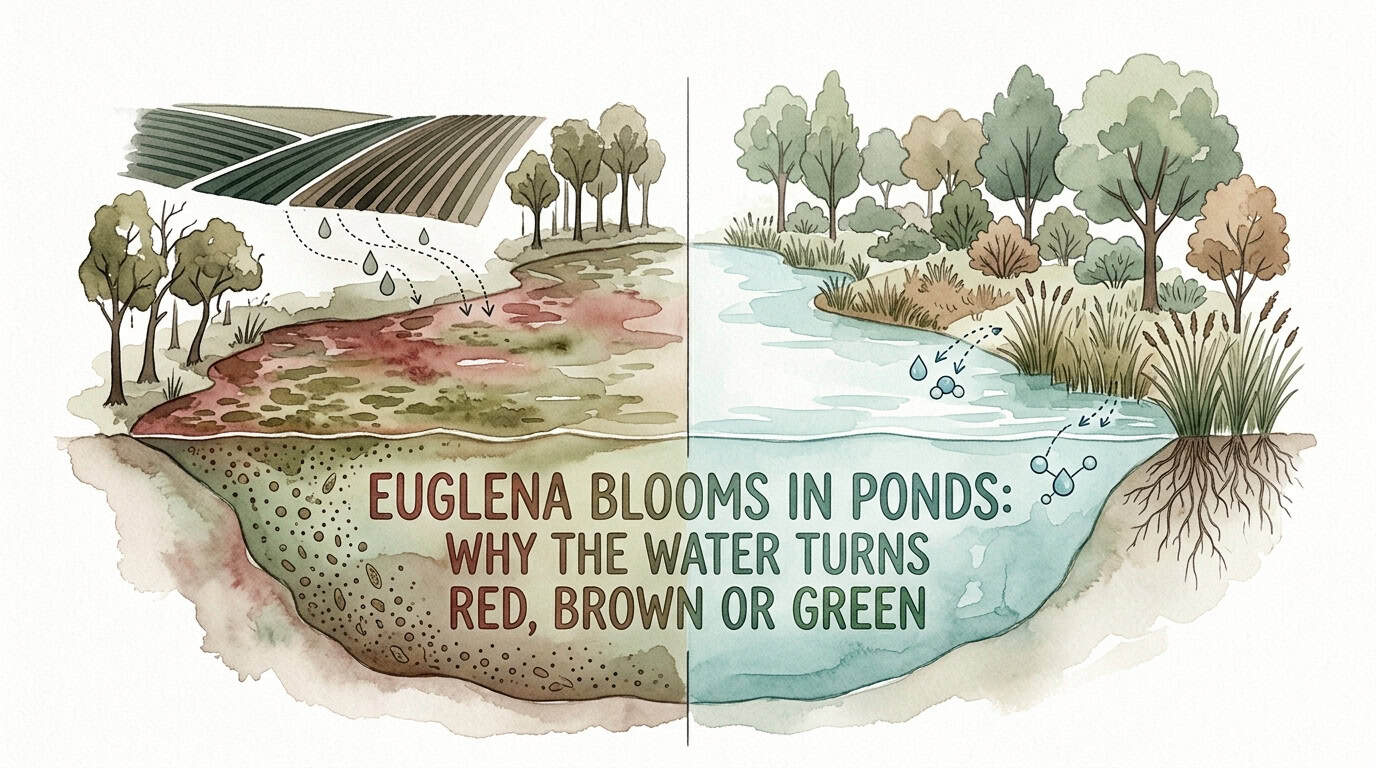
Environmental management of pond coloration often involves comparing different land-use strategies. The effectiveness of a natural riparian buffer versus a runoff-polluted waterway is measurable in the reduction of nutrient inflows. A well-designed buffer acts as a biological filter, intercepting pollutants before they reach the pond’s edge.
| Parameter | Runoff-Polluted Waterway | Natural Riparian Buffer |
|---|---|---|
| Nitrogen Removal Efficiency | 0–10% (Direct discharge) | 40–90% (Biological uptake) |
| Phosphorus Retention | Minimal; mostly sediment-bound | 50–85% (Soil filtration) |
| Sediment Control | High turbidity and siltation | 70–95% reduction in TSS |
| Dissolved Oxygen Stability | Low; prone to “crashes” | High; consistent levels |
| Maintenance Requirement | Frequent chemical intervention | Occasional plant management |
Establishing a riparian zone involving native grasses, shrubs, and trees creates a complex root network that stabilizes the shoreline and absorbs dissolved nutrients. This infrastructure is a passive, high-efficiency system that reduces the need for active mechanical intervention. In contrast, a runoff-polluted waterway relies entirely on downstream dilution, which is rarely effective in closed-loop pond systems.
Practical Tips for Pond Management
Regular monitoring is essential for preventing the next color shift. Pond owners should utilize a Secchi disk to measure water transparency. A reading of less than 12 inches indicates a high risk of an oxygen crash, while a reading of 18–24 inches is generally considered the target for a healthy, balanced ecosystem.
- Audit Nutrient Sources: Identify and eliminate the use of high-phosphorus fertilizers within the pond’s immediate watershed.
- Enhance Circulation: Ensure that the aeration system is operational 24/7 during the summer months to prevent the formation of stagnant “dead zones.”
- Utilize Beneficial Bacteria: Supplement the pond with specialized aerobic bacteria cultures that accelerate the digestion of nitrogenous waste.
- Monitor pH Levels: Euglena blooms often thrive in slightly acidic to neutral water; maintaining a stable alkalinity above 50 ppm can help buffer the system.
Physical removal of surface scums can provide temporary aesthetic relief, but it does not address the underlying chemical imbalance. If a bloom is currently in the red “sunscreen” phase, avoid using algaecides that cause a rapid cell die-off. A sudden crash of the bloom can release a massive amount of toxin and deplete all remaining oxygen as the cells decompose simultaneously.
Advanced Considerations in Mixotrophic Metabolism
Experienced practitioners should consider the metabolic flexibility of euglenoids when designing a management plan. Unlike many green algae, Euglena can switch to “phagotrophic” feeding, where they ingest solid particles of bacteria or organic debris. This means that even if sunlight is limited, the bloom can persist if the water is rich in dissolved organic carbon (DOC).
Chemical Oxygen Demand (COD) is a critical metric for these systems. A high COD indicates that the pond is holding a large amount of oxidizable pollutants. When euglenoids occupy this environment, they utilize the organic load as an alternative energy source. Reducing the COD through enzymatic treatments or high-efficiency ozone injection can sometimes be necessary in professional-grade water management.
The presence of a protein-based pellicle instead of a cellulose wall also affects the efficacy of certain algaecides. Some copper-based treatments may be less effective against euglenoids because the pellicle provides a robust barrier. Using chelated copper or percarbonate-based oxidizers often yields better results by breaking down the protein structure more effectively than standard copper sulfate crystals.
Examples of Bloom Remediation in Practice
Consider a 1-acre residential pond with a maximum depth of 8 feet that has turned a deep brick-red. Soil testing of the surrounding lawn shows phosphorus levels at 50 ppm due to over-fertilization. The water transparency is measured at 6 inches using a Secchi disk, indicating an extreme bloom density.
The remediation plan starts with the installation of a 1/2 HP subsurface aeration system with two dual-head diffusers. This setup provides a turnover rate of approximately 1.5 times per day. Simultaneously, a lanthanum-modified clay treatment is applied at a rate of 250 lbs per acre to lock the soluble phosphorus into the sediment.
Within seven days, the aeration begins to break the thermal stratification, and the increased oxygen levels stimulate native bacteria to compete for the remaining nitrogen. The red color fades to a light green as the UV stress is reduced by deeper water mixing. Within three weeks, the Secchi reading improves to 20 inches, and the Euglena population returns to a stable, non-blooming baseline.
Final Thoughts
Managing a pond that has turned red, green, or brown requires a move away from reactive chemical treatments and toward proactive mechanical and biological optimization. The color of your water is a high-fidelity signal of the underlying nutrient and oxygen status of the ecosystem. By interpreting these signals correctly, you can implement solutions that address the root cause rather than just the symptoms.
Biological filters such as riparian buffers and mechanical systems like subsurface aerators are the cornerstones of a stable pond. These interventions promote a resilient environment capable of resisting the metabolic shifts of organisms like Euglena. Consistency in monitoring and nutrient management is the only way to ensure long-term water clarity and safety for aquatic life.
Experimenting with different aeration patterns and nutrient-binding agents will provide deeper insights into the specific needs of your water body. As you refine your approach, you will find that a balanced pond requires less effort to maintain and offers a far more predictable and healthy environment for everyone involved.

Frequently Asked Questions About Euglena Blooms in Ponds: Why the Water Turns Red, Brown or Green
Is the red water in my pond toxic to pets or humans?
While the primary toxin produced by Euglena sanguinea, euglenophycin, is specifically known for its ichthyotoxicity (toxicity to fish), it is generally recommended to avoid contact with any water experiencing a dense bloom. These blooms often occur alongside other harmful microbes or bacteria that can cause skin irritation or gastrointestinal distress if ingested. Furthermore, because euglenophycin has shown anti-proliferative effects in laboratory settings, its long-term impact on mammalian health is still a subject of scientific study. It is safer to treat the pond and wait for the bloom to dissipate before allowing pets or people to swim in the water.
How quickly can a Euglena bloom change color from green to red?
A Euglena bloom can change color in as little as 10 to 30 minutes. This rapid shift is not due to a change in the population size, but rather a mechanical movement of pigments within the individual cells. When sunlight intensity increases, the cells move their astaxanthin-filled granules to the outer edges of their bodies to protect their chloroplasts. This phototactic response is a highly efficient survival mechanism. Conversely, when a cloud passes or the sun sets, the pigments are retracted, and the pond may appear to “clear up” or return to a green tint almost as quickly as it turned red.
Why did my pond turn red even though I don’t use fertilizer?
Fertilizer is only one source of the nutrients that fuel Euglena blooms. Nutrients can also enter your pond through “internal loading,” where phosphorus and nitrogen are released from the muck and decaying organic matter already sitting on the pond floor. Additionally, leaf litter from surrounding trees, waste from waterfowl like geese and ducks, and even atmospheric nitrogen deposited during rainstorms can provide sufficient fuel for a bloom. If your pond is stagnant and has a layer of organic sludge at the bottom, it essentially has a built-in reservoir of nutrients that can trigger a bloom whenever the temperature and light conditions are right.
Can I use standard copper sulfate to kill a red Euglena bloom?
Copper sulfate is frequently used as a broad-spectrum algaecide, but it can be problematic when dealing with a Euglena bloom. These organisms are highly motile and can swim away from areas with high chemical concentrations. Moreover, a rapid kill-off of a massive bloom will lead to a sudden release of cell-bound toxins and a catastrophic drop in dissolved oxygen levels as the dead cells decompose. This often results in a fish kill that is more damaging than the bloom itself. A better approach is to use chelated copper products combined with aeration to manage the population more gradually and safely.
Will a pond fountain prevent Euglena blooms from occurring?
A fountain provides some surface aeration and aesthetic value, but it is often insufficient to prevent Euglena blooms in ponds deeper than 4 or 5 feet. Fountains only move the water at the surface, leaving the nutrient-rich, oxygen-poor water at the bottom untouched. This allows “dead zones” to form where organic matter accumulates and fuels microbial growth. For true prevention, a bottom-diffused aeration system is required. This type of system moves the entire water column from the bottom up, ensuring that oxygen reaches the sediment-water interface where it is needed most to facilitate the breakdown of the nutrients that Euglena thrives on.