Integrating Algae Into Permaculture Designs

Photo of author
By Mark Washburn

Mark is a pond management specialist with over 20 years in the field. His wealth of experience will help you with your pond!

Your pond shouldn’t be an island; it should be the battery that powers your entire garden. In a vacuum, Euglena is a problem. In a system, it’s the solution. It filters nutrients from fish waste, provides high-protein feed, and creates liquid fertilizer for your crops. Stop treating it like an intruder and start using it as an employee.

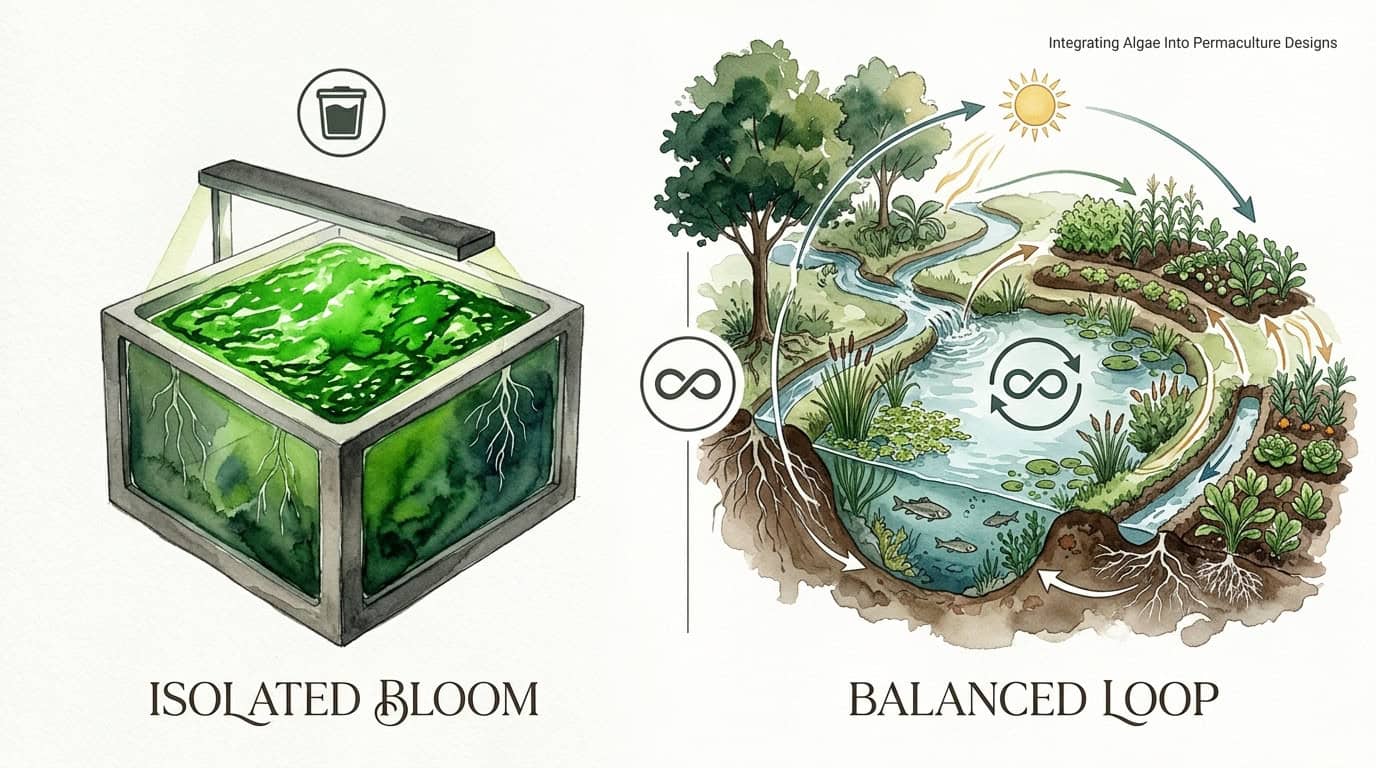
Integrating algae into permaculture designs involves utilizing microalgae and macroalgae as functional components for nutrient cycling, carbon sequestration, and biomass production. These organisms recover dissolved nitrogen and phosphorus from aquatic systems, converting waste into high-protein animal feed and mineral-rich biofertilizers. When managed as a BALANCED LOOP rather than an ISOLATED BLOOM, algae stabilize water chemistry, increase total system caloric output, and reduce reliance on external inputs by mimicking natural successional processes.

Integrating Algae Into Permaculture Designs

Algae integration refers to the deliberate cultivation of photosynthetic aquatic organisms—ranging from single-celled microalgae like Chlorella to nitrogen-fixing aquatic ferns like Azolla—within a closed-loop agricultural framework. In a technical sense, algae function as biological processors that capture solar energy and dissolved minerals to produce organic matter.

These systems are implemented in diverse real-world contexts, including recirculating aquaculture systems (RAS), integrated multi-trophic aquaculture (IMTA), and wastewater phycoremediation. Unlike terrestrial crops, algae do not require high-quality arable land and can achieve significantly higher biomass turnover rates. This makes them a critical tool for intensifying production in limited spaces.

The fundamental objective is to transform an environmental liability, such as nutrient runoff, into a biological asset. Instead of allowing excess nitrogen to trigger uncontrolled eutrophication, the permaculture designer creates a controlled environment where algae absorb these nutrients. This biomass is then harvested and cycled back into the soil or the animal food chain.

How to Integrate Algae Into a Permaculture System

Effective integration requires a mechanical and biological understanding of nutrient flows. The process begins with identifying a nutrient-rich water source, typically the effluent from a fish pond or livestock runoff. This water is diverted into specialized cultivation zones where the algae can maximize light absorption and gas exchange.

Step 1: Selection of Cultivation Method

Designers must choose between open pond systems and closed photobioreactors (PBR). Open raceway ponds are the most common in large-scale applications due to lower construction costs, though they are prone to contamination. PBRs, which utilize transparent tubes or panels, offer higher areal productivities (up to 19–24 g m?² day?¹) and better control over environmental variables.

Step 2: Species Selection and Inoculation

Species selection depends on the specific goals of the system. Spirulina is often chosen for its high protein content (up to 70%), while Azolla is preferred for its ability to fix atmospheric nitrogen. Once the species is selected, the water must be inoculated with a starter culture during a period of optimal light and temperature.

Step 3: Nutrient and Environment Management

Algae require a balanced supply of nitrogen (N), phosphorus (P), and potassium (K), along with trace minerals. Monitoring pH levels is critical, as algae consumption of CO2 can cause water to become alkaline. Most microalgae species thrive in temperatures between 65 and 85 degrees Fahrenheit. Supplemental aeration or paddlewheel mixing is often necessary to prevent thermal stratification and ensure all cells receive adequate light.

Step 4: Harvesting and Processing

Harvesting occurs when the culture reaches peak density, which can be measured via turbidity or spectrophotometry. Common methods include skimming, filtration, or centrifugation. Once harvested, the biomass must be used immediately, dried, or fermented to prevent decomposition. Dried algae can be stored as a concentrated feed supplement or soil amendment.

Benefits of Algae in Permaculture

The technical advantages of algae integration center on efficiency and resource recovery. Algae act as a biological filter, with species like Chlorella vulgaris capable of removing up to 86.1% of total nitrogen and 82.7% of phosphorus from aquaculture wastewater.

Nutritional density is another primary benefit. Algae are rich in essential amino acids, fatty acids, and vitamins, making them a superior alternative to traditional corn or soy-based feeds. For example, Spirulina contains significantly more protein per acre than terrestrial livestock crops. This high-protein biomass can replace a substantial portion of soybean meal in poultry and swine diets, potentially reducing feed costs and land requirements.

From a soil perspective, algae function as powerful biostimulants. They contain phytohormones, such as auxins and cytokinins, which stimulate plant growth and increase resistance to abiotic stress. Research indicates that microalgae-based fertilizers can improve soil nutrient availability, increasing available phosphorus and nitrogen by significant margins while enhancing the microbial community structure.

Challenges and Common Mistakes

One frequent error in algae management is the failure to control for contamination. In open systems, invasive “weed” algae or predators like rotifers can quickly overtake a desired culture. This often happens when the nutrient balance is skewed or the harvesting schedule is inconsistent.

Another challenge is light limitation. In pond systems, the effective photosynthetic zone is often limited to the top 5 centimeters of the water column. Without proper mixing, cells at the bottom remain in the dark, leading to net respiration rather than growth, which can deplete oxygen levels at night and cause a system crash.

Temperature sensitivity is a common pitfall for outdoor systems in temperate climates. Algae growth rates drop significantly in cold weather, and extreme heat can lead to rapid die-offs. Designers often overlook the need for thermal mass or greenhouse integration to extend the growing season, resulting in seasonal nutrient spikes that the system cannot handle.

Limitations of Algae Integration

Environmental constraints play a significant role in the feasibility of algae systems. While algae are highly efficient, they require consistent access to sunlight and water. In regions with high cloud cover or severe water scarcity, the energy required to maintain optimal conditions may outweigh the biological yields.

Operational complexity is another limiting factor. Managing a high-density algae culture requires more technical monitoring than traditional composting or mulching. It involves regular testing of water chemistry and maintenance of mechanical hardware like pumps and aerators. For small-scale practitioners, the initial capital investment for photobioreactors or high-efficiency harvesting equipment can be prohibitive.

Furthermore, some algae species can produce cyanotoxins under certain stress conditions. If these toxins enter the food chain via animal feed or irrigation water, they can cause health issues for livestock and humans. Regular qPCR assays or microscopic monitoring are required to ensure the culture remains safe and productive.

Comparison: Open Ponds vs. Closed Photobioreactors

The choice between open and closed systems involves a trade-off between cost, control, and productivity. The following table summarizes the key metrics for these two primary cultivation methods.

Factor Open Raceway Ponds Closed Photobioreactors (PBR)
Construction Cost Low to Moderate High
Areal Productivity 10–15 g m?² day?¹ 19–24 g m?² day?¹
Contamination Risk Very High Low
Evaporative Loss High Negligible
Operational Skill Moderate Advanced
Harvesting Difficulty High (Low cell density) Low (High cell density)

Practical Tips and Best Practices

* Integrate with Animal Housing: Position algae ponds near livestock facilities to capture CO2 and nutrient runoff directly, minimizing transport energy.
* Use Polycultures: In open systems, growing multiple compatible algae species can increase resilience against pests and environmental fluctuations.
* Optimize Harvesting Windows: Harvest algae during the late afternoon when biomass density and lipid/protein content are typically at their peak following a full day of photosynthesis.
* Recycle the Water: After harvesting the biomass, return the “spent” water to the aquaculture pond. It will still contain beneficial dissolved metabolites and trace minerals.
* Monitor pH and Alkalinity: Use a simple pH probe to ensure values stay within the 7.5 to 9.0 range for most species. If the pH rises too high, increase aeration to introduce more atmospheric CO2.

Advanced Considerations in Algae Design

Serious practitioners should consider the integration of Genome-Scale Model Process Control (GMPC). This involves using data science to predict algae growth based on real-time variables like light intensity and nutrient concentration. Automated systems can then adjust flow rates or nutrient dosing to maximize efficiency, sometimes increasing biomass yields by more than twofold compared to manual control.

Another advanced technique is the use of algae for carbon sequestration. A one-hectare algae pond has the potential to sequester approximately one ton of CO2 per day. By coupling an algae system with a biomass burner or biodigester, permaculture designers can create a carbon-negative energy cycle, where the CO2 emitted from energy production is immediately reabsorbed by the next generation of algae.

Scaling considerations are also vital. Moving from a backyard “bucket” culture to a pond system introduces new fluid dynamics challenges. Paddlewheel design, baffle placement, and the optical path length must be precisely engineered to ensure uniform light distribution and prevent “dead zones” where algae can settle and rot.

Scenario: The Algae-Aquaponics Loop

Consider a system where a 500-gallon tilapia tank produces effluent rich in ammonia and solids. Instead of using a standard gravel biofilter, the water flows into a shallow, 20-square-meter raceway pond. A paddlewheel keeps the water moving at 0.2 meters per second.

In this pond, Spirulina thrives on the fish waste, absorbing 80% of the dissolved nitrogen. Every three days, the owner skims the pond, harvesting 5 kilograms of wet biomass. This biomass is dried and used to replace 20% of the tilapia’s commercial feed, reducing input costs. The purified water then flows to a vegetable bed, where the remaining nutrients and algal metabolites stimulate a 15% increase in lettuce yield. This demonstrates a BALANCED LOOP where every waste stream is converted into a yield.

Final Thoughts

The integration of algae into permaculture represents a shift from passive observation to active biological management. By viewing algae as a high-speed nutrient processor, designers can significantly increase the efficiency of their land. These organisms close the gaps in traditional nutrient cycles, ensuring that no nitrogen or phosphorus leaves the system as waste.

Success in this field requires technical discipline and a willingness to monitor biological metrics. While the initial learning curve may be steeper than that of traditional gardening, the potential rewards—including high-protein feed, powerful biofertilizers, and a smaller carbon footprint—are substantial. Algae are not an intruder in the pond; they are the engine of a truly regenerative design.

Experimentation with hardy local species is the best entry point for any practitioner. As you gain experience, the complexity of the system can grow, leading toward a fully automated, high-output ecosystem that turns sunlight and waste into sustainable abundance.

Frequently Asked Questions About Integrating Algae Into Permaculture Designs

What is the nitrogen-phosphorus-potassium (NPK) value of algae fertilizer?

The NPK value of algae varies by species and processing method, but it is generally considered a high-quality organic fertilizer. Dried microalgae often exhibit nitrogen levels between 4% and 10%, phosphorus between 0.5% and 2%, and potassium around 1% to 3%. More importantly, algae provide a vast array of trace minerals and plant growth hormones like cytokinins and auxins that are not found in synthetic NPK fertilizers. These hormones stimulate root development and improve the plant’s ability to withstand environmental stressors. When used as a liquid extract, algae can be applied as a foliar spray for rapid nutrient uptake.

Can algae grown in wastewater be safely used as animal feed?

Using algae grown in wastewater for animal feed requires careful management to avoid pathogen transfer or heavy metal bioaccumulation. While algae are excellent at “polishing” water by removing nutrients, they can also absorb contaminants. If the wastewater comes from a clean source, such as a filtered fish pond or greywater from a residential kitchen, the risk is minimal. However, biomass grown in industrial or untreated municipal sewage must undergo rigorous testing and often pasteurization before it is safe for livestock. For permaculture systems, focusing on “clean” waste streams ensures the highest safety standards for the resulting feed.

How do I harvest algae without expensive mechanical equipment?

For small-scale permaculture setups, low-tech harvesting methods are highly effective. For macroalgae like Azolla, a simple fine-mesh dip net or surface skimmer is sufficient. For microalgae like Spirulina, a 50-micron filter cloth can be used to strain the biomass from the water. Another effective technique is “flocculation,” where natural agents like lime or even crushed seeds from the Moringa oleifera tree are added to the water, causing the algae cells to clump together and sink to the bottom. Once settled, the concentrated “sludge” can be siphoned off and dried on a screen or in a solar dehydrator.

Does algae growth in a pond compete with fish for oxygen?

Algae have a dual effect on oxygen levels. During the day, they produce oxygen through photosynthesis, often saturating the water and benefiting the fish. However, at night, photosynthesis stops and the algae consume oxygen through respiration. In a highly dense “bloom” or an unmanaged system, this nighttime consumption can deplete oxygen levels, leading to fish kills. To prevent this, permaculture designers use aeration (like air stones or waterfalls) and ensure the algae density is managed through regular harvesting. Keeping the system in a state of active growth—a BALANCED LOOP—prevents the massive die-offs that lead to oxygen crashes.

Which algae species is best for a beginner to start with?

Azolla (also known as mosquito fern) is the ideal entry point for beginners. While technically a floating fern, it lives in a symbiotic relationship with nitrogen-fixing cyanobacteria. It is incredibly hardy, grows rapidly (doubling its biomass every 2-3 days in ideal conditions), and is easy to harvest with a simple net. It can be used as a direct feed for ducks, chickens, and pigs, or tossed directly into compost piles as a nitrogen booster. For those specifically interested in microalgae, Spirulina is a good second step because it thrives in highly alkaline water, which naturally discourages most invasive competing species and pests.

We're Not All Talk

Sign up for the best pond tips you'll find anywhere online.  We'll send them out during the summer months and you won't want to miss a single one!

Invalid email address
We promise - no spam. You can unsubscribe at any time.