

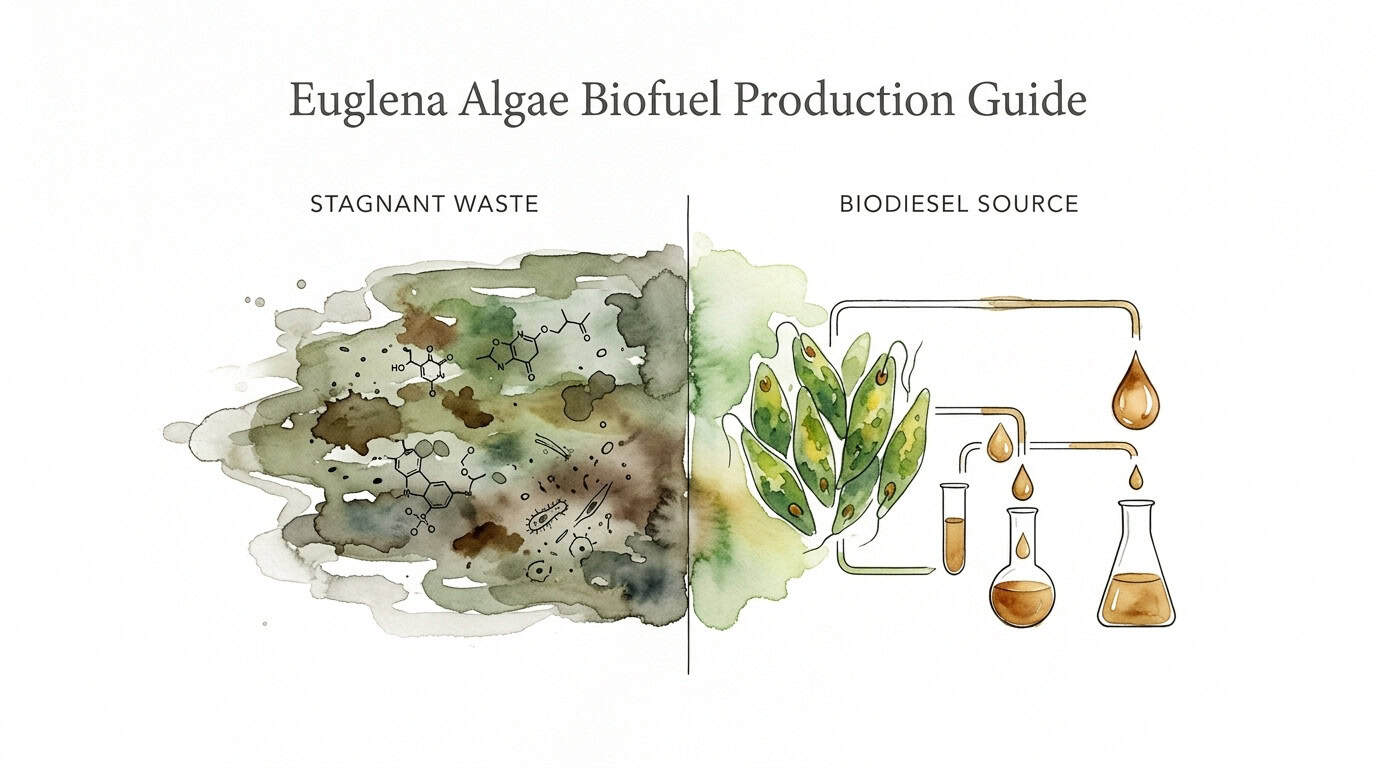
Could the water in your drainage ditch be the secret to carbon-neutral energy? Euglena is nature’s most efficient carbon-capture machine. Instead of letting it rot and release methane, we can harvest its oils to create high-performance biodiesel. It’s time to stop seeing waste and start seeing watts.
Producing biofuel from Euglena algae involves cultivating the microalgae in specialized photobioreactors, harvesting the biomass through flocculation, and triggering anaerobic wax ester fermentation. This process converts stored paramylon into high-density wax esters, which are then extracted and refined via transesterification into biodiesel or biojet fuel. This method provides a renewable, high-yield energy source capable of reducing carbon emissions while utilizing non-arable land and wastewater resources.
Euglena Algae Biofuel Production Guide
Euglena gracilis is a unique unicellular protist that blurs the line between plants and animals. Unlike many microalgae, Euglena lacks a rigid cell wall, which significantly reduces the energy required for lipid extraction. This organism is highly adaptable, capable of growing through photosynthesis (photoautotrophic), consuming organic carbon (heterotrophic), or a combination of both (mixotrophic).
In the context of renewable energy, Euglena is primarily utilized for its ability to produce wax esters. Under standard aerobic conditions, it stores energy as paramylon, a crystalline beta-1,3-glucan. However, when shifted to anaerobic (oxygen-free) environments, Euglena undergoes a unique metabolic process known as “wax ester fermentation.” This pathway converts paramylon into wax esters, which are long-chain fatty acids and alcohols that serve as ideal precursors for high-quality biodiesel and sustainable aviation fuel (SAF).

The Technical Mechanism of Wax Ester Fermentation
Understanding the internal chemistry of Euglena is critical for optimizing fuel yield. The production of lipids in this organism does not follow the standard triglyceride pathway found in most oilseed crops or green algae like Chlorella. Instead, it relies on a mitochondrial anaerobic respiratory chain.
During wax ester fermentation, Euglena degrades its stored paramylon via glycolysis to produce pyruvate. This pyruvate is then converted into acetyl-CoA. In the absence of oxygen, the mitochondria perform a “reverse beta-oxidation” process. This pathway uses acetyl-CoA as both a primer and a donor to synthesize fatty acids, specifically myristic acid (C14:0). These fatty acids are then esterified with fatty alcohols (like myristyl alcohol) to form wax esters, predominantly myristyl myristate (C28).
The resulting wax esters are insoluble in water and accumulate within the cell body. Because Euglena possesses a flexible pellicle rather than a cellulose cell wall, these lipids are easily accessible during the downstream extraction phase. This mechanical advantage translates to lower operational costs compared to other microalgae species that require high-pressure homogenization or chemical solvents to break cell walls.
Cultivation Systems: Designing for Maximum Yield
Successful production requires a strictly controlled environment to manage the transition between biomass accumulation and lipid induction.
Photobioreactors vs. Open Raceway Ponds
Large-scale production typically employs one of two systems. Open raceway ponds are cost-effective but prone to contamination. However, Euglena thrives in highly acidic environments (pH 3.0 to 4.0), a condition that naturally inhibits the growth of most competing bacteria and predatory protozoa. This allows for relatively stable outdoor cultivation.
Closed photobioreactors (PBRs) offer superior control over parameters like CO2 concentration and light exposure. In a PBR, light intensity should be maintained at approximately 100 µmol photons/m²/s for optimal multiplication. While Euglena is shade-tolerant, excessive light can lead to photoinhibition, reducing the overall biomass density.

Nutrient Requirements
Growth media must be precisely balanced. Ammonium sulfate is the most effective nitrogen source for rapid cellular division. For high-density cultivation, a mixotrophic approach is recommended. This involves providing light for photosynthesis while supplementing the media with organic carbon sources such as glucose or refined food waste. Research indicates that supplementing media with 15 g/L of glucose can significantly enhance both biomass production and paramylon accumulation.
Step-by-Step Production Process
Phase 1: Inoculation and Aerobic Growth
Start with a pure strain of Euglena gracilis in an aerobic environment. Supply the culture with a mix of CO2 (approximately 4% of total gas flow) and light. The objective here is to maximize the accumulation of paramylon. Maintain the temperature between 27°C and 31°C to ensure the highest multiplication rates.
Phase 2: Anaerobic Induction
Once the biomass reaches its peak density—often measured by a darkening green hue and specific cell counts—the system must be shifted to anaerobic conditions. This is achieved by ceasing aeration and allowing the cells to consume the remaining dissolved oxygen. Within 24 to 48 hours of oxygen deprivation, the cells will begin converting their paramylon reserves into wax esters.
Phase 3: Harvesting and Dehydration
Harvesting microalgae is historically the most expensive step in biofuel production. For Euglena, a two-step process is most efficient. First, use chemical flocculation (typically utilizing Poly Aluminium Chloride or chitosan) to aggregate the cells. This can be combined with pH adjustment to trigger natural sedimentation. Once pre-concentrated, the resulting slurry is filtered or centrifuged to produce a “green paste” with approximately 20-25% dry matter.
Phase 4: Lipid Extraction
The biomass is dried and then subjected to solvent extraction (often using a hexane-ethanol mixture). Because Euglena lacks a cell wall, mild mechanical agitation is usually sufficient to release the intracellular wax esters. The solvent is then evaporated and recycled, leaving behind the crude algal oil.
Phase 5: Transesterification
The final chemical conversion involves reacting the wax esters with an alcohol (usually methanol) and a catalyst (such as potassium hydroxide). This process, known as transesterification, breaks the ester bonds to produce fatty acid methyl esters (FAME)—the chemical name for biodiesel—and a byproduct of fatty alcohols.
Benefits of Euglena Biofuel
The primary advantage of Euglena is its exceptional carbon sequestration capability. It can tolerate flue gas concentrations of CO2 far better than terrestrial plants, making it an ideal candidate for integration with industrial power plants.
Furthermore, the wax esters produced by Euglena are uniquely suited for cold-weather applications. Standard vegetable-based biodiesels often gel at low temperatures due to long-chain saturated fats. Euglena wax esters have a naturally lower freezing point (around -32°C). Recent advancements in CRISPR/Cas9 genetic engineering have even allowed researchers to shorten the carbon chains further, creating a fuel that remains liquid at the extreme temperatures required for commercial aviation.
Efficiency is another major factor. On a per-hectare basis, microalgae can produce up to 10 to 100 times more oil than traditional crops like soybeans or rapeseed. Because Euglena can be grown on marginal land or in wastewater, it does not compete with food production, addressing a major ethical and economic concern in the biofuel industry.
Challenges and Common Mistakes
The most frequent error in Euglena production is failing to manage the timing of the anaerobic shift. If oxygen is reintroduced too early, the cells will stop fermenting and begin consuming the wax esters for energy, leading to a rapid decline in fuel yield.
Contamination in open pond systems remains a secondary risk. While the acidic pH helps, “grazer” organisms like rotifers can occasionally adapt. Monitoring the pond daily for shifts in turbidity or the presence of unwanted microorganisms is essential. Operators must also be wary of nutrient “shocks.” Adding too much nitrogen during the induction phase can encourage the cells to prioritize protein synthesis over lipid accumulation, resulting in a low-energy biomass.
Limitations and Environmental Constraints
Despite its potential, Euglena biofuel production is currently limited by the high capital expenditure required for photobioreactors. While open ponds are cheaper, they occupy vast amounts of land and are subject to weather variations. Temperature control is vital; if the culture exceeds 35°C for prolonged periods, the cells may die or enter a dormant cyst state, halting production.
There is also the challenge of the Net Energy Ratio (NER). If the energy required to pump water, provide artificial lighting, and centrifuge the biomass exceeds the energy contained in the produced fuel, the system is not viable. Current industrial research focuses on improving the NER by using solar-powered pumps and passive harvesting techniques like gravity-assisted flocculation.
Optimization and Comparison
When comparing Euglena to other microalgae like Chlorella, the trade-off usually centers on harvesting complexity versus lipid profile.
| Metric | Euglena gracilis | Chlorella vulgaris |
|---|---|---|
| Cell Wall | None (Flexible Pellicle) | Rigid Cellulose |
| Primary Lipid | Wax Esters | Triglycerides |
| Extraction Ease | High | Low |
| Cold Flow (Fuel) | Superior | Average |
| Acid Tolerance | Excellent (pH 3.0) | Moderate (pH 6.0+) |
Euglena excels in specialized fuel markets, such as jet fuel, due to its wax ester composition. Chlorella is often preferred for mass-market biodiesel where volume is prioritized over cold-flow performance.
Practical Tips for Practitioners
For those looking to scale up production, focus on the following best practices:
- Use pH as a Weapon: Keep your culture at pH 3.5. This eliminates 90% of contamination issues without the need for expensive antibiotics or filtration.
- Implement Phototaxis: Euglena is motile and moves toward light. You can use this “phototaxis” to naturally concentrate the cells near the surface before harvesting, reducing the volume of water you need to process.
- Recycle the Media: After harvesting, the water still contains valuable nutrients. Treat the water to remove metabolic waste and reinject it into the system to reduce fertilizer costs.
- Monitor C/N Ratios: Keep your Carbon-to-Nitrogen ratio high (above 25:1) during the accumulation phase if your goal is maximum energy storage.
Advanced Considerations: Genetic Engineering
The future of Euglena biofuel lies in metabolic engineering. Modern techniques involve the use of CRISPR/Cas9 to knockout specific genes that regulate the length of carbon chains. By forcing the organism to produce C10 to C12 chains instead of C14 to C18, the resulting fuel becomes even more efficient for turbine engines.
Another area of research involves “light-harvesting antenna” reduction. In dense cultures, cells at the surface block light from reaching cells at the bottom (self-shading). Genetically reducing the size of the chlorophyll antenna allows light to penetrate deeper into the reactor, theoretically doubling the volumetric productivity of the system.
Production Scenario: 1-Hectare System
Consider a 1-hectare open raceway pond system. At an average biomass productivity of 20 grams per square meter per day, the system generates 200 kilograms of dry biomass daily. With a wax ester content of 30%, this yields 60 kilograms of crude algal oil.
Over a 300-day growing season, this single hectare produces 18,000 kilograms of oil. When converted to biodiesel, this equates to roughly 20,000 liters of fuel. While the initial setup cost for such a system can exceed $100,000, the integration of wastewater treatment (using the algae to remove nitrogen and phosphorus) can provide additional revenue streams through “credits,” making the operation economically competitive with fossil fuels over a 5-to-10-year horizon.

Final Thoughts
Euglena algae represents a frontier in biological energy production. Its ability to thrive in harsh, acidic conditions and produce high-performance wax esters makes it a unique asset in the transition away from petroleum. By leveraging its natural “wax ester fermentation” cycle, we can produce fuels that are not only renewable but technically superior in cold-flow performance to traditional biodiesels.
Success in this field requires a meticulous focus on the transition from aerobic growth to anaerobic induction. While harvesting remains a significant cost bottleneck, the combination of flocculation and the lack of a cell wall in Euglena provides a clearer path to profitability than many other microalgal species. As we refine our genetic tools and cultivation designs, the “secret in the drainage ditch” may very well power the next generation of carbon-neutral transportation.
Frequently Asked Questions About Euglena Algae Biofuel Production Guide
Can Euglena be grown in saltwater for biofuel?
Euglena gracilis is primarily a freshwater organism, but certain strains show varying degrees of salt tolerance. For industrial biofuel production, freshwater or brackish water is preferred to maintain high growth rates. Using saltwater often stresses the cells, which can increase lipid production but significantly slows down the multiplication phase. If your only water source is marine, you should look into specialized saline-tolerant species like Nannochloropsis, as Euglena will likely suffer from osmotic shock and lysing in high-salinity environments. However, research into hybridizing or acclimating Euglena strains for saline environments is ongoing to expand its geographic utility.
What is the most cost-effective way to harvest Euglena?
The most cost-effective method is a combined approach using flocculation followed by filtration or gravity settling. Centrifugation, while highly effective, consumes too much electricity to be profitable for low-margin products like biofuel. By using a flocculant like Poly Aluminium Chloride (PAC) or bio-based chitosan, you can cause the microscopic Euglena cells to clump together and sink. This pre-concentration can reduce the volume of water by 95% or more. The remaining concentrated slurry can then be processed with much smaller, more efficient equipment. This two-step method dramatically improves the Net Energy Ratio of the entire production cycle.
How does Euglena fuel compare to regular diesel?
Euglena-derived biodiesel is a “drop-in” replacement, meaning it can be used in existing diesel engines without modification. Chemically, it consists of fatty acid methyl esters (FAME) or alkanes if fully hydrotreated. One of its standout features is its superior cold-flow properties. Because the wax esters can be refined into shorter carbon chains, Euglena fuel has a much lower cloud point and pour point than palm or soy-based biodiesel. This makes it ideal for use in cold climates and high-altitude aviation, where standard biodiesels would typically freeze or clog fuel filters. It also burns cleaner, with lower particulate matter emissions.
Is it possible to produce Euglena biofuel at home?
While possible on a small scale, it is technically challenging for a hobbyist. The main difficulty is the anaerobic induction phase required to trigger wax ester production. You can grow the algae in a simple “aquarium” setup with light and CO2, but extracting the oil requires chemical solvents like hexane or ethanol, which can be hazardous if not handled with professional equipment. Furthermore, the transesterification process requires handling strong bases like lye and flammable alcohols. For most individuals, small-scale production is better suited for educational purposes or as a supplement for nutrient-rich garden fertilizer rather than a viable source of vehicle fuel.
How much CO2 does Euglena consume during production?
Euglena is highly efficient at carbon capture, typically requiring between 1.8 and 2.0 grams of CO2 for every 1 gram of dry biomass produced. This makes it an excellent candidate for carbon-neutral or even carbon-negative energy systems if the CO2 is sourced from industrial flue gas. In a well-optimized system, the algae can utilize nearly 90% of the CO2 pumped into the culture. This dual-benefit of producing fuel while mitigating greenhouse gas emissions is a primary driver for investment in large-scale Euglena farms, particularly when they are co-located with power plants or cement factories that produce high volumes of waste CO2.