

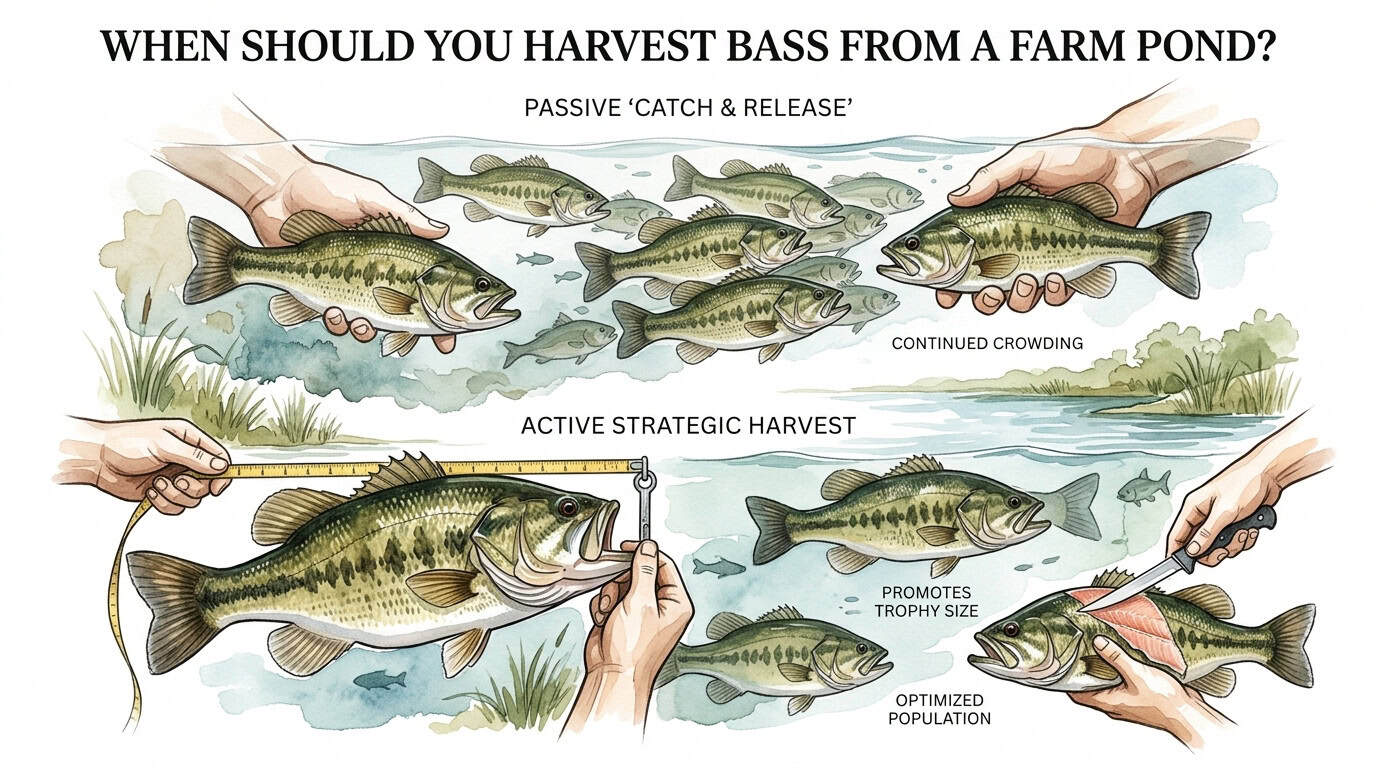
Catch and release is killing your pond. Here is the data why. To grow big bass, you have to take some out. Passive management leads to stunting; active harvesting leads to trophies. Here is when to pull the trigger.
Harvest bass from a farm pond when the population exhibits signs of stunting, typically indicated by a Relative Weight (Wr) below 90 or when fish length frequency peaks at 10–12 inches with no upward progression. Most balanced ponds require an annual removal of 10–25 pounds of undersized bass per acre to maintain growth rates. Strategic harvest prevents the predator population from exceeding the available forage biomass, ensuring that remaining individuals have sufficient caloric intake to reach trophy sizes.
When Should You Harvest Bass from a Farm Pond?
Pond management relies on the fundamental principle of carrying capacity. Every body of water has a fixed limit on the total pounds of fish it can support, regardless of individual fish size. This limit is determined by primary productivity, nutrient levels, and dissolved oxygen. If a pond supports 100 pounds of bass per acre, that biomass can consist of 400 quarter-pound fish or 20 five-pound fish.
Harvesting is the mechanical removal of excess individuals to redistribute the available energy. When too many bass compete for the same forage base, growth rates flatline. This condition, known as stunting, occurs when bass utilize all consumed calories for basic metabolic maintenance rather than somatic growth. Active harvest must begin once the initial stocked generation reaches maturity and produces its first successful year class, typically three years post-stocking.

How the Harvest Process Works
Successful harvest management utilizes biological metrics to identify the exact moment the system requires intervention. Relying on visual observation is insufficient. Managers must utilize data collection methods such as creel surveys and standardized weighing.
Relative Weight (Wr) Calculations
Relative weight is the most reliable metric for determining harvest timing. It compares the actual weight of a captured fish to a “Standard Weight” for that specific length. The formula is: Wr = (Actual Weight / Standard Weight) x 100.
A Wr score of 100 indicates a fish is at the ideal weight for its length. Scores between 90 and 100 are considered healthy. When the average Wr of captured bass drops below 90, the pond is overpopulated relative to its food supply. If scores reach 80 or below, the population is severely stunted and requires immediate, aggressive harvest of the underperforming size classes.
Proportional Size Distribution (PSD)
PSD measures the balance between “stock” size fish (8 inches for bass) and “quality” size fish (12 inches for bass). A balanced pond typically maintains a bass PSD between 20 and 60. If the PSD drops below 20, the pond is “bass-crowded,” meaning there are far too many small fish and not enough food to push them into the quality category.
Setting Harvest Quotas
Standard guidelines for harvest volume vary by region and pond fertility. Unfertilized ponds in northern climates often require the removal of 10–15 pounds of bass per acre annually. Fertilized ponds in southern climates, which have higher primary productivity, often necessitate the removal of 25–35 pounds per acre. These quotas focus almost exclusively on fish in the 10–14 inch range to protect the larger, more efficient predators.
Benefits of Strategic Bass Harvest
Active harvesting functions as a population reset, ensuring that the energy flow within the ecosystem remains efficient. Removing mid-sized predators directly increases the survival rate of the forage base, which in turn fuels the growth of the remaining bass.

- Increased Growth Rates: Reducing competition allows remaining bass to consume more calories per unit of effort.
- Forage Base Recovery: Fewer predators allow bluegill and other prey species to reach larger sizes, providing more substantial meals for trophy bass.
- Population Balance: Regular removal of small bass prevents the “boom and bust” cycles common in unmanaged ponds.
- Reduced Disease Risk: Lower population densities decrease the transmission of parasites and bacterial infections.
Harvesting also improves the genetic health of the pond over time. By removing fish that show poor growth characteristics despite having access to food, managers ensure that the most efficient hunters and faster-growing individuals remain to spawn the next generation.
Challenges and Common Mistakes
The most frequent error in pond management is the emotional resistance to harvesting small bass. Anglers trained in catch-and-release culture often feel that they are “saving” the pond by returning every fish, when they are actually contributing to its decline.
Delayed Intervention
Waiting until the pond is visibly stunted makes recovery difficult. Once bass reach a certain age without growth, they may remain permanently stunted even if forage is reintroduced. These “old-small” fish have different metabolic profiles than young, fast-growing fish. Identifying stunting early through Wr metrics is critical.
Removing the Wrong Size Class
Many pond owners harvest the largest fish they catch, thinking they are taking the “best” for the table. This is counterproductive. Large bass are the primary biological control for the small bass population. Removing a 5-pound bass takes away a predator capable of eating the very 10-inch bass that are causing the overpopulation.
Inconsistent Record Keeping
Harvesting must be tracked by weight, not just by the number of fish. Removing 20 bass sounds significant, but if they only weigh 8 ounces each, you have only removed 10 pounds of biomass. In a 5-acre pond, that is a negligible 2 pounds per acre. Precision is required to meet annual quotas.
Limitations of Harvest Management
Harvesting is not a universal solution for every pond issue. Certain environmental constraints can override the benefits of population thinning.
| Constraint | Impact on Harvest Effectiveness | Metric to Watch |
|---|---|---|
| Water Fertility | Low fertility limits total biomass; harvest won’t grow “trophies” if food can’t grow. | Secchi Disk Depth |
| Habitat Structure | Excessive cover (over 30%) prevents bass from catching forage efficiently. | Percent Cover |
| Water Temperature | Northern ponds have shorter growing seasons; harvest must be more conservative. | Growing Degree Days |
| Dissolved Oxygen | Low DO levels stunt fish regardless of forage availability. | PPM of O2 |
In ponds with excessive aquatic vegetation, bass may be “stunted” even with high forage numbers because the prey has too many places to hide. In these scenarios, harvesting bass without addressing the vegetation will actually worsen the problem by further reducing the predator-to-prey contact rate.
Practical Tips for Pond Managers
Implementing a harvest plan requires a systematic approach to angling and data entry.
- Use a Digital Scale: Guessing weight leads to data skew. Accurate measurements are required for Wr calculations.
- Target Specific Slots: Implement a mandatory harvest on all bass caught between 10 and 13 inches until your annual poundage goal is met.
- Protect “Quality” Fish: Release all bass over 15 inches immediately unless they show signs of severe injury or disease.
- Monitor Forage: If you stop seeing 1-3 inch bluegill in the shallows, your bass population is likely too high and consuming the entire year class of prey.
- Encourage Guests: Use guest anglers to help reach harvest quotas, but ensure they follow the strict size-limit rules.
Advanced Considerations: The Bioenergetic Reality
Serious practitioners must understand the conversion efficiency of largemouth bass. It takes approximately 5 to 10 pounds of forage (bluegill, crawfish, or shad) for a bass to gain a single pound of body weight. In an unmanaged pond where 500 small bass are competing for 1,000 pounds of bluegill, the math for trophy growth does not work.
Genetic plasticity also plays a role. Largemouth bass are highly adaptable, but they are limited by their environment. If a pond has reached its carrying capacity, the only way to induce growth in the remaining population is to mechanically reduce the predator biomass. This “vacuums” up the available forage for the survivors. Advanced managers may also consider supplemental feeding for the bluegill to increase the overall carrying capacity of the system, allowing for a higher bass biomass limit.
Example Scenario: The 1-Acre Stunted Pond
Consider a 1-acre unmanaged pond stocked five years ago. The owner reports catching “hundreds of 12-inch bass” but nothing larger. A sample of 10 bass shows an average weight of 0.75 pounds. The Standard Weight for a 12-inch bass is approximately 0.88 pounds.
Calculation: (0.75 / 0.88) x 100 = 85.2 Wr.
The Wr of 85.2 confirms the pond is bass-crowded and forage-limited. To rectify this, the owner should implement an immediate harvest of 25–30 pounds of those 12-inch bass. This represents roughly 35 to 40 individual fish. Removing this biomass frees up approximately 200–300 pounds of bluegill annually for the remaining bass, theoretically allowing the survivors to gain significant weight within a single growing season.
Final Thoughts
Harvesting is the most difficult but essential tool in the pond manager’s kit. The data consistently shows that catch-and-release, while noble in large public reservoirs, is the primary cause of failure in private pond ecosystems. Ponds are closed systems with finite resources; you cannot stock your way out of a forage deficit, and you cannot wish your way to a trophy population without intervention.
Successful management requires viewing the pond as a biological machine. Like any machine, it requires regular maintenance and the removal of excess friction—in this case, undersized predators—to run at peak efficiency. Start weighing your fish, calculate your relative weights, and do not be afraid to fire up the skillet. Your trophy bass will thank you for the extra food.
Frequently Asked Questions About When Should You Harvest Bass from a Farm Pond?
How many pounds of bass should I remove per acre each year?
The annual harvest quota depends on pond fertility and location. For unfertilized ponds, a removal of 10 to 15 pounds of bass per acre is standard. In fertilized or highly productive southern ponds, this number increases to 25 or even 35 pounds per acre. These quotas focus specifically on small, crowded bass in the 10-14 inch range. The goal is to remove enough biomass to alleviate competition for the bluegill forage base. Failure to reach these poundage goals usually results in the population remaining in a stunted state, where fish consume only enough calories to survive without adding length or weight.
Can I harvest too many bass from my pond?
It is possible, though rare in private ponds, to over-harvest. If you remove too many predators, the bluegill population can explode, leading to a “bluegill-crowded” state where thousands of 3-inch fish compete for limited insects. This makes it difficult for new bass to spawn because bluegill will raid bass nests and eat the eggs. You will know you have over-harvested if your bass Relative Weights (Wr) consistently exceed 110 but you rarely catch any small bass. A balanced harvest should aim for a Wr between 90 and 100 and a steady presence of multiple size classes of fish.
What happens if I never harvest any bass?
In a closed system like a farm pond, a lack of harvest leads to “bass stunting.” The bass will continue to reproduce, adding more mouths to the system every year. Eventually, the total biomass of bass will reach the pond’s maximum carrying capacity. Because the food is spread across too many individuals, none of them can grow beyond a certain size—typically 10 to 12 inches. These fish will become “thin-headed” and look sickly. Over time, the forage base (bluegill) will also be decimated, leaving the pond full of small, hungry, and slow-growing predators that never reach trophy potential.
When is the best time of year to harvest bass?
Harvest can occur year-round, but late spring and early summer are often the most effective times for management. During the spring, bass are most active and easier to catch in high numbers, allowing you to reach your poundage quotas quickly. Additionally, removing bass before the peak of the growing season ensures that the remaining fish have the entire summer to capitalize on the increased forage availability. Some managers also prefer fall harvesting to reduce the total biomass entering the winter months, which can prevent oxygen depletion issues under ice in northern climates or during late-season heat waves in the south.
Should I harvest the big bass or the small bass?
Management goals almost always dictate harvesting the small bass (typically under 14 inches) and protecting the larger ones. Large bass are the most efficient hunters and serve as the primary control mechanism for the small bass population. By removing a 12-inch bass, you take away one competitor for food; by keeping a 5-pound bass, you keep a predator that will eat dozens of 12-inch bass throughout the year. Unless a fish is a record-breaking trophy you wish to mount, or it is visibly injured, it should be released to continue growing and managing the pond’s population naturally.
