

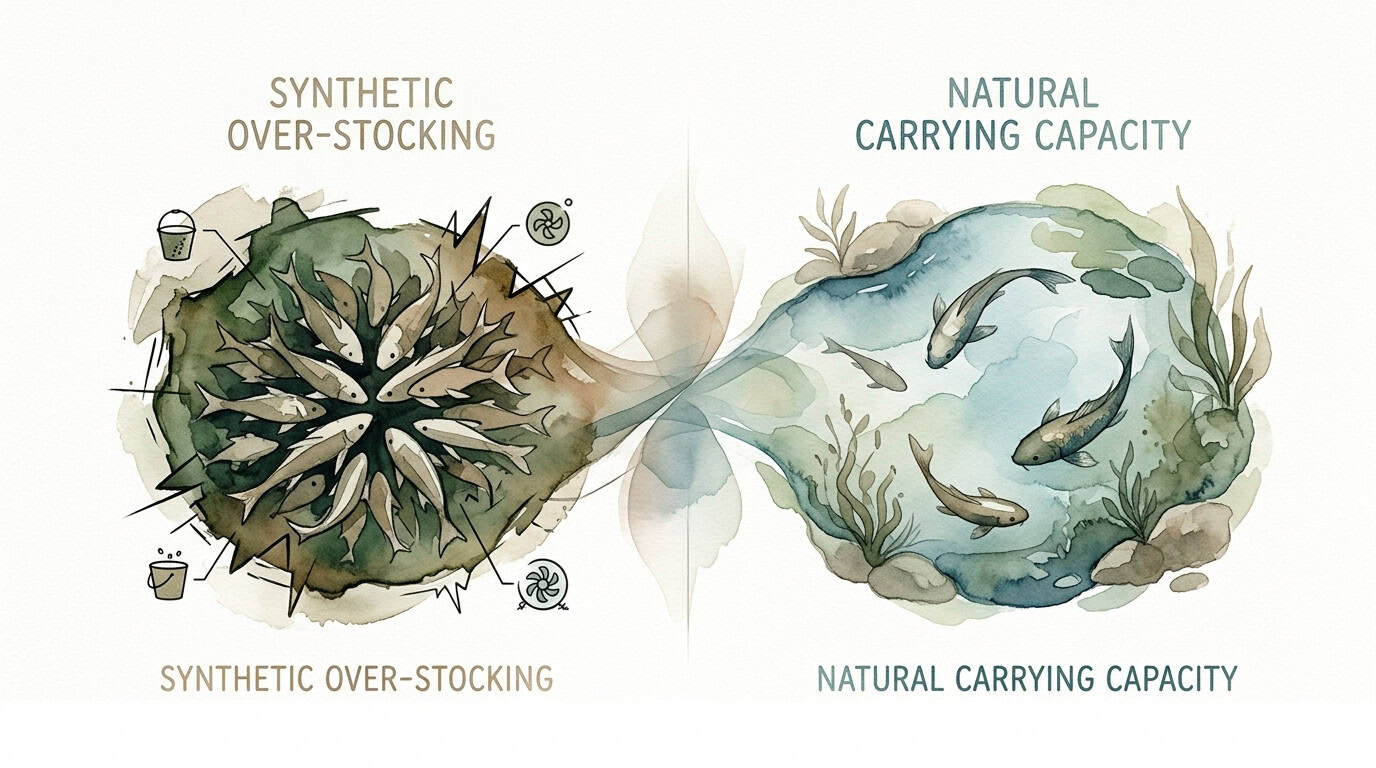
A standard unmanaged pond typically supports 100 to 400 pounds of fish biomass per surface acre, depending on natural fertility and species composition. With supplemental feeding and continuous mechanical aeration, this ceiling can be extended to 1,000–5,000 pounds per acre. However, exceeding these limits triggers exponential increases in biological oxygen demand and toxic metabolic waste, making the system highly susceptible to catastrophic oxygen depletion and mass mortality events.
Stop trying to ‘feed’ your way out of a small pond. Every pond has a ceiling. Whether you use synthetic feeds or natural forage, the biomass limit is real. Learn how to calculate yours before the oxygen runs out.
Managing a pond ecosystem requires a mechanical understanding of its biological constraints. Every gallon of water contains a finite amount of dissolved oxygen and a specific capacity for processing nitrogenous waste. When fish biomass increases, the margin for error narrows. In this technical guide, we will analyze the variables that determine your pond’s maximum carrying capacity and how to manage the transition from a natural ecosystem to an intensive production environment.
How Much Fish Biomass Can a Pond Actually Support?
Pond carrying capacity is defined as the maximum weight of fish that a body of water can sustain without experiencing a decline in water quality or mass mortality. This limit is not a fixed number; it is a dynamic equilibrium determined by the balance between oxygen production and consumption, as well as the rate of nutrient cycling.

In a natural, “extensive” system, the pond relies entirely on internal primary production—algae and aquatic plants—to generate oxygen and provide the base of the food web. In these environments, biomass is limited by the availability of natural forage. In contrast, “intensive” systems use external inputs like synthetic feed and mechanical aeration to bypass natural constraints. While this increases the total biomass, it also turns the pond into a high-stakes life-support system where any mechanical failure can result in a total loss within hours.
Visualizing this concept requires viewing the pond as a biological reactor. The fish are the “reactants” producing waste (ammonia) and consuming “fuel” (oxygen). The pond’s surface area and microbial communities are the “processing units” that replenish oxygen and neutralize waste. When the consumption rate exceeds the replenishment rate, the system crashes.
The Mechanics of Carrying Capacity
The ceiling of any pond is governed by three primary mechanical factors: dissolved oxygen (DO) availability, nitrogenous waste processing (nitrification), and biological oxygen demand (BOD).
1. Dissolved Oxygen Dynamics
Oxygen is the most immediate limiting factor in fish production. While air contains roughly 21% oxygen, water at 80°F can only hold about 8.0 mg/L at saturation. Fish typically begin to experience physiological stress when DO levels fall below 3.0 mg/L, and mortality often occurs below 1.0–2.0 mg/L. Larger fish are generally more sensitive to low DO than smaller fish because of their lower surface-area-to-volume ratio in their gills.
2. Nitrogen Loading and Toxicity
Fish excrete nitrogen primarily as ammonia (NH3/NH4+) through their gills. In a balanced pond, nitrifying bacteria (Nitrosomonas and Nitrobacter) convert toxic ammonia into nitrite and then into relatively harmless nitrate. However, these bacteria are aerobic; they require oxygen to function. In high-biomass ponds, the demand for oxygen by nitrifying bacteria can rival the demand from the fish themselves. If ammonia production exceeds the bacterial processing rate, fish suffer from “New Tank Syndrome” or chronic ammonia stress, which suppresses the immune system.
3. Biological Oxygen Demand (BOD)
BOD is the total amount of oxygen required by all living organisms in the pond, including fish, algae, zooplankton, and bacteria. In a typical aquaculture pond, the fish may only account for 20–30% of the total oxygen consumption. The majority is often consumed by the decomposition of organic matter (feces and uneaten feed) on the pond bottom. This is why “muck” accumulation significantly reduces the effective carrying capacity of older ponds.

Synthetic Over-Stocking vs Natural Carrying Capacity
The difference between a natural pond and an intensively managed one is the source of energy and oxygen. Understanding where your pond sits on this spectrum is critical for risk management.
| Feature | Natural Carrying Capacity | Synthetic Over-Stocking (Intensive) |
|---|---|---|
| Biomass Limit | 100–400 lbs/acre | 1,000–5,000+ lbs/acre |
| Oxygen Source | Photosynthesis & Surface Diffusion | Mechanical Aeration (Diffusers/Paddlewheels) |
| Nutrient Source | Natural Forage (Insects, Algae) | High-Protein Synthetic Pellets |
| Management Complexity | Low (Self-Sustaining) | High (Requires Constant Monitoring) |
| Risk of Mass Die-off | Very Low | High (Mechanical/Biological Failure) |
Factors Influencing Biomass Limits
Several environmental variables dictate how close you can push a pond to its theoretical limit. These factors influence the metabolic rate of the fish and the physical properties of the water.
Water Temperature (The Q10 Rule)
Fish are ectotherms, meaning their metabolism is dictated by water temperature. The “Q10 rule” states that for every 10°C (18°F) increase in temperature, the metabolic rate—and thus the oxygen demand—of the fish roughly doubles. Simultaneously, warmer water holds less dissolved oxygen. This “double jeopardy” is why most oxygen-related fish kills occur during the hottest months of the summer.
Altitude and Atmospheric Pressure
Partial pressure dictates gas exchange. Ponds at higher altitudes have a lower saturation point for dissolved oxygen because of the reduced atmospheric pressure. A pond in the mountains will naturally support less biomass than a pond at sea level, even if all other variables are identical.
Surface Area to Volume Ratio
Shallow ponds (less than 4 feet deep) have a high surface-area-to-volume ratio, which allows for better gas exchange but also leads to rapid temperature fluctuations. Deeper ponds (8–12 feet) provide a “thermal buffer” but are prone to stratification, where the bottom water becomes anoxic (depleted of oxygen). Total biomass support is usually calculated per surface acre, but the “acre-foot” (volume) becomes critical when calculating the total oxygen reserve available during a crisis.
Challenges and Common Mistakes
The most frequent error in pond management is overestimating the system’s ability to process waste. This often manifests as “feeding your way into a kill.”
Overfeeding: When more feed is added than the fish can consume, the excess sinks to the bottom. This uneaten organic matter fuels a bacterial explosion. These bacteria consume massive amounts of oxygen during the night when photosynthesis has stopped, leading to a “morning crash” where DO levels hit zero just before sunrise.
Neglecting Algae Health: While algae produce oxygen during the day, they consume it at night. An overly “thick” or pea-soup-green pond has high daytime oxygen but becomes a liability at night. If an algae bloom “crashes” (dies off suddenly due to cloudy weather or nutrient depletion), the resulting decomposition will strip the water of all oxygen within hours.
Lack of Redundancy: Intensive systems that rely on a single aerator are essentially waiting for a fuse to blow. At high biomass levels, the “time to death” following an aeration failure can be as short as 45 minutes in warm water.
Limitations of Intensive Biomass Management
Pushing a pond to its absolute limit is not always ideal, even with the best equipment. There are biological trade-offs that occur as density increases.
Growth Suppression: High densities lead to the accumulation of growth-inhibiting hormones and increased social stress. Beyond a certain point, adding more fish results in slower growth rates for the entire population, meaning it takes longer to reach harvestable size.
Disease Transmission: Pathogens move through water with high efficiency. In over-stocked ponds, a minor infection that would be self-limiting in a natural system can quickly become an epidemic. The stress of living near the carrying capacity suppresses the fish’s immune system, making them more susceptible to common issues like Columnaris or Ich.
Practical Tips for Optimizing Carrying Capacity
If you intend to increase your pond’s biomass safely, follow these mechanical best practices:
- Install Bottom-Up Aeration: Unlike fountains, which are primarily aesthetic, bottom-mounted diffusers break the thermocline and ensure the entire water column is oxygenated. This increases the “habitable volume” of the pond.
- Monitor Feed Conversion Ratio (FCR): Aim for an FCR of 1.5:1 to 2.0:1. If you are putting in 2 pounds of feed but only getting 1 pound of fish growth, the extra nutrients are simply polluting the system.
- Use “Emergency” Aeration: Keep a high-volume splash aerator or a PTO-driven paddlewheel ready for use during summer heatwaves or cloudy streaks.
- Gradual Stocking: Do not add maximum biomass at once. Allow the pond’s microbial community (the “biofilter”) to expand and adapt to the increasing nitrogen load over several months.
Advanced Considerations: The Oxygen Transfer Coefficient
Serious practitioners calculate oxygen transfer rates to determine if their aeration is sufficient. The rate of oxygen movement into water is described by the gas transfer equation: dC/dt = KL(A/V)(Cs – Cm). In simpler terms, oxygen transfer is most efficient when the water is furthest from saturation (Cm is low). This is why running aerators during the peak of the day when DO is already high is often a waste of energy; the most critical window for mechanical aeration is from 10:00 PM to 7:00 AM.
Furthermore, different species have different oxygen requirements. Trout, for example, require much higher DO levels (5.0+ mg/L) and lower temperatures than catfish or tilapia. When calculating biomass, you must account for the specific metabolic demand of the species. A pond that can support 1,000 lbs of catfish may only support 200 lbs of trout due to the higher metabolic “cost” of salmonid respiration.
Example Scenario: The One-Acre Catfish Pond
Consider a one-acre pond with an average depth of 6 feet. In a natural state with no feeding, this pond might support 200 lbs of channel catfish. The limiting factor is the natural production of aquatic insects and small forage fish.
The owner begins a supplemental feeding program with 32% protein pellets. Within two years, the biomass reaches 800 lbs. At this point, the natural oxygen production is still sufficient during the day, but the owner notices fish piping at the surface at dawn. This is a sign that the nighttime BOD is exceeding the pond’s natural replenishment rate.
To safely push the pond to 2,000 lbs, the owner installs a 1-hp electric paddlewheel aerator. Research suggests that 1 hp of aeration can support approximately 400–500 kg (approx. 900–1,100 lbs) of additional fish production beyond the natural limit. By adding this mechanical input, the pond’s ceiling is effectively doubled, provided the aerator runs consistently throughout the summer nights.
Final Thoughts
Understanding the biomass ceiling of a pond is a matter of biology and physics, not guesswork. Every pound of fish added to the system is a withdrawal from the oxygen bank and a deposit into the waste account. While technology allows us to bypass the limits of nature, it does not exempt us from the laws of ecology.
For the average pond owner, staying at 75% of the calculated carrying capacity provides a “safety buffer” that can absorb the impact of a sudden power outage or an unexpected algae die-off. For the commercial practitioner, the goal is to maximize efficiency through precision aeration and rigorous water quality monitoring. Regardless of your goal, remember that the pond always has the final word; respect the ceiling, or the system will reset itself—usually at the cost of your entire stock.

Frequently Asked Questions About How Much Fish Biomass Can a Pond Actually Support?
How can I tell if my pond has reached its fish biomass limit?
The most reliable indicator that a pond is approaching its carrying capacity is the behavior of the fish and the fluctuations in dissolved oxygen. If you observe fish “piping” or gasping at the surface in the early morning hours, the biological oxygen demand (BOD) has exceeded the supply. Other signs include a plateau in growth rates despite consistent feeding, or water that remains chronically turbid with a dark green or brown “pea soup” appearance. Technically, if your morning dissolved oxygen levels are consistently dropping below 3.0 mg/L, you have reached the practical limit of that system under current management conditions.
Does a deeper pond always support more fish than a shallow one?
Not necessarily. While a deeper pond has more total volume, carrying capacity is more closely tied to surface area for gas exchange and the “productive zone” where sunlight reaches. In many cases, deep ponds (over 10 feet) can actually support less biomass if they are not aerated, because they tend to stratify. This creates a large volume of “dead water” at the bottom that is devoid of oxygen and full of toxic gases like hydrogen sulfide. Without mechanical mixing, only the top few feet of the pond are habitable for fish during the summer, meaning a 15-foot deep pond might have the same functional capacity as a 4-foot deep pond.
Can I increase carrying capacity just by adding more air?
Aeration significantly raises the biomass ceiling by ensuring dissolved oxygen remains above critical levels, but it is not the only limit. Eventually, you will hit the “nitrogen wall.” Even with perfect oxygen levels, the accumulation of ammonia and nitrites from fish waste and decaying feed will reach toxic thresholds. Furthermore, extreme fish densities lead to physical stress and suppressed growth due to social crowding and hormonal buildup. Aeration is a powerful tool, but it cannot solve the problems of toxic waste accumulation or the biological stress of over-crowding.
How does the species of fish change the biomass calculation?
Different species have vastly different metabolic demands and waste profiles. For example, cold-water species like trout require much higher dissolved oxygen (minimum 5.0–6.0 mg/L) and produce more metabolic waste per pound of growth compared to “tougher” species like tilapia or channel catfish. A pond that can safely support 1,500 pounds of catfish might only support 300 pounds of trout before the oxygen demand becomes unsustainable. Additionally, predator-prey ratios matter; a pond can support more total biomass of forage fish (like bluegill) than it can top-level predators (like bass) due to the energy loss at each trophic level.
What happens to the carrying capacity in the winter?
In winter, the carrying capacity technically increases because cold water can hold much more dissolved oxygen and the metabolic rate of the fish drops significantly (the Q10 rule in reverse). However, a new risk emerges: “winterkill.” If a pond freezes over and becomes covered in snow, sunlight cannot reach the algae to produce oxygen. Simultaneously, the ice prevents atmospheric gas exchange. The fish and the decaying muck on the bottom continue to consume the trapped oxygen. In shallow ponds with high organic loads, the oxygen can be completely exhausted before the spring thaw, resulting in total mortality despite the cold temperatures.