

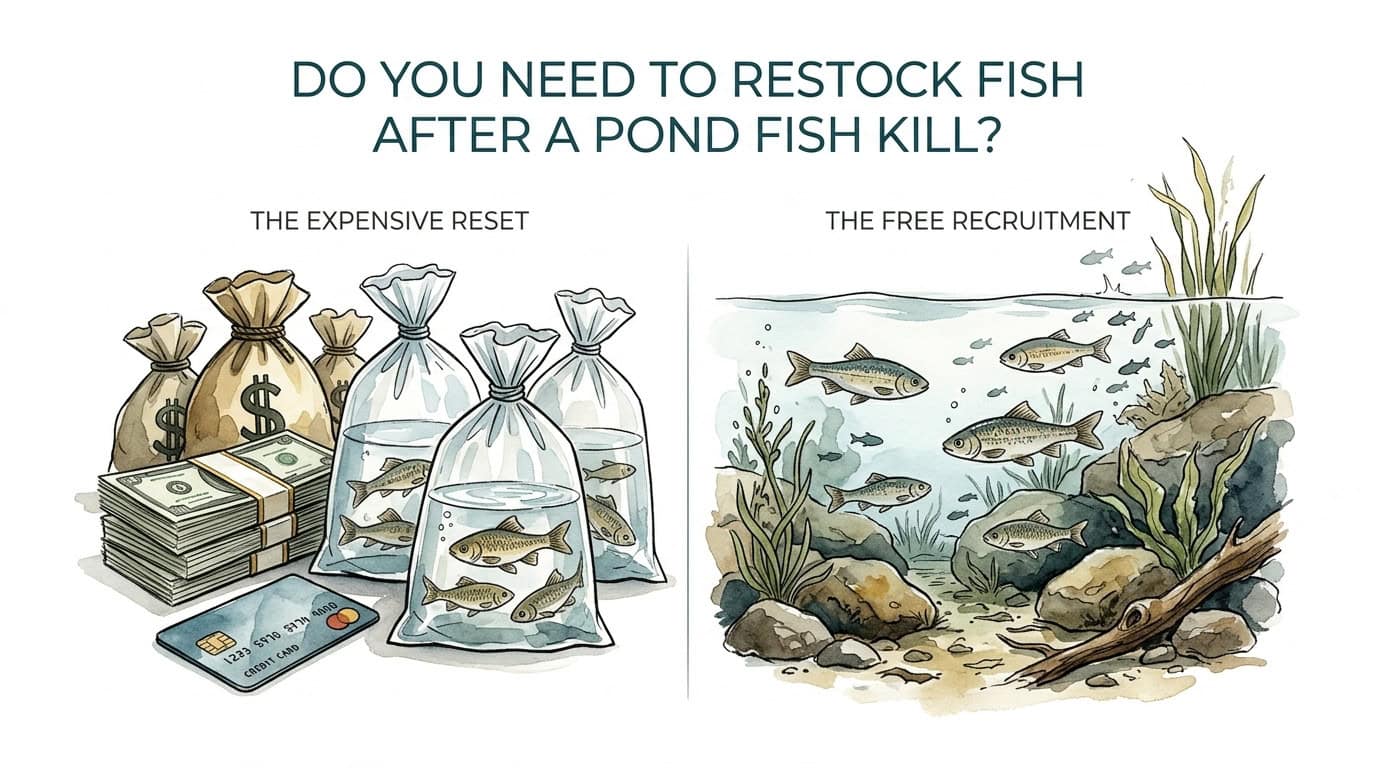
Don’t call the hatchery yet. Your pond might be fixing itself for free. A fish kill looks like the end, but it’s often a new beginning. Before you spend thousands on restocking, see if your ‘survivors’ can do the job for free.
Restocking is not always required after a fish kill. If the mortality event was partial, natural recruitment from surviving fish often restores the population more efficiently and with greater genetic fitness than supplemental stocking. You must first identify the root cause—typically dissolved oxygen depletion—and quantify the remaining biomass. Restocking into an unstable system before addressing underlying environmental failures leads to secondary mortality and wasted capital.
Do You Need to Restock Fish After a Pond Fish Kill?
A fish kill is a localized mass mortality event, usually resulting from rapid environmental shifts. In approximately 90% of cases, the primary driver is a depletion of dissolved oxygen (DO). When DO levels drop below 1.0 to 2.0 mg/L (milligrams per liter), most high-demand species like Largemouth Bass and Bluegill suffer acute respiratory failure. However, these events are rarely 100% lethal.
Fish kills are often selective. Larger fish have higher metabolic demands and a lower gill-surface-area-to-body-mass ratio, making them the first to succumb during a hypoxia event. Smaller fingerlings and certain hardy species often survive in the thin, oxygen-rich layer at the surface or near inflows. This “survivor” population represents the most resilient genetics in your specific ecosystem.

The decision to restock hinges on whether the remaining population can reach carrying capacity within an acceptable timeframe. Carrying capacity is the maximum biomass of fish a pond can support based on available nutrients and oxygen. If 20% of your fish survived, they now have access to 100% of the pond’s resources. This often triggers a massive reproductive “recruitment” phase where growth rates accelerate exponentially.
How to Assess a Pond After a Fish Kill
Determining the necessity of restocking requires a quantitative assessment of the remaining population. Visual inspection of floating carcasses is insufficient; many dead fish sink or are consumed by scavengers, leading to an underestimation of the total kill.
Quantitative Sampling Techniques
To accurately measure the “survivor” population, employ standardized sampling methods. Seining a representative portion of the shoreline provides data on forage fish recruitment. If you pull a 20-foot seine and find hundreds of small Bluegill or Fathead Minnows, the forage base is intact. Electrofishing, performed by a professional, is the most precise method for assessing predator-to-prey ratios.
Water Quality Diagnostics
Before considering new fish, you must verify that the environment is stable. Use a DO meter to measure oxygen levels at various depths (0, 3, and 6 feet) before dawn, which is when oxygen is at its lowest. If the DO remains below 3.0 mg/L at daybreak, the pond is in a state of chronic stress. Check ammonia (NH3) levels and pH; high pH increases the toxicity of ammonia, which can cause secondary kills in weakened survivors.
Secchi Disk Visibility
A Secchi disk measures water clarity, which serves as a proxy for phytoplankton density. If visibility is less than 12 inches, the pond is hyper-eutrophic. This high nutrient load creates a high Biological Oxygen Demand (BOD), increasing the risk of another crash. Conversely, a clear pond (visibility > 30 inches) may lack the primary production necessary to support rapid natural recruitment.
Benefits of Natural Recruitment Over Restocking
Choosing the “Free Recruitment” path offers several mechanical and biological advantages over the “Expensive Reset.”

Genetic resilience is the most significant benefit. The fish that survived the kill did so because of physiological advantages—better gill efficiency, lower metabolic requirements, or superior stress-response mechanisms. These survivors will pass these traits to their offspring. Restocking with hatchery fish introduces “soft” genetics that have never been tested by your pond’s specific stressors.
Niche optimization occurs more smoothly with natural recruitment. When you restock, you are introducing a fixed number of fish into an ecosystem with fluctuating resources. In natural recovery, the fish population grows in direct proportion to the available food. This prevents the “stunting” often seen in restocked ponds where the predator population outpaces the forage base before the system stabilizes.
Capital conservation is a practical metric. A professional restocking of a one-acre pond can cost between $1,500 and $5,000, depending on species and size. If the survivors can repopulate the pond in 12 to 18 months, that capital is better spent on mechanical optimizations like aeration systems that prevent future kills.
Challenges and Common Mistakes in Post-Kill Management
The most frequent error is stocking fish immediately after a kill. The conditions that caused the initial mortality—such as a massive algae die-off or a pond turnover—often take weeks to resolve. Introducing new, stressed fish into a recovering system is a recipe for total loss.
Failure to Address Nutrient Loads
Nutrient loading is the underlying engine of most fish kills. If the pond has excessive muck (organic sediment) or high phosphorus levels from runoff, the BOD will remain dangerously high. Restocking into a nutrient-heavy pond is like putting a new engine into a car with a broken cooling system. The hardware is new, but the environment will eventually cause another failure.
Over-Harvesting Survivors
Pond owners often continue to fish after a partial kill. This is a mistake. The remaining large predators are the critical “broodstock” needed for recruitment. Removing even a few surviving bass can drastically extend the time it takes for the population to rebalance.
Ignoring the “Forage First” Rule
When restocking is necessary, many owners focus on the sport fish (Bass) and ignore the forage (Bluegill/Minnows). Predators require a 10:1 biomass ratio of forage to grow. If you stock 100 bass without a robust forage base, they will quickly consume the survivors and then starve, resulting in a stunted, worthless fishery.
Limitations: When Restocking is Mandatory
Natural recruitment is not a universal solution. Certain scenarios demand a manual reset of the ecosystem.
A total fish kill (100% mortality) obviously requires restocking. Total kills are rare but can happen with chemical spills, extreme winter kills in shallow ponds, or severe golden algae blooms. If intensive sampling yields zero survivors across all species, the biological clock has been reset to zero.
Species-specific crashes may also require intervention. If a summer hypoxia event killed all the Largemouth Bass but left the Bluegill untouched, the pond will rapidly become “bass crowded.” In this state, thousands of tiny, stunted Bluegill will eat every egg the surviving bass lay, preventing natural recruitment. You must manually introduce adult predators to break this cycle.
Structural changes to the pond, such as dredging or dam repair, often require a total drain. Once the pond is refilled, it is a “blank slate.” Natural recruitment is impossible here unless the pond is connected to an upstream source of fish.
Practical Tips for Pond Recovery and Optimization
If you decide to let the pond recover naturally, or if you choose a supplemental restocking strategy, follow these technical best practices.
- Install Sub-Surface Aeration: A diffused aeration system is the most effective way to prevent future kills. It breaks thermal stratification and ensures DO is distributed throughout the entire water column.
- Manage Nutrient Influx: Establish a 10-foot “no-mow” buffer strip around the pond to filter nitrogen and phosphorus from lawn runoff. Use professional-grade beneficial bacteria to accelerate the decomposition of organic muck.
- Monitor Phytoplankton Blooms: Use a Secchi disk weekly. If visibility drops below 18 inches, be prepared for a potential oxygen crash. If it stays above 36 inches, consider a specialized pond fertilizer to jumpstart the food chain.
- Harvest Selectively: Once the pond recovers, do not return to “catch and release only.” Harvesting small, stunted fish is essential to maintaining a healthy growth rate among the remaining population.
Advanced Considerations: Trophic State and Oxygen Transfer Rates
Serious practitioners must understand the relationship between the Trophic State Index (TSI) and fish survival. Most ponds experiencing kills are in the “Eutrophic” or “Hypereutrophic” categories. In these systems, the Oxygen Transfer Rate (OTR) from the atmosphere into the water cannot keep up with the Respiration (R) rate of the biomass at night.
Calculating your pond’s Biological Oxygen Demand (BOD) allows you to size an aeration system accurately. A system with a low OTR will fail during a “bloom crash”—when a large amount of algae dies simultaneously. This die-off causes a massive spike in bacterial activity, which consumes all available oxygen in a matter of hours.
Furthermore, consider the “Alkalinity” of your water. High alkalinity (above 100 ppm) acts as a buffer, stabilizing pH swings and reducing the toxicity of metabolic wastes. If your alkalinity is low, adding agricultural lime can improve the efficiency of your pond’s entire biological engine, making it less prone to the conditions that cause fish kills.
Example Scenario: Recovery of a 1-Acre Farm Pond
Consider a 1-acre pond that suffered a summer kill after a week of cloudy, hot weather. The owner observed roughly 200 dead Bass and 500 dead Bluegill.
Instead of immediate restocking, the owner performs a seining test and finds thousands of 1-inch Bluegill. This indicates a partial kill where the forage base and the “recruits” of the year survived. However, no Bass are caught in the seine or via hook-and-line.
The owner decides on a **Supplemental Restocking Strategy**. Since the forage is abundant but the predators are gone, they stock 50 “advanced” Largemouth Bass (6–8 inches) rather than fingerlings. These larger predators can immediately begin thinning the overabundant Bluegill. To prevent a recurrence, the owner installs a 3/4 HP diffuser system. Total cost: $2,200. This is significantly cheaper than a total reset and utilizes the existing, resilient forage base.
Final Thoughts
A fish kill is a mechanical failure of the pond’s life-support system. While the sight of dead fish is alarming, it is often a corrective measure by nature to bring an over-stressed ecosystem back within its carrying capacity. Jumping straight to restocking without a technical assessment often leads to a cycle of repeated failures and wasted resources.
Assess your survivors, measure your water quality, and address the nutrient issues that fueled the crash. Whether you choose to let the pond recover naturally or opt for a targeted supplemental stocking, your focus should be on long-term stability. A healthy pond is not defined by how many fish you put in, but by how many the environment can sustain.

Frequently Asked Questions About Do You Need to Restock Fish After a Pond Fish Kill?
How long should I wait to restock after a fish kill?
You should wait a minimum of 2 to 4 weeks before introducing new fish. This window allows the environmental stressors that caused the kill—such as low dissolved oxygen or an ammonia spike—to stabilize. During this time, the decomposition of the dead fish will temporarily increase the biological oxygen demand (BOD), making the water even more dangerous for new arrivals. Before restocking, use a dissolved oxygen meter to ensure levels are consistently above 5.0 mg/L and check that the water temperature is within the optimal range for the species you intend to stock. Restocking too early is a primary cause of secondary fish mortality.
Can a pond recover from a fish kill without any restocking?
Yes, many ponds recover fully through natural recruitment if the kill was partial. If as little as 10% to 20% of the population survives, the reduced competition for food and space triggers rapid growth and increased spawning success. In a single season, surviving Bluegill can produce thousands of offspring to fill the forage niche, while surviving Bass will grow faster due to the abundance of prey. This natural recovery often results in a more resilient fish population, as the survivors possess the genetics best suited for that specific pond’s environment. Recovery typically takes 12 to 24 months to reach previous biomass levels.
Why did only the large fish die in my pond?
Large fish die first during a dissolved oxygen crash because of their physiology and metabolic requirements. Larger fish have a higher total oxygen demand but a proportionally smaller gill surface area compared to their body mass. This makes it much harder for them to extract sufficient oxygen from hypoxic (low-oxygen) water. Additionally, larger fish are often less able to utilize the thin layer of oxygen-rich water at the very surface of the pond, which is where smaller fingerlings can often find just enough oxygen to survive. This selective mortality is a classic sign of an oxygen-related fish kill rather than a chemical or toxic event.
What is the most common cause of a partial fish kill?
The most common cause is a sudden depletion of dissolved oxygen, often triggered by a “phytoplankton crash” or “pond turnover.” A crash occurs when a dense bloom of algae dies off due to cloudy weather or nutrient exhaustion, leading to a massive spike in oxygen-consuming bacteria. A turnover happens when heavy, cold rain or strong winds mix the oxygen-depleted bottom water with the oxygen-rich surface water, suddenly lowering the DO of the entire pond. These events are most frequent in late summer when water temperatures are high and the pond’s oxygen-carrying capacity is naturally at its lowest point.
How do I know if I have enough surviving fish to avoid restocking?
You must perform a population assessment using seining, hook-and-line sampling, or professional electrofishing. If you can catch several healthy fish of various size classes, or if you see significant numbers of small “recruits” (young fish) along the shoreline, the pond likely has enough broodstock to recover naturally. A professional survey is recommended for large or high-value fisheries to provide a quantitative biomass estimate. If the sampling shows a complete absence of a key species (like all predators being gone), then supplemental stocking is necessary to prevent the remaining species from becoming overpopulated and stunted.