

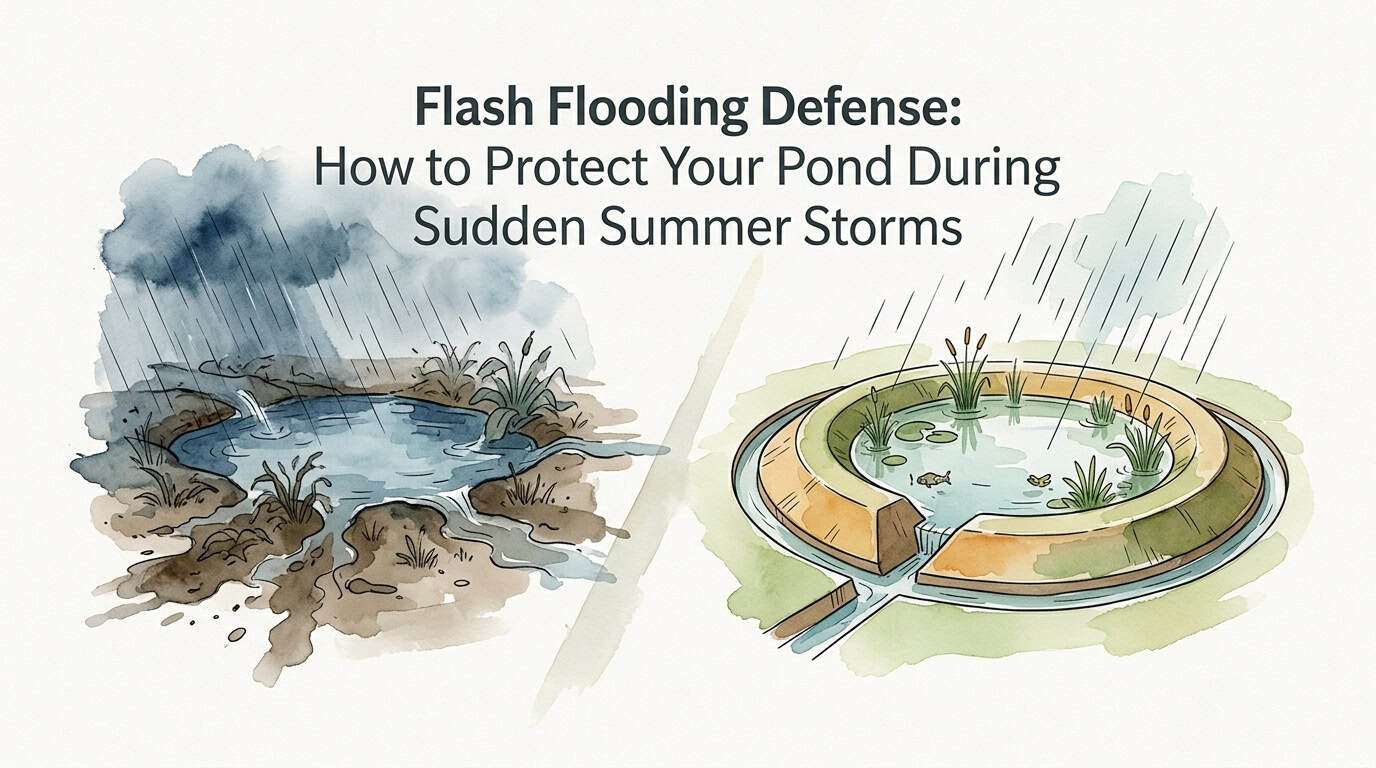
One summer storm shouldn’t reset your pond’s ecosystem to zero. Most pond failures during summer happen because the pond is the lowest point in the yard. By creating a ‘negative grade’ away from the water and installing an overflow bypass, you keep the mud out and the fish in.
Hydraulic management is a critical component of pond engineering that practitioners often overlook until a high-intensity precipitation event occurs. When a pond functions as the terminal point for yard runoff, it ceases to be a closed ecosystem and instead becomes a sedimentation basin for every pollutant, fertilizer, and sediment particle in the surrounding watershed. This structural vulnerability, often called “The Low-Ground Trap,” results in immediate water chemistry instability and mechanical stress on filtration components.
The objective of a robust flood defense system is to decouple the pond’s water volume from the surrounding topography. Transforming a vulnerable basin into a “Bermed Fortress” requires a precise understanding of site grading, hydraulic load calculations, and overflow capacity. This technical guide examines the mechanical and hydrological principles required to safeguard an ornamental or functional pond against sudden summer deluges.
Flash Flooding Defense: How to Protect Your Pond During Sudden Summer Storms
Flash flooding defense for ponds is the implementation of physical barriers and bypass systems designed to prevent uncontrolled surface runoff from entering the water and to provide a controlled exit for excess internal volume. In a typical residential landscape, gravity dictates that water follows the path of least resistance. If a pond is excavated in a natural depression without topographical modification, it will collect runoff from the entire uphill catchment area.

This uncontrolled influx introduces several failure points. First, “acid rain” typically possesses a pH between 5.0 and 5.5, which is significantly more acidic than the 7.0 to 8.6 range required for most aquatic life. Second, runoff carries Total Suspended Solids (TSS) such as silt and clay, which increase turbidity and can physically abrade fish gill membranes. Third, the sudden introduction of large volumes of water can cause a “thermal shock” or “turnover” event, where oxygen-poor water from the bottom is rapidly mixed with the surface, potentially leading to acute hypoxia in fish populations.
A defended pond utilizes three primary mechanisms: a perimeter berm to deflect surface water, negative grading to guide that water toward a separate drainage area, and a high-capacity overflow bypass to prevent the pond from overtopping its liner. These systems work in tandem to maintain a consistent water level and stable chemical parameters regardless of external weather conditions.
Mechanical Principles of Runoff Management
Effective flood protection begins with the Rational Method, a formula used by civil engineers to estimate peak runoff rates. To design an effective defense, you must first calculate the hydraulic load your pond might face. The formula is Q = CiA, where Q represents the peak flow rate in cubic feet per second (CFS), C is the runoff coefficient (reflecting the “slickness” of the surface), i is the rainfall intensity in inches per hour, and A is the drainage area in acres.
In a residential context, a grass lawn has a runoff coefficient of approximately 0.30, meaning 30% of the rain becomes runoff. A roof or concrete patio has a coefficient of 0.90 to 0.95. If your pond is situated at the bottom of a 2,000-square-foot slope, a 2-inch-per-hour storm can generate a flow rate exceeding 15 gallons per minute (GPM) into the pond. Without a berm or negative grade, this volume enters the pond, displacing the treated, balanced water and introducing raw pollutants.
The Bermed Fortress: Topographical Isolation
Construction of a perimeter berm is the most effective method for physical isolation. A berm is a raised earthen ridge, typically 6 to 12 inches high, that encircles the pond. For maximum stability and aesthetic integration, the berm should maintain a 3:1 slope ratio (3 units horizontal to 1 unit vertical). This ratio ensures that the berm is steep enough to deflect water but shallow enough to prevent erosion and allow for the establishment of stabilizing vegetation.
Compaction is vital during berm construction. Loose soil will quickly saturate and liquefy under heavy rain, leading to structural failure. The soil should be placed in 3-inch “lifts” and mechanically compacted to a minimum of 95% Proctor density. Using clay-heavy soil provides better hydraulic resistance than sandy or loamy mixtures.

Negative Grading and Swale Integration
Negative grading refers to the intentional sloping of the terrain away from the pond’s edge. Even a slight 2% grade (a 1/4-inch drop per foot) is sufficient to prevent standing water and ensure that runoff is directed toward a swale or French drain. A swale is a wide, shallow channel lined with turf or riprap that conveys water to a safe discharge point, such as a municipal storm drain or a dedicated rain garden.
If the pond is located on a hillside, a “diversion canal” or “interceptor ditch” should be dug uphill from the pond. This trench captures the sheet flow from the mountain or higher yard and redirects it around the pond’s perimeter. Lining these trenches with geotextile fabric and D50-sized riprap (stones with an average diameter of 3–6 inches) prevents the trench itself from eroding during high-velocity flow.
Implementing the Overflow Bypass System
Every pond requires a dedicated overflow to manage the water that falls directly onto the pond’s surface. While a 2-inch storm may not sound significant, on a 500-square-foot pond, it adds over 600 gallons of water in a matter of hours. If this volume has no designated exit, it will find the lowest point of the liner, often eroding the soil behind the liner and causing “floating liner” syndrome or structural collapse.
Sizing the Overflow Pipe
Undersizing the overflow is a common engineering error. The flow capacity of a pipe is determined by its diameter and its slope (hydraulic gradient). A 2-inch PVC pipe at a 1% slope can only handle approximately 30–40 GPM. In contrast, a 4-inch pipe can manage roughly 130–150 GPM. For most residential ponds, a 4-inch Schedule 40 PVC pipe is the minimum recommended size for a primary overflow.
Types of Overflow Structures
- The Standpipe: A vertical pipe connected to a T-junction or elbow that exits through the liner. The top of the pipe sits exactly at the desired water level. When the water rises, it spills into the pipe and is carried away by gravity.
- The Surface Skimmer Bypass: Many professional pond skimmers include a pre-drilled overflow port. This allows excess water to exit through the back of the skimmer box before it can overtop the pond edges.
- The Emergency Spillway: For large earthen ponds, a wide, flat “weir” or spillway lined with large stones acts as a secondary safety. It is set 2 inches higher than the primary pipe overflow and handles extreme volumes that exceed the pipe’s capacity.
Advantages of Technical Flood Defense
The primary advantage of a technical defense system is the preservation of water quality parameters. High-value ornamental fish, such as Koi (Cyprinus carpio), are sensitive to rapid shifts in Carbonate Hardness (KH) and pH. Rainwater has near-zero KH, meaning it provides no “buffer” against acidity. A pond protected from runoff maintains its KH levels, preventing a lethal “pH crash” where the water acidity spikes rapidly.
Furthermore, a flood-defended pond experiences significantly lower nutrient loading. Surface runoff often contains lawn fertilizers (nitrogen and phosphorus) and organic debris. These nutrients fuel catastrophic algae blooms and increases the Biological Oxygen Demand (BOD), which can deplete dissolved oxygen levels at night. By keeping these nutrients out, the filtration system operates at peak efficiency with lower maintenance requirements.
Mechanical longevity is another measurable benefit. Submersible pumps and external filtration systems are designed to handle clear or moderately turbid water. When a pond “muds out” due to a flood, the high concentration of abrasive silts can accelerate wear on pump impellers and clog bead filters or pressure filters, leading to motor burnout or system bypass.
Challenges and Common Mistakes
The most frequent error in flood defense is the “Low-Ground Assumption.” Builders often assume that because a site is dry during construction, it will remain dry during a storm. Failure to account for the “100-year flood” elevation can lead to total system loss. Always survey the yard with a transit or laser level to identify the true drainage patterns before excavation begins.
Another common pitfall is the use of flat lids on overflow drains. A flat grate is easily blinded by floating leaves or mulch during a storm. Once the grate is blocked, the overflow fails, and the pond overtops. Using a “beehive” or “dome” style grate increases the surface area for water intake and allows water to enter from the sides even if the top is partially covered by debris.
Improper liner termination is a hidden failure point. If the liner is buried in a trench that sits lower than the surrounding yard, water can seep behind the liner through “wicking” or capillary action. This hydrostatic pressure can push the liner up, creating massive air or water bubbles (often called “hippos”) under the pond floor.
Limitations of Flood Defense Systems
No residential system can provide 100% protection against extreme “Acts of God,” such as a 500-year flood or a tropical cyclone that drops 15 inches of rain in 24 hours. In these scenarios, the regional water table may rise above the level of the pond, creating upward pressure that even the best berms cannot counteract.
Additionally, berms and swales require consistent maintenance. Over time, soil settles and vegetation can block drainage paths. A system designed for 150 GPM may only provide 50 GPM of capacity if the pipes are 50% restricted by root intrusion or sediment buildup. Physical constraints, such as a narrow property line or proximity to a neighbor’s house, may also limit the size and effectiveness of negative grading.
Comparison of Defensive Strategies
The following table compares the two primary philosophies of pond placement and protection.
| Feature | The Low-Ground Trap | The Bermed Fortress |
|---|---|---|
| Placement | Lowest point in yard drainage. | Raised or mid-slope with diversion. |
| Inflow Control | Uncontrolled surface runoff. | Berm deflection and swale bypass. |
| Water Stability | High risk of pH crash and turbidity. | High parameter stability. |
| Maintenance | High (frequent sediment removal). | Low (preventative pipe cleaning). |
| Failure Mode | Overtopping and fish washout. | Controlled overflow through pipes. |
Practical Tips for Immediate Implementation
To assess your pond’s current vulnerability, perform a “dry run” with a garden hose. Place the hose at various high points in your yard and observe the flow path. If the water naturally migrates toward the pond edge, you have a grading issue that requires remediation.
When installing an overflow pipe, always use rigid PVC rather than corrugated “black” drainage pipe. Corrugated pipe has a much higher friction coefficient, reducing flow velocity, and is prone to collapsing under soil weight or being punctured by shovels during future landscaping. Ensure the exit point of the overflow pipe is at least 5 feet away from the pond and discharges onto a “splash pad” of river rock to prevent erosion at the outlet.
Establish a “vegetative buffer strip” around the pond. Dense, deep-rooted plants like ornamental grasses or sedges act as a biological filter. They slow down any surface water that manages to bypass the berm, trapping sediment and absorbing excess nutrients before they can enter the aquatic environment.
Advanced Considerations for Large-Scale Hydrology
Serious practitioners should consider the integration of a “sedimentation basin” or “forebay” if the watershed is large. A forebay is a small, separate pool that runoff enters first. It allows heavy solids to settle out in a controlled area that is easy to dredge before the cleaner water spills over a weir into the main pond.
Advanced systems can also utilize “active overflow management.” This involves electronic sensors that detect rising water levels and trigger high-volume auxiliary pumps. While more expensive and reliant on power, these systems can move thousands of gallons per hour, providing a level of protection that gravity-fed pipes cannot match.
Furthermore, consider the “Hydrostatic Relief Valve.” In areas with high water tables, these valves are installed in the bottom of the pond liner. If the external water pressure exceeds the internal weight of the pond water, the valve opens, allowing groundwater to enter the pond rather than pushing the liner up. This prevents the catastrophic stretching or tearing of the EPDM or PVC liner material.
Technical Scenario: The 1,000-Square-Foot Catchment
Consider a pond situated adjacent to a patio and a portion of a house roof. The combined impervious surface area (A) is 1,000 square feet. During a standard summer thunderstorm with an intensity (i) of 2 inches per hour, the runoff calculation (Rational Method) is as follows:

1,000 sq. ft. is approximately 0.023 acres.
Q = 0.90 (impervious C) * 2 (i) * 0.023 (A) = 0.0414 CFS.
Converting CFS to GPM: 0.0414 * 448.8 = 18.57 GPM.
In this scenario, if there is no berm or negative grade, the pond must absorb nearly 19 gallons of raw runoff every minute. Over a 60-minute storm, that is 1,140 gallons. If the pond is only 2,000 gallons total, over 50% of its volume has been replaced by untreated stormwater in one hour. Installing a 4-inch overflow and a 6-inch berm would reduce this percentage to near zero, as the only water entering the pond would be the direct rainfall onto its own surface area.
Final Thoughts
Successful pond management is an exercise in hydraulic and chemical control. By recognizing that the pond is naturally the most vulnerable point in a landscape’s drainage hierarchy, you can take the necessary engineering steps to isolate it. The implementation of negative grading, structural berms, and high-capacity overflow systems transforms a potential flood hazard into a stable, self-contained aquatic environment.
The cost of preventative topographical modification is a fraction of the cost of replacing a mature fish collection or dredging thousands of pounds of sediment after a single storm event. Precision in grading and pipe sizing ensures that the ecosystem remains resilient in the face of increasingly volatile summer weather patterns.
Continue to monitor your drainage paths annually, as soil settlement and plant growth can shift the hydraulic dynamics of your yard. A well-engineered defense is not a “set and forget” system but a critical piece of infrastructure that requires the same attention as your biological filtration or UV sterilization. Applying these principles will ensure that the next summer storm is merely a scenic event rather than an ecological disaster.