

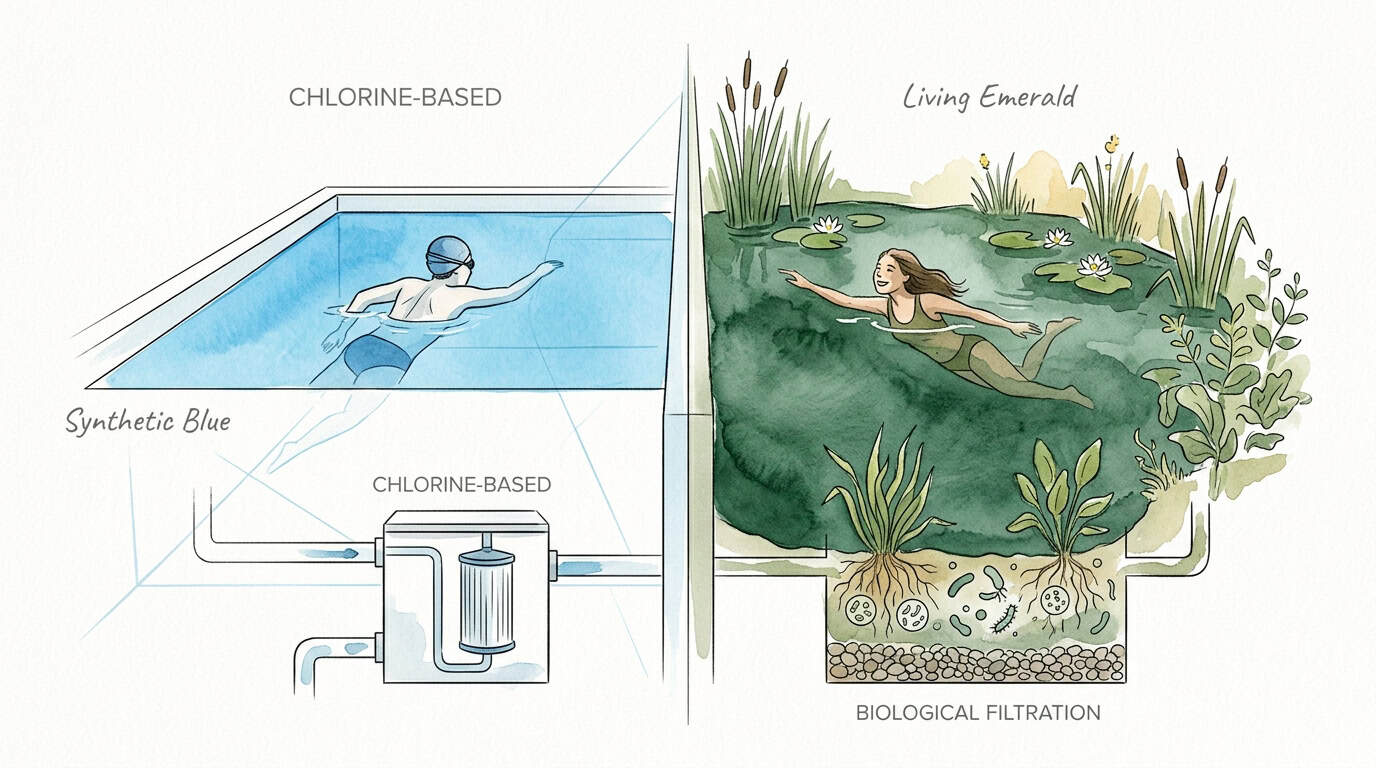
Why are we still swimming in bleach when plants can do the cleaning for us? Traditional pools are sterile debt traps. Wild swim ponds use a ‘regeneration zone’ of plants to strip nutrients and pathogens, leaving you with skin-soft water and zero chemical bills. Here is how to make the switch.
Creating a Sustainable “Wild Swim” Pond: Filtration Without Chlorine
Natural Swimming Ponds (NSPs) are engineered aquatic systems that replace oxidative chemical disinfection with biological purification. These systems are partitioned into two primary functional areas: the swimming zone and the regeneration zone. The swimming zone is a deep, unobstructed basin for recreation, while the regeneration zone acts as a living filter, utilizing hydrobotanical processes to maintain water quality.
This approach is rooted in the German FLL (Landscaping and Landscape Development Research Society) guidelines, which have standardized the design and maintenance of biological water treatment systems since the early 2000s. NSPs are increasingly used in residential and public infrastructure across Europe and North America as a low-energy, chemical-free alternative to traditional chlorinated infrastructure.
The core principle is nutrient limitation. In a traditional pool, chlorine kills organic life to prevent algae. In a natural pond, the system is designed to reach an oligotrophic state, where phosphorus and nitrogen levels are kept so low that opportunistic algae cannot thrive. The regeneration zone acts as a biological “sink” for these nutrients, effectively starving algae while providing a safe environment for human immersion.

The Technical Mechanics of Biological Filtration
Biological filtration in a wild swim pond relies on the establishment of complex biofilms and the physical sequestering of particles within a multi-layer filter bed. Unlike a mechanical filter that simply traps debris, a biological filter processes dissolved organic matter.
Water is typically drawn from the surface of the swimming zone via skimmers or overflow gutters. This prevents the accumulation of floating debris and oils, which can cause surface films. The water is then pumped into the base of the regeneration zone, where it percolates upward through layers of specialized aggregate.
Biofilm Colonization and Nutrient Stripping
The aggregate—usually a mix of washed gravel and expanded clay—provides a massive surface area for the colonization of aerobic bacteria. These microbes form a biofilm, a gelatinous matrix that captures dissolved nutrients. This process, known as nitrification, converts ammonia and urea (the primary waste products from swimmers) into nitrites and then into stable nitrates.
Plants within the regeneration zone then uptake these nitrates through their root systems to build biomass. This synergy ensures that nutrients do not remain in the water column to feed filamentous algae. For optimal performance, phosphorus levels must be maintained below 0.01 mg/L, as even trace amounts can trigger an algal bloom.
Hydraulic Turnover and Retention Time
Efficiency is determined by the Hydraulic Retention Time (HRT) within the filter bed. If water moves too fast, the biofilm cannot effectively strip nutrients. If it moves too slow, anaerobic pockets can form, leading to the release of hydrogen sulfide.
Engineering standards suggest a turnover rate where the entire volume of the pond passes through the filter 1 to 2 times every 24 hours. This constant circulation ensures oxygenation, which is critical for the aerobic bacteria performing the bulk of the purification.

Quantitative Benefits and Operational Efficiency
Shifting from a chemical-based system to a biological one results in measurable changes in operational expenditure and system longevity.
Lower Operational Expenditure (OPEX)
Traditional pools require a continuous supply of chlorine, pH balancers, and algaecides. In contrast, the annual chemical cost for a natural swim pond is zero. The primary operational cost is electricity for a low-wattage circulation pump. Because these pumps run at lower pressures than traditional high-speed pool filters, they consume significantly less energy.
System Longevity and Structural Integrity
Traditional pool liners and concrete shells are subject to the corrosive effects of chlorine and acid. Natural ponds often utilize EPDM (Ethylene Propylene Diene Monomer) liners, which are chemically inert and UV-stabilized, often lasting over 50 years. There is no need for frequent resurfacing or acid-washing, which are common 10-year maintenance requirements for gunite pools.
Ecological Integration and Biodiversity
While difficult to quantify in strictly financial terms, the ecological benefit is significant. A wild swim pond functions as a constructed wetland, providing habitat for odonata (dragonflies) and amphibians. Dragonflies are efficient predators of Culicidae (mosquitoes), naturally controlling pest populations without the use of insecticides.
Common Engineering Failures and Pitfalls
Designing a natural system requires precise balance; failure to account for specific environmental variables can lead to system collapse.
Inadequate Regeneration Zone Ratios
A frequent error is undersizing the regeneration zone. For a “Type I” or “Type II” pond (low technology, high biology), the regeneration area should be equal in surface area to the swimming zone (a 1:1 ratio). Reducing this ratio without increasing mechanical aeration or technical filtration often leads to persistent turbidity and high phosphorus levels.
Improper Plant Selection and Density
Using high-nutrient-demand garden plants instead of specialized aquatic macrophytes is a common mistake. Native species such as Iris pseudacorus or Phragmites australis are preferred for their aggressive nutrient uptake. If the plant density is too low (fewer than 4-6 plants per square meter), the biological “sink” will be insufficient to compete with algae.
Substrate Contamination
Using unwashed or high-phosphate gravel can sabotage a pond from day one. Many types of limestone or river rock contain high levels of bound phosphorus. Once submerged, this phosphorus leaches into the water, providing a permanent food source for algae. Technical-grade, washed silica or expanded clay substrates are mandatory for high-performance systems.
Environmental and Practical Limitations
Natural swimming ponds are not a universal solution for every site. There are specific constraints that must be analyzed during the feasibility phase.
Spatial Requirements
Because the regeneration zone requires significant real estate, NSPs are often twice the size of a comparable chlorinated pool. Homeowners with limited backyard space may find that the required footprint for a balanced ecosystem leaves little room for the actual swimming area.
Thermal Constraints
NSPs are generally not designed for high-temperature operation. Heating a natural pond above 28°C (82°F) can disrupt the biological equilibrium, reducing dissolved oxygen levels and accelerating the growth of pathogenic bacteria. For users who require “hot tub” temperatures, a biological system is not suitable.
Initial Capital Expenditure (CAPEX)
The upfront cost of a natural swim pond is often 20% to 30% higher than a traditional pool. This is due to the increased excavation volume, the cost of specialized aggregates, and the complexity of the internal hydraulic plumbing. While the system pays for itself over 10-15 years through lower maintenance, it requires a larger initial investment.
Comparison: Traditional Chlorine vs. Natural Swim Pond
The following table outlines the technical and financial differences between a standard chemical pool (Synthetic Blue) and a natural swim pond (Living Emerald).
| Feature | Traditional Chlorine Pool | Natural Swimming Pond |
|---|---|---|
| Sanitization Method | Chemical Oxidation (Chlorine/Bromine) | Biological Sequestration & Biofilm |
| Annual Chemical Cost | $500 – $1,500 | $0 |
| Pump Energy Consumption | High (Intermittent high-pressure) | Low (Continuous low-pressure) |
| Water Replacement | Required (Backwashing/Dilution) | Minimal (Evaporation makeup only) |
| Expected Lifespan (Liner) | 10 – 15 Years | 30 – 50 Years |
| Winterization | Required (Cover/Drain lines) | Optional (Functions as garden feature) |
Practical Maintenance Protocols
Maintenance in a wild swim pond is more akin to gardening than chemistry. It requires observational skills and seasonal intervention.
Biomass Management
The most critical task is the annual harvest of aquatic plants. In late autumn, before the plants die back and rot, all emergent vegetation should be cut back to 5-10 cm above the water level. This removes the nutrients stored in the plant tissue from the system. Failure to do this allows the nutrients to cycle back into the water as the plant decomposes.
Skimmer and Pre-filter Cleaning
Mechanical skimmers should be checked weekly. Removing leaves and organic debris before they sink to the bottom is the first line of defense against phosphorus buildup. If debris is allowed to settle, it forms a benthic sludge layer that can become anaerobic.
Water Quality Monitoring
While you do not need to test for chlorine, monitoring pH and phosphorus is vital. A pH range of 7.0 to 8.5 is ideal for biofilm health. If phosphorus levels begin to climb, lanthanum-modified clay or iron hydroxide filters can be used as a temporary technical “booster” to bind the excess minerals.
Advanced Considerations for High-Performance Systems
Serious practitioners may look beyond basic designs to optimize system efficiency through advanced hydraulic and biological engineering.
Ultra-Violet (UV) Clarification
While not always necessary in a well-balanced pond, UV-C clarifiers can be integrated as a fail-safe. These units use short-wave ultraviolet light to disrupt the DNA of single-celled algae and pathogens. In high-traffic public ponds, UV systems provide an extra layer of pathogen attenuation without leaving chemical residues that would harm the regeneration zone.
Zonated Hydraulic Distribution
Advanced systems use multiple inlet points in the regeneration zone to ensure even water distribution. Using a “manifold” system allows the operator to adjust the flow rate to different sections of the filter bed, preventing “dead zones” where water might stagnate.

Oxygenation through Cascades and Venturis
Dissolved oxygen (DO) is the fuel for biological purification. Incorporating a waterfall or a venturi injector at the return point increases gas exchange. High DO levels support the heterotrophic bacteria that break down organic sludge, keeping the swimming zone clear.
Scenario: Converting a Traditional Pool to a Wild Swim Pond
Transforming an existing sterile debt trap into a living emerald system is a technical process that requires structural modifications.
Step 1: Structural Assessment and Stripping
The process begins by draining the pool and removing all existing plumbing, including the sand filter and chlorine feeder. The internal shell (plaster or tile) is inspected for cracks. If the shell is compromised, a new EPDM liner is installed over a protective geotextile fleece.
Step 2: Partitioning the Zones
A retaining wall is built within the pool shell to separate the swimming area from the new regeneration zone. This wall usually stops about 10 cm below the final water level, allowing water to flow over the top. Concrete blocks or stainless steel frames are commonly used for this partition.
Step 3: Plumbing and Aggregate Installation
Perforated pipes are laid at the bottom of the regeneration zone and connected to the circulation pump. This area is then filled with washed 16-32 mm gravel at the bottom, followed by a layer of 2-8 mm zeolite or expanded clay.
Step 4: Planting and Balancing
Aquatic macrophytes are planted directly into the top layer of gravel. The pond is then filled with fresh water. Because the new ecosystem needs time to establish, the water may turn green for the first 2-4 weeks. Once the biofilm matures and the plants begin to grow, the water clears naturally.
Final Thoughts
Wild swim ponds represent a significant shift in how we manage private and public aquatic infrastructure. By moving away from the “sterilize and maintain” model of traditional pools and toward a “balance and observe” ecological model, we can create swimming environments that are both cost-effective and environmentally restorative.
The success of these systems depends on rigorous adherence to hydraulic engineering and biological principles. When designed correctly, a natural swim pond provides a self-regulating, oligotrophic environment that requires far less intervention than a chemical pool. It is an investment in long-term efficiency and biological health.
For those considering the switch, the primary takeaway is that the regeneration zone is the engine of the pond. Treat it with the same technical precision you would a mechanical filter, and the result will be a sustainable, crystal-clear swimming experience that lasts for decades.