

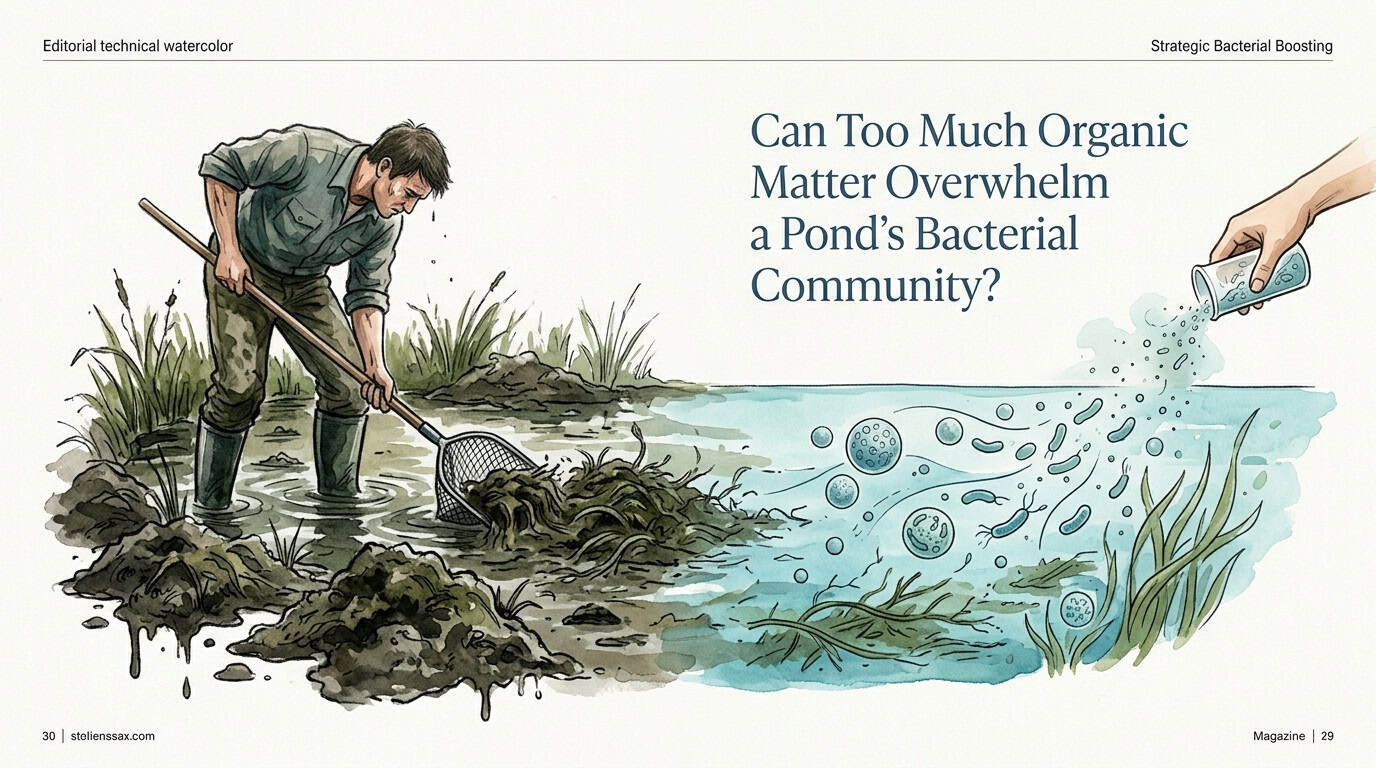
Yes, excessive organic matter overwhelms a pond’s bacterial community by creating a Biochemical Oxygen Demand (BOD) that exceeds the available dissolved oxygen. When the organic load surpasses the microbial metabolic capacity, aerobic bacteria perish, shifting the system to slow, inefficient anaerobic decomposition. This transition leads to the accumulation of toxic byproducts like hydrogen sulfide, nutrient spikes, and a collapsed ecosystem that can no longer process waste effectively.
Nature doesn’t have a rake. It has microbes. Why aren’t yours working? Every leaf and grass clipping that enters your pond is a meal for your bacteria. But when the buffet is too big, the system crashes. Learn how to increase your pond’s ‘metabolism.’
Pond management often focuses on visible symptoms like algae or murky water, but the underlying mechanical failure is usually a metabolic bottleneck. Microorganisms are the primary engine of nutrient cycling. When the input of organic carbon exceeds the processing speed of these microbes, the system enters a state of biological bankruptcy. Understanding how to manage this organic load is the difference between a self-sustaining ecosystem and a stagnant pit of muck.
The goal is to shift from a reactive mindset of “cleaning” to a proactive strategy of optimizing microbial throughput. This article examines the physics and biology of organic overload, providing technical benchmarks for maintaining a high-functioning bacterial community.

Can Too Much Organic Matter Overwhelm a Pond’s Bacterial Community?
The bacterial community in a pond is a finite resource governed by the laws of thermodynamics and gas exchange. Organic matter—including fish waste, uneaten feed, leaf litter, and dead algae—serves as the primary substrate for heterotrophic bacteria. These bacteria break down complex organic molecules into simpler components like carbon dioxide, water, and inorganic nutrients.
However, this decomposition process is not “free.” It requires a specific stoichiometric ratio of oxygen to carbon. As the volume of organic matter increases, the demand for oxygen—referred to as Biochemical Oxygen Demand (BOD)—rises exponentially. If the BOD exceeds the pond’s re-aeration rate, the aerobic bacterial community suffers a catastrophic decline. This is the definition of a system being “overwhelmed.”
In a healthy pond, aerobic bacteria process waste up to 20 times faster than their anaerobic counterparts. When the organic load is too high, the dissolved oxygen (DO) levels drop to near zero at the sediment-water interface. This shift forces the pond into anaerobic respiration. In this state, bacteria use nitrates, sulfates, or carbon dioxide as electron acceptors instead of oxygen, resulting in a significantly slower decomposition rate and the production of toxic “swamp gas” (methane and hydrogen sulfide).
How Organic Overload Triggers System Failure
The transition from a high-functioning aerobic state to a sluggish anaerobic state involves several quantifiable mechanical stages. Understanding these stages allows for better monitoring and intervention before the system crashes.
1. The Rise of Biochemical Oxygen Demand (BOD): Every gram of organic matter requires a specific amount of oxygen to be fully oxidized. In aquaculture and pond management, the five-day BOD test (BOD5) is the standard metric. If a pond receives a sudden influx of leaves or grass clippings, the BOD5 spikes. If the pond’s aeration system or natural surface gas exchange cannot keep up, the bacteria consume oxygen faster than it can be replenished.
2. Stratification and the Hypolimnetic Void: In deeper ponds, organic matter settles at the bottom. This creates a “sludge blanket” where bacterial activity is highest. Because oxygen is supplied at the surface, the bottom layer (the hypolimnion) can become depleted of oxygen while the surface appears healthy. This localized overload halts decomposition at the very place where it is most needed, leading to “muck” accumulation.

3. Nutrient Feedback Loops: As aerobic bacteria die off, they release the nutrients they had previously sequestered. Phosphorus and nitrogen levels spike, fueling algae blooms. When those algae eventually die, they add to the organic load, creating a “vicious cycle” of increasing BOD and decreasing oxygen availability. This is known as the Autotrophic-Heterotrophic imbalance.
Benefits of Strategic Bacterial Augmentation
Optimizing the microbial community through strategic boosting allows a pond to handle a significantly higher organic load than it could naturally. This is not about “adding more life,” but about increasing the efficiency of the existing biological machinery.
Aerobic decomposition is the gold standard for pond health. By ensuring a robust population of aerobic bacteria, the system converts organic waste directly into CO2, which gasses off into the atmosphere. This prevents the buildup of soft sediment (muck) and keeps the pond floor firm and mineralized.
High-efficiency bacterial communities also act as a nutrient sink. They “lock up” phosphorus and nitrogen in their own biomass, making these nutrients unavailable to opportunistic algae. A well-managed bacterial community provides a biological buffer that protects the pond against sudden environmental shocks, such as heavy rain runoff or high summer temperatures.
Finally, a metabolically active pond maintains a higher Oxidation-Reduction Potential (ORP). High ORP values indicate a clean, oxidizing environment where waste is rapidly processed. This environment is hostile to pathogens and parasitic organisms that thrive in low-oxygen, high-organic settings.
Challenges and Common Mistakes in Managing Organic Load
The most frequent error in pond management is relying solely on mechanical filtration or chemical treatments to manage organic matter. Chemicals that kill algae or weeds often provide a temporary visual fix but create a massive spike in BOD as the dead vegetation begins to rot. This can lead to sudden fish kills and a complete collapse of the bacterial community.
Another common pitfall is ignoring the “C:N Ratio” (Carbon to Nitrogen ratio). Bacteria need nitrogen to process carbon. If a pond has a high influx of carbon-heavy material—like dry leaves—but lacks sufficient nitrogen, the bacteria cannot multiply fast enough to decompose the material. This results in “stalled” decomposition where organic matter sits on the bottom for years without breaking down.
Over-aeration can also be a challenge if it isn’t targeted. Surface fountains look impressive but often fail to deliver oxygen to the sediment-water interface where the bulk of the bacteria live. Without bottom-up circulation, the “engine” of the pond remains oxygen-starved regardless of how much water is splashing at the surface.
Limitations of Microbial Decomposition
Microbes are highly efficient, but they are not magic. They are subject to environmental constraints that can limit their performance regardless of how many “beneficial bacteria” products are added to the water.
Temperature is the primary limiting factor for pond metabolism. Microbial activity doubles for every 10°C increase in water temperature (up to about 35°C). Conversely, when water temperatures drop below 10°C (50°F), bacterial metabolism slows significantly. Below 4°C (40°F), it nearly stops. During winter, a pond’s capacity to process organic matter is at its lowest, meaning any leaves entering the pond during the fall will likely persist until spring.
pH levels also dictate bacterial efficiency. Most beneficial pond bacteria, such as Bacillus and nitrifiers like Nitrospira, function best in a pH range of 7.0 to 8.5. If a pond becomes too acidic (common in high-organic environments due to organic acid production), the bacterial community shifts toward fungi. Fungi are far less efficient at waste processing and often lead to further acidification and system decline.
Strategic Bacterial Boosting vs. Manual Struggle
The following table compares the efficiency of traditional manual maintenance against an optimized microbial approach for managing organic matter.
| Feature | Manual Struggle (Dredging/Raking) | Strategic Bacterial Boosting |
|---|---|---|
| Primary Mechanism | Physical removal of solids. | Microbial digestion and mineralization. |
| Metabolic Throughput | Low; limited by human labor. | High; continuous 24/7 processing. |
| Nutrient Sequestration | Zero; only removes settled solids. | High; bacteria consume dissolved nutrients. |
| System Disturbance | High; stirs up toxins and sediments. | Low; stabilizes the sediment-water interface. |
| Operational Cost | High (Heavy equipment, labor). | Moderate (Aeration energy, probiotics). |
| Long-term Stability | Short-term; organics return immediately. | Long-term; increases system “metabolism.” |
Practical Tips for Optimizing Your Pond’s Metabolism
To prevent your bacterial community from being overwhelmed, you must manage the inputs and the environment simultaneously. The goal is to maximize the “surface area” available for bacteria while ensuring they have the “fuel” (oxygen) they need.
- Target Bottom Aeration: Use diffused aeration systems that place air stones at the deepest part of the pond. This breaks up stratification and delivers oxygen directly to the muck layer where bacteria are most active.
- Monitor Dissolved Oxygen (DO): Maintain DO levels above 5 mg/L throughout the entire water column. If DO drops below 2 mg/L at the bottom, your aerobic bacteria will stop working.
- Manage the C:N Ratio: If you have heavy leaf fall, consider adding a small amount of high-nitrogen pond fertilizer or specialized microbial blends that include nitrogen-fixing bacteria to speed up carbon breakdown.
- Apply Bacteria During Peak Temperatures: Supplement your pond with concentrated beneficial bacteria when water temperatures are between 15°C and 30°C. This is when their metabolic rate is high enough to make a noticeable dent in the organic load.
- Reduce External Loads: Use pond netting during the fall to prevent leaves from entering. Divert lawn runoff that may contain grass clippings or fertilizers, as these represent “low-hanging fruit” for bacteria that can trigger a BOD spike.
Advanced Considerations: Biofilm Architecture
Experienced pond managers know that bacteria don’t just float in the water; they live in complex structures called biofilms. A biofilm is a slimy layer of bacteria and extracellular polymeric substances (EPS) that adheres to rocks, liners, and plants. This is where 90% of the pond’s waste processing actually happens.
When a pond is overwhelmed by organic matter, the biofilm can become “choked.” Excessive sludge coats the surfaces, preventing oxygen from reaching the deeper layers of the biofilm. This turns the biofilm itself into an anaerobic zone, even if the surrounding water has some oxygen.
To optimize biofilm health, you must provide high-surface-area “bio-media.” In larger systems, this can include submerged gravel beds or specialized plastic media in filters. By increasing the available surface area, you provide more “real estate” for the bacterial community, effectively increasing the total metabolic capacity of the pond without needing to increase its volume.
Scenario: Calculating the Impact of a Leaf Drop
Consider a 1/4-acre pond with an average depth of 4 feet. During a heavy autumn storm, approximately 100 pounds of dry leaves blow into the pond. Dry leaves have a high carbon content and a BOD5 of roughly 0.5 to 0.8 lbs of oxygen per lb of leaves over a 20-day period.
If those 100 lbs of leaves enter the system, the bacterial community will require approximately 50 to 80 lbs of oxygen just to break down that single event. A standard 1/2 HP pond aerator might only deliver 1.5 to 2.0 lbs of oxygen per hour to the water. If the natural surface transfer is low due to calm weather, it could take days of continuous aeration just to “break even” on the oxygen demand of those leaves.
In this scenario, if the aeration is turned off or if the pond relies on natural diffusion, the DO will plummet. The aerobic bacteria will die, and those 100 lbs of leaves will sit on the bottom for years as “muck.” However, if the pond is boosted with specialized cellulase-producing bacteria and bottom-up aeration, the decomposition rate can be accelerated by 300% to 500%, mineralizing those leaves before they can form a permanent sludge layer.
Final Thoughts
The health of a pond is fundamentally a balance of metabolic supply and demand. Organic matter is the demand; the bacterial community, fueled by oxygen, is the supply. When the demand exceeds the supply, the system fails. This is not a matter of “luck” or “nature taking its course,” but a predictable mechanical outcome based on the organic loading rate.

Managing a pond as a high-throughput biological reactor allows for much greater clarity, stability, and biodiversity. By focusing on the sediment-water interface, maintaining high dissolved oxygen levels, and strategically boosting the microbial population, you can ensure that the “buffet” of organic matter never crashes the system.
Consistent monitoring and a technical approach to bacterial health will transform a pond from a maintenance burden into a self-cleaning ecosystem. Experimenting with different aeration patterns and microbial blends will help you find the “metabolic sweet spot” for your specific environment.
Frequently Asked Questions About Can Too Much Organic Matter Overwhelm a Pond’s Bacterial Community?
How can I tell if my pond’s bacteria are already overwhelmed?
The primary indicators of an overwhelmed bacterial community are “pig-pen” odors, persistent murky water, and the accumulation of soft, dark sludge on the pond bottom. If you see bubbles rising from the bottom that smell like rotten eggs, this is a sign of anaerobic decomposition, meaning your aerobic bacteria have been outcompeted. Other signs include frequent fish gasping at the surface (low oxygen) and rapid algae regrowth immediately after chemical treatments. A technical way to confirm this is by measuring the Oxidation-Reduction Potential (ORP); values below 100 mV indicate a system struggling with organic load.
Does adding more bacteria actually help an overwhelmed pond?
Adding more bacteria only works if the environmental conditions—specifically oxygen levels and pH—support their survival. If you dump beneficial bacteria into a pond with zero oxygen at the bottom, those microbes will simply die and become part of the organic load themselves. However, if paired with proper aeration, “seeding” the pond with high-concentration probiotics can be very effective. These commercial blends often contain specific strains of Bacillus and Pseudomonas that are selected for their aggressive waste-digestion capabilities, allowing them to jump-start the decomposition process faster than native populations could on their own.
What is the relationship between temperature and organic matter breakdown?
Temperature acts as the “accelerator” for bacterial metabolism. In warm water (above 70°F), bacteria are highly active and consume organic matter rapidly. However, warm water also holds less dissolved oxygen than cold water. This creates a paradox: the bacteria want to work faster, but they have less “fuel” to do so. In cold water (below 50°F), bacterial metabolism slows to a crawl. This is why organic matter, like fall leaves, often persists through the winter. Managing a pond requires adjusting your expectations and your bacterial inputs based on these seasonal thermal constraints.
Can fish waste alone overwhelm a bacterial community?
Yes, particularly in high-density stocking scenarios. Fish waste is high in ammonia and phosphorus. While nitrifying bacteria process the ammonia, heterotrophic bacteria must process the solid waste. If the fish population exceeds the “carrying capacity” of the pond’s biological filter, the waste will accumulate faster than it can be mineralized. This leads to a spike in Biochemical Oxygen Demand (BOD), which can deplete oxygen and lead to a toxic environment. Balancing fish load with adequate bio-media surface area and aeration is critical to preventing this specific type of organic overload.
What is the fastest way to reduce organic matter in a pond?
The fastest way to reduce organic matter is a two-pronged approach: physical removal of large debris (like raking out visible leaves) followed by “microbial dredging” using high-dose bacterial treatments and bottom aeration. Physical removal reduces the immediate BOD “shock” to the system, while the bacteria and aeration tackle the smaller particles and settled muck that are impossible to rake. This combined strategy prevents the nutrient spikes and oxygen crashes that often follow a purely mechanical cleaning, ensuring the pond remains stable during the transition.