

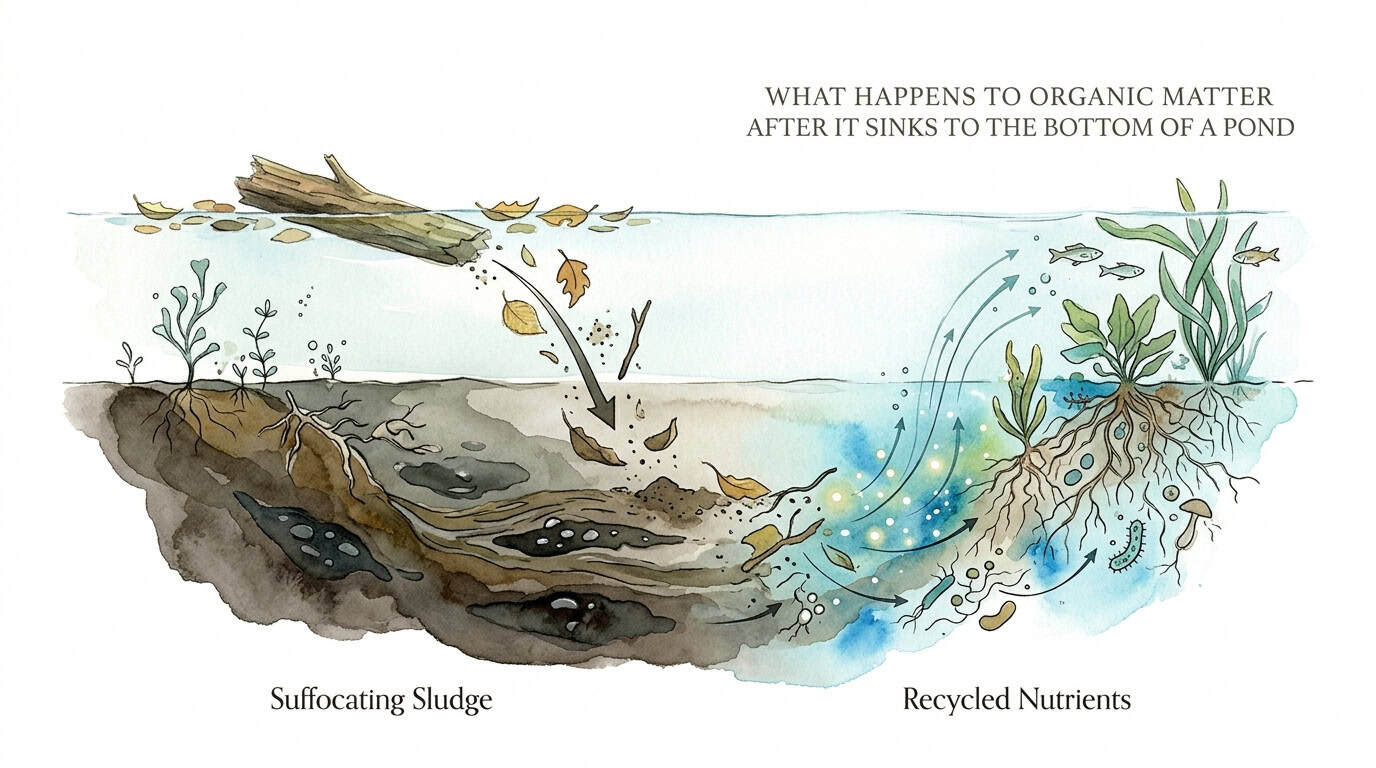
When organic matter sinks to the bottom of a pond, it undergoes a complex sequence of physical fragmentation and microbial decomposition. Initially, aerobic bacteria break down carbon compounds into carbon dioxide and soluble nutrients. As oxygen levels in the sediment pore water are depleted, anaerobic processes take over, producing methane, hydrogen sulfide, and organic acids. This results in the formation of a nutrient-dense sediment layer known as muck, which either recycles nutrients back into the water column or accumulates as long-term sludge.
Organic matter isn’t trash; it is the fuel for your pond’s future growth if managed correctly. Where do all those leaves go? Understand the journey from surface debris to bottom nutrients.
The accumulation of organic debris at the benthic zone is a fundamental driver of aquatic succession. Whether derived from external sources like leaf litter or internal sources like senescent algae, this material dictates the pond’s chemical profile and biological productivity. For a pond manager or aquatic scientist, understanding the mechanical and chemical shifts occurring at the sediment-water interface is critical for maintaining ecological stability and preventing eutrophication.
This article provides a technical analysis of the decomposition pathways, the role of redox potential in nutrient release, and the practical implications of sediment accumulation. By examining the transition from surface debris to “Suffocating Sludge vs Recycled Nutrients,” we can better optimize pond health through targeted intervention strategies.

What Happens to Organic Matter After It Sinks to the Bottom of a Pond?
Once organic matter reaches the pond floor, it transitions from a particulate state to a component of the sediment profile. This process begins with leaching, where soluble components such as sugars and amino acids dissolve into the water within hours of submersion. Following this, the material is colonized by microbial biofilms, consisting primarily of bacteria and fungi, which initiate the breakdown of complex polymers like cellulose and lignin.
In a healthy pond environment, this organic matter is a key energy source. It exists in three primary forms: living plankton, detritus (dead particulate matter), and dissolved organic matter (DOM). The fate of these materials is largely determined by the availability of terminal electron acceptors, primarily dissolved oxygen. When organic matter settles, it forms a flocculent layer (often called the F-horizon), which is a light, porous mixture of fresh debris and microorganisms. Over time, this layer compacts and integrates with the underlying mineral sediment, contributing to the “muck” that characterizes older or unmanaged ponds.
The chemical composition of the sinking material significantly influences its decomposition rate. For instance, organic matter derived from phytoplankton typically has a Carbon-to-Nitrogen (C:N) ratio of approximately 12:1, making it highly labile and easy for bacteria to process. Conversely, terrestrial leaf litter or woody debris may have a C:N ratio exceeding 50:1, requiring much longer periods for complete mineralization. This discrepancy explains why a pond can process an algae bloom relatively quickly but may struggle with a massive influx of autumn leaves.
The Decomposition Process: From Aerobic to Anaerobic
The journey of organic matter is defined by the Redox Ladder. Decomposition follows a predictable sequence based on which chemical species are available to accept electrons during the oxidation of carbon. Understanding these stages is vital for diagnosing pond issues such as foul odors or sudden fish kills.
1. The Aerobic Phase
In the presence of dissolved oxygen (DO concentrations > 2.0 mg/L), aerobic microorganisms oxidize organic carbon into carbon dioxide (CO2) and water. This is the most efficient form of decomposition, releasing the maximum amount of energy for microbial growth. The simplified chemical reaction is C6H12O6 + 6O2 → 6CO2 + 6H2O. This phase occurs primarily in the upper few millimeters of the sediment where oxygen can still diffuse from the water column.
2. The Hypoxic Transition
As the microbial community consumes oxygen faster than it can be replenished, the environment becomes hypoxic. Bacteria begin to use alternative electron acceptors in a specific order: Nitrate (NO3-), then Manganese (Mn4+), and then Iron (Fe3+). This transition marks the beginning of nutrient release, as the reduction of iron minerals often releases bound phosphates back into the water column.

3. The Anaerobic Phase
Once oxygen and nitrates are exhausted, anaerobic decomposition dominates. This process is significantly slower and less efficient than aerobic breakdown. Specialized microbes, including sulfate-reducers and methanogens, take over. Sulfate reduction produces hydrogen sulfide (H2S), which is responsible for the “rotten egg” smell often associated with disturbed pond muck. Finally, methanogenesis converts organic acids into methane gas (CH4), which can often be seen bubbling to the surface in stagnant ponds.
Nutrient Cycling and the Nitrogen Cycle
The decomposition of organic matter is the engine of the pond’s Nitrogen Cycle. As proteins and nucleic acids in the debris are broken down, nitrogen is released in the form of ammonia (NH3/NH4+). This process, known as ammonification, is the first step in recycling nutrients back into the food web.
In well-oxygenated environments, nitrifying bacteria (such as Nitrosomonas and Nitrobacter) quickly convert toxic ammonia into nitrites (NO2-) and then into relatively harmless nitrates (NO3-). These nitrates act as primary fertilizers for aquatic plants and algae. However, if the pond bottom remains anaerobic, this cycle is interrupted. Ammonia can accumulate to toxic levels, and through a process called denitrification, nitrates may be converted into nitrogen gas (N2) and lost to the atmosphere, potentially starving the pond of necessary nutrients or leading to an imbalance that favors harmful cyanobacteria.
Phosphorus cycling is equally critical. Phosphorus is often the “limiting nutrient” in freshwater ponds. Under aerobic conditions, phosphorus tends to bind tightly to iron and aluminum in the sediment. When the bottom becomes anaerobic and iron is reduced from Fe3+ to Fe2+, that bond is broken, and a massive “pulse” of phosphorus is released into the water. This internal loading can trigger algae blooms even if external nutrient runoff is controlled.
Benefits of Controlled Organic Decomposition
While often viewed negatively, the decomposition of organic matter provides several essential ecosystem services:
- Nutrient Bioavailability: Mineralization converts complex organic molecules into inorganic forms (N, P, K) that are essential for the growth of beneficial aquatic plants.
- Food Web Support: The microbial biomass produced during decomposition (the “biofilm”) serves as a primary food source for macroinvertebrates, which in turn support fish populations.
- Carbon Sequestration: A portion of the organic matter is converted into stable humic substances that remain in the sediment for decades, effectively locking away carbon.
- Substrate Engineering: In new ponds, a thin layer of organic sediment provides a better rooting medium for submerged macrophytes compared to raw clay or sand.
Challenges and the “Muck” Problem
The primary challenge occurs when the rate of organic input exceeds the rate of decomposition. This leads to the accumulation of Pond Sludge or muck. Several factors contribute to this imbalance:
Excessive Biological Oxygen Demand (BOD):
When a large volume of organic matter sinks simultaneously (e.g., after a chemical algae treatment), the resulting “spike” in microbial activity can strip all oxygen from the water column. This not only halts efficient decomposition but can lead to mass fish mortality.
Sedimentation Rates:
Typical sedimentation rates range from 1 to 10 millimeters per year. Over a decade, this can result in a loss of several inches of water depth. In shallow ponds, this reduces the “thermal buffer,” causing the water to heat up faster and further accelerating algae growth.
Toxic Gas Accumulation:
Anaerobic pockets within the muck can trap hydrogen sulfide and methane. If the pond “turns over” during a storm or temperature shift, these gases can be released into the upper water layers, causing acute toxicity to fish and other aerobic life forms.
Limitations of Natural Decomposition
Natural decomposition is not a limitless process. It is constrained by several environmental boundaries:
Temperature Constraints:
Microbial metabolic rates are temperature-dependent. Decomposition typically doubles for every 10°C increase in water temperature (up to roughly 35°C). In winter, decomposition nearly stops, leading to a “backlog” of organic matter that must be processed in the spring.
pH Sensitivity:
Bacteria involved in decay function best at a pH between 7.0 and 8.5. If the pond becomes too acidic (pH < 6.0), decomposition shifts from efficient bacteria to less efficient fungi. This often happens in ponds surrounded by pine trees or in areas with acidic soil, leading to faster muck buildup.
Surface Area vs. Volume:
In very deep, stratified ponds, the ratio of the aerobic sediment surface to the total volume of organic matter is low. This means that a significant portion of the organic matter will inevitably undergo anaerobic breakdown regardless of surface aeration efforts.
Practical Tips for Managing Bottom Organic Matter
To prevent the negative impacts of muck accumulation, pond managers should implement the following best practices:
- Install Diffused Aeration: Unlike fountains, which only agitate the surface, diffused aeration systems sit on the bottom and push oxygen directly into the sediment-water interface. This maintains the “aerobic cap” and prevents nutrient release.
- Use Beneficial Bacteria: Regular dosing with specialized aerobic bacterial strains (bioaugmentation) can supplement the natural microbial population and accelerate the digestion of organic solids.
- Manage External Inputs: Use pond vacuums or skimmers to remove leaves before they sink. Establish a vegetative buffer strip around the pond to filter out grass clippings and agricultural runoff.
- Monitor Redox Potential: For professional management, using an ORP (Oxidation-Reduction Potential) meter can help determine if the pond bottom is “Reduced” (anaerobic) or “Oxidized” (aerobic) before problems become visible.
- Apply Lime if Necessary: If the sediment pH is low, adding agricultural lime can stabilize the pH, favoring bacterial decomposition and improving the efficiency of the nitrogen cycle.
Advanced Considerations: The Role of Humic Substances
For those managing high-value aquaculture or long-term conservation ponds, it is important to distinguish between “fresh” organic matter and “humus.” As microbes process debris, they leave behind complex, dark molecules called humic and fulvic acids. These substances are highly resistant to further decay. In a 50-year-old pond, the organic carbon concentration often plateaus at around 2–3% because these stable humic substances dominate the sediment profile. While they contribute to the dark color of muck, they are chemically stable and do not exert the same oxygen demand as fresh debris.
Scenario: The Impact of a Single Autumn Leaf Fall
Consider a 1-acre pond that receives approximately 500 lbs of dry leaf litter during the autumn. If the pond is well-oxygenated, aerobic bacteria will reduce the mass of this litter by roughly 50% within the first 60 days. The remaining 250 lbs, consisting of lignin and cellulose, will slowly compact into the sediment. However, if that same pond is stagnant and anaerobic, only about 10–15% of that mass will be processed in the same timeframe. The result is a net gain of over 400 lbs of muck in a single season, highlighting why aeration is the most effective tool for depth preservation.
Final Thoughts
The journey of organic matter from the pond surface to the benthic sediment is a critical ecological process that determines the long-term viability of the water body. By understanding the transition from aerobic to anaerobic decomposition, managers can take proactive steps to ensure that sinking debris fuels growth rather than creating a toxic sludge layer.
Successful management relies on maintaining high dissolved oxygen levels at the sediment-water interface and managing the chemical balance of the pond. Through aeration, bioaugmentation, and physical debris removal, the natural “biological pump” of the pond can be optimized to keep the water clear and the ecosystem balanced.
As you continue to monitor your pond, remember that the muck on the bottom is not just dirt—it is a dynamic chemical laboratory. Engaging with these processes allows for a more scientific and effective approach to aquatic management, ensuring that your pond remains a healthy resource for years to come.
Frequently Asked Questions About What Happens to Organic Matter After It Sinks to the Bottom of a Pond?
How long does it take for leaves to turn into muck?
The timeline for leaves to transform into muck varies based on water temperature, oxygen levels, and the type of leaf. Soft, nitrogen-rich leaves (like those from fruit trees) can begin to lose their structure within weeks and may be significantly decomposed within 2-3 months in well-aerated, warm water. However, tougher, carbon-heavy leaves (like oak or pine needles) contain high amounts of lignin and tannins, which resist microbial breakdown. In an anaerobic or cold pond, these can remain intact for over a year, eventually compacting into a dense, fibrous muck layer. On average, the transition to a recognized “sludge” state takes 6 to 12 months in temperate climates.

Can too much organic matter kill my fish?
Yes, excessive organic matter is a leading cause of pond fish kills, primarily through a process called “Oxygen Depletion.” As bacteria consume organic matter, they use up dissolved oxygen (DO). A large influx of organic debris creates a high Biological Oxygen Demand (BOD). If the bacteria consume oxygen faster than it can be replenished by plants or surface agitation, the DO levels drop below the threshold required for fish survival (typically < 3 mg/L). Furthermore, if the bottom is anaerobic, the decomposition process produces toxic gases like hydrogen sulfide. If a storm or temperature change causes the pond to “turn over,” these gases can mix with the upper water, poisoning the fish almost instantly.
Does pond muck ever stop growing?
In an unmanaged system, pond muck will continue to accumulate until the pond undergoes “succession,” eventually filling in completely and becoming a wetland or meadow. However, in a managed pond, the muck layer can reach a state of equilibrium. Research on older aquaculture ponds shows that organic carbon concentrations often stabilize at 2% to 3% after several decades. This happens because the rate of “mineralization” (where old muck is slowly turned into gas and soluble nutrients) eventually matches the rate of new organic inputs. To achieve this equilibrium without losing significant water depth, active management like aeration and bacterial treatments is usually necessary to keep the decomposition rate high.
What is the difference between “good” and “bad” pond muck?
Technically, muck is classified by its oxygen status and composition. “Good” muck, often called Copropel or Gyttja, is usually brown or gray, has a near-neutral pH, and is well-oxygenated. It supports a healthy population of macroinvertebrates like dragonfly larvae and worms, which help aerate the sediment. “Bad” muck, or Sapropel, is glossy black, watery, and smells of rotten eggs. This color comes from ferrous sulfide, which only forms in the absence of oxygen. Sapropel is toxic to most beneficial bottom-dwelling life and serves as a reservoir for phosphorus, which can trigger massive algae blooms if the water is disturbed.
Can I just use chemicals to get rid of the organic matter?
Chemical treatments like algaecides or herbicides do not “get rid” of organic matter; they actually increase it. When you kill algae or weeds with chemicals, the dead plant mass sinks to the bottom, dramatically increasing the organic load and BOD. To actually remove organic matter without physical dredging, you must use “bioaugmentation” (adding beneficial bacteria) and aeration. These biological tools accelerate the natural digestion process, turning the solid muck into harmless carbon dioxide gas and soluble nutrients. While chemical treatments are sometimes necessary to control an immediate bloom, they must be followed by biological management to prevent the resulting debris from turning into suffocating sludge.