

You can spend thousands dredging your pond, or you can let trillions of microbes do it for free. Underneath that layer of muck is a city of microbes working to keep your water clean. If you treat them right, they’ll keep your pond clear without you lifting a finger.
Pond management often focuses on visible metrics such as algae bloom density or water clarity. However, the true biological engine of any still-water ecosystem resides in the benthic zone. This hidden microbial community is responsible for the mineralization of organic matter and the regulation of nutrient flux between the sediment and the water column.
Understanding the mechanics of this microscopic workforce is the difference between a self-sustaining aquatic environment and a stagnant basin prone to eutrophication. By optimizing the conditions for these microbes, you can effectively gasify organic waste and prevent the accumulation of sapropel muck.
The Hidden Microbial Community Living in Pond Sediment
The microbial community in pond sediment, known as the benthos, is a complex consortium of bacteria, archaea, and fungi. These organisms live within the top few centimeters of the sediment-water interface, where they perform essential biogeochemical transformations. In a healthy pond, this community can reach densities of billions of cells per cubic centimeter, forming a stable biofilm that processes incoming organic loads.

This community is primarily composed of heterotrophic bacteria, which derive energy from the oxidation of organic carbon. Key phyla typically identified in these environments include Pseudomonadota (formerly Proteobacteria), Chloroflexota, Acidobacteria, and Bacteroidetes. These organisms act as the pond’s “digestive system,” breaking down complex molecules like cellulose, proteins, and lipids into simpler inorganic forms.
The sediment itself is categorized by its composition and the type of microbial activity present. Copropel (Gyttja) is a nutrient-rich muck containing fine plant fragments and algal remains, often well-oxygenated at the surface. In contrast, Sapropel is a black, foul-smelling layer characterized by anaerobic conditions and the presence of hydrogen sulfide (H2S), indicating a failure of the aerobic microbial community to keep pace with organic input.
The Stratification of Microbial Niches
Microbial life in the sediment is not uniform; it is stratified based on the availability of electron acceptors. At the very surface, aerobic bacteria utilize molecular oxygen (O2) for respiration. Just a few millimeters deeper, as oxygen is depleted, the community shifts to facultative anaerobes and then to obligate anaerobes. These layers utilize nitrate, manganese, iron, sulfate, and finally carbon dioxide as electron acceptors in a predictable “redox ladder.”
How It Works: The Biogeochemical Engine
The breakdown of pond muck is a multi-stage biochemical process. It begins with the secretion of extracellular enzymes by heterotrophic bacteria. These enzymes—such as cellulase for plant matter, protease for proteins, and lipase for fats—hydrolyze large organic polymers into smaller monomers that the bacteria can then absorb and metabolize.
The efficiency of this process depends heavily on the respiration pathway utilized. Under aerobic conditions, the oxidation of organic matter is highly efficient. The generic chemical formula for this process is:
C6H12O6 + 6O2 ? 6H2O + 6CO2 + Energy

This pathway results in the complete conversion of organic carbon into carbon dioxide gas, which escapes into the atmosphere, effectively reducing the volume of muck. However, when dissolved oxygen (DO) levels fall below 1.5–2.0 mg/L, the community is forced into anaerobic respiration.
Anaerobic Pathways and Byproducts
Anaerobic decomposition is significantly slower and less complete. Instead of CO2 and water, it produces intermediate organic compounds and toxic gases. Key anaerobic processes include:
- Sulfate Reduction: Performed by bacteria like Desulfovibrio, converting sulfate into hydrogen sulfide (H2S), which causes the “rotten egg” smell.
- Methanogenesis: Performed by archaea that convert acetate or H2/CO2 into methane gas (CH4). This is the final step in the anaerobic decay chain.
- Denitrification: Converting nitrates into nitrogen gas (N2), which is a beneficial way to remove excess nitrogen from the system.
Because anaerobic pathways are energetically less favorable, organic matter tends to accumulate faster than it can be processed, leading to the thickening “black muck” layer commonly found in stagnant ponds.
Benefits of a Balanced Microbial Community
Maintaining a robust and diverse microbial population provides measurable benefits to pond health and maintenance costs. A balanced system functions as a biological filter, preventing the “snowball effect” of nutrient loading.
1. Natural Muck Reduction: Through a process often called “bio-dredging,” microbes can digest up to 1 inch of organic muck per month under optimal conditions. This reduces the need for expensive mechanical dredging and extends the lifespan of the pond.
2. Nutrient Sequestration: Beneficial bacteria compete with algae for essential nutrients like nitrogen and phosphorus. By sequestering these minerals into microbial biomass or converting them into atmospheric gases (N2), the community starves algae blooms at their source.
3. Pathogen Suppression: A diverse microbial community exhibits “competitive exclusion,” where beneficial species outcompete opportunistic pathogens like Aeromonas or Vibrio. This leads to healthier fish populations and reduced disease outbreaks.
4. Odor Control: By maintaining aerobic conditions at the sediment-water interface, you prevent the release of H2S and methane. This ensures the pond remains an asset rather than a liability in terms of air quality and aesthetics.
Challenges and Common Mistakes
The primary challenge in managing pond microbes is environmental instability. Rapid changes in temperature, pH, or oxygen levels can cause mass microbial die-offs, leading to a sudden release of sequestered nutrients—often triggering massive algae blooms.
Mistake: Over-reliance on Algaecides
Frequent use of copper-based algaecides can be counterproductive. While they kill the visible algae, the resulting “slump” of dead organic matter settles to the bottom, overwhelming the microbial community. Furthermore, copper is a heavy metal that can inhibit bacterial enzymatic activity, effectively “pickling” the muck and stopping decomposition.
Mistake: Ignoring Dissolved Oxygen
Many pond owners add “beneficial bacteria” supplements without addressing the underlying oxygen deficit. Aerobic bacteria are highly metabolic; without sufficient DO, the added microbes will either die or remain dormant, rendering the treatment ineffective.
Mistake: Insufficient Bacterial Diversity
Using a single-strain bacterial product often fails because different organic materials require different enzymes. A pond with high leaf litter needs cellulolytic specialists, while a fish-heavy pond requires proteolytic and nitrifying strains. Homogeneous treatments rarely provide the full spectrum of decomposition needed.
Limitations of Microbial Remediation
While microbes are highly effective at processing organic waste, they have physical and chemical boundaries. It is essential to recognize when biological methods reach their limit.
Inorganic Sediment: Microbes only “eat” organic matter. If your pond is filling with sand, silt, or clay from shoreline erosion or runoff, biological treatments will not reduce the sediment volume. Mechanical removal is the only solution for inorganic accumulation.
Extreme Organic Loads: If the rate of organic input (leaves, grass clippings, fertilizer runoff) significantly exceeds the microbial metabolic rate, even an optimized system will fail to prevent muck buildup. In these cases, source reduction—such as installing buffer strips or leaf nets—is required alongside microbial management.
Temperature Constraints: Microbial activity is highly temperature-dependent. Below 50°F (10°C), metabolic rates drop significantly. While specialized “cold-water” strains exist, biological remediation is largely a seasonal process in temperate climates.
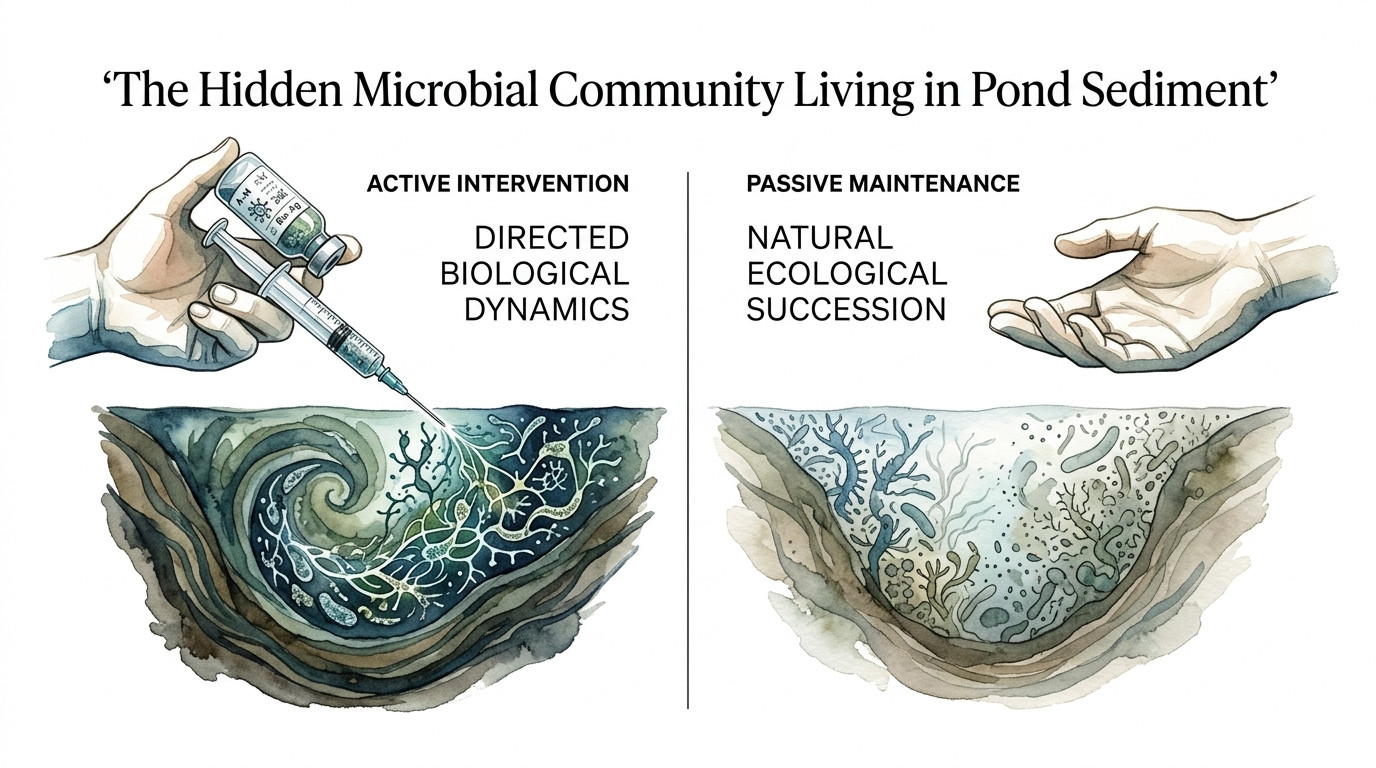
Active Intervention vs Passive Maintenance
Choosing between physical removal and biological management is a decision involving cost, time, and ecological impact. The following table compares the two primary strategies: Active Intervention (Dredging) and Passive Maintenance (Microbial Remediation).

| Factor | Active Intervention (Dredging) | Passive Maintenance (Microbial) |
|---|---|---|
| Initial Cost | High ($8–$50 per cubic yard) | Low (Cents per gallon/lb) |
| Speed of Result | Immediate (Days) | Slow (Months to Years) |
| Inorganic Removal | Yes (Sand, silt, clay) | No (Organic only) |
| Ecosystem Impact | High (Destructive to habitat) | Low (Restorative) |
| Sustainability | Temporary (Muck re-accumulates) | Long-term (Ongoing digestion) |
Dredging is often viewed as a “reset” button, while microbial remediation is a “maintenance” strategy. In many cases, a hybrid approach is most efficient: dredging to restore depth from inorganic silt, followed by microbial management to prevent future organic muck accumulation.
Practical Tips for Microbial Optimization
To maximize the efficiency of your pond’s hidden community, focus on environmental optimization. You are not just adding bacteria; you are managing a living bioreactor.
- Install Sub-Surface Aeration: Bottom-diffused aeration is the most effective way to oxygenate the benthic zone. By moving oxygen-poor water from the bottom to the surface, you eliminate the anaerobic “dead zone” where muck accumulates.
- Use Bio-Augmentation Wisely: Supplement your pond with high-concentrate microbial pellets that sink into the muck. These pellets deliver the microbes and enzymes directly to the interface where they are needed most.
- Monitor Carbon-to-Nitrogen (C:N) Ratios: High-carbon inputs like woody debris take longer to break down. If your pond has heavy leaf fall, choose microbial blends specifically high in cellulase enzymes.
- Maintain pH Stability: Most beneficial bacteria thrive in a pH range of 6.5 to 8.5. Extreme fluctuations can shock the community and halt mineralization.
Advanced Considerations: Redox Potential
For serious practitioners, the Redox Potential (Eh) of the sediment is the ultimate metric of microbial health. Measured in millivolts (mV), redox potential indicates the oxidative capacity of the environment.
Aerobic environments typically have an Eh greater than +200 mV. As oxygen is depleted and the community shifts to anaerobic pathways, the redox potential drops. Methane production generally occurs at Eh levels below -200 mV. By monitoring redox potential, managers can determine the exact depth of the “oxygenated crust” on the sediment and adjust aeration rates to push that boundary deeper into the muck layer.
Furthermore, Metabolic Stratification can be manipulated. By “pulsing” aeration or adding specific catalysts, managers can encourage “nitrate-shunting,” where denitrification occurs more rapidly, removing nitrogen from the system without the production of toxic ammonia or sulfides.
Example Scenario: Remediating a 1-Acre Farm Pond
Consider a 1-acre farm pond with 12 inches of accumulated organic muck and a persistent “rotten egg” odor. A standard dredging quote might range from $15,000 to $35,000, excluding disposal fees.
Instead, a biological remediation plan is implemented:
Month 1-3: A 1/2 HP bottom-diffused aeration system is installed to raise DO levels at the sediment interface to 3.0 mg/L. Initial bio-augmentation with a broad-spectrum microbial pellet is performed at a “shock” dose of 10 lbs per acre.
Month 4-6: Maintenance doses of 3 lbs per month are applied. Water clarity improves as the microbes sequester suspended nutrients. Odors dissipate as H2S production is halted by the shift in redox potential.
Results: After one full season, the muck layer is reduced by an average of 4 inches. Total cost for the system and treatments is approximately $2,500. The pond has not only regained depth but has established a biological balance that prevents future stagnation.
Final Thoughts
The microbial community living in your pond sediment is a powerful, yet often overlooked, asset in aquatic management. These trillions of organisms work continuously to process organic waste, recycle nutrients, and maintain the ecological integrity of the water body. By shifting your focus from “killing” problems with chemicals to “cultivating” solutions with biology, you can achieve superior results with significantly less physical effort and expense.
Successful management requires a technical understanding of the relationship between oxygen, enzymatic activity, and microbial succession. When you provide the right environment—specifically high dissolved oxygen and stable pH—the benthic community becomes a self-replicating workforce that can eliminate decades of muck and restore your pond to its natural, clear-water state.
Don’t view your pond as a static body of water; view it as a living, breathing system. If you invest in the health of the invisible city beneath the muck, it will pay dividends in clarity, biodiversity, and ease of maintenance for years to come.
Frequently Asked Questions About The Hidden Microbial Community Living in Pond Sediment
What exactly is “pond muck” from a biological perspective?
From a biological standpoint, pond muck is a heterogeneous mixture of organic detritus and inorganic minerals. The organic component consists of undecayed plant matter (cellulose and lignin), fish waste (proteins and ammonia), and dead algae (lipids and carbohydrates). This material accumulates when the input of organic carbon exceeds the metabolic capacity of the local microbial community. In anaerobic environments, this muck undergoes partial decomposition, leading to the formation of sapropel—a dense, black sludge characterized by high levels of organic acids and reduced sulfur compounds. Biologically, muck represents a failure of the nutrient cycle to reach completion, effectively locking up energy and nutrients in a stagnant physical form.
Can beneficial bacteria actually reduce the depth of my pond?
Yes, beneficial bacteria can reduce the depth of organic sediment, a process often referred to as “biological dredging.” However, it is important to note that they only affect the organic fraction of the sediment. Through the secretion of extracellular enzymes, these microbes hydrolyze organic solids into soluble liquids and eventually into gases like carbon dioxide and nitrogen. As the organic framework of the muck is consumed, the overall volume of the sediment layer shrinks, often leading to a measurable increase in water depth. In ponds where the “fill-in” is primarily organic (leaves, weeds, algae), microbial remediation can be highly effective. If the depth loss is due to sand or silt runoff, bacteria will have no impact on the sediment volume.
Why does my pond smell like rotten eggs when I stir the bottom?
The “rotten egg” smell is caused by hydrogen sulfide (H2S) gas, which is a byproduct of anaerobic microbial respiration. When oxygen is depleted in the sediment, specialized bacteria known as sulfate-reducers (such as Desulfovibrio) begin to use sulfate as an electron acceptor instead of oxygen. This metabolic pathway is much less efficient and produces H2S as a waste product. The gas becomes trapped within the dense, compacted muck layer. When the sediment is disturbed—either by a boat motor, a heavy rain event, or manual raking—the trapped gas is released into the water column and atmosphere. This smell is a definitive indicator that your pond’s benthic zone is in an anaerobic state and requires increased aeration to restore aerobic microbial dominance.
How long does it take for microbes to clear a mucky pond?
Microbial remediation is a gradual process that depends on several environmental variables, including water temperature, dissolved oxygen levels, and the nature of the organic load. In a well-aerated pond during the peak growing season (water temps above 70°F), you can expect to see a reduction of 1 to 2 inches of organic muck per month. However, significant transformations in water clarity and odor control usually occur within the first 30 to 60 days of treatment. To achieve deep muck reduction—such as removing a foot of accumulated sludge—it typically takes one to two full seasons of consistent bio-augmentation and aeration. It is a marathon, not a sprint, focusing on restoring long-term biological equilibrium rather than providing an overnight fix.
Do I need to keep adding bacteria every year?
While beneficial bacteria occur naturally in every pond, their populations often fluctuate based on nutrient availability and environmental stress. In a perfectly balanced ecosystem with low organic input, the microbial community might become self-sustaining. However, most managed ponds—especially those near lawns, farms, or deciduous trees—receive a constant “overdose” of organic material. Regular bio-augmentation ensures that the microbial population remains at a high enough density to process this incoming load before it settles and compacts. Think of it as a proactive maintenance “boost.” For most pond owners, a monthly application during the warm season is sufficient to keep the benthic community optimized and prevent the recurrence of muck buildup.