

Oxygen is the fuel that runs your pond. Without enough of it, the whole system turns into a waste-processing disaster. Dissolved oxygen is more than just ‘air in water.’ It is the engine of the ecosystem. Learn why saturation levels determine if your fish thrive or perish.
Dissolved oxygen saturation represents the maximum equilibrium concentration of oxygen that water can hold at a specific temperature, atmospheric pressure, and salinity. It serves as a critical threshold because it dictates the rate of oxygen transfer and the biological capacity of an aquatic environment. If saturation falls too low, aerobic metabolism and nitrification cease; if it exceeds 100% significantly, gas bubble disease can occur, making precise saturation management essential for ecosystem stability.
Oxygen management requires more than just adding air. You must understand the physics of gas solubility to maintain a productive environment. This guide breaks down the mechanics of saturation to help you optimize your system for maximum efficiency and health.
What Is Dissolved Oxygen Saturation and Why Does It Matter?
Dissolved oxygen (DO) saturation is a physical state where the partial pressure of oxygen in the water equals the partial pressure of oxygen in the atmosphere. At this point, the water has reached its maximum carrying capacity for oxygen under current environmental conditions. This value is not a fixed number like 8.0 mg/L; rather, it shifts constantly based on external variables. For example, cold water at sea level can hold significantly more oxygen than warm water at high altitudes.

The concept matters because the “saturation point” defines the limit of passive oxygen transfer. When water is below 100% saturation, oxygen naturally diffuses from the air into the water. When it is at 100%, net transfer stops. In a high-load environment like a fish pond or a wastewater treatment plant, biological demand often pulls the levels far below 100%, requiring mechanical intervention. Understanding the ceiling of saturation allows operators to calculate the “oxygen deficit,” which is the primary driver of aeration efficiency.
Real-world applications of this data are found in aquaculture, environmental monitoring, and industrial cooling. In a koi pond, for instance, a reading of 6.0 mg/L might be 90% saturation in 85°F water (safe), but only 60% saturation in 50°F water (dangerously low). Percent saturation provides context that raw mg/L readings lack, revealing how much “room” the water has left to support life.
How Dissolved Oxygen Saturation Works
The behavior of dissolved oxygen is governed by Henry’s Law, which states that the amount of dissolved gas in a liquid is proportional to its partial pressure above the liquid. Several physical factors dictate the exact saturation point at any given moment.
Temperature is the most influential variable. Gas solubility has an inverse relationship with temperature; as water molecules heat up and move faster, they make it harder for gas molecules to remain trapped in the liquid. Consequently, cold water is naturally more oxygen-rich than warm water. A pond at 40°F can hold nearly twice as much oxygen as one at 90°F.
Atmospheric pressure and altitude also play significant roles. At higher elevations, the air is thinner, meaning the partial pressure of oxygen is lower. This reduces the force pushing oxygen into the water, resulting in lower saturation concentrations. A pond in the mountains will always have a lower maximum DO capacity than a pond at the beach, even if the temperatures are identical.
Salinity is the third major factor. Dissolved salts occupy space between water molecules, effectively “crowding out” gas molecules. As salinity increases, the 100% saturation point decreases. This is why saltwater aquariums and coastal estuaries typically have lower oxygen levels than freshwater systems at the same temperature.

Benefits of Maintaining High Saturation
Operating a system near or slightly below 100% saturation provides several mechanical and biological advantages. The primary benefit is the optimization of the nitrogen cycle. Nitrifying bacteria, which convert toxic ammonia into nitrite and then nitrate, are obligate aerobes. They require significant amounts of oxygen to fuel these chemical reactions. When DO levels are high, nitrification is efficient, preventing the buildup of toxins that can stunt fish growth or cause mortality.
High saturation levels also improve the feed conversion ratio (FCR) in aquaculture. Fish are more active and have higher metabolic efficiency when oxygen is abundant. If oxygen levels are suppressed, fish reduce their feed intake to lower their metabolic demand, leading to slower growth and wasted feed. Maintaining DO above 60-70% saturation ensures that fish can process nutrients at peak capacity.
Furthermore, adequate oxygenation promotes aerobic decomposition at the pond bottom. Beneficial bacteria use oxygen to break down fish waste and decaying plant matter. If the bottom becomes anaerobic (oxygen-depleted), these processes shift to fermentation, which releases harmful byproducts like hydrogen sulfide and methane. Keeping the water column saturated prevents these “dead zones” from forming.
Challenges and Common Mistakes
The most frequent error in oxygen management is relying solely on daylight measurements. Photosynthesis from algae and plants produces massive amounts of oxygen during the day, often pushing saturation levels well above 100%. However, at night, these same plants stop producing oxygen and begin consuming it through respiration. This can lead to a “pre-dawn crash” where oxygen levels plummet to lethal lows just before sunrise.
Overstocking is another common pitfall. Every animal and bacterium in the pond contributes to the Total Oxygen Demand (TOD). If the biological load exceeds the aeration system’s ability to replenish oxygen, saturation will steadily decline. Many practitioners fail to account for the increased oxygen demand that occurs after feeding or during heatwaves, leading to sudden and catastrophic losses.
Neglecting the impact of organic sludge is a hidden challenge. A thick layer of “muck” on the pond floor has a high Biochemical Oxygen Demand (BOD). Even if the surface water looks well-aerated, the bottom-dwelling bacteria may be stripping oxygen from the lower layers of the water faster than it can be replaced. This stratification creates a dangerous environment for bottom-dwelling species.
Limitations and Environmental Constraints
Mechanical aeration has a diminishing return as water approaches 100% saturation. The rate of oxygen transfer is highest when the oxygen deficit is greatest. If your water is already at 90% saturation, an aerator has to work much harder and consume more energy to add that last 10% compared to water that is at 20% saturation. This makes “super-oxygenation” using standard air diffusers energy-inefficient.
Environmental limits also dictate that you cannot simply “force” more oxygen into water indefinitely using ambient air. To reach levels significantly above 100% saturation, you would need pure oxygen injection or high-pressure systems. These are costly and complex to maintain. In most natural or semi-natural ponds, the physical properties of the water (temperature and pressure) act as a hard ceiling that cannot be bypassed without specialized industrial equipment.
Deep water bodies face the limitation of thermal stratification. In the summer, a layer of warm, buoyant water (the epilimnion) sits on top of a cold, dense layer (the hypolimnion). Oxygen cannot easily pass through the boundary between these layers. Without mechanical circulation to break this “thermocline,” the bottom half of a deep pond can become completely anoxic, regardless of how much oxygen is at the surface.
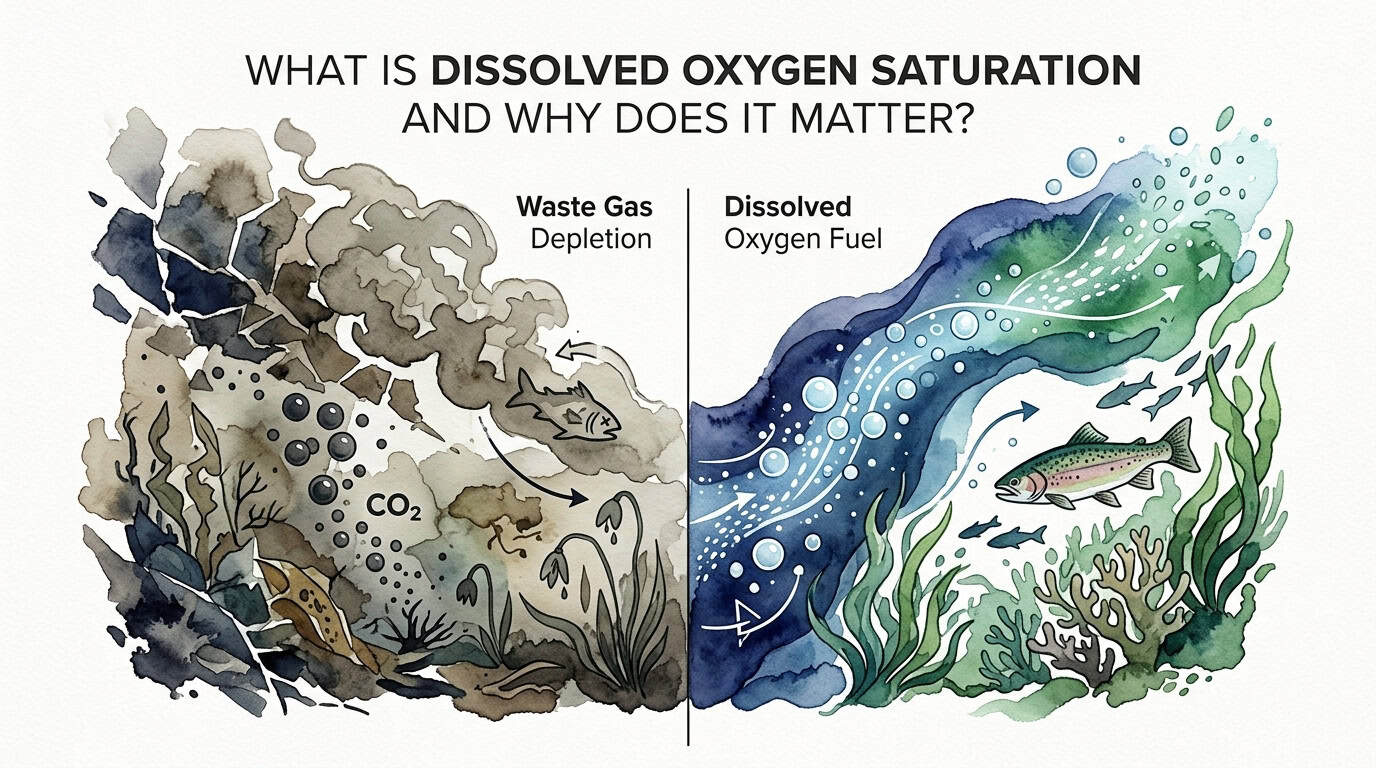
Waste Gas Depletion vs. Dissolved Oxygen Fuel
It is important to distinguish between the two primary functions of aeration: adding “fuel” (oxygen) and removing “waste” (carbon dioxide and other gases). This comparison highlights why different aeration methods are used.
| Factor | Waste Gas Depletion | Dissolved Oxygen Fuel |
|---|---|---|
| Primary Goal | Remove CO2, Ammonia, and Methane. | Infuse O2 for metabolism and nitrification. |
| Mechanism | Surface agitation and gas stripping. | Molecular diffusion and bubble contact time. |
| Best Tool | Fountains, waterfalls, paddlewheels. | Fine-bubble diffusers, oxygen cones. |
| Efficiency Metric | Gas exchange rate at the surface. | Oxygen Transfer Efficiency (OTE). |
| Critical Time | During peak feeding and high pH periods. | Nighttime and high-temperature peaks. |
Practical Tips for Managing Saturation
To keep your system optimized, start by measuring both mg/L and percent saturation. Use an optical DO probe rather than chemical test kits; optical probes are more accurate and do not require constant calibration or membrane replacement. Position your sensors at mid-depth to get a representative reading of the whole water column.
Optimize your aeration placement. Diffusers should be placed in the deepest part of the pond to maximize the “bubble rise time,” which allows more oxygen to dissolve before the bubble reaches the surface. However, avoid placing them directly in the center if you have a circular flow, as this can disrupt the settling of solids. Instead, place them to reinforce a circular current that moves waste toward the drain.
Implement a “smart” aeration schedule. If your daytime saturation is regularly above 110%, you can save electricity by scaling back aeration during the peak of the day when photosynthesis is active. Conversely, you must ensure your aeration is at maximum capacity from dusk until dawn. Using a controller with a DO probe can automate this process, turning on blowers only when saturation drops below a set threshold (e.g., 75%).
Advanced Considerations: OTE and SOTR
Serious practitioners should understand Oxygen Transfer Efficiency (OTE). This is the percentage of oxygen from an air source that actually dissolves into the water. Fine-bubble diffusers typically have a much higher OTE than coarse bubbles because they create more surface area for the same volume of air. Improving OTE reduces the horsepower required for blowers, significantly lowering operational costs over time.
Standard Oxygen Transfer Rate (SOTR) is another critical metric. This measures how many kilograms of oxygen an aerator can move per hour in clean water at 20°C and zero initial DO. However, in a real pond, the Actual Oxygen Transfer Rate (AOTR) will be much lower due to the presence of fish, organics, and higher temperatures. Always oversize your aeration system by 20-30% to account for this “Alpha factor” (the difference between clean and dirty water transfer).
Total Dissolved Gas (TDG) monitoring is vital if you use high-pressure pumps or waterfalls. If water is forced into a deep plunge pool, it can trap air under pressure, leading to supersaturation (e.g., 120%+). While this sounds good, it can cause gas bubble disease, where gas bubbles form inside the fish’s blood and tissues, leading to embolisms. Always ensure that supersaturated water has a chance to “off-gas” before reaching the fish.
Example Scenario: Temperature and Saturation
Consider a 5,000-gallon pond located at sea level. In the spring, the water temperature is 50°F (10°C). At 100% saturation, this water holds approximately 11.3 mg/L of oxygen. The fish are active, and the biological filter is processing waste efficiently because the “fuel” supply is abundant.
As summer arrives, the temperature climbs to 86°F (30°C). The 100% saturation point drops to approximately 7.5 mg/L. Despite the pond having the same volume of water, it now physically cannot hold more than 66% of the oxygen it held in the spring. If the fish have grown larger over the summer, their oxygen demand has increased exactly when the water’s capacity has decreased.
If a measurement shows 5.0 mg/L in this warm water, the pond is at 66% saturation. This is manageable but approaching a stress zone. If the same 5.0 mg/L were measured in the 50°F spring water, the pond would be at only 44% saturation, which would be a critical emergency for many species. This example demonstrates why you must always interpret DO readings in the context of the current saturation limit.
Final Thoughts
Dissolved oxygen saturation is the fundamental metric that determines the health and efficiency of any aquatic system. It acts as the “governor” on the engine of your pond, limiting how much life the system can support and how quickly waste can be processed. By understanding the relationship between temperature, pressure, and solubility, you can move beyond simple guesswork and manage your water with technical precision.

Maintaining levels near saturation ensures that your fish are not just surviving, but thriving with optimal growth and immune function. It also guarantees that your bio-filtration remains robust, preventing the toxic spikes that often lead to “new pond syndrome” or seasonal crashes. Consistent monitoring and efficient aeration are the best investments any pond owner or aquaculture operator can make.
As you apply these principles, remember that oxygen is a dynamic variable. Continue to experiment with diffuser placement, aeration timing, and stocking densities. The more you optimize your oxygen “fuel” delivery, the more resilient and productive your ecosystem will become. Deepening your knowledge of gas laws and transfer efficiency will set you apart as a serious practitioner in the field.
Frequently Asked Questions About What Is Dissolved Oxygen Saturation and Why Does It Matter?
What is the difference between mg/L and percent saturation?
Milligrams per liter (mg/L) measures the actual mass of oxygen dissolved in a specific volume of water, often referred to as concentration. Percent saturation measures how much oxygen the water is holding relative to the maximum amount it *can* hold at its current temperature, pressure, and salinity. While mg/L tells you the quantity of oxygen present, percent saturation tells you the availability and the “pressure” of that oxygen. For example, 7 mg/L might be plenty of oxygen in warm water (high saturation) but insufficient in very cold water (low saturation) because the metabolic needs and diffusion rates change based on the saturation state.
Can water have more than 100% dissolved oxygen saturation?
Yes, water can become supersaturated, exceeding 100% saturation. This most commonly occurs during the day in ponds with heavy algae or plant growth, as photosynthesis releases pure oxygen directly into the water column faster than it can escape to the atmosphere. It can also happen mechanically if air is forced into water under high pressure, such as in a leaky pump or a very deep waterfall. While moderate supersaturation (up to 110-120%) is usually harmless, extreme levels can cause gas bubble disease in fish, where gas comes out of solution inside the fish’s body, causing tissue damage or death.
How does altitude affect oxygen saturation in a pond?
Altitude affects oxygen saturation through atmospheric pressure. At higher elevations, the air pressure is lower, meaning there are fewer oxygen molecules in a given volume of air and less “push” to drive those molecules into the water. According to Henry’s Law, the solubility of a gas is directly proportional to its partial pressure. Therefore, a pond at 5,000 feet will have a lower 100% saturation point than a pond at sea level, even if the temperatures are the same. Operators at high altitudes must be more diligent with aeration because their water has a naturally lower ceiling for oxygen capacity.
Why do oxygen levels drop so fast at night?
Oxygen levels drop at night because the primary source of oxygen production—photosynthesis—stops when there is no sunlight. However, the processes that consume oxygen, known as respiration, continue 24 hours a day. Fish, plants, algae, and beneficial bacteria all breathe oxygen and exhale carbon dioxide. In a heavily planted or algae-rich pond, the combined nighttime respiration of all these organisms can strip the water of oxygen in just a few hours. This is why mechanical aeration is most critical during the dark hours to prevent a pre-dawn oxygen crash.
How does salinity change the amount of oxygen water can hold?
Salinity has an inverse relationship with dissolved oxygen solubility. As the concentration of dissolved salts increases, the number of “free” water molecules available to bond with and hold oxygen gas decreases. The salt ions effectively “occupy” the spaces between water molecules. Consequently, seawater at 35 parts per thousand (ppt) salinity holds about 20% less oxygen at 100% saturation than freshwater does at the same temperature. This means that saltwater systems have less “buffer” during low-oxygen events and require more vigorous aeration to maintain the same mg/L concentration as freshwater systems.