

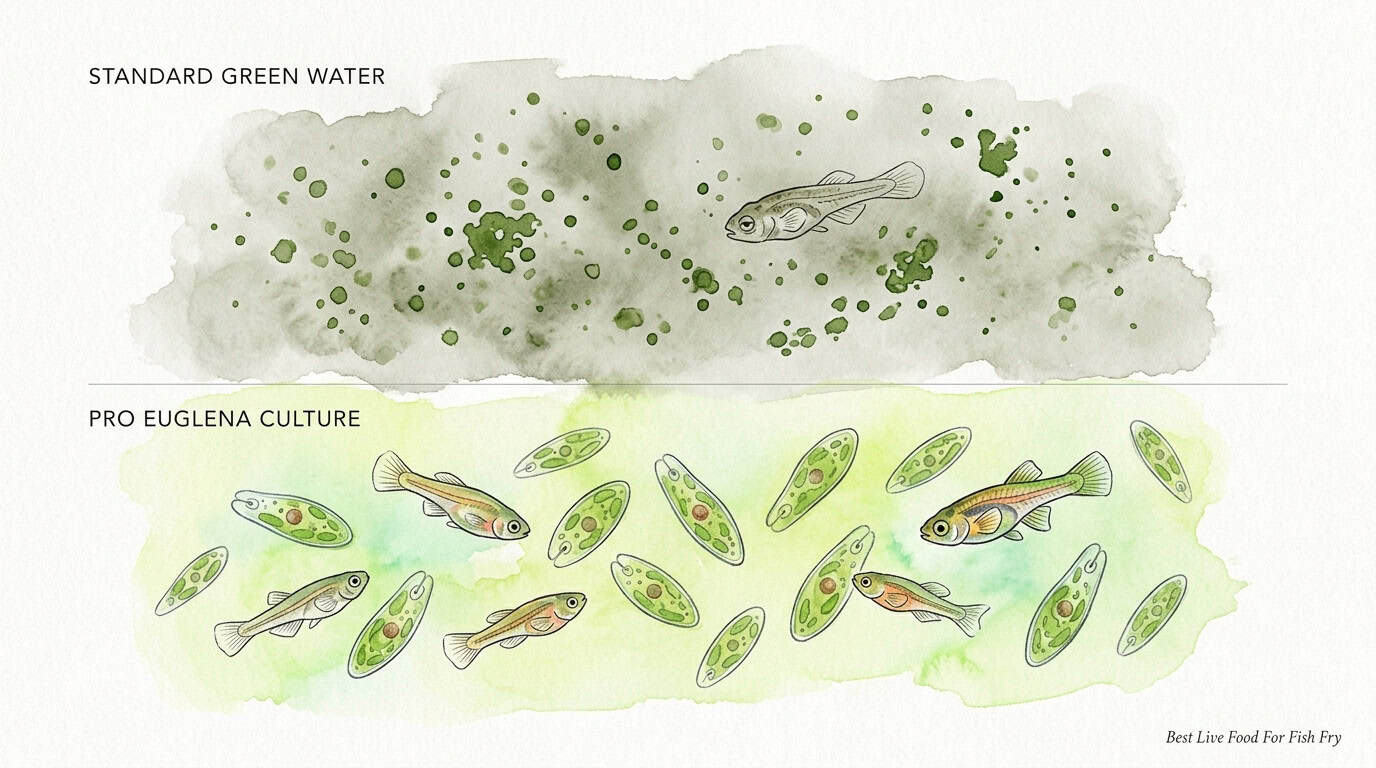
The best live food for fish fry is Euglena gracilis, particularly during the critical first-feeding stage of small-egg species such as bettas, gouramis, and many tetras. Unlike standard green water, which contains unpredictable concentrations of diverse algae, Euglena provides a consistent 50–70% protein content and essential polyunsaturated fatty acids like DHA and EPA. Its lack of a cell wall ensures nearly 100% digestibility, while its active motility triggers the essential predatory strike response in developing larvae.
Why do professional hatcheries ignore standard pond water and spend thousands on this one specific emerald organism? Most hobbyists lose 50% of their hatch to starvation in the first week because “green water” is too unpredictable. The pros use Euglena—a unique organism that is half-plant and half-animal—to provide a high-protein, vitamin-rich feast that doubles fry growth rates. Here is how you can transition from a lucky amateur to a precision breeder.
In high-output aquaculture, the margin between a profitable hatch and a total loss is often measured in microns. For the first 72 to 120 hours post-yolk-sac absorption, fish larvae are biologically incapable of digesting complex formulated diets. Their enzymatic pathways are underdeveloped, and their mouth gape is too small for standard brine shrimp nauplii.
This is where the distinction between “Standard Green Water” and “Pro Euglena Culture” becomes critical. While many hobbyists rely on a jar of sunlit pond water, professionals utilize controlled monocultures to ensure biosecurity and nutritional density. By focusing on Euglena gracilis, breeders can provide a stable, high-energy biomass that supports rapid organogenesis and immune system development.

Best Live Food For Fish Fry
The term “live food” encompasses a broad spectrum of organisms, but the best live food for fish fry is defined by three metrics: size compatibility, nutritional density, and digestibility. Euglena gracilis excels in all three, functioning as a “superfood” for the earliest stages of fish development.
Euglena is a genus of single-celled, flagellated microorganisms that inhabit freshwater environments. They are technically mixotrophs, meaning they can produce energy through photosynthesis (like a plant) or by consuming organic matter (like an animal). This dual nature allows them to accumulate a biochemical profile that includes high concentrations of essential amino acids and long-chain omega-3 fatty acids.
In real-world hatchery situations, Euglena is used to bridge the gap between prolarvae (newly hatched) and the stage where fry can consume rotifers or Artemia. Its size typically ranges from 20 to 60 microns, placing it perfectly in the “micro-prey” category required by the most delicate species. Without this specific size tier, many species face “starvation in the midst of plenty,” where the provided food is simply too large to ingest.
How to Culture Euglena for Maximum Yield
Culturing Euglena requires a shift from passive observation to active mechanical management. The goal is to reach a high cell density (often exceeding 10^6 cells per milliliter) before harvesting for the fry tanks. Successful culturing follows a specific technical protocol designed to maximize biomass production.
First, the selection of the culture medium is paramount. While professional laboratories use Modified Egger’s or Pringsheim’s media, a highly effective and lower-cost alternative is a 5% tomato juice solution fortified with Vitamin B12 and B1. Research indicates that Euglena grown in tomato juice-based media can reach densities six times higher than standard mineral-based cultures due to the abundance of organic carbon and vitamins.
Second, lighting must be optimized for photosynthetic efficiency. Use full-spectrum LED grow lights with a PAR (Photosynthetically Active Radiation) value between 100 and 150. A 16-hour light and 8-hour dark cycle is standard, as it allows the cells to undergo cellular repair during the dark phase while maximizing carbon fixation during the day.

Third, temperature and aeration control the metabolic rate of the culture. Maintain the water between 21°C and 25°C (70°F–77°F). Moderate aeration using a fine-pore air stone prevents cell settling and ensures that nutrients and light reach every organism in the water column. Avoid aggressive bubbling, which can physically damage the delicate cell membranes of the Euglena.
Benefits of Using Euglena Over Other Live Foods
The primary advantage of Euglena is its nutritional bioavailability. Most green algae, such as Chlorella, possess a rigid cellulose cell wall that many fish fry cannot break down efficiently. Euglena lacks this wall, instead possessing a proteinaceous pellicle. This results in a digestibility coefficient near 99%, ensuring that the fry absorb the maximum amount of energy for every cell consumed.
Another measurable benefit is the presence of Paramylon, a unique beta-1,3-glucan found only in Euglenoids. Paramylon acts as an immunostimulant, significantly increasing the survival rates of fry when they are exposed to common pathogens like Vibrio or Aeromonas. In commercial trials, fry fed with Euglena showed a 20–30% increase in immune markers compared to those fed on standard rotifer diets.
Finally, the motility of Euglena is a mechanical advantage. Many species of fish larvae are “strike-feeders,” meaning they only recognize food that moves. Unlike dormant algae or powdered feeds that settle to the bottom, Euglena remains suspended in the water column and moves with a distinctive wobbling motion that triggers the predatory instinct of the fry, increasing the rate of ingestion.
Challenges and Common Culture Mistakes
The most frequent failure in culturing the best live food for fish fry is ciliate contamination. If a Euglena culture is not started from a sterile inoculant, opportunistic ciliates like Paramecium or Tetrahymena can out-compete the Euglena for organic nutrients. Once the ciliate population reaches a threshold, the Euglena density will crash, leaving the breeder without food at a critical moment.
Another mistake is nutrient lockout caused by pH drifting. As Euglena consume CO2 during photosynthesis, the pH of the culture will naturally rise. If it exceeds 8.5, certain essential minerals like iron and manganese become insoluble. Breeders must monitor pH and occasionally “gas off” the culture or add dilute organic acids (like vinegar) to maintain a range of 5.5 to 7.0, which is the biological sweet spot for this organism.
Lastly, light inhibition can occur if the culture is placed in direct, intense sunlight. Unlike some terrestrial plants, Euglena can suffer from photo-oxidation. Professional setups use diffused LED lighting to provide consistent energy without the thermal spikes and UV damage associated with direct solar exposure.
Limitations of Euglena in the Feeding Schedule
While Euglena is the superior starter food, it is not a complete solution for the entire grow-out phase. Its small size (20–60 microns) eventually becomes an energy-negative pursuit for larger fry. As fish reach 10–14 days post-hatch, the caloric expenditure required to hunt such small particles outweighs the nutritional gain.
Furthermore, Euglena is a freshwater organism. While it can survive for short periods in brackish water, it is not suitable for marine larviculture unless used as a “nutritional boost” in the green-water stage of a saltwater tank. In marine environments, its metabolic functions cease, and the cells eventually sink, potentially contributing to ammonia spikes if not consumed immediately.
Comparing Pro Euglena to Standard Green Water
To understand why professional hatcheries invest in monocultures, we must look at the technical differences between a wild “green water” mix and a controlled Euglena system.
| Metric | Standard Green Water | Pro Euglena Culture |
|---|---|---|
| Species Composition | Random (Chlorophyta, Diatoms, Ciliates) | Monoculture (Euglena gracilis) |
| Protein Content | 20% – 40% (Variable) | 50% – 70% (Consistent) |
| Digestibility | Low (due to cellulose walls) | High (99% bioavailability) |
| Pathogen Risk | High (contains wild bacteria) | Low (sterile start protocol) |
| Strike Response | Moderate (some cells are sessile) | Maximum (active flagellar motion) |
Focusing on the Pro Euglena Culture allows for a “precision breeding” approach where the biomass concentration can be measured with a hemocytometer and adjusted to match the density of the fry population. This eliminates the guesswork inherent in standard pond water methods.
Practical Tips for Fry Feeding Success
- Target Density: Maintain a density of 5,000 to 10,000 Euglena cells per ml in the fry tank for the first 48 hours of feeding.
- The “Split Harvest” Method: Never harvest more than 30% of your Euglena culture at once. This ensures the remaining population can quickly rebound to maximum density.
- Vitamin Loading: Add a drop of liquid Vitamin B complex to the Euglena culture 24 hours before feeding to the fry. The Euglena will absorb these vitamins, delivering them directly to the fish.
- Visual Cues: A healthy Euglena-fed fry will have a visible “green belly.” If the fry remain transparent, increase the feeding frequency or the cell density of the culture.
Advanced Considerations: Mixotrophic Optimization
Serious practitioners can further increase the nutritional value of Euglena by employing sequential-heterotrophy-photoinduction (SHP). This involves growing the Euglena in total darkness with an organic carbon source (like glucose or acetate) for 72 hours to maximize biomass, followed by 24 hours of high-intensity light to trigger chlorophyll and lipid synthesis.
Studies show that SHP-treated Euglena have significantly higher concentrations of amino acids and a more robust fatty acid profile than those grown under constant light. This technique allows a hatchery to produce “customized” live food that is tailored to the specific metabolic needs of high-value species like discus or exotic rainbowfish.
Example Scenario: Raising 1,000 Betta Splendens Fry
In a controlled trial, two spawns of 1,000 Betta splendens were raised. Group A was fed standard infusoria (from decaying vegetation), and Group B was fed a Euglena gracilis monoculture.
By day 7, Group A showed a 45% survival rate with significant variation in fry size. Group B showed a 92% survival rate with uniform growth across the cohort. The difference was attributed to the consistent protein levels and the ease of digestion offered by the Euglena. By day 14, Group B fry were large enough to transition to Artemia nauplii, while Group A fry were still requiring micro-prey, extending the high-risk developmental window by an extra week.
Final Thoughts
The success of a fish hatchery is built on the foundation of the first five days of life. While standard green water is a traditional fallback, it lacks the precision and nutritional density required for modern breeding. Moving to a Euglena-based system represents a shift from “luck-based” results to a calculated, technical approach to aquaculture.
By mastering the culture of Euglena gracilis, you provide your fry with a highly digestible, protein-rich, and immune-boosting organism that mirrors their natural environmental needs. This technical optimization reduces mortality rates and accelerates growth, allowing you to produce higher-quality stock in less time.
Experimenting with different media, such as tomato juice or specialized salts, and implementing advanced lighting schedules will further refine your process. As you move toward precision feeding, you will find that the “difficult” species become manageable, and your productivity as a breeder will reach new levels of efficiency.
Frequently Asked Questions About Best Live Food For Fish Fry
Is Euglena better than Infusoria for all fish fry?
Euglena is technically a type of infusoria, but it is superior to the “mixed infusoria” cultures usually created by decaying lettuce or hay. Mixed infusoria cultures are often dominated by ciliates like Paramecium, which have a lower protein content and lack the essential fatty acid profile found in Euglena. Furthermore, decaying-matter cultures carry a high risk of bacterial bloom and ammonia spikes, whereas a Euglena monoculture is photosynthetic and actively helps oxygenate the water, making it a safer and more nutritious choice for delicate fry.
How often should I feed Euglena to my fish fry?
During the first three to five days of exogenous feeding, you should maintain a constant presence of Euglena in the fry tank. Because Euglena is a living organism that does not immediately die or pollute the water, you can add a concentrated dose once or twice a day. The goal is to keep the water slightly tinted green. This “constant access” feeding model is much more effective for larvae than the “stop-and-start” feeding used for adult fish, as fry have very limited energy reserves and need to graze continuously to support their rapid metabolism.

Can I use store-bought Euglena supplements instead of live cultures?
While dried Euglena powder is available as a human health supplement, it is not an effective substitute for live Euglena when raising fish fry. The primary benefit of live food is the motility-induced strike response; fish fry are biologically programmed to hunt moving prey. Dead, powdered particles will simply sink to the bottom, where the fry will ignore them, leading to water quality degradation. Additionally, the process of drying often degrades the delicate lipids and vitamins that make Euglena so valuable. For the best results, you must maintain a living, swimming culture.
What temperature is best for a Euglena culture?
Euglena gracilis is a temperate-to-subtropical organism that thrives best between 21°C and 25°C (70°F–77°F). While it can survive at lower temperatures (down to 15°C), its reproductive rate slows down significantly, making it difficult to harvest enough biomass for a large hatch. Conversely, temperatures exceeding 30°C (86°F) can lead to culture crashes, as high heat reduces the dissolved oxygen in the water and can cause the cells to enter a dormant “cyst” stage. Maintaining a stable, room-temperature environment with consistent lighting is the most effective way to ensure a reliable food supply.
How do I know when to transition from Euglena to larger foods?
The transition should occur when the fry reach a physical size where their mouth gape can accommodate larger prey like Microworms or newly hatched Brine Shrimp (Artemia). For most small species, this happens between 7 and 14 days post-hatch. You will notice the fry becoming more active and capable of swimming against stronger currents. To transition, start by introducing a small amount of the larger food alongside the Euglena. Once you observe the fry successfully hunting and swallowing the larger prey—usually evidenced by a change in their belly color from green to orange (in the case of Artemia)—you can phase out the Euglena over 48 hours.