

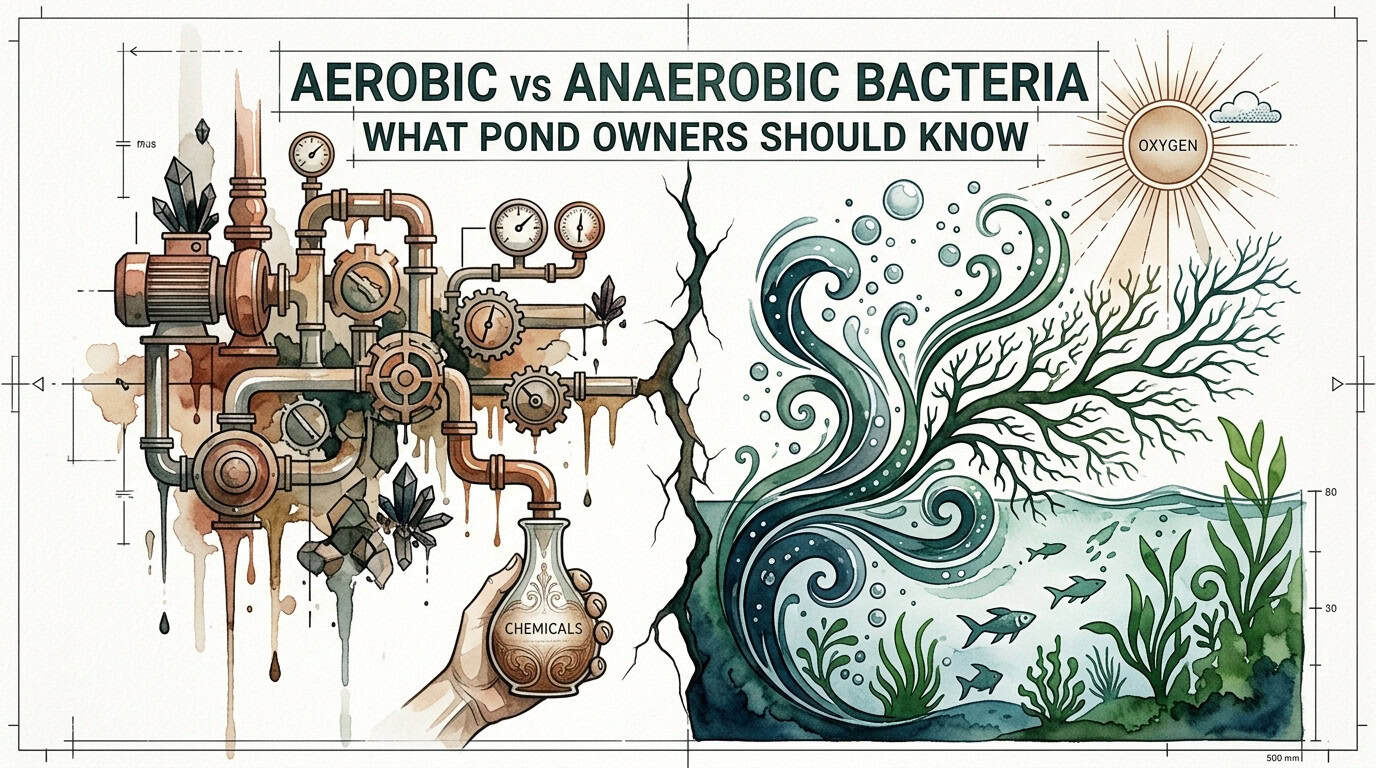
One bacteria smells like a swamp; the other cleans like a pro. The only difference is air. Anaerobic bacteria create toxic gases and foul smells. Aerobic bacteria are super-efficient cleaners. The shift from a ‘stinky’ pond to a ‘sparkling’ one is simpler than you think.
Aerobic bacteria are oxygen-dependent microorganisms that decompose organic matter up to 20 times faster than anaerobic bacteria, which thrive in oxygen-depleted environments. For pond owners, maintaining aerobic dominance is critical because aerobic processes produce harmless carbon dioxide and water, whereas anaerobic decomposition releases toxic hydrogen sulfide and methane. Sustaining high dissolved oxygen levels through mechanical aeration ensures efficient nutrient cycling and prevents the accumulation of organic muck.
Aerobic vs Anaerobic Bacteria: What Pond Owners Should Know
In the context of pond management, bacteria are the primary engines of nutrient cycling and organic waste decomposition. These microorganisms are categorized based on their relationship with dissolved oxygen (DO). Aerobic bacteria require a continuous supply of free oxygen (O2) to fuel their metabolic processes. They are the highly efficient “cleaners” of the pond, responsible for breaking down fish waste, decaying vegetation, and excess nutrients into benign byproducts.
Anaerobic bacteria, conversely, survive and multiply in environments where oxygen is absent or severely depleted (typically less than 1.5–2.0 mg/L). While they do contribute to decomposition, their metabolic pathways are significantly less efficient. In a typical pond, these bacteria inhabit the “benthic zone”—the very bottom layer of muck and sediment where oxygen diffusion from the surface is restricted.

The fundamental issue for pond owners is the rate of decomposition versus the rate of organic input. If leaves, fish waste, and runoff enter the pond faster than the resident bacteria can process them, a thick layer of organic sludge, or “muck,” develops. When a pond becomes anaerobic, this muck layer thickens rapidly because anaerobic bacteria cannot keep up with the load. This leads to a feedback loop where the increasing organic load consumes even more oxygen, further entrenching anaerobic conditions.
How It Works: The Chemistry of Decomposition
The biological conversion of waste in a pond is a series of oxidation-reduction (redox) reactions. Bacteria extract energy by moving electrons from an electron donor (organic waste) to an electron acceptor.
Aerobic Respiration
In an aerobic environment, oxygen serves as the terminal electron acceptor. The generalized chemical equation for this process is:
C6H12O6 + 6O2 ? 6CO2 + 6H2O + Energy
This process is highly energetic and complete. The organic carbon is converted entirely into carbon dioxide and water. Because these byproducts are odorless and easily utilized by aquatic plants or vented into the atmosphere, the pond remains clear and smells fresh.
Anaerobic Fermentation and Methanogenesis
When oxygen is removed from the equation, bacteria must use alternative electron acceptors such as nitrate, sulfate, or even carbon dioxide. This process occurs in several stages:
- Hydrolysis: Complex molecules (proteins, fats, carbohydrates) are broken down into simpler sugars and amino acids.
- Acidogenesis: These simpler compounds are converted into volatile fatty acids and alcohols.
- Methanogenesis: Final products like methane (CH4) and carbon dioxide are produced.
The byproduct hydrogen sulfide (H2S) is particularly problematic. It is produced by sulfate-reducing bacteria in the absence of oxygen and is responsible for the “rotten egg” smell characteristic of stagnant ponds. Furthermore, anaerobic processes are inherently slow, often resulting in “partial” decomposition where complex organic remains are left behind, contributing to the persistent muck layer.
The Role of Redox Potential (ORP)
Oxidation-Reduction Potential (ORP) is a technical measurement (in millivolts, mV) of the pond’s ability to cleanse itself.

- +300 mV to +450 mV: Optimal aerobic activity. High cleaning efficiency.
- 0 mV to +100 mV: Transition zone. Aerobic bacteria struggle; anaerobic activity begins to rise.
- -150 mV and below: Highly reduced, anaerobic environment. Decomposition is minimal, and toxic gas production is at its peak.
Benefits of Maintaining Aerobic Dominance
The primary benefit of an aerobic pond is mechanical and biological stability. When oxygen is present throughout the water column, the entire pond—not just the surface—becomes a functional bio-filter.
1. Rapid Muck Reduction
Aerobic bacteria can digest organic sludge at a rate many times faster than anaerobes. By introducing oxygen to the bottom of the pond (where the muck resides), you activate “muck-eating” bacteria that can reduce sludge depth by several inches per season without the need for expensive mechanical dredging.
2. Elimination of Toxic Gases
Because aerobic respiration produces CO2 instead of H2S or methane, the pond environment remains safe for fish and pleasant for owners. High oxygen levels also facilitate nitrification, the process where toxic ammonia (NH3) is converted into nitrite (NO2) and then into relatively harmless nitrate (NO3) by specialized aerobic bacteria like Nitrosomonas and Nitrobacter.
3. Improved Water Clarity
Aerobic bacteria compete with algae for the same nutrients, particularly phosphorus and nitrogen. In a well-oxygenated pond, the bacteria are more efficient at sequestering these nutrients, effectively “starving” the algae and reducing the frequency of green-water blooms.
Challenges and Common Mistakes
Managing the balance between these two bacterial groups is not without its difficulties. The most frequent errors involve a misunderstanding of how oxygen moves through water.
The Thermocline Trap
In the summer, ponds often undergo thermal stratification. Sunlight warms the top layer of water (epilimnion), while the bottom remains cold and dense (hypolimnion). These layers do not mix. Even if the surface is saturated with oxygen from wind or a fountain, the bottom layer can become completely anaerobic. Pond owners often assume their pond is healthy because the surface looks fine, while a toxic “dead zone” is brewing at the bottom.
Undersizing Aeration Systems
A common mistake is using a decorative fountain as the primary source of aeration for a deep pond. Fountains only pull water from the top 1–2 feet. For effective aerobic activity, oxygen must reach the sediment interface. In deep ponds (over 6 feet), a diffused aeration system—which pumps air to the bottom through a diffuser membrane—is required to break the thermocline and circulate oxygenated water to the benthic zone.
Ignoring Biological Oxygen Demand (BOD)
BOD is the amount of oxygen required by bacteria to break down the organic matter currently in the pond. If you have a massive leaf fall in autumn, the BOD spikes. If your aeration system is only designed for “normal” conditions, it may fail to meet the sudden demand, leading to a temporary anaerobic crash and potential fish kills.
Limitations: When Aeration Isn’t Enough
While aerobic bacteria are powerful, they are constrained by certain physical and environmental limits.
- Temperature Constraints: Aerobic bacteria are most active in warm water (70°F–80°F). However, warm water holds significantly less dissolved oxygen than cold water. This creates a “summer squeeze” where bacterial demand is highest but oxygen availability is lowest.
- Extremely High Organic Loads: If a pond is 50% filled with muck, biological digestion alone may take decades. In such extreme cases, mechanical dredging may be a necessary prerequisite to establishing a manageable aerobic system.
- Chemical Interference: The use of certain algaecides or herbicides can kill beneficial bacteria or create a massive surge in dead organic matter, causing an oxygen crash that wipes out the aerobic population.
Technical Comparison: Aerobic vs. Anaerobic
| Feature | Aerobic Bacteria | Anaerobic Bacteria |
|---|---|---|
| Oxygen Requirement | High (>2.0 mg/L) | Low to None ( |
| Decomposition Speed | Fast (Primary Digesters) | Slow (Secondary/Residual) |
| Byproducts | CO2, H2O | H2S, CH4, NH3 |
| Odor | None | Strong (Rotten Egg) |
| Primary Location | Upper layers/Aerated zones | Bottom muck/Sediment |
Practical Tips for Pond Management
To optimize the bacterial balance in your pond, follow these data-driven best practices:
- Monitor Dissolved Oxygen (DO): Use a DO meter during the hottest weeks of summer. Readings should ideally remain above 5.0 mg/L for fish health and aerobic efficiency. If levels drop below 3.0 mg/L at night, increase aeration immediately.
- Deploy Bottom-Up Aeration: Ensure your air diffusers are placed at the deepest points of the pond. This leverages the “airlift” effect, pulling oxygen-depleted water from the bottom and exposing it to the atmosphere.
- Supplement with Probiotics: In ponds with high organic loads, adding concentrated aerobic bacterial strains (often sold as “muck pellets”) can jumpstart the decomposition process. These pellets sink into the anaerobic layer and create localized aerobic “pockets.”
- Manage Nutrient Influx: Reduce the amount of organic material entering the pond. Use pond netting in the fall to catch leaves and establish a “buffer zone” of native plants around the perimeter to filter out nitrogen and phosphorus from lawn runoff.
Advanced Considerations: The Nitrogen Cycle and Bio-Augmentation
For the serious practitioner, understanding the Nitrogen Cycle is essential. Aerobic bacteria are the only organisms capable of performing nitrification—the oxidation of ammonia to nitrate. This is a two-step process requiring significant oxygen:
1. Nitrosomonas converts NH3 to NO2- (Nitrite).
2. Nitrobacter converts NO2- to NO3- (Nitrate).
If the pond bottom remains anaerobic, this cycle breaks. Ammonia builds up, which is toxic to fish even at low concentrations (above 0.05 mg/L in some species). Furthermore, anaerobic conditions can trigger denitrification, but in a closed pond system, this often leads to the release of phosphorus from the sediments back into the water column, fueling “internal loading” and perpetual algae issues.
Bio-augmentation involves the regular addition of specific bacterial species to the pond. Not all bacteria are created equal; some are optimized for cellulose breakdown (leaves), while others focus on proteins (fish waste). Advanced pond managers use seasonal blends—psychrophilic (cold-loving) bacteria in the spring and autumn, and thermophilic (heat-loving) strains in the summer—to maintain peak decomposition rates year-round.
Example Scenario: The Restoration of a 1-Acre Stagnant Pond
Consider a 1-acre farm pond with an average depth of 8 feet and a 12-inch muck layer. The pond has no aeration and suffers from annual fish kills and a persistent rotten-egg odor.
Initial Assessment:
– Dissolved Oxygen at surface: 6.0 mg/L.
– Dissolved Oxygen at 7 feet: 0.2 mg/L (Anaerobic).
– ORP at sediment interface: -200 mV.
Restoration Strategy:
1. Mechanical Aeration: A 1/2 HP rocking piston compressor is installed with two weighted diffusers at the 8-foot depth.
2. Gradual Turnover: The system is run for 1 hour the first day, 2 hours the second, doubling each day. This prevents “toxic turnover,” where an immediate mix of anaerobic water could kill fish.
3. Bio-augmentation: 10 lbs of aerobic muck-eating pellets are applied over the deepest areas once every two weeks for three months.
Results after 6 Months:
– Dissolved Oxygen at 7 feet: 5.5 mg/L.
– ORP at sediment interface: +250 mV.
– Muck Depth: Reduced from 12 inches to 8 inches (a 33% reduction via biological digestion).
– Odor: Completely eliminated.
Final Thoughts
Maintaining the balance between aerobic and anaerobic bacteria is the single most important factor in long-term pond health. While anaerobic bacteria are a natural part of any aquatic ecosystem, their dominance leads to stagnation, toxic gas production, and the accumulation of organic waste. Aerobic bacteria, supported by adequate mechanical aeration, provide a high-efficiency solution for maintaining water clarity and preventing muck buildup.
By focusing on oxygenation and nutrient management, pond owners can transform a high-maintenance, “stinky” water body into a self-cleansing ecosystem. Understanding the technical requirements of these microorganisms allows for more precise interventions, reducing the reliance on chemical fixes and promoting a stable environment for fish and biodiversity.
For those looking to deepen their expertise, exploring the relationship between water temperature, oxygen saturation, and chemical oxygen demand (COD) will provide even greater control over the pond’s biological trajectory.

Frequently Asked Questions About Aerobic vs Anaerobic Bacteria: What Pond Owners Should Know
Can aerobic bacteria survive if my aerator turns off?
Aerobic bacteria are highly sensitive to oxygen levels. If an aeration system fails, the dissolved oxygen in a pond can be depleted rapidly, especially in warm weather or ponds with high biological oxygen demand. Within hours, the aerobic population will begin to die off or go dormant. If the anaerobic state persists for several days, the bacterial community will shift toward anaerobic dominance. This shift results in a cessation of rapid decomposition and the onset of toxic gas production. It is critical to have a backup power source or to repair aeration systems immediately to prevent a total biological collapse.
Is it possible to have too much aerobic bacteria in a pond?
In a balanced ecosystem, the bacterial population is limited by the available food source (organic waste). While you cannot realistically have “too many” beneficial bacteria, a massive surge in bacterial activity can temporarily deplete dissolved oxygen. This is known as an oxygen crash. This typically happens if a pond owner adds a large amount of supplemental bacteria to a pond with high muck levels without providing enough aeration to support the increased respiration. Always ensure your aeration system is rated for your pond’s volume and organic load before beginning a heavy bio-augmentation program.
Do anaerobic bacteria serve any beneficial purpose in a pond?
Anaerobic bacteria are not “bad” in an absolute sense; they are a necessary part of the global carbon and nitrogen cycles. In a natural pond, they handle the final stages of decomposition in deep sediments where oxygen cannot penetrate. They are also responsible for denitrification, which converts nitrates into nitrogen gas that escapes into the atmosphere. However, in an enclosed backyard or farm pond, their byproducts (ammonia, hydrogen sulfide) and their slow rate of work usually outweigh their benefits. The goal is not to eliminate them entirely—which is impossible—but to prevent them from dominating the water column.
How can I tell if my pond has become anaerobic without a meter?
Several physical signs indicate anaerobic conditions. The most obvious is a “rotten egg” smell, which is the off-gassing of hydrogen sulfide. You may also see bubbles rising from the bottom that don’t come from an aerator; these are often methane or carbon dioxide trapped in the muck. If your pond’s water turns dark or “inky,” or if you notice fish gasping at the surface (especially in the early morning), the bottom layers are likely anaerobic. Additionally, if you pull up a handful of muck and it is jet black and foul-smelling, it is currently in a highly reduced, anaerobic state.
Does cold weather stop bacterial activity?
Temperature significantly impacts metabolic rates. Most common aerobic pond bacteria become sluggish when water temperatures drop below 50°F (10°C) and may become nearly dormant below 40°F. While decomposition does not stop entirely, it slows down significantly. This is why muck often accumulates over the winter. To combat this, some pond owners use specialized “cold-water” bacterial strains that are genetically adapted to remain active in temperatures as low as 35°F. These strains help process the organic matter from autumn leaf-fall throughout the winter months, preventing a massive nutrient spike in the spring.